Non-DOT fittings often look close enough to standard truck air brake fittings to create a risky purchasing question. A part may thread in, seal during a quick bench check, and still create concerns for resale, inspection, warranty, or brake-critical use. I handle this question by separating mechanical fit, air-tight performance, and verified application suitability.
Non-DOT fittings should not be defaulted into truck air brake systems unless the buyer can verify that the fitting is suitable for the exact application, pressure, temperature, tubing, and regulatory expectations involved. A fitting that physically connects or does not leak is not automatically acceptable for brake-critical circuits without markings, documentation, and applicable standard references.1
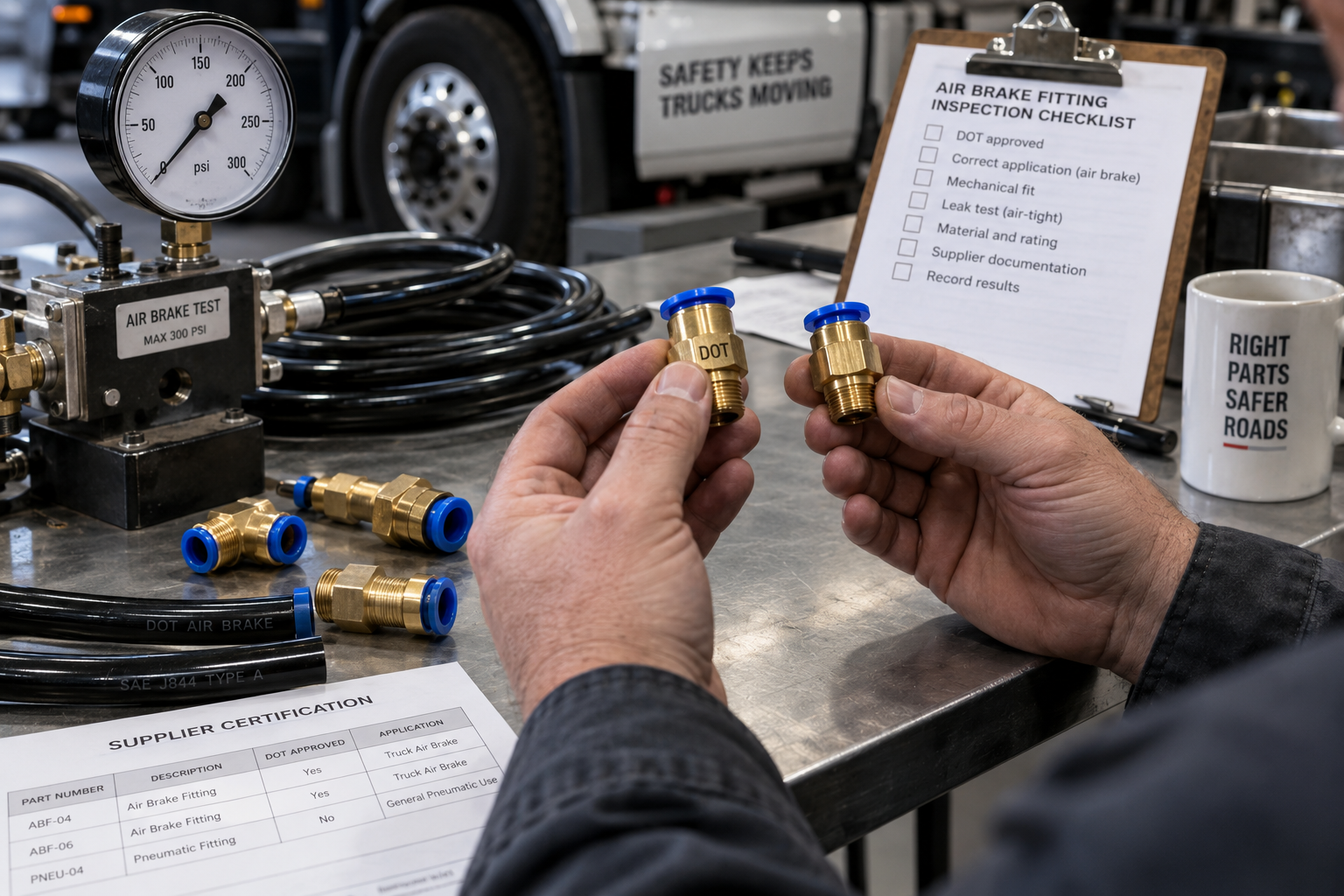
In my experience with overseas distributors, repair shops, and fleet buyers, the confusion usually starts with appearance. Brass looks strong. Threads match. The supplier says “air brake compatible.” But procurement risk starts where simple fitment ends.
Why Are Non-DOT Fittings Not Automatically Approved for Truck Air Brake Systems?
A buyer may see Non-DOT fittings that appear identical to DOT-marked fittings and assume they belong in the same bin. That assumption can become expensive. If a fitting cannot be tied to the right standard, application, and documentation, a distributor may face blocked resale, customer complaints, or inspection questions.
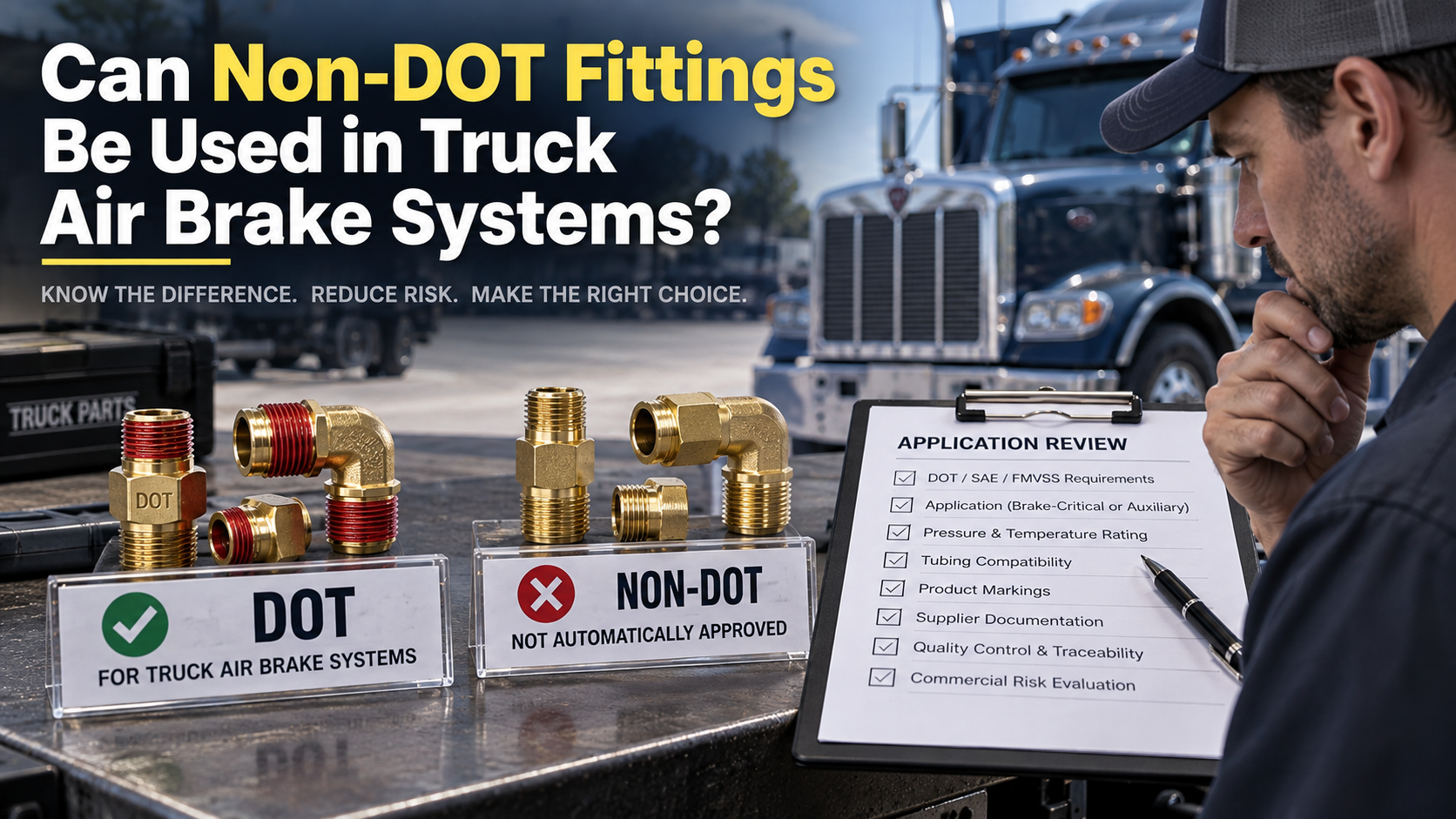
Non-DOT fittings are not automatically approved for truck air brake systems because material, shape, and thread compatibility do not prove regulatory or application suitability. Buyers need to verify markings, test references, supplier documents, tubing compatibility, and whether the fitting is intended for brake-critical air circuits under DOT, SAE, FMVSS, or other applicable requirements.2
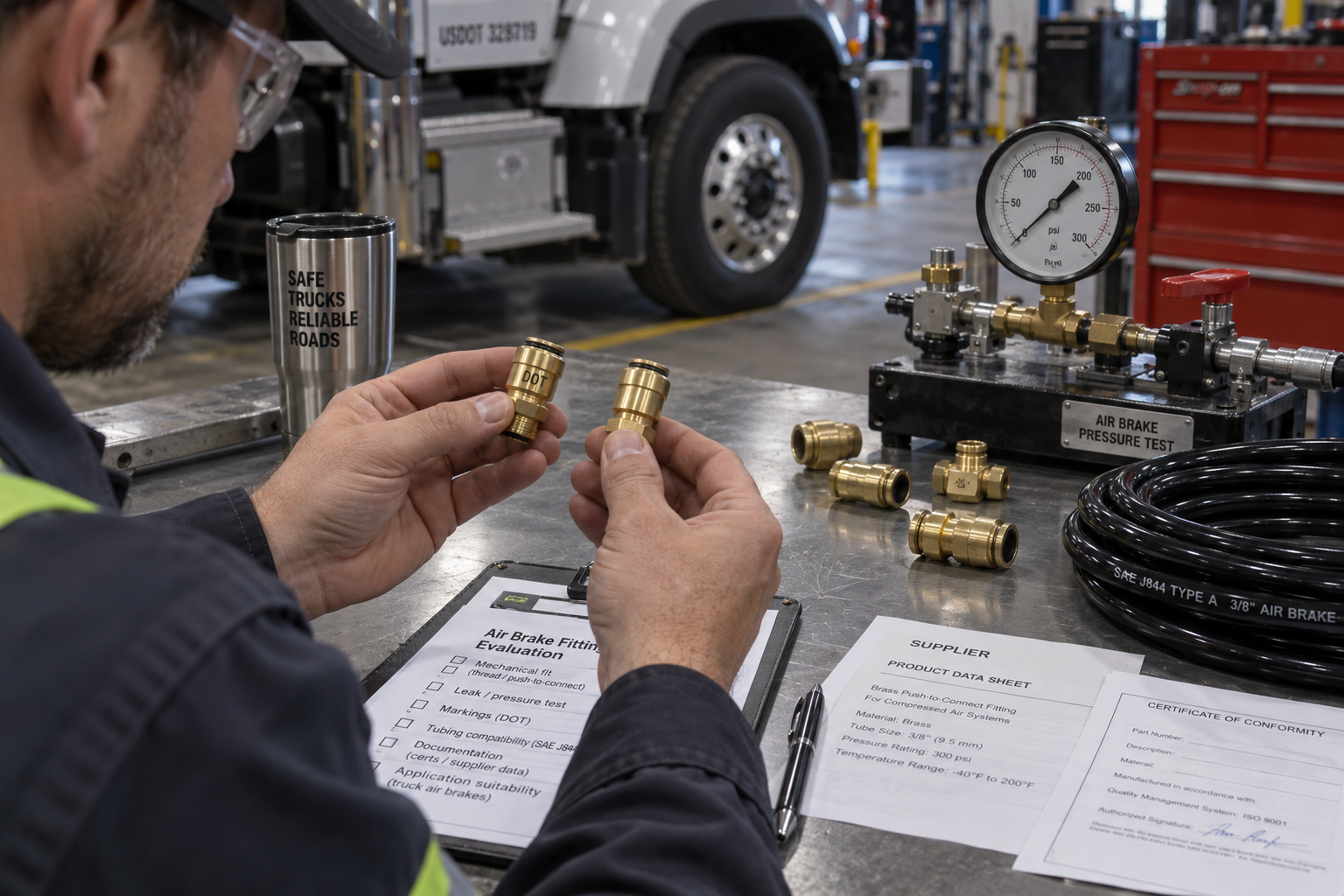
Mechanical Fit Is Only the First Check
I often explain this with a simple three-layer model:
-
Mechanical fit
The fitting threads in, connects to tubing, and appears to assemble correctly. -
Air-tight performance
The fitting holds air under a defined pressure and condition. -
Regulatory and application suitability
The fitting is supported by markings, documents, test references, and intended-use confirmation.
These three points are related, but they are not the same. A fitting can pass the first two checks and still fail the third from a procurement or compliance standpoint.
For truck air brake systems, this distinction matters because the application carries higher consequences than general pneumatic plumbing. The fitting is not just a connector. It becomes part of a vehicle system that buyers, installers, inspectors, and end users expect to meet recognized requirements.
Brass Material Does Not Equal DOT Approval
One common misunderstanding is that brass fittings are automatically DOT-compliant3. I understand why buyers think this. Brass is widely used in heavy-duty truck air systems4 because it offers corrosion resistance, machinability, and stable performance when manufactured correctly.
However, brass is only a material. It is not a certification.
A brass fitting may be suitable for:
- General shop air
- Industrial pneumatic equipment
- Non-brake vehicle air accessories
- Low-risk auxiliary circuits
- Certain truck applications when properly documented
But that does not mean it is automatically suitable for a brake-critical air line.
| Buyer Assumption | More Careful Procurement View |
|---|---|
| “It is brass, so it is DOT.” | Brass is material, not approval. |
| “It seals, so it is fine.” | Sealing is necessary but not enough. |
| “The supplier said air brake.” | Verbal claims need documents and markings. |
| “The thread matches.” | Fitment does not prove standard compliance. |
| “It looks like our old part.” | Appearance does not confirm application suitability. |
What Buyers Should Verify First
Before I would treat any fitting as acceptable for a truck air brake application, I would ask for clear proof points:
- Product markings, where applicable
- Standard references, such as SAE or FMVSS-related claims5 that can be checked
- DOT-related documentation, when the product is sold as DOT-compliant
- Tubing compatibility, including nylon air brake tubing specifications6
- Pressure and temperature performance data7
- Quality control process records
- Batch traceability
- Supplier experience in North American truck aftermarket applications
At ROADSPOWER, I do not recommend treating a supplier’s casual phrase like “air brake compatible” as enough. I prefer to see product-level documentation and consistent manufacturing control. Buyers should also verify current requirements with qualified professionals or applicable regulatory sources, especially for brake-critical decisions.
When Can Non-DOT Fittings Be Considered in a Truck Air System?
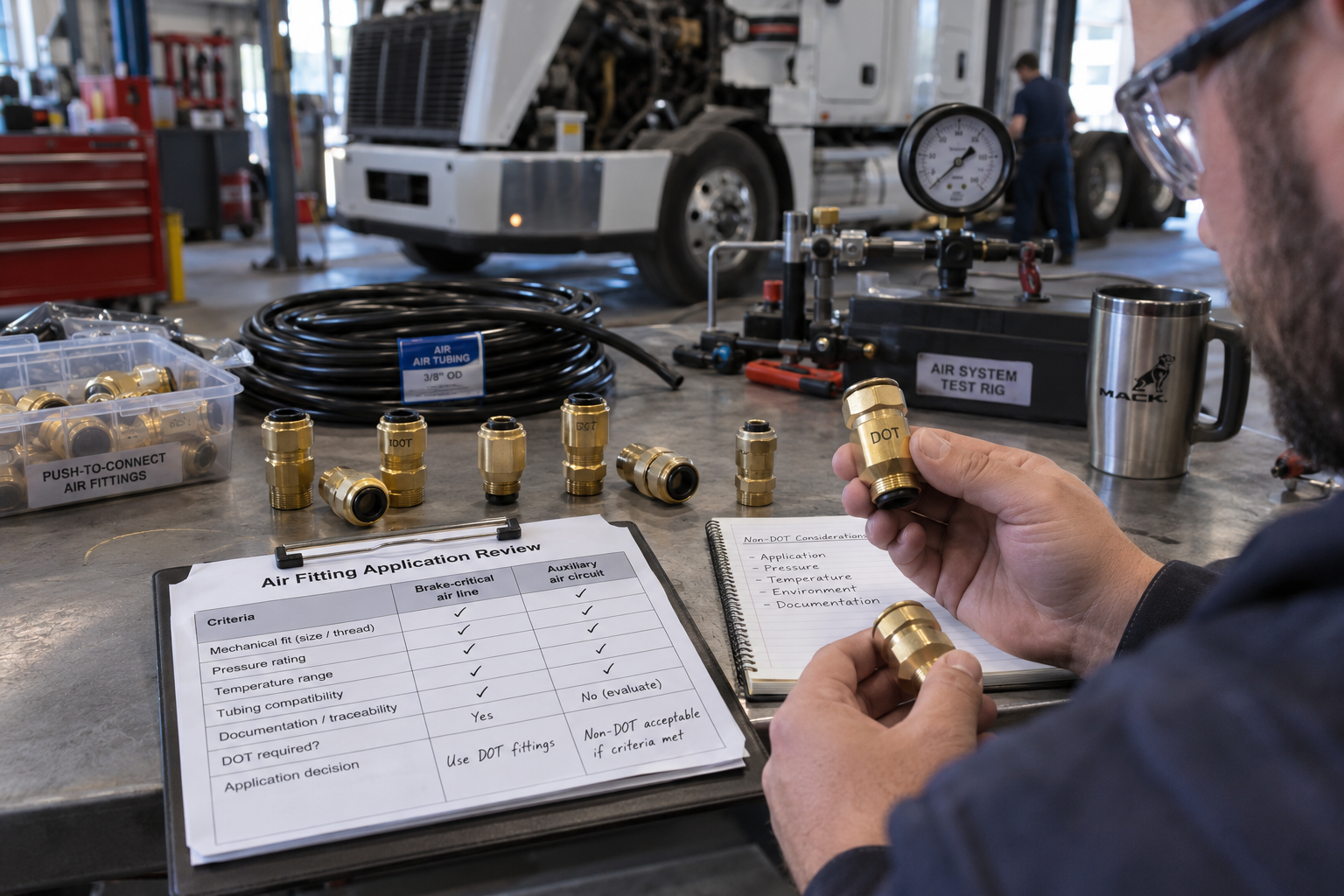
Non-DOT fittings create a gray area because not every air circuit on a truck carries the same regulatory or safety burden. The problem starts when a buyer treats all air circuits as identical. That shortcut can lead to wrong stocking decisions and avoidable customer disputes.
Non-DOT fittings may be considered only when the specific truck air application does not require DOT-marked or DOT-supported fittings8, and when the buyer verifies pressure, temperature, media, tubing, installation, and documentation needs. They should not be used by default in brake-critical circuits without confirmed suitability and professional evaluation.9
Not Every Air Circuit Has the Same Risk
A heavy-duty truck may use air for more than braking.10 Air can support accessories, suspension-related functions, auxiliary controls, cab features, or other pneumatic operations depending on the vehicle design.
That is why I avoid saying Non-DOT fittings can never be used anywhere on a truck. That statement is too broad. A better question is:
Where exactly will this fitting be installed, and what standard or performance expectation applies to that location?
For brake-critical circuits, the burden of proof is higher.11 For non-brake pneumatic circuits, buyers may still need performance validation, but the regulatory and commercial risk may differ.
Application Scope Matters More Than Product Name
A fitting name can mislead buyers. A supplier may call a product:
- Air fitting
- Pneumatic fitting
- Truck fitting
- Brass connector
- Push-to-connect fitting
- Air brake style fitting
Those names do not prove where it can be used. The real evaluation should focus on the installed application.
| Application Area | Procurement Risk Level | Suggested Buyer Action |
|---|---|---|
| Brake-critical air line | High | Require verified DOT/SAE/FMVSS support and documentation |
| Trailer air line repair | High | Match application-specific requirements and confirm compatibility |
| Auxiliary non-brake air circuit | Medium | Verify pressure, temperature, vibration, and supplier documents |
| Shop pneumatic tool line | Lower | Confirm general pneumatic rating and material compatibility |
| Display sample or non-functional use | Low | Confirm it will not enter service inventory |
This table is not a legal classification. It is a procurement screening tool. Buyers should still confirm current requirements and consult qualified technical or compliance professionals when the application affects braking performance.
Why Distributors Need Extra Discipline
A repair shop may buy a fitting for one job. A distributor may stock hundreds or thousands of pieces and resell them across different customers. That creates a different risk profile.
If a distributor stocks Non-DOT fittings next to DOT-supported air brake fittings, the internal controls must be strong. Labels, bins, catalogs, and sales descriptions need to prevent misuse.
I recommend several practical controls:
-
Separate SKU codes
DOT-supported and Non-DOT fittings should not share confusing part numbers. -
Clear catalog language
The catalog should not imply brake suitability unless the claim is documented. -
Application notes
The listing should say where the fitting is intended to be used. -
Document storage
Procurement teams should keep supplier documents, inspection records, and batch information. -
Sales team training
Staff should understand that “fits the line” does not mean “approved for brake use.”
In my own supplier discussions, I have seen buyers focus heavily on unit price and overlook catalog wording. That is dangerous in the truck aftermarket. A few cents saved on a fitting can create larger costs if customers return stock, question certification, or stop trusting the distributor’s product descriptions.
What Proof Should Buyers Request Before Purchasing Non-DOT Fittings?
The biggest procurement mistake is relying on verbal confirmation. A supplier may say a fitting is strong, leak-free, or commonly used on trucks. Those claims may sound helpful, but they are not enough for brake-related purchasing. Buyers need evidence that can survive internal review and customer questions.
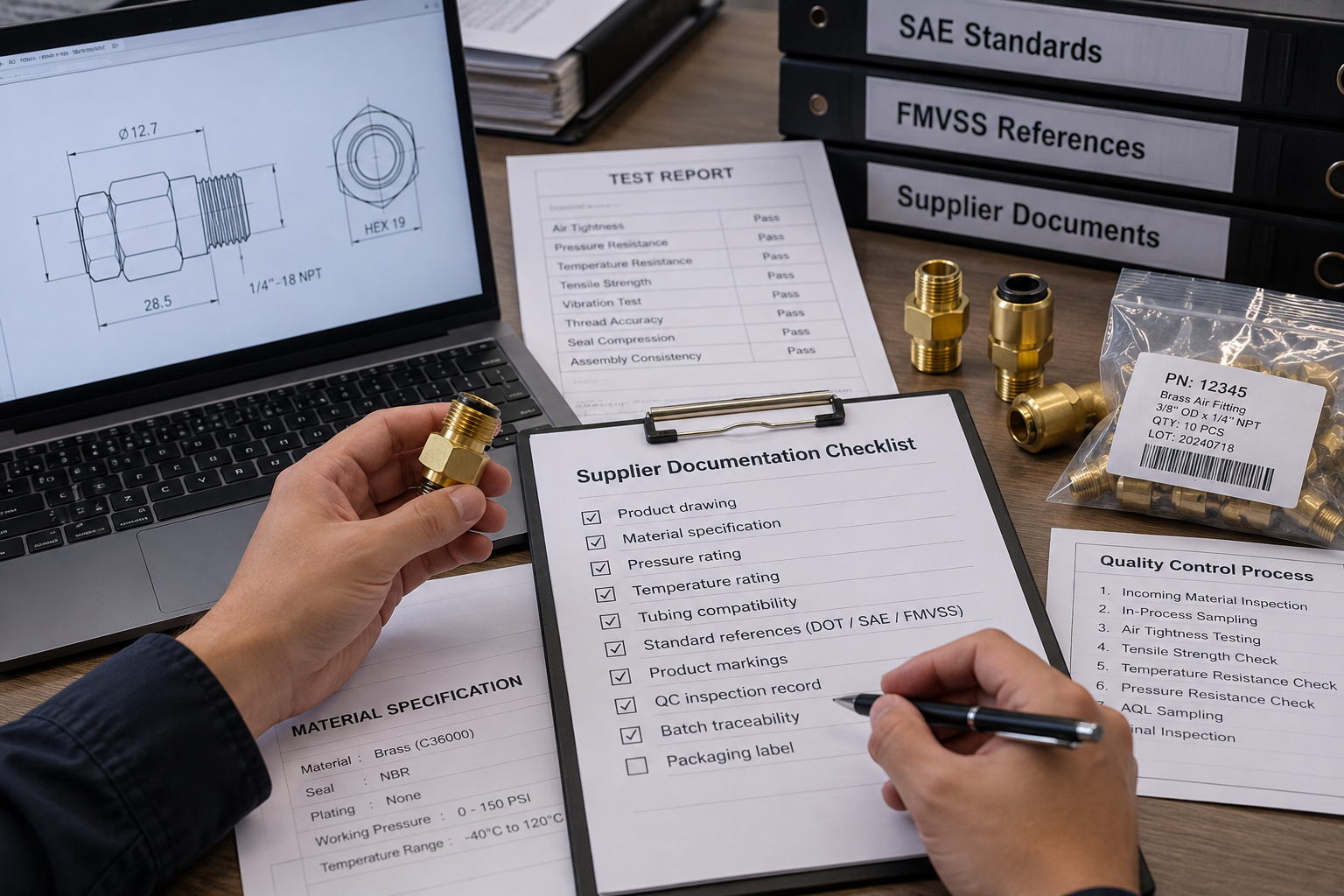
Before purchasing Non-DOT fittings, buyers should request product drawings, material specifications, pressure and temperature ratings, tubing compatibility data, inspection procedures, batch traceability, packaging labels, and any relevant DOT, SAE, or FMVSS references. If a fitting is claimed as suitable for air brake use, the supplier should provide written support that buyers can verify.
A Practical Documentation Checklist
I suggest buyers build a standard checklist for every fitting supplier. The checklist does not need to be complicated, but it should be consistent.
| Document or Proof Point | Why It Matters |
|---|---|
| Product drawing | Confirms dimensions, threads, ports, and design |
| Material specification | Confirms brass grade, seals, plating, or other materials |
| Pressure rating | Confirms basic operating limits |
| Temperature rating | Helps evaluate cold and hot service conditions |
| Tubing compatibility | Confirms fit with intended nylon or rubber air line |
| Standard references | Shows whether SAE, FMVSS, or DOT claims are supported |
| Product markings | Helps identify approved or intended products in the field |
| QC inspection record | Shows process control, not just sales claims |
| Batch traceability | Supports complaint handling and recall control |
| Packaging label | Reduces warehouse and resale confusion |
This list is especially useful for distributors that purchase mixed containers or small-batch replenishment orders. It gives procurement teams a repeatable way to compare suppliers.
Performance Tests Buyers Should Ask About
A fitting used in truck air applications may face vibration, pressure cycling, temperature changes12, moisture, road contaminants, and installation variation. A simple one-time air leak check does not represent all real use conditions.
Important test areas may include:
- Air tightness
- Pressure resistance
- Temperature resistance
- Tensile or pull-out resistance
- Thread accuracy
- Seal compression
- Vibration-related loosening risk
- Assembly consistency
- Surface finish and burr control
At ROADSPOWER, our quality control process for relevant truck and trailer parts includes incoming material inspection, in-process sampling, air tightness testing, tensile strength checks, temperature resistance checks, pressure resistance checks, AQL sampling before warehousing, and final inspection on key products. I present that as a supplier quality-control practice, not as a substitute for a buyer’s own application review.
How to Read Supplier Claims Carefully
Supplier wording can be tricky. Buyers should slow down when they see phrases like:
- “DOT type”
- “DOT style”
- “Air brake compatible”
- “Same as DOT fitting”
- “For truck air”
- “Heavy-duty quality”
- “Meets market standard”
These phrases may or may not be meaningful. The safest approach is to ask, “What document supports this claim?”
A more reliable supplier response should include:
- The exact product part number
- The applicable standard reference
- The tested configuration
- The compatible tubing size and type
- The marked packaging or product identification
- The inspection method
- The batch or production traceability process
If a supplier cannot provide written confirmation, I would not treat the fitting as proven for brake-critical resale or installation. The part may still be useful in a different air application, but it should not be casually promoted as an air brake fitting.
How Do Non-DOT Fittings Create Commercial Risk for Distributors and Fleets?
Many buyers frame the issue as a technical question only. I think that is incomplete. The more practical concern is commercial risk. A fitting that creates uncertainty can slow resale, trigger returns, increase warranty conversations, and damage customer confidence even before a field failure happens.
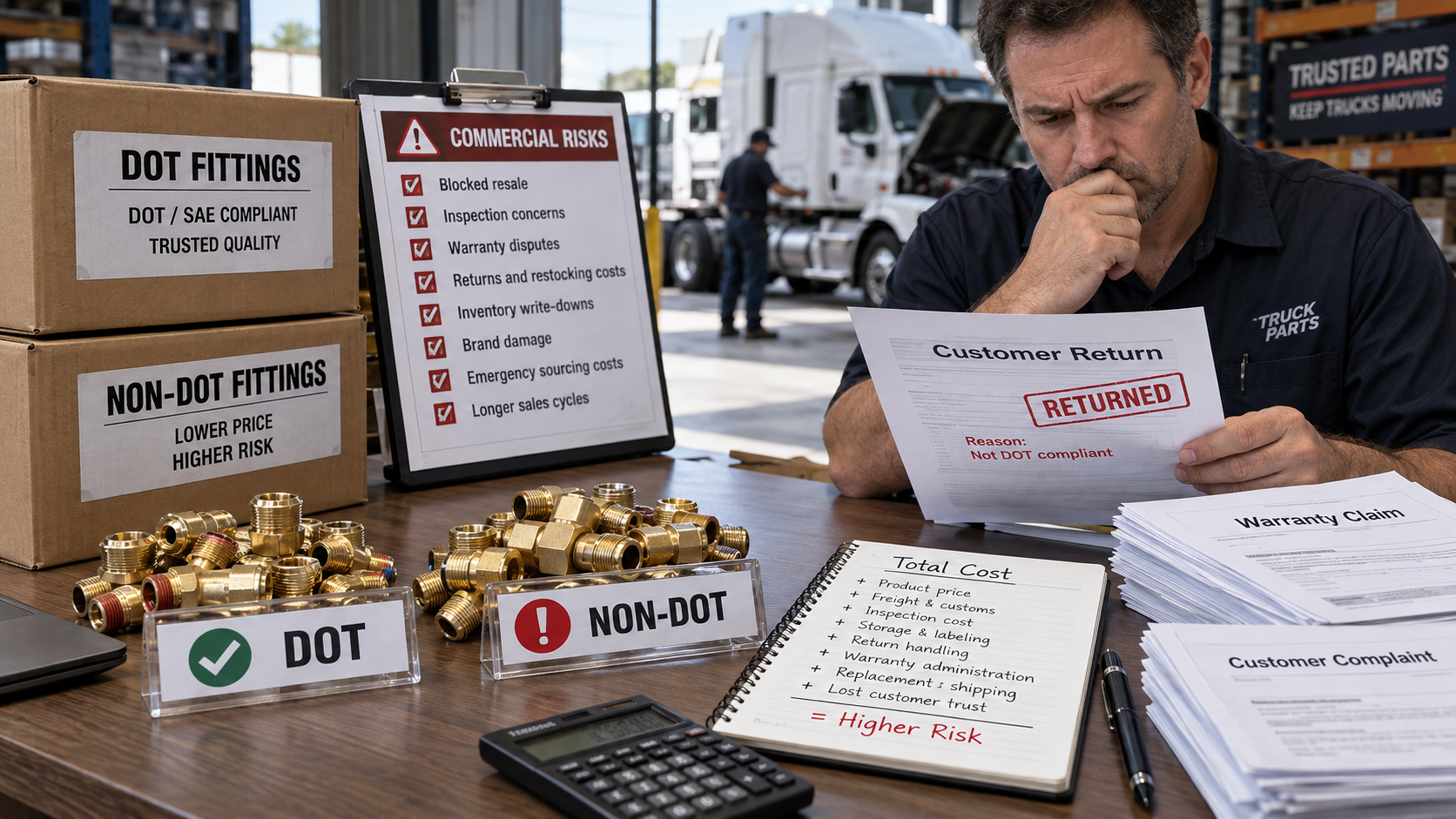
Non-DOT fittings create commercial risk because they may be difficult to defend during resale, inspection, warranty review, or customer complaint handling. If the fitting lacks markings and documentation, distributors and fleets may struggle to prove it was suitable for the installed air brake application, even if it physically sealed at installation.
The Risk Is Bigger Than Leakage
Leakage is an obvious problem, but it is not the only one. In the aftermarket, confidence and documentation affect purchasing decisions. A customer may reject a product simply because it does not carry the expected marking or paperwork.
Commercial risks can include:
- Blocked resale if customers require DOT-supported products
- Inspection concerns when markings or documentation are missing
- Warranty disputes after an air system issue
- Returns and restocking costs
- Inventory write-downs
- Brand damage for distributors
- Emergency sourcing costs
- Longer sales cycles due to customer doubts
For fleets, the risk can also show up as maintenance inconsistency. If one shop installs one type of fitting and another shop installs a different type, the fleet may lose standardization. That can complicate future repairs.
Procurement Teams Need a Risk Matrix
I like using a simple risk matrix before adding a fitting to inventory.
| Evaluation Factor | Low Risk | Medium Risk | High Risk |
|---|---|---|---|
| Application | Non-critical pneumatic use | Auxiliary truck air circuit | Brake-critical circuit |
| Documentation | Complete and verified | Partial | Verbal only |
| Marking | Clear and consistent | Packaging only | None |
| Supplier history | Proven in target market | Limited record | Unknown |
| QC control | Documented process | Basic inspection | Unclear process |
| Customer expectation | General pneumatic | Mixed requirement | DOT-supported required |
This matrix helps buyers avoid emotional decisions based only on price. It also supports internal approval. If a product is high risk in several categories, the buyer should either reject it for that use or request stronger evidence.
Why Price Savings Can Be Misleading
Non-DOT fittings may cost less. That can be attractive for high-volume distributors and repair shops. However, unit cost is not total cost.
Total cost may include:
- Product purchase price
- Freight and customs cost
- Inspection cost
- Storage and labeling cost
- Return handling cost
- Warranty administration
- Replacement shipping
- Lost customer trust
A fitting that saves USD 0.10 per piece can become expensive if it creates a product line that customers do not trust. This is especially true in North America, where heavy-duty truck parts buyers often ask about DOT, SAE, FMVSS, and application references before approving new suppliers.
At ROADSPOWER, I often recommend that buyers compare fittings by landed cost plus risk, not by factory unit price alone. That view is more realistic for distributors selling into demanding markets.
How Should Buyers Select a Supplier for Truck Air Brake Fittings?
Supplier selection matters because a fitting is only as reliable as the process behind it. A beautiful sample does not guarantee repeatable mass production. The problem becomes more serious when procurement teams buy mixed SKUs, urgent replenishment orders, or customized fittings for North American truck applications.
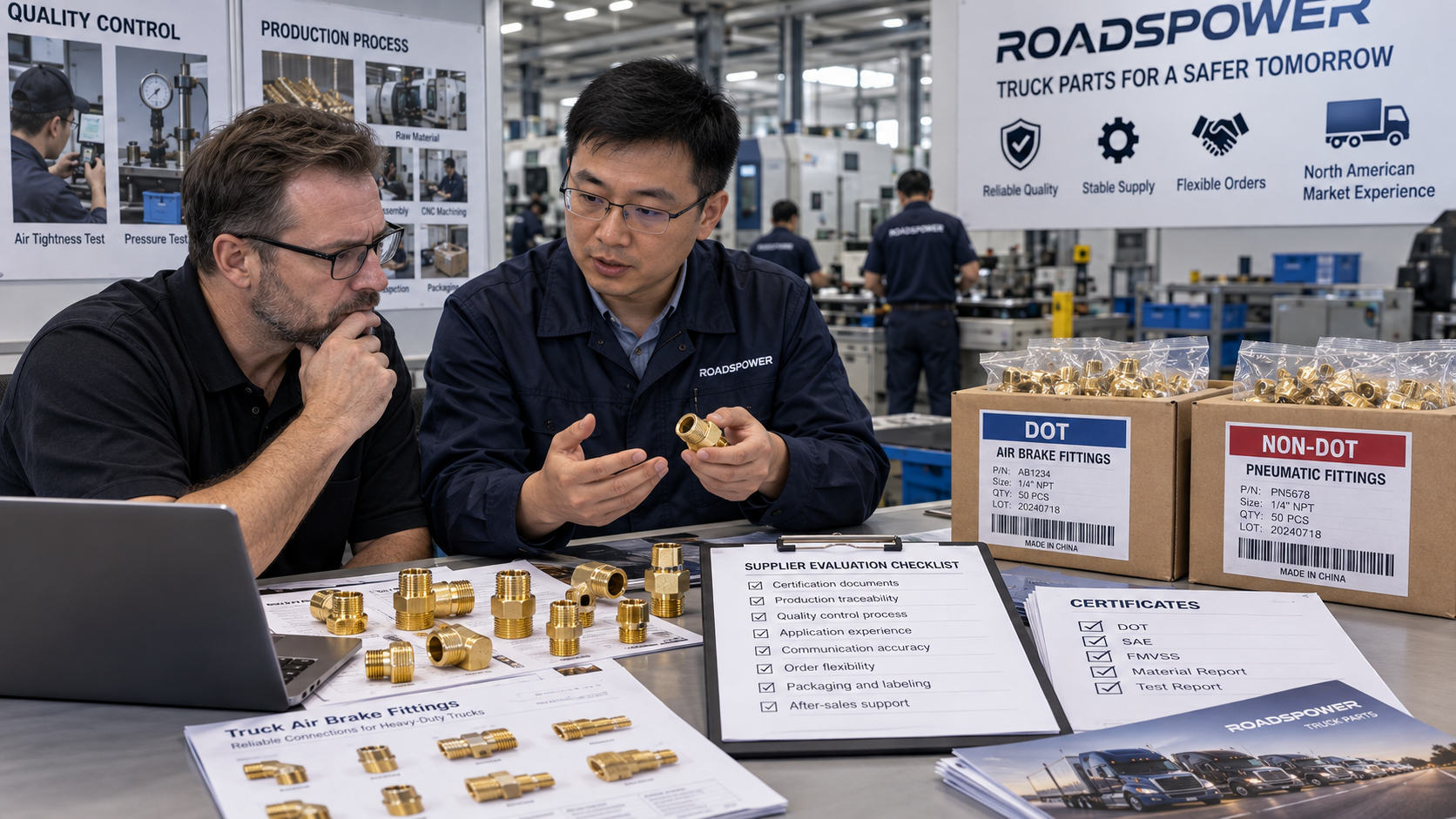
Buyers should select a truck air brake fittings supplier by reviewing certification documents, production traceability, quality control steps, application experience, communication accuracy, and order flexibility. For Non-DOT fittings and DOT-supported fittings alike, the supplier should clearly separate product categories and provide written documentation for claims.
What I Look for in a Supplier Review
When I evaluate fitting supply from a procurement perspective, I look beyond the sample box. I want to understand whether the supplier can repeat quality over time.
Important supplier factors include:
- In-house control of core processes
- Incoming material inspection
- Stable machining and assembly procedures
- Documented SOPs
- Batch traceability
- Pressure and air-tightness testing
- Clear standard references
- Consistent packaging labels
- Experience with North American truck models
- Responsive technical communication
ROADSPOWER operates from a 6,000+ sqm facility in Ningbo, with six production lines and in-house control of core processes from mold development and raw material processing to assembly. We support air power lines, brass fittings, and related accessories for heavy-duty truck aftermarket buyers. I still encourage customers to verify product documents for their own applications, especially where brake-related standards apply.
Questions Buyers Should Ask Suppliers
A good supplier should answer specific questions without vague language.
Buyers can ask:
- Is this fitting intended for brake-critical air circuits or only general pneumatic use?
- Which tubing types and sizes are confirmed?
- What pressure and temperature ranges apply?
- What markings appear on the fitting or packaging?
- Which DOT, SAE, or FMVSS references support the claim?
- Can you provide batch inspection records?
- Do you provide samples for buyer testing?
- How do you separate DOT-supported and Non-DOT fittings in production and packing?
- What is the MOQ for mixed orders?
- What happens if a buyer reports a quality issue?
These questions make the conversation practical. They also reveal whether the supplier understands the North American aftermarket.
Why Packaging and Labeling Matter
Many procurement teams focus on the fitting itself and forget packaging. That is a mistake. In distribution, packaging is part of compliance control and customer communication.
Good packaging should support:
- SKU identification
- Application notes
- Quantity control
- Batch traceability
- Country-of-origin needs
- Barcode or warehouse scanning
- Separation between similar-looking parts
- Reduced picking errors
For products that look similar, a packaging mistake can create real risk. A warehouse worker may pick a Non-DOT fitting instead of a DOT-supported fitting if the label is unclear. A repair shop may install the wrong item if the bag does not communicate the intended use.
That is why I recommend that buyers treat packaging design as part of supplier qualification, not as an afterthought. ROADSPOWER supports packaging design and customization for distributors, which helps customers align products with their resale channels and warehouse systems.
Frequently Asked Questions
Are Non-DOT fittings illegal in every truck air system?
No. Non-DOT fittings should not be treated as automatically forbidden in every truck air circuit. The key question is the specific application. Brake-critical circuits usually require stronger proof, markings, and documentation. Buyers should verify current DOT, SAE, and FMVSS expectations before stocking, installing, or reselling.
Does a brass fitting automatically meet DOT requirements?
No. Brass material does not equal DOT approval. Brass may be suitable for many pneumatic and truck-related parts, but compliance depends on design, testing, markings, documentation, tubing compatibility, and application scope. Buyers should not rely on material or appearance alone.
Is “air brake compatible” enough proof from a supplier?
No. “Air brake compatible” is only a claim unless it is supported by written documents, standard references, markings, and quality records. Buyers should request product drawings, pressure ratings, temperature ratings, tubing compatibility, and applicable DOT, SAE, or FMVSS references.
Can a fitting be leak-free but still unsuitable for air brake use?
Yes. A fitting can seal during installation and still lack verified suitability for brake-critical service. Air-tightness is important, but it does not prove regulatory acceptance, long-term durability, temperature performance, vibration resistance, or compliance with customer purchasing requirements.
How should distributors manage similar-looking DOT and Non-DOT fittings?
Distributors should separate SKUs, bins, labels, catalog descriptions, and sales instructions. They should store supplier documentation by part number and batch. Clear packaging and staff training reduce the chance that Non-DOT fittings are sold or installed as brake-approved products.
Conclusion
Non-DOT fittings can physically connect to truck air lines, but that does not make them automatically suitable for truck air brake systems. I recommend that buyers separate fit, sealing performance, and verified application suitability before making purchasing decisions. For distributors, repair shops, and fleets, the safest commercial approach is to demand clear markings, documentation, testing references, and supplier traceability. If you need help comparing air brake fittings, brass fittings, or air line kits for North American and South American heavy-duty truck markets, contact ROADSPOWER for a documented supplier discussion.
"49 CFR 571.106 -- Standard No. 106; Brake hoses.", https://www.ecfr.gov/current/title-49/subtitle-B/chapter-V/part-571/subpart-B/section-571.106. Under FMVSS No. 106, brake hose assemblies and end fittings must meet specified tests and bear identification marks, indicating that documentation and labeling are integral to brake-system compliance beyond a simple leak test. Evidence role: definition; source type: government. Supports: That brake hose assemblies and their end fittings must meet test requirements and carry identifying markings under FMVSS No. 106.. Scope note: The marking requirements apply to hose assemblies and end fittings; other fittings may be governed indirectly via system-level standards. ↩
"Federal Motor Vehicle Safety Standards No. 121; Air Brake ...", https://www.federalregister.gov/documents/2008/03/07/E8-4460/federal-motor-vehicle-safety-standards-no-121-air-brake-systems. FMVSS No. 121 establishes federal performance requirements for air brake systems on certain vehicles, indicating that brake-system components must meet recognized standards rather than relying solely on mechanical fit; see NHTSA’s FMVSS No. 121 (Air Brake Systems). Evidence role: definition; source type: government. Supports: That U.S. federal motor vehicle safety standards set performance requirements for air brake systems, meaning compliance involves recognized standards beyond mechanical fit.. Scope note: FMVSS 121 addresses system-level performance and does not directly certify individual fittings. ↩
"49 CFR 571.106 -- Standard No. 106; Brake hoses.", https://www.ecfr.gov/current/title-49/subtitle-B/chapter-V/part-571/subpart-B/section-571.106. FMVSS No. 106 requires brake hose assemblies and end fittings to meet specified performance tests and bear identifying markings, demonstrating that DOT compliance is based on tested conformance and labeling rather than the use of a particular material such as brass. Evidence role: general_support; source type: government. Supports: That DOT compliance is a regulatory status tied to meeting FMVSS tests and markings (e.g., FMVSS No. 106 for hose assemblies and end fittings), not the composition of the material alone.. Scope note: FMVSS 106 directly addresses hose assemblies and end fittings; it does not cover every type of pneumatic connector. ↩
"Brass - Wikipedia", https://en.wikipedia.org/wiki/Brass. General encyclopedic sources describe brass as corrosion resistant and readily machinable, which aligns with its common use in fluid and pneumatic fittings. Evidence role: general_support; source type: encyclopedia. Supports: That brass is known for corrosion resistance and ease of machining, which explains its frequent use in fittings.. Scope note: Such sources discuss material properties broadly and do not quantify usage specifically in heavy-duty truck air systems. ↩
"Federal Motor Vehicle Safety Standards No. 121; Air Brake ...", https://www.federalregister.gov/documents/2008/03/07/E8-4460/federal-motor-vehicle-safety-standards-no-121-air-brake-systems. NHTSA’s FMVSS No. 121 sets federal performance requirements for air brake systems, providing the regulatory basis for assessing claims of brake-system suitability. Evidence role: definition; source type: government. Supports: That FMVSS No. 121 is the federal safety standard governing air brake systems on certain vehicles.. Scope note: The standard specifies system-level performance rather than approving individual aftermarket fittings. ↩
"Federal Motor Vehicle Safety Standards; Brake Hoses", https://www.federalregister.gov/documents/2007/10/09/E7-19467/federal-motor-vehicle-safety-standards-brake-hoses. Government specifications for commercial vehicle brake systems frequently reference SAE J844 for nonmetallic (nylon) air brake tubing, indicating that tubing compatibility should be checked against this standard. Evidence role: definition; source type: government. Supports: That nonmetallic (nylon) air brake tubing used on commercial vehicles is commonly specified to SAE J844 in government and regulatory specifications.. Scope note: Full technical content of SAE J844 is paywalled; public documents typically reference the standard rather than reproduce its requirements. ↩
"[PDF] Air Brake Systems - Federal Motor Carrier Safety Administration", https://www.fmcsa.dot.gov/sites/fmcsa.dot.gov/files/docs/brake_safety_systems_02-14.pdf. Government driver and maintenance materials for air brake systems describe typical reservoir pressures on the order of 100–125 psi and emphasize functionality under varying ambient temperatures, justifying verification of pressure and temperature ratings. Evidence role: statistic; source type: government. Supports: That commercial vehicle air brake systems typically operate around 100–125 psi and must function across a range of ambient temperatures, supporting the need to verify component ratings.. Scope note: Values are typical rather than universal; specific vehicles and duty cycles may differ. ↩
"49 CFR 571.106 -- Standard No. 106; Brake hoses.", https://www.ecfr.gov/current/title-49/subtitle-B/chapter-V/part-571/subpart-B/section-571.106. Federal requirements under FMVSS No. 106 mandate identification and conformance testing for brake hose assemblies, indicating that in regulated brake applications, DOT-marked or DOT-supported components are expected. Evidence role: general_support; source type: government. Supports: That brake hose assemblies must meet FMVSS No. 106 and carry DOT identification, illustrating when DOT-marked components are required.. Scope note: Marking requirements vary by component type and may not apply to every fitting in an air circuit. ↩
"49 CFR Part 396 -- Inspection, Repair, and Maintenance", https://www.ecfr.gov/current/title-49/subtitle-B/chapter-III/subchapter-B/part-396. FMCSA regulations require that commercial motor vehicle brakes be maintained in safe condition and inspected by qualified personnel, supporting the need for professional evaluation when substituting components in brake-critical circuits. Evidence role: expert_consensus; source type: government. Supports: That commercial motor vehicle brake systems must be maintained in safe condition and inspected by qualified personnel under federal regulations, implying professional oversight for component changes.. Scope note: Regulations set qualifications and maintenance obligations but do not prescribe evaluation methods for every specific fitting type. ↩
"Air brake (road vehicle)", https://en.wikipedia.org/wiki/Air_brake_(road_vehicle). Reference articles on road-vehicle air brake systems note that the compressed-air supply is commonly used for auxiliary functions such as air suspension and accessory actuation in addition to braking. Evidence role: general_support; source type: encyclopedia. Supports: That vehicle compressed-air systems are used beyond braking, including for suspension and accessory actuation.. Scope note: Descriptions are general and may not apply to every vehicle design. ↩
"49 CFR 571.121 -- Standard No. 121; Air brake systems. - eCFR", https://www.ecfr.gov/current/title-49/subtitle-B/chapter-V/part-571/subpart-B/section-571.121. Federal rules such as FMVSS No. 121 and FMCSA brake equipment provisions establish defined performance and component requirements for brake systems, underscoring the higher evidentiary burden for brake-critical components. Evidence role: general_support; source type: government. Supports: That federal regulations (FMVSS 121 and FMCSA Part 393) set specific performance and equipment requirements for vehicle brake systems, indicating a higher compliance threshold.. Scope note: These regulations apply at the system and certain component levels; they do not address every possible fitting type directly. ↩
"49 CFR 571.106 -- Standard No. 106; Brake hoses.", https://www.ecfr.gov/current/title-49/subtitle-B/chapter-V/part-571/subpart-B/section-571.106. NHTSA’s FMVSS No. 106 specifies tensile, burst, whip, and temperature conditioning tests for brake hose assemblies, demonstrating that brake-system components must withstand vibration, pressure cycling, and thermal variation. Evidence role: mechanism; source type: government. Supports: That regulatory tests for brake hose assemblies include whip (vibration-related), tensile, burst, and temperature conditioning, reflecting real-world stresses.. Scope note: The tests are defined for hose assemblies; analogous expectations for rigid fittings are inferred from system durability needs. ↩