If you've ever ordered a brass fitting and ended up with a leaking joint or a part that simply wouldn't thread in, you already know the frustration. "NPT" appears on almost every fitting spec sheet, but most buyers don't realize that knowing the term is only the starting point. Without confirming the full specification, you're guessing — and guessing costs time, money, and downtime.
NPT stands for National Pipe Taper, a North American thread standard that creates a pressure-tight seal through the mechanical interference of tapered threads.1 In brass fittings, NPT is the most common thread type for pneumatic and fluid connections.2 However, NPT alone does not fully define a fitting. You also need to confirm the nominal thread size, the connection end type, and the specific application before placing an accurate order.
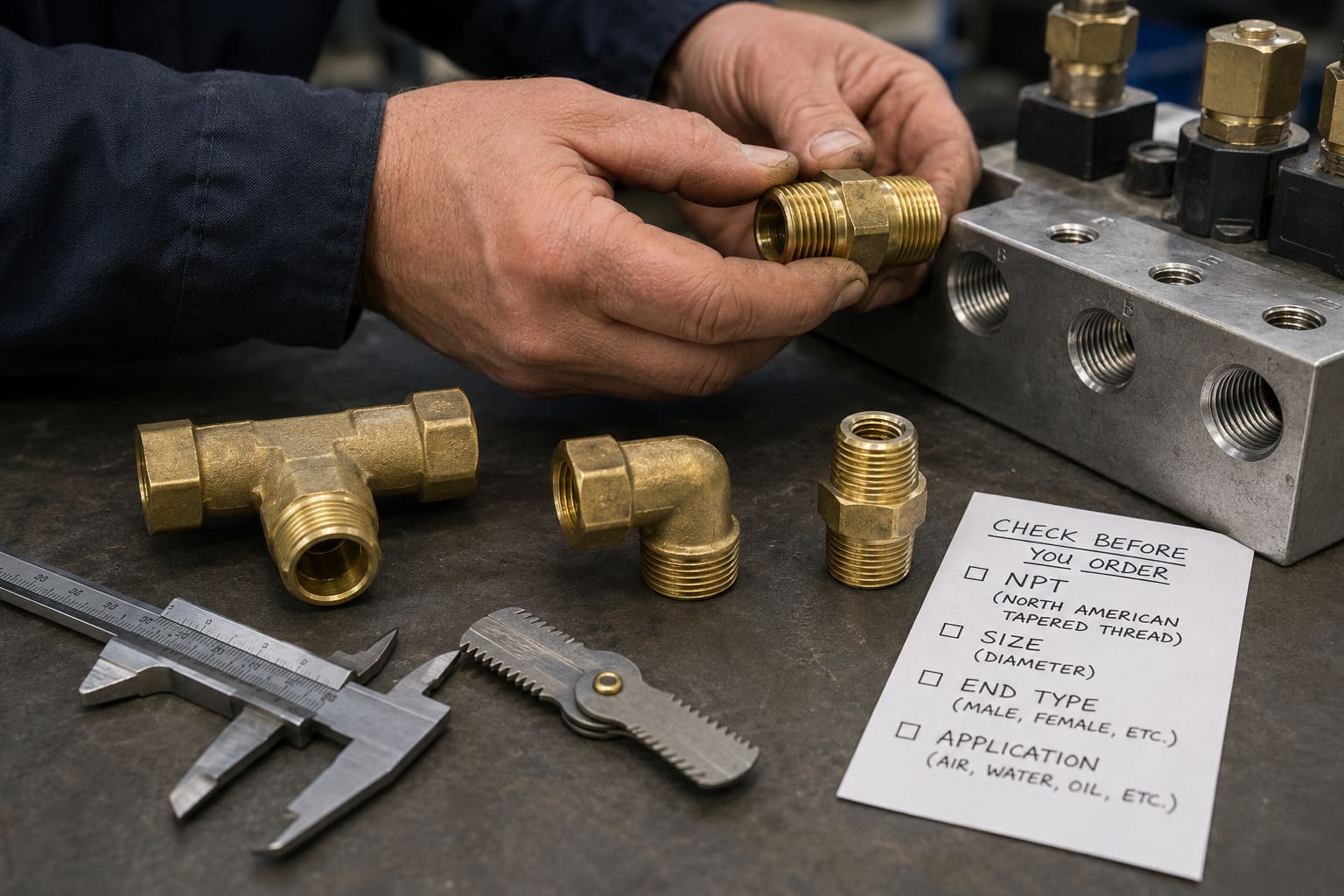
Understanding what NPT means is useful. But the more important question is whether NPT actually matches your port, your application, and your replacement part. Those details determine whether a fitting seals correctly or fails under pressure. The sections below break it all down.
What exactly is the NPT thread standard?
Many buyers assume "NPT" is a size. It isn't. Confusing a thread standard with a thread size is one of the most common specification mistakes I see in fitting inquiries — and it leads to mismatched parts almost every time.
NPT, or National Pipe Taper, is a standardized thread form defined by ANSI/ASME B1.20.13. It specifies the geometry of tapered threads used to connect pipes and fittings in North American plumbing, pneumatic, and hydraulic systems. The taper — 1° 47' (approximately 1 in 16)4 — allows threads to wedge together as they tighten, creating a mechanical seal.
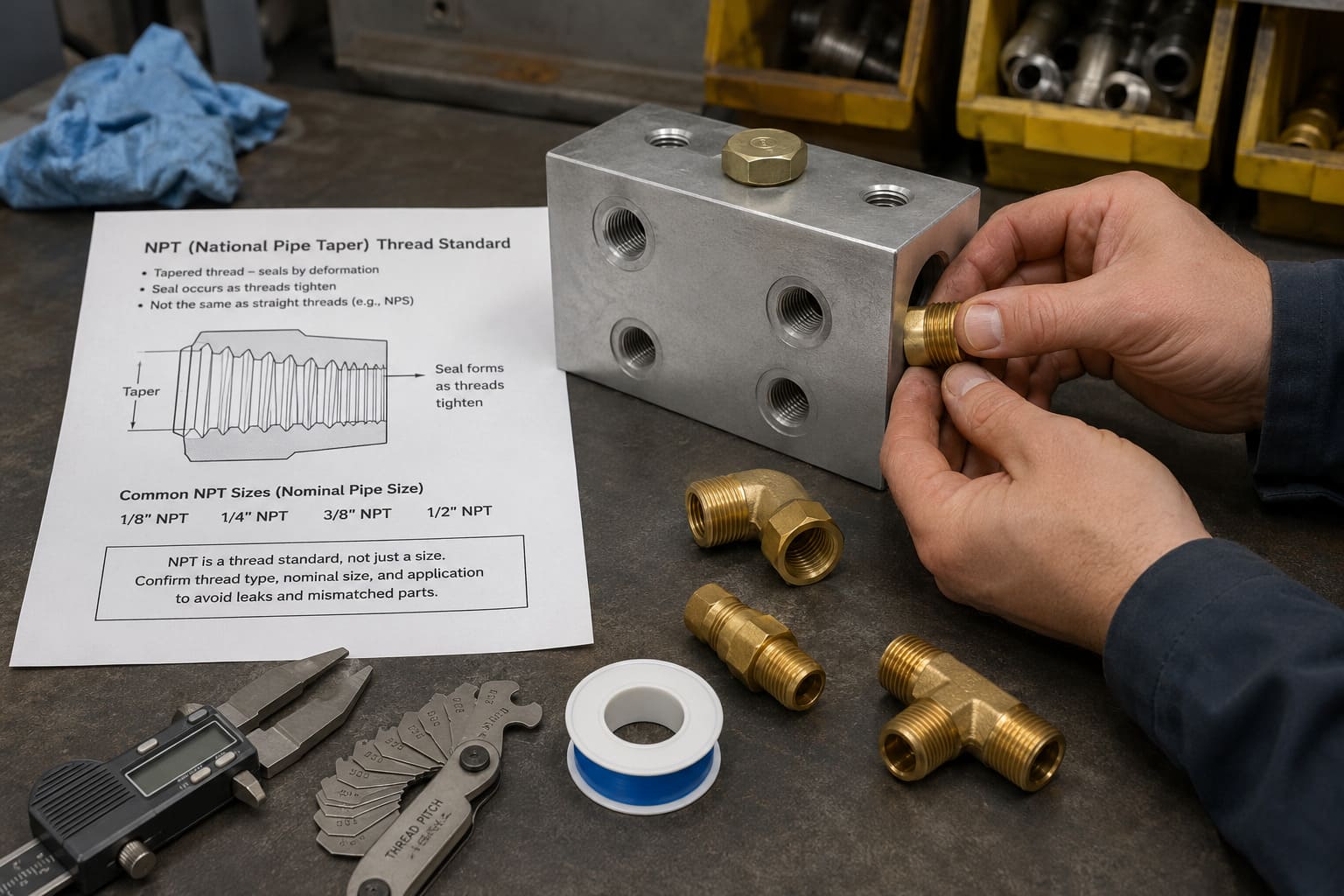
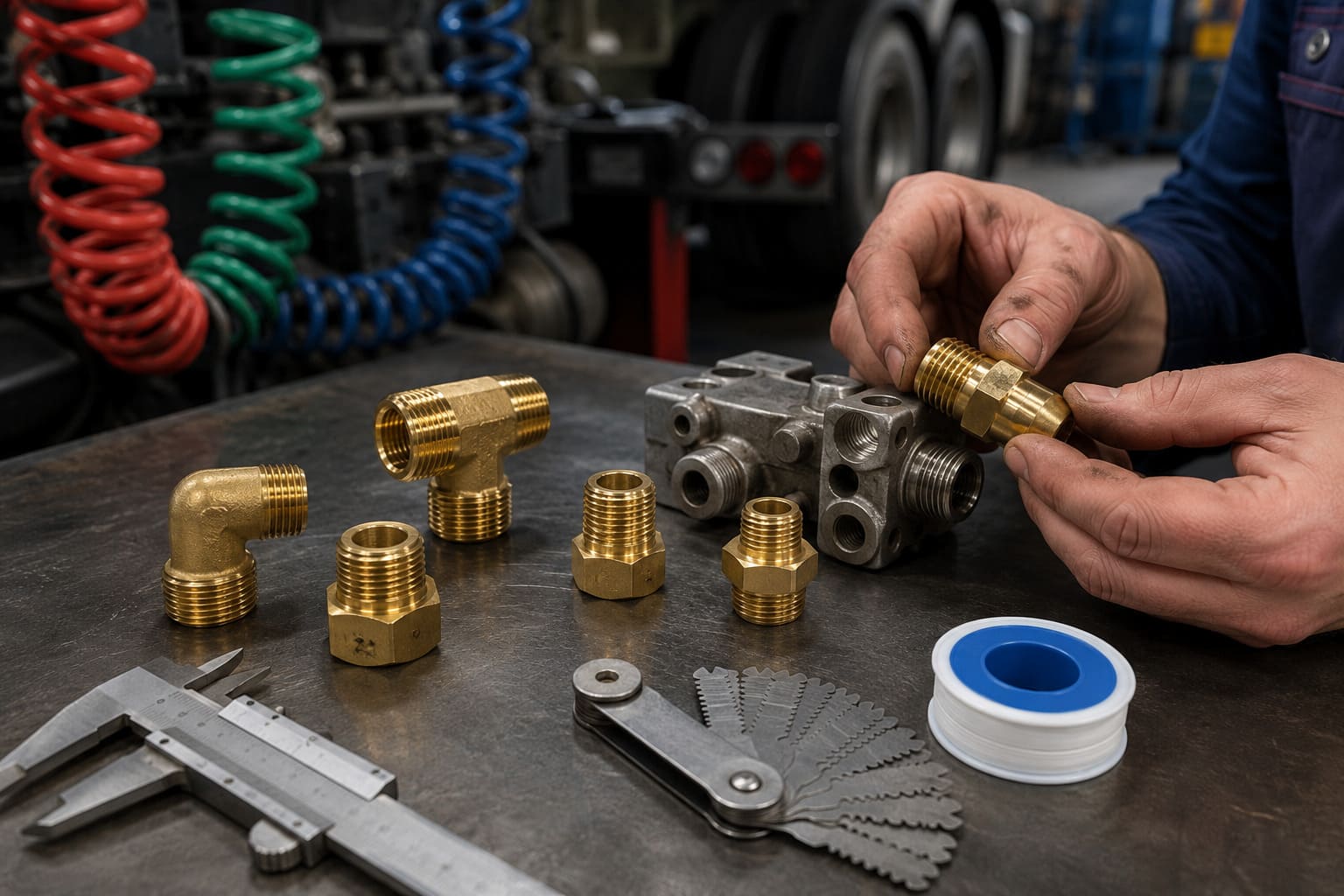
The "taper" is what makes NPT different from straight threads. When two NPT threads engage, the taper forces metal-to-metal contact across the thread flanks. This interference is what creates the seal. Thread sealant or PTFE tape is almost always used alongside NPT threads to fill microscopic gaps and ensure a leak-free joint.5
Why the taper matters in practice
- Straight threads (like BSPP or SAE straight pipe threads) rely on a separate sealing face or O-ring to seal. NPT relies on the thread itself.
- Tapered threads must be tightened to a specific engagement depth to seal properly. Too shallow and you get leakage. Too deep and you risk cracking the fitting body.
- In heavy-duty truck air systems, even a minor air leak reduces brake response efficiency. Thread type and engagement are not small details.
NPT nominal size: the other half of the specification
Every NPT thread comes in a nominal pipe size (NPS). Common sizes in brass truck fittings include:
| Nominal Size | Threads Per Inch (TPI) | Actual OD (approx.) |
|---|---|---|
| 1/8" | 27 | 0.405" |
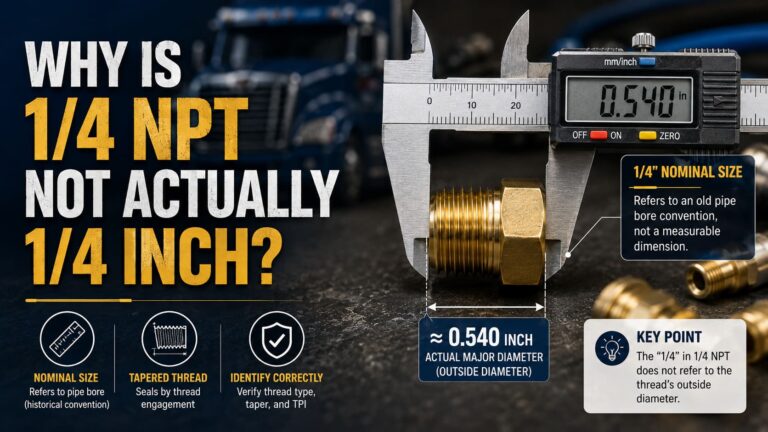
| 1/4" | 18 | 0.540" |
| 3/8" | 18 | 0.675" |
| 1/2" | 14 | 0.840" |
| 3/4" | 14 | 1.050" |
Note that the nominal size does not equal the actual thread outer diameter. A 1/4" NPT fitting has an actual OD of about 0.540 inches.6 This confuses many first-time buyers. When someone asks me for a "1/4 NPT brass elbow," I always confirm whether they mean the nominal pipe size or the measured outside diameter.
How is NPT different from NPTF, BSP, and metric threads?
This is where I see the most costly mistakes in procurement. Customers receive a fitting that physically starts to thread into the port — and assume it fits. Physical engagement is not proof of compatibility.
NPT and several other thread standards look similar enough to engage by hand. But they are not interchangeable.7 Using the wrong thread type in a pressurized system is a reliable path to leakage, fitting damage, or port thread failure.
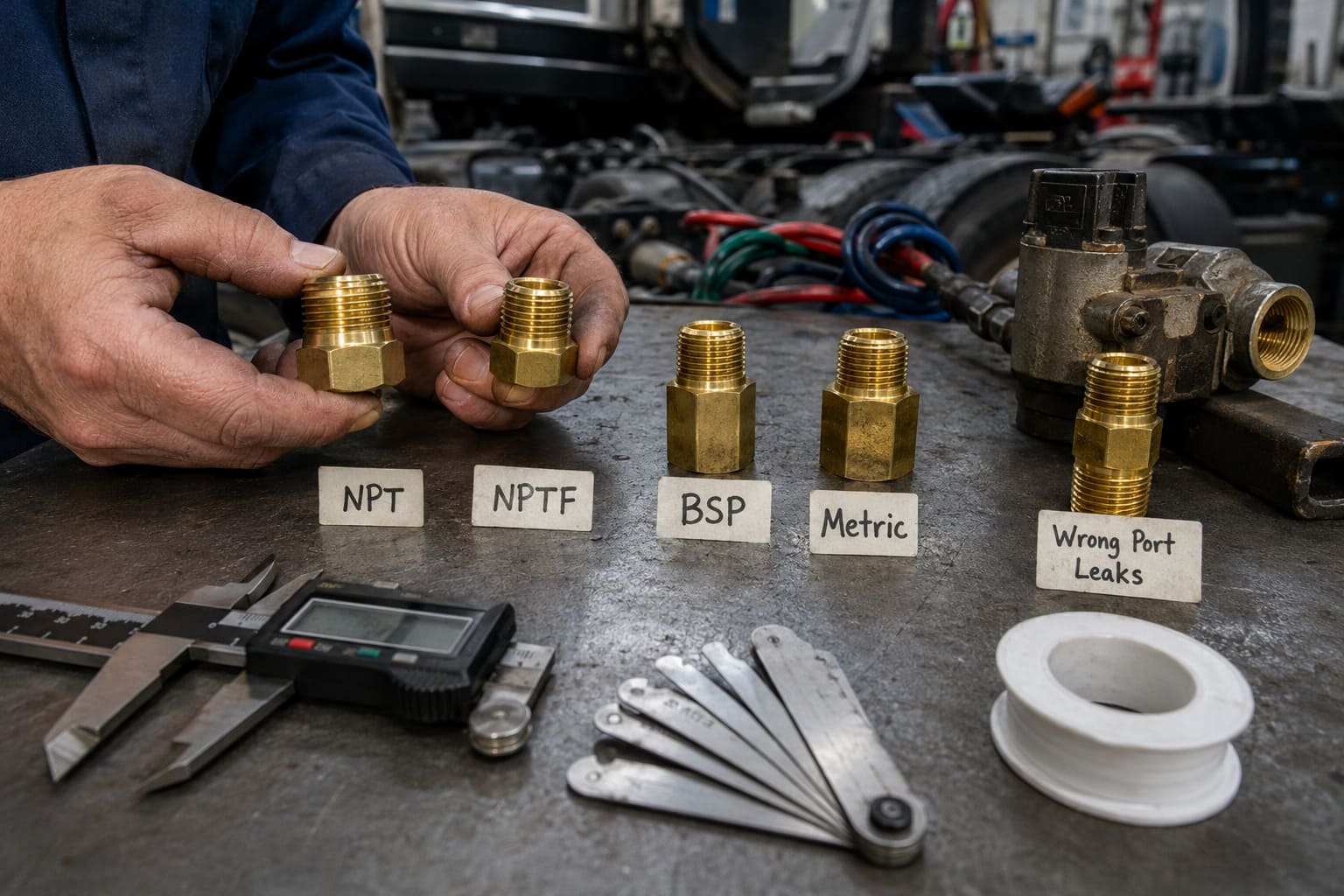
The four thread types that create the most confusion in the North American heavy truck aftermarket are NPT, NPTF, BSP, and metric pipe threads. Here is a practical comparison:
| Thread Standard | Taper or Straight | Sealing Method | Common Region | Compatible with NPT? |
|---|---|---|---|---|
| NPT (National Pipe Taper) | Tapered | Thread interference + sealant | North America | — |
| NPTF (Dryseal) | Tapered | Thread interference alone | North America | Partially — with caution |
| BSPT (British Standard Pipe Taper) | Tapered | Thread interference + sealant | Europe, Asia | No — different thread angle |
| BSPP (British Standard Pipe Parallel) | Straight | Sealing face or O-ring | Europe, Asia | No |
| Metric Pipe Thread (ISO 7-1) | Tapered | Thread interference + sealant | Europe, Asia | No |
NPT vs. NPTF: the most overlooked distinction
NPTF — National Pipe Taper Fuel — is sometimes called "Dryseal" thread.8 It uses the same basic taper as NPT but with tighter dimensional tolerances. The goal of NPTF is to seal without thread sealant by achieving full thread root-to-crest contact.9
In practice:
- NPT fittings can often be used in NPTF ports if sealant is applied — but this is application-dependent.
- NPTF fittings in NPT ports may over-engage or create stress concentrations if the tolerances are mismatched.
- For most heavy-duty truck air brake and pneumatic applications, NPT with PTFE tape or thread sealant is standard practice.
BSP: the most common cross-border confusion
Many truck parts sourced from European or Asian markets carry BSP threads. BSPT has a 55° thread angle, while NPT has a 60° thread angle.10 They look almost identical to the eye. They will partially engage. They will not seal. I receive inquiries where customers have been threading BSP fittings into NPT ports for months before a leak finally appears or a fitting cracks.
If you are sourcing from outside North America, always request written thread standard confirmation — not just a photo.
Why does "NPT" alone not define your brass fitting order?
When a customer sends me an inquiry that says only "I need NPT brass fittings," I cannot quote accurately. Every time, I have to ask follow-up questions. This is not a supplier problem — it is a specification problem.
NPT defines the thread standard. It does not define the fitting.
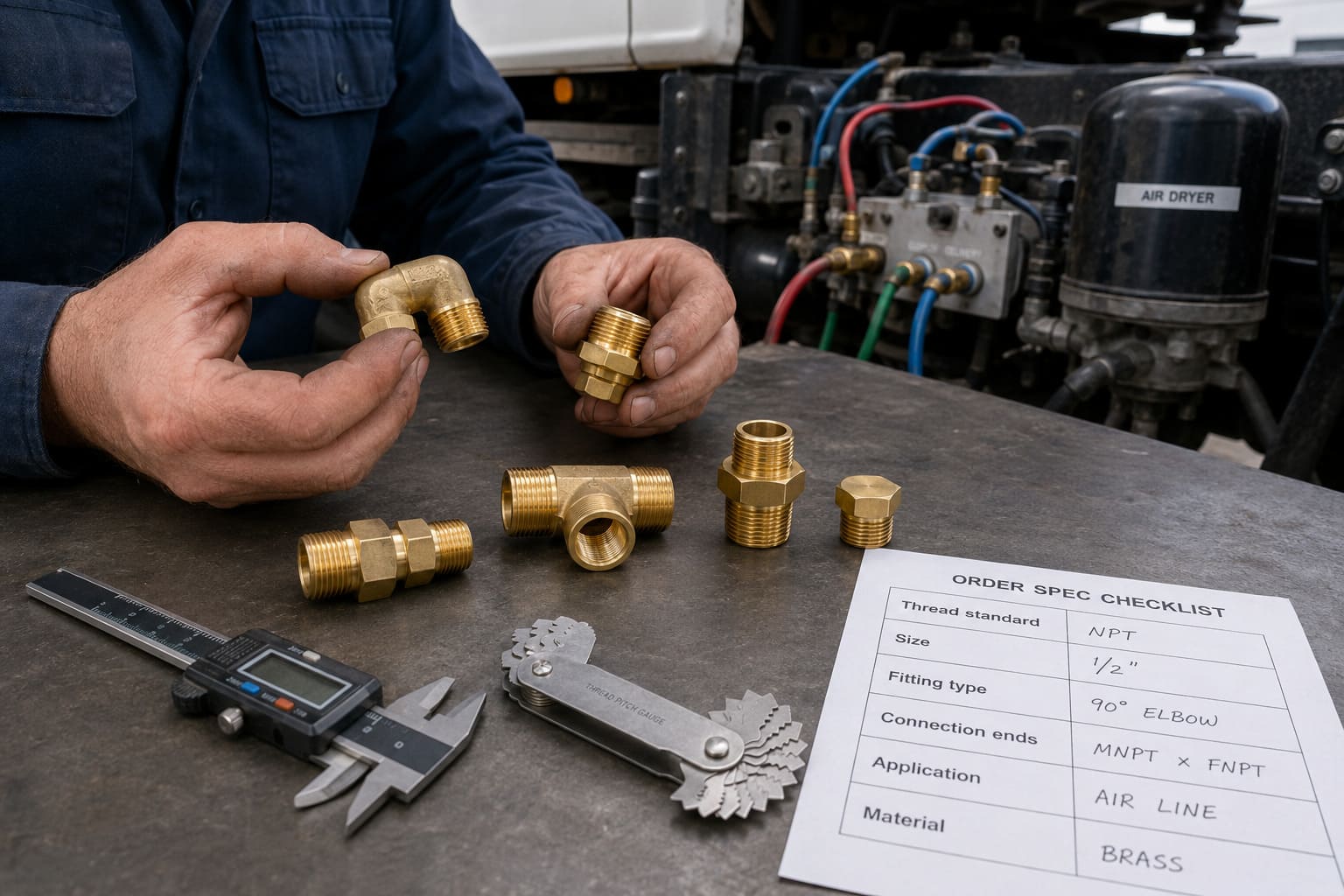
A complete brass fitting specification includes at minimum:
- Thread standard — NPT, NPTF, BSP, etc.
- Nominal thread size — 1/8", 1/4", 3/8", 1/2", etc.
- Fitting type — straight union, elbow, tee, reducer, adapter, plug, etc.
- Connection ends — both ends may not be the same standard or size
- Application — air brake system, fuel line, hydraulic, water? Pressure range?
- Material grade — standard brass, forged brass, dezincification-resistant brass?
The reducer example
A 3/8" NPT male to 1/4" NPT female reducer adapter has three different descriptors in one part: thread standard, two nominal sizes, and two end types. If a customer asks for a "3/8 NPT brass fitting," they could mean a straight union, a tee, an elbow, or a reducer. I've shipped wrong parts because a single descriptor was assumed to be complete.
The truck OEM port example
Different truck OEMs sometimes use different port thread standards on similar components. A Freightliner air dryer port may differ from the same position on a Kenworth or an International. Always cross-reference the OEM part number or measure the port thread before ordering replacement brass fittings.
What is the practical checklist before buying NPT brass fittings?
Procurement mistakes with brass fittings are almost always specification mistakes. The fitting itself is often fine. The information used to select it was incomplete.
Before placing an order — or before sending an inquiry to a supplier — run through this checklist. It takes two minutes and eliminates most return-and-reship cycles.

Pre-order specification checklist
- [ ] Thread standard confirmed: NPT, NPTF, BSP, or other? Do not assume.
- [ ] Nominal size confirmed: Measured with a thread gauge or verified against OEM documentation.
- [ ] Both connection ends identified: Are both ends NPT? Is one end a hose barb, compression, or push-to-connect?
- [ ] Fitting geometry identified: Straight, 45° elbow, 90° elbow, tee, union, adapter, plug?
- [ ] Application confirmed: Air brake? Fuel? Hydraulic? What is the working pressure?
- [ ] OEM part number available: Cross-referencing eliminates ambiguity.
- [ ] Sample, photo, or drawing available: A clear photo of the fitting and port answers most questions immediately.
- [ ] Replacement or new installation: Replacement parts should match the original exactly unless a documented upgrade is intended.
What to send to a supplier
When I receive an inquiry with a photo of the old fitting, the port location on the truck, and the OEM part number, I can confirm a match or flag a discrepancy within hours. When I receive only "1/4 NPT brass elbow," I need to ask at least three more questions before I can confirm suitability.
The more complete your inquiry, the faster and more reliably you get the right part.
Frequently Asked Questions
Can I use NPT fittings with BSP ports?
No — not reliably. NPT and BSP threads have different thread angles (60° vs. 55°) and different pitch specifications. They may partially engage, but they will not create a reliable pressure-tight seal. Using an NPT fitting in a BSP port risks leakage and port thread damage. Use a dedicated NPT-to-BSP adapter if cross-standard connection is required.
Do NPT brass fittings always need thread sealant?
Standard NPT threads are designed to be used with PTFE tape or liquid thread sealant to fill the small gaps that remain between thread flanks. NPTF (Dryseal) threads are designed to seal without sealant under ideal conditions, but sealant is still commonly used in practice. For air brake and pneumatic systems on heavy trucks, always follow OEM recommendations for sealant use.
What is the most common NPT size in heavy-duty truck air systems?
In North American heavy-duty truck pneumatic and air brake systems, 1/4" NPT and 3/8" NPT are the most frequently encountered sizes in brass fittings. These cover most air line connections, valve ports, and ancillary pneumatic components. However, always measure or verify against the OEM specification — do not assume size from appearance alone.
How do I identify an NPT thread if I don't have documentation?
Use a thread gauge to measure threads per inch and confirm the taper. NPT threads taper at 1:16 — a gauge or caliper can detect the diameter change along the thread length. Alternatively, compare thread engagement against a known NPT fitting. If you're unsure, send a clear photo and measurements to your supplier for confirmation before ordering.
Is NPT the same as pipe thread?
"Pipe thread" is a broad category. NPT is the most common pipe thread standard in North America, but it is one of several. BSPT, BSPP, and ISO 7-1 metric tapered pipe threads are all "pipe threads" used in other regions. When someone says "pipe thread" without specifying the standard, always ask for clarification.
Conclusion
NPT — National Pipe Taper — is the foundational thread standard for brass fittings in North American heavy-duty truck applications. But knowing what NPT means is only part of the picture. A complete fitting specification always includes the nominal size, both connection end types, the fitting geometry, and the application. Without those details, even an experienced supplier cannot guarantee a match.
The fastest way to avoid returns, air leaks, and installation delays is to treat NPT as the starting point of a conversation — not the end of it. If you're sourcing brass fittings for your distribution business, repair shop, or fleet, send us your part number, a photo, or a sample. At ROADSPOWER, we help overseas buyers confirm specifications before orders are placed, not after parts arrive. Contact us to discuss your fitting requirements.
"National pipe thread", https://en.wikipedia.org/wiki/National_pipe_thread. ANSI/ASME material on pipe-thread standards identifies NPT as a tapered pipe-thread form and supports the statement that its sealing function depends on engagement of tapered mating threads. Evidence role: definition; source type: institution. Supports: The source should define NPT as a tapered pipe thread standard and explain that the taper creates sealing interference between mating threads.. Scope note: The source supports the standard and mechanism generally, not the performance of every brass fitting or installation. ↩
"National pipe thread", https://en.wikipedia.org/wiki/National_pipe_thread. A neutral overview of National Pipe Thread describes NPT as the U.S. national technical standard for tapered threaded pipes and fittings, providing contextual support for its common use in North American fluid connections. Evidence role: general_support; source type: encyclopedia. Supports: The source should support that NPT is a widely used or standard pipe-thread system in North America for pipes and fittings.. Scope note: This would support broad common use, not a quantified ranking specifically for brass pneumatic fittings. ↩
"ANSI B1.20.1", https://www.armechalloys.com/pdf/ansi-b1-20-1.pdf. ANSI/ASME B1.20.1 is the referenced standard for general-purpose inch pipe threads, including National Pipe Taper thread dimensions and designations. Evidence role: definition; source type: institution. Supports: The source should identify ANSI/ASME B1.20.1 as the standard for general-purpose inch pipe threads including NPT.. ↩
"National Standard Taper Pipe Threads Size NPT Chart", https://www.engineersedge.com/hardware/taper-pipe-threads.htm. Standards references for National Pipe Taper threads specify a taper of 1 in 16 on diameter, corresponding to an angle of approximately 1°47′. Evidence role: definition; source type: institution. Supports: The source should confirm the standard NPT taper ratio and equivalent taper angle.. ↩
"Thread seal tape", https://en.wikipedia.org/wiki/Thread_seal_tape. Engineering references describe standard NPT joints as tapered threaded connections in which sealant or PTFE tape is commonly applied to close remaining thread clearances and reduce leakage. Evidence role: mechanism; source type: education. Supports: The source should explain that NPT threads may leave leak paths or gaps and that thread sealant or PTFE tape is commonly used to seal them.. Scope note: This supports common practice and mechanism, but may not quantify the phrase 'almost always' across all industries. ↩
"Pipe sizes threads", https://www.bestmaterials.com/pdf_files/pipe-sizes-threads.pdf?srsltid=AfmBOorgTD-1e1PJ0HsM9XY1rfnQY3OrQo62rAZe2v68E48wy5jpSskR. Standard NPT dimension tables list 1/4-inch NPT as an 18 TPI tapered pipe thread with an outside diameter of approximately 0.540 inches. Evidence role: definition; source type: institution. Supports: The source should provide the standard nominal size, threads per inch, and approximate outside diameter for 1/4-inch NPT.. Scope note: The value is a nominal reference dimension; actual measured diameter varies along the taper and with thread engagement location. ↩
"NPT vs. BSP Threads: Key Differences and Applications", https://www.titanfittings.com/articles/npt-vs-bsp-threads-key-differences-and-applications?srsltid=AfmBOop_NJZ-HnMaL2OI1fhU0WflcPKkPsAjzrLNcw0JF-X7tyt9lRHA. Engineering references comparing pipe-thread systems note that visually similar standards such as NPT and BSP differ in thread form and pitch, so partial engagement does not establish a compatible pressure seal. Evidence role: general_support; source type: education. Supports: The source should support that NPT and BSP or other pipe-thread standards differ dimensionally and should not be treated as interchangeable even if they partially engage.. Scope note: The source would substantiate the general compatibility issue, not every possible mixed-thread pairing. ↩
"National pipe thread", https://en.wikipedia.org/wiki/National_pipe_thread. Standards references for Dryseal pipe threads identify NPTF as National Pipe Taper Fuel, a Dryseal tapered pipe-thread designation. Evidence role: definition; source type: institution. Supports: The source should define NPTF and identify it as a Dryseal pipe-thread designation.. ↩
"Getting to Leakproof with NPT & NPTF Threads: What Matters", https://www.industrialspec.com/about-us/blog/detail/npt-nptf-tapered-threads-and-leakproof-seals?srsltid=AfmBOor2odrk_b7dPe56Kf4rgja4Em2ij6UjNAUkoDlJiXcKeMe2-9h0. Dryseal pipe-thread references explain that NPTF threads are dimensioned to produce crest-to-root interference that can form a pressure seal without added sealing compound under specified conditions. Evidence role: mechanism; source type: institution. Supports: The source should explain that Dryseal/NPTF threads are dimensioned to reduce or eliminate leak paths by crest-root contact.. Scope note: This supports the design intent; actual leak-tightness still depends on manufacturing tolerances, assembly, medium, and service conditions. ↩
"The Difference Between BSPT, NPT and BSPP Threads", https://anglostainless.co.uk/the-difference-between-bspt-npt-and-bspp-threads/. Reference descriptions of pipe-thread forms specify Whitworth/BSP threads with a 55° profile and National Pipe Thread with a 60° profile. Evidence role: definition; source type: encyclopedia. Supports: The source should confirm the different thread flank angles for BSPT and NPT.. ↩