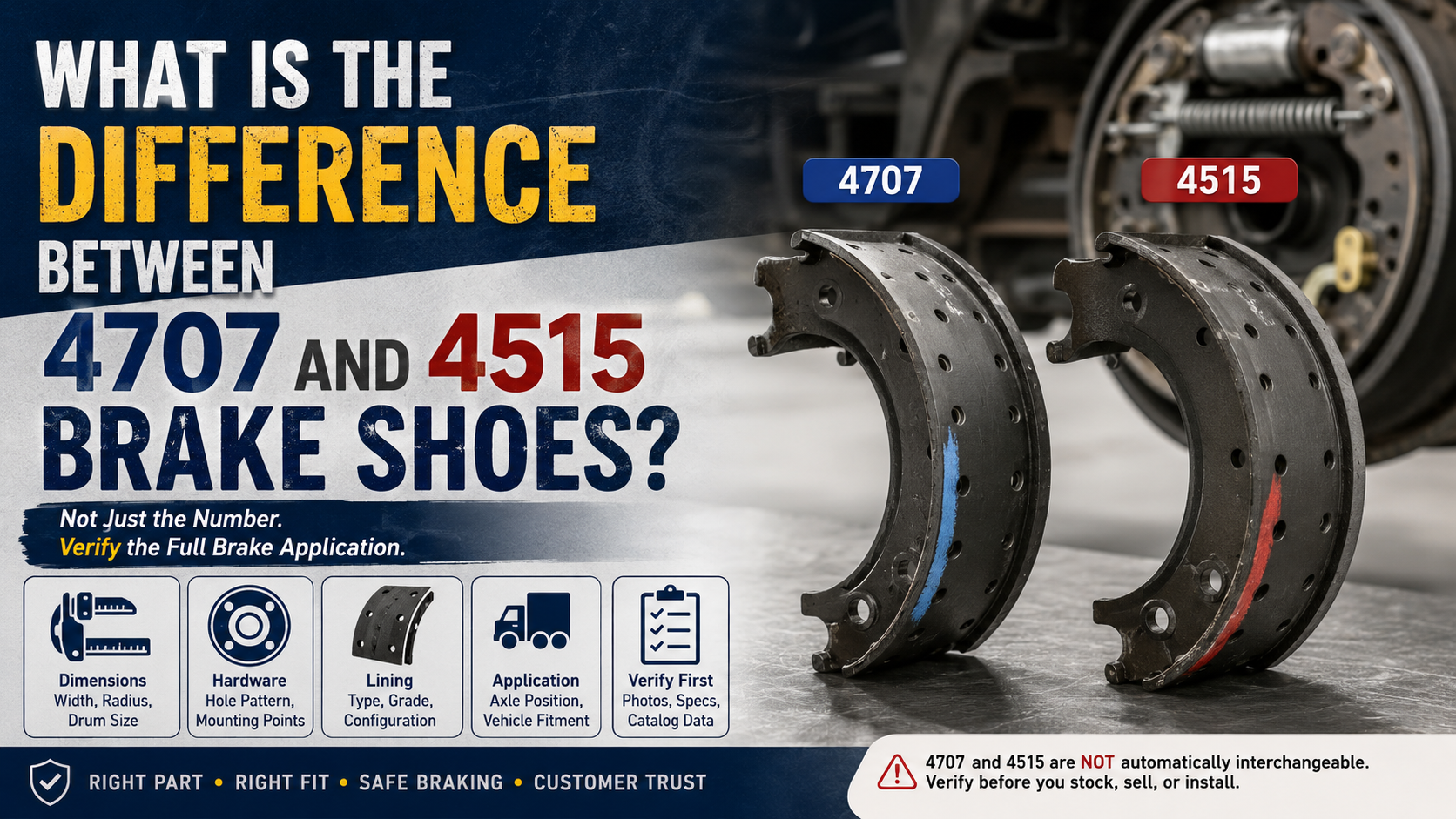
4707 and 4515 brake shoes can create costly confusion when a buyer treats the number as the whole answer. A similar-looking shoe may still fail fitment because the drum size, shoe width, hardware, or lining setup is different1. The safer solution is to verify the full brake application before stocking, selling, or installing either part.
4707 and 4515 brake shoes should not be treated as interchangeable based only on appearance or part number.2 The real difference must be verified through brake system specifications, shoe dimensions, drum size, shoe width, hardware configuration, lining type, axle position, vehicle application, and trusted catalog or OE cross-reference data.
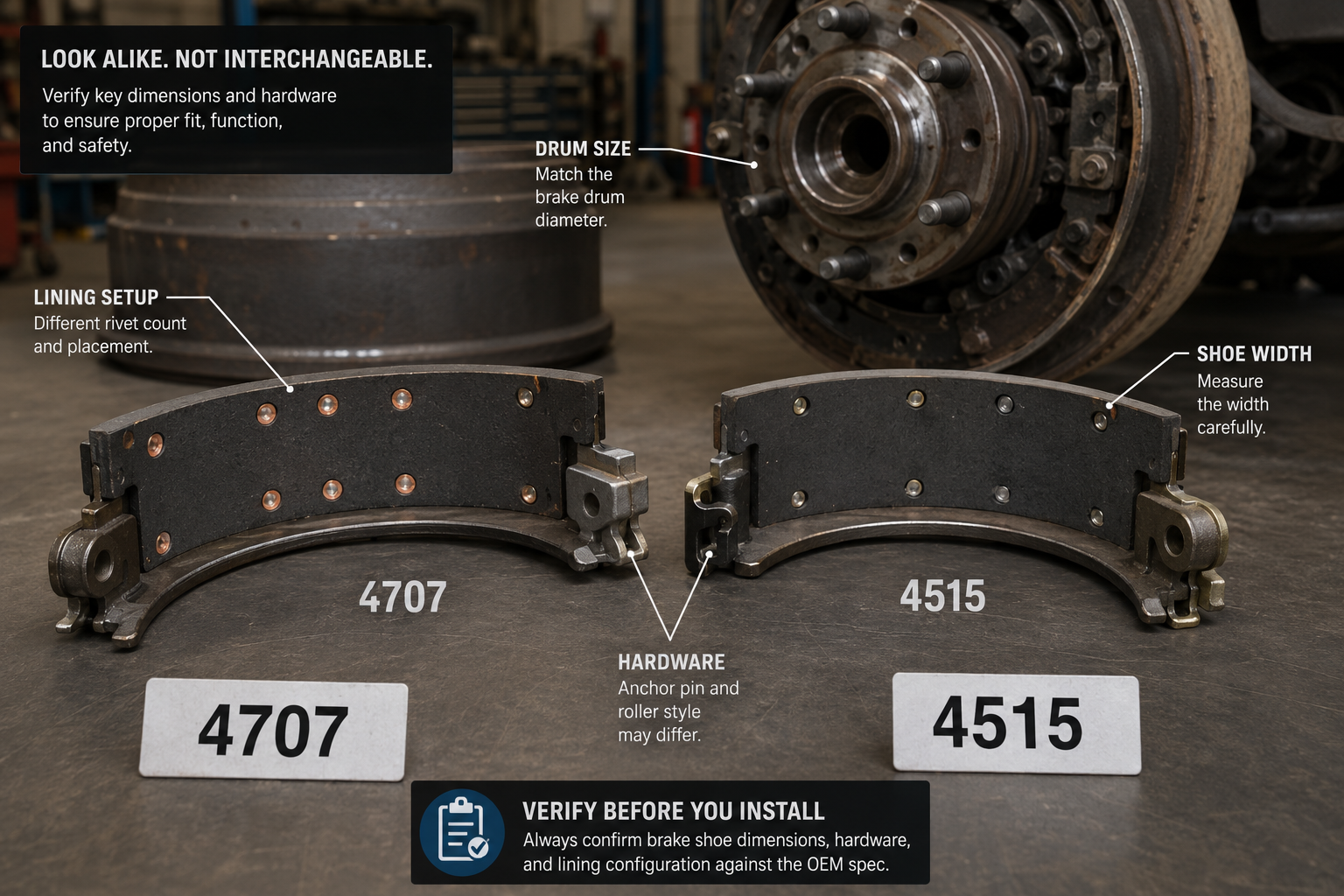
I handle overseas brake shoe matching inquiries often, and I have seen buyers lose time because a visible number or a quick cross-reference looked “close enough.” The better question is not only “What is different?” It is “Which shoe matches the truck, axle, drum, and existing assembly?”
Are 4707 and 4515 brake shoes interchangeable?
Wrong interchange assumptions create real procurement risk. A distributor may add a substitute SKU to inventory, a repair shop may install the wrong part, or a fleet may face downtime after the truck is already scheduled for service. The difference may not be obvious from one photo.
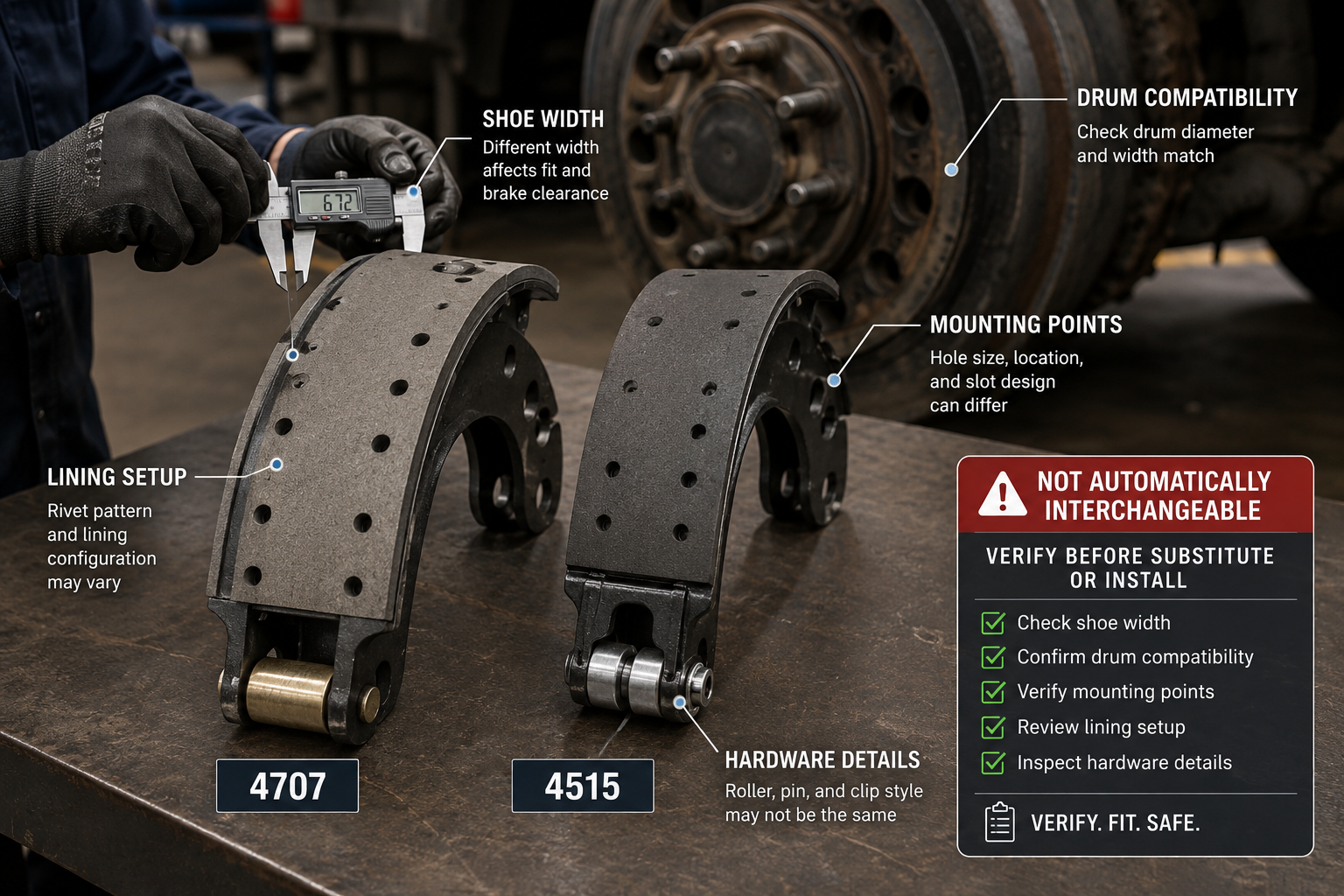
4707 and 4515 brake shoes are not automatically interchangeable. They may look similar, but buyers should verify dimensions, shoe width, drum compatibility, mounting points, lining setup, and hardware details before using one as a replacement for the other.
Why “similar-looking” is not enough
In many matching inquiries, the customer sends me one photo and asks, “Can I use 4707 instead of 4515?” I understand why this happens. Brake shoes are heavy, dirty, and often removed in busy repair environments. The stamped number may be partly visible. The shape may look familiar. A cross-reference list may show a possible match. However, brake shoe selection is not a visual guessing game.
A brake shoe must work inside a specific brake system. If one detail is wrong, the shoe may not seat correctly, the lining contact may be poor, or the hardware may not assemble as expected3. Even if the shoe can be physically installed, that does not prove it is the correct choice.4
For distributors and wholesalers, the risk is also commercial. A wrong substitute can create:
- Returns and credit claims
- Inventory confusion
- Customer complaints
- Delayed repair jobs
- Loss of trust in the parts counter
- Possible safety responsibility
What must be checked before interchange?
A buyer should verify several details before treating 4707 and 4515 as substitutes.
| Fitment item | Why it matters | How I usually ask customers to verify it |
|---|---|---|
| Existing part number | It gives a starting point, not final proof | Send clear photos of all numbers on the old shoe |
| Brake drum size | It affects brake shoe radius and fit | Confirm drum marking or vehicle brake specification |
| Shoe width | It affects contact area and assembly fit | Measure the old shoe width accurately |
| Hole pattern | It affects hardware and mounting | Send photos of web holes and anchor ends |
| Lining setup | It affects friction surface and duty use | Send lining photos and note riveted or bonded type |
| Hardware configuration | It affects installation compatibility | Send photos of rollers, pins, springs, and clips |
| Vehicle application | It confirms catalog fitment | Provide year, make, model, axle, and position |
I do not recommend deciding from the number alone. A number can be incomplete, misread, reused in a local market, or linked to different lining and hardware packages by different suppliers. A correct brake shoe match should combine physical verification + application verification + catalog verification.
My practical rule is simple: if the buyer cannot confirm drum size, shoe width, and hardware details, I do not treat a 4707-to-4515 substitution as confirmed.
Why this matters for distributors
A repair shop may only need one axle set today. A distributor may stock dozens or hundreds of sets. That changes the risk. If a distributor imports the wrong brake shoe in bulk, the cost is not just one wrong installation. The cost includes freight, warehousing, customer returns, slow-moving inventory, and future confusion in the sales team.
For this reason, I suggest that distributors build an internal fitment note for each brake shoe SKU. That note should include:
- Verified old part photos
- Confirmed shoe width
- Confirmed drum size
- Known compatible hardware kit
- Vehicle or axle application notes
- Supplier catalog reference
- Any market-specific cross-reference numbers
- Any “do not substitute without checking” warning
This approach is slower at the start, but it reduces mistakes later. It also helps new sales staff answer customer questions with confidence.
What details make 4707 and 4515 brake shoes different?
A buyer may feel frustrated when two brake shoe numbers look close but cannot be confirmed quickly. That frustration gets worse when a customer is waiting at the counter or a truck is down in the shop. The solution is to break the difference into verifiable categories.
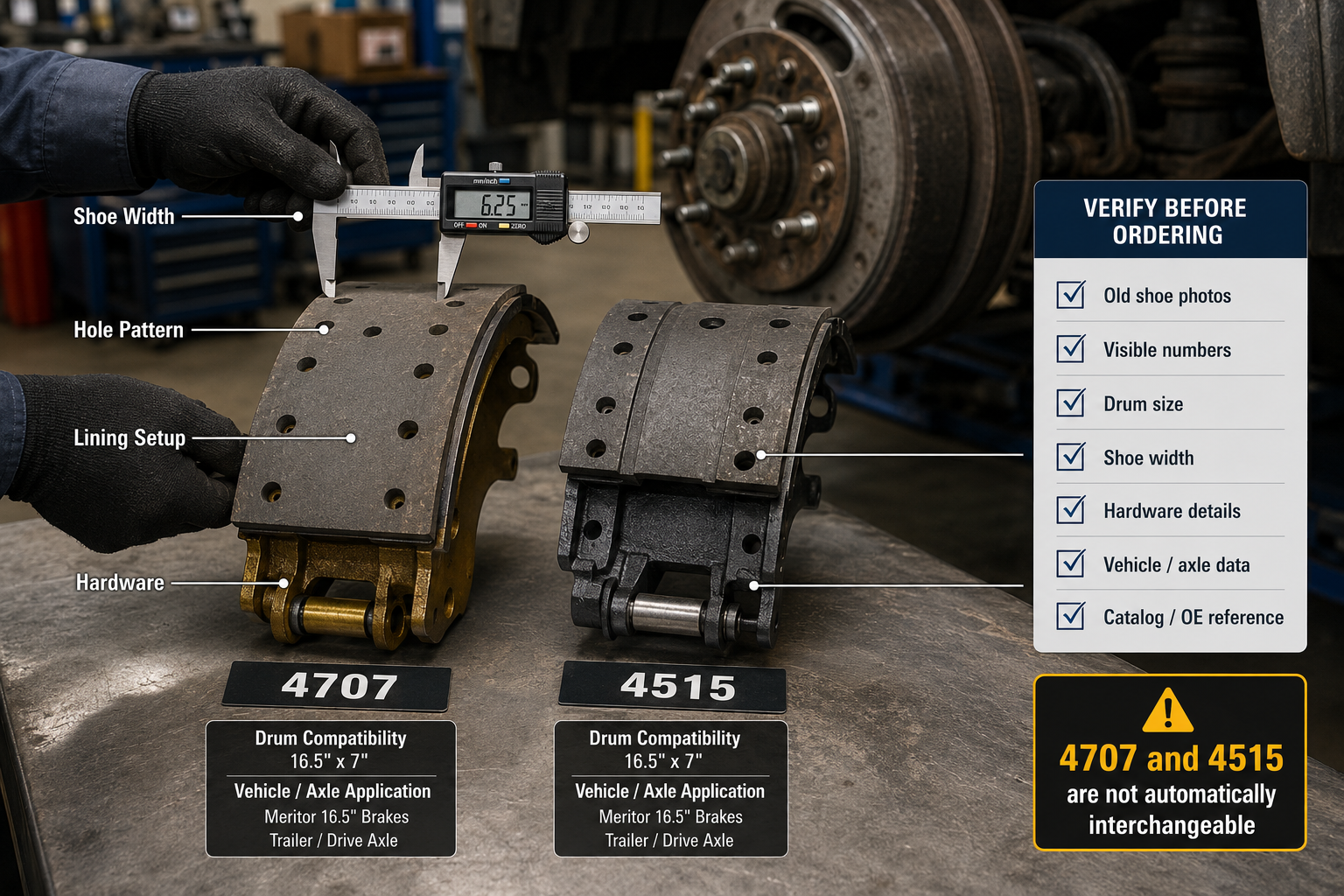
The difference between 4707 and 4515 brake shoes may involve dimensions, shoe width, brake drum compatibility, web design, hole pattern, lining configuration, hardware, axle position, and vehicle application. Exact specifications should be verified against supplier catalogs, OE references, and the removed brake shoe.
The main difference categories
I avoid giving fixed specifications unless I have confirmed product data in front of me. Brake shoe numbers can vary by catalog system, market, lining grade, and supplier package.5 For procurement decisions, I prefer a structured verification method.
| Difference category | What to check | Status without verified data |
|---|---|---|
| Overall shoe shape | Arc, web profile, anchor end | To be verified |
| Shoe width | Width of friction surface and shoe body | To be verified |
| Drum size match | Compatible brake drum diameter | To be verified |
| Hole pattern | Web holes and attachment points | To be verified |
| Lining type | Riveted, bonded, lining grade | To be verified |
| Hardware kit | Springs, rollers, pins, clips | To be verified |
| Axle position | Front, drive, trailer, or other use | To be verified |
| Vehicle coverage | Truck make, model, year, axle spec | To be verified |
Dimension differences
Dimensions are usually the first thing buyers ask about. They are important, but they are not the full answer. A brake shoe with the wrong width or wrong radius will not be a correct fit6 even if the number looks familiar.
The buyer should check:
- Shoe width
- Shoe arc and radius
- Web thickness
- Anchor end design
- Cam end design
- Lining length and placement
- Rivet pattern, if applicable
- Overall shape compared with the old shoe
When I receive a matching request, I usually ask for a photo with a ruler or caliper. A photo without scale can mislead both sides. A brake shoe is a dimensional part, and small differences can matter.
Hardware and hole pattern differences
The hardware arrangement is another common source of confusion. Two brake shoes can appear similar from the lining side, but the web side may tell a different story. The hole pattern, spring attachment position, and roller or anchor arrangement must match the brake assembly.7
For example, a buyer may send a photo of the friction side only. I then ask for:
- Front view
- Back view
- Side view
- Close-up of anchor end
- Close-up of cam end
- Close-up of all visible numbers
- Existing hardware photo
This is not because I want to make the process difficult. It is because a single photo often hides the information that decides fitment.
Lining setup and application risk
Brake shoes may also differ by lining material, friction rating, duty level, or installation method.8 For aftermarket procurement, this matters because customers may operate in different environments. A fleet in mountain routes, city delivery, highway hauling, or construction service may have different braking demands.9
I do not claim that one lining is universally better. Instead, I recommend checking the application requirement:
- Is the truck used for long-haul highway work?
- Is the vehicle frequently loaded near maximum weight?
- Does the route include steep grades?
- Is the part for a trailer, drive axle, or another position?
- Does the buyer require a specific compliance document?
- Does the local market expect a certain lining type?
This is why the question should not stop at “4707 or 4515?” The better question is: “Which verified brake shoe package fits the brake system and the duty cycle?”
How should buyers verify 4707 and 4515 brake shoes before ordering?
A wrong brake shoe order can look like a small mistake at first. Then the buyer pays for urgent replacement freight, a repair shop loses bay time, and the distributor has to explain why the catalog match failed. A simple verification workflow prevents most of these issues.
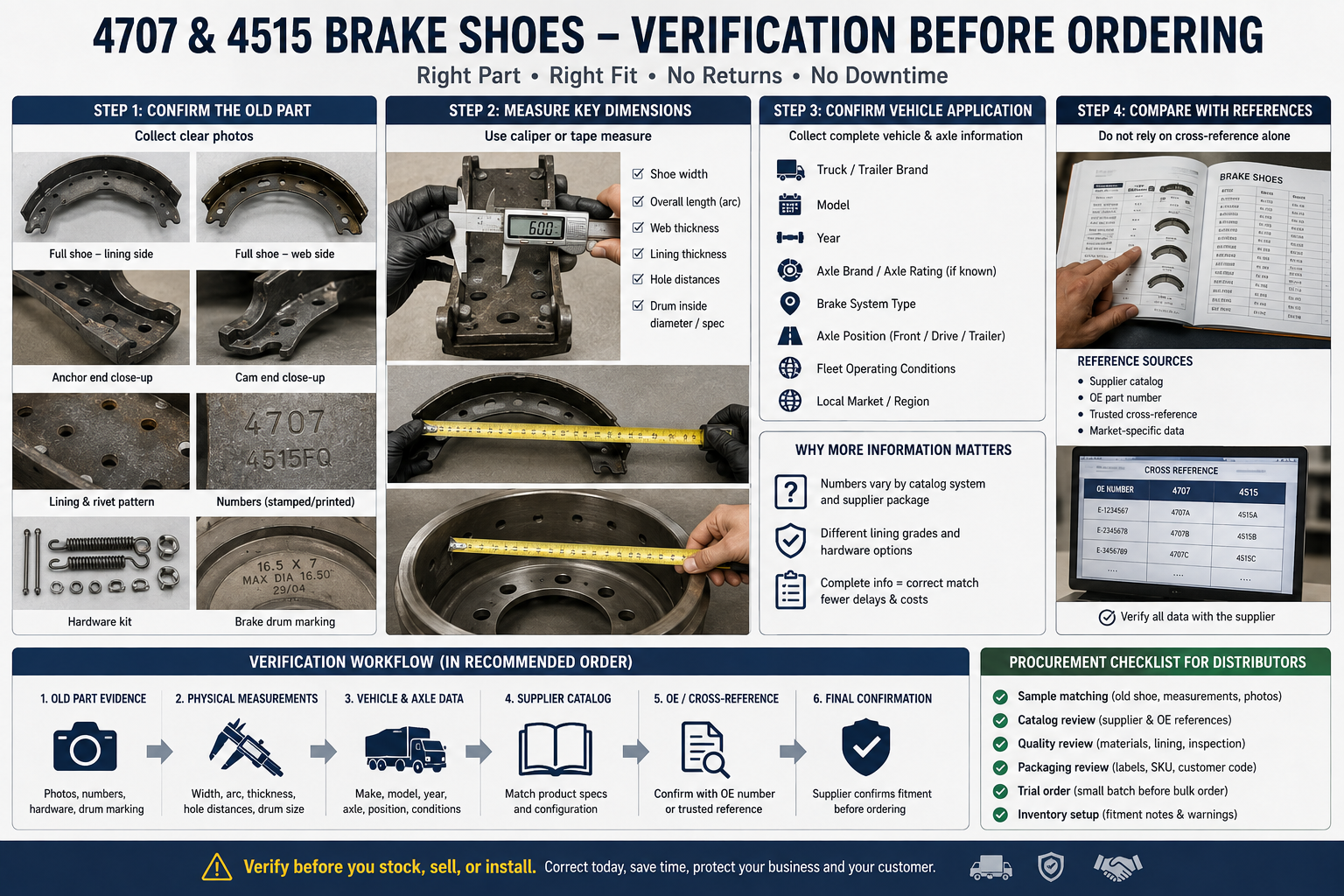
Buyers should verify 4707 and 4515 brake shoes by collecting old shoe photos, visible numbers, drum size, shoe width, hardware details, vehicle year and model, axle position, application notes, and OE or supplier cross-reference data before confirming an order.
A practical verification checklist
When I support an overseas customer, I like to collect enough data before quoting or confirming. This does not need to be complicated. The buyer can use a simple checklist.
Step 1: Confirm the old part
Ask the repair shop or fleet to remove one old shoe and take clear photos.
Required photos:
- Full shoe, lining side
- Full shoe, web side
- Anchor end close-up
- Cam end close-up
- Lining and rivet pattern close-up
- All stamped, cast, or printed numbers
- Hardware kit beside the shoe
- Brake drum marking, if visible
Step 2: Measure the key dimensions
The buyer should measure the old part carefully. A tape measure is better than nothing, but a caliper is better for width and thickness.
Key measurements:
- Shoe width
- Overall length along the arc, if possible
- Web thickness
- Lining thickness, if still useful
- Hole distances, when relevant
- Drum inside diameter or drum specification
Step 3: Confirm the vehicle application
A brake shoe cannot be confirmed only from the loose part. The vehicle application gives another layer of verification.
Useful application details:
- Truck or trailer brand
- Model
- Year
- Axle brand or axle rating, if known
- Brake system type
- Axle position
- Fleet operating conditions
- Local market or region
Step 4: Compare with catalog references
Cross-reference lists are useful, but they should not be the only proof.10 A cross-reference may point to a family of parts, while the actual assembly may need a specific width, lining, or kit.
I suggest this order:
- Old part evidence
- Physical measurements
- Vehicle and axle data
- Supplier catalog
- OE or trusted cross-reference
- Final confirmation from the supplier
Why buyers should send more than one number
Customers sometimes send only “4707” or “4515” in a message. I can start with that, but I cannot responsibly confirm every detail from that alone. Brake shoe numbers may appear in multiple catalog systems. Also, aftermarket suppliers may package shoes with different lining grades or hardware options for different markets.
A better inquiry looks like this:
“We need brake shoes for a North American heavy-duty truck application. The old shoe has number 4707 visible. Shoe width is to be confirmed. Attached are photos of both sides, hardware, drum marking, and vehicle information. Please help verify whether this matches your product or cross-reference.”
That kind of inquiry saves time. It helps the supplier respond with fewer assumptions.
Procurement checklist for distributors
Distributors should build a standard internal process before adding 4707 and 4515 brake shoes to stock or cross-reference lists.
| Procurement stage | What to verify | Why it matters |
|---|---|---|
| Sample matching | Old shoe, measurements, photos | Confirms physical fitment |
| Catalog review | Supplier and OE references | Reduces cross-reference errors |
| Quality review | Materials, lining, inspection process | Supports consistent supply |
| Packaging review | Labels, SKU, customer code | Prevents warehouse confusion |
| Trial order | Small batch before bulk order | Tests market fit and installation feedback |
| Inventory setup | Fitment notes and warnings | Helps sales team avoid wrong substitution |
This is especially important for mixed aftermarket orders. Many of my customers buy brake-related parts together with air line kits, brass fittings, and other truck accessories. A mixed order creates convenience, but it also makes SKU accuracy more important. One wrong brake shoe model can delay the whole order or create extra sorting work after arrival.
What quality and supplier factors matter when sourcing 4707 and 4515 brake shoes?
A buyer may confirm the correct number and still face problems if the supplier cannot control consistency. This creates a second layer of risk. The part may match the sample, but poor process control can cause uneven quality, labeling errors, or shipment delays.
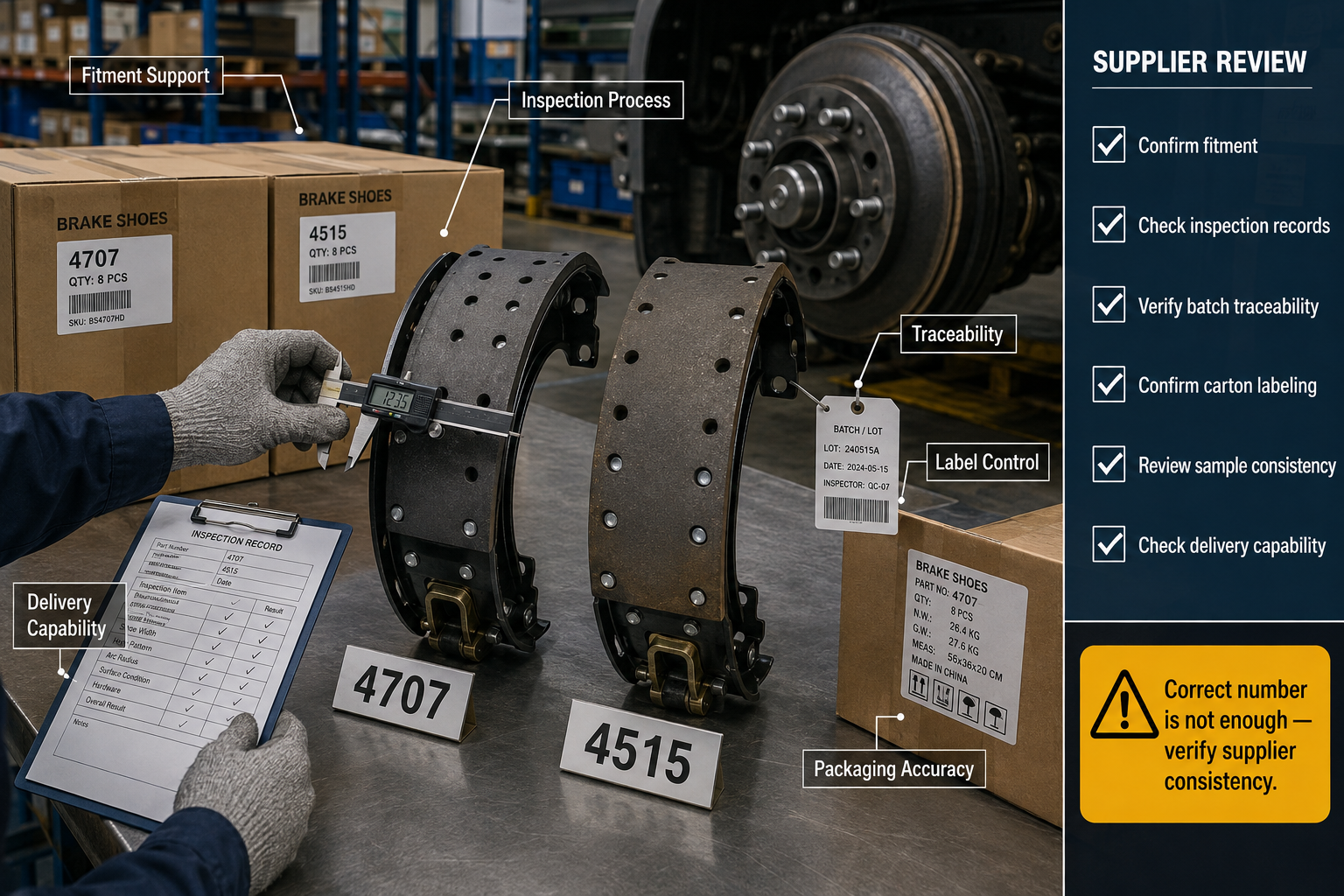
When sourcing 4707 and 4515 brake shoes, buyers should evaluate supplier fitment support, inspection process, documentation, traceability, packaging accuracy, delivery capability, and willingness to verify details before confirming substitute or bulk orders.
Fitment support comes before price
Price matters in the heavy-duty truck aftermarket. I work with distributors and wholesalers, so I know margins are real. However, the lowest price does not help if the shoe is wrong. A good supplier should help the buyer confirm the part before pushing a quote.
For brake shoe sourcing, I would evaluate a supplier on these points:
- Does the supplier ask for old part photos?
- Does the supplier confirm dimensions before quoting?
- Does the supplier understand the target market?
- Does the supplier separate similar SKUs clearly?
- Does the supplier provide consistent labeling?
- Does the supplier support sample or small-batch orders?
- Does the supplier keep records of confirmed matches?
At ROADSPOWER, our main focus is heavy-duty truck aftermarket parts for North and South America. In my daily work, that market focus helps because many inquiries involve similar truck platforms, repair habits, and distributor stocking decisions. I still do not treat a number alone as final proof. I prefer to confirm the old part, application, and catalog reference together.
Quality control documents buyers should verify
Certifications and compliance documents are useful, but buyers should verify them as part of procurement due diligence. For brake-related products, the buyer should ask for documents that match the product and destination market.
Important documents may include:
- ISO 9001 quality management certificate11
- Relevant DOT documentation, where applicable
- SAE or FMVSS-related compliance references, where applicable12
- Material inspection records
- Batch traceability records
- In-process inspection reports
- Final inspection records
- Packaging and labeling confirmation
I describe these as buyer-verification items, not automatic guarantees. A certificate is a document that should match the supplier, product category, validity period, and purchasing requirement.
Manufacturing and inspection questions
A buyer should ask practical questions before placing a recurring order. These questions reveal whether the supplier understands repeatability.
| Supplier question | What the answer should show |
|---|---|
| How do you control incoming materials? | Batch checks and documented inspection |
| How do you control process consistency? | SOPs, sampling, and archived records |
| How do you test performance? | Air tightness, tensile, pressure, or product-specific testing where relevant |
| How do you prevent mixed SKUs? | Label control, warehouse separation, final checks |
| Can you support sample-based customization? | Engineering and production flexibility |
| Can you handle mixed small-batch orders? | Practical support for distributors |
| Can you support FOB or DDP terms? | Export and logistics capability |
ROADSPOWER operates from a 6,000+ sqm facility in Ningbo, with 6 production lines and in-house control of core processes. Our business supplies pneumatic and mechanical parts such as air power lines, brass fittings, and related truck accessories. When brake shoe or brake-related inquiries come in, I approach them with the same supplier-side discipline: confirm fitment first, then discuss quantity, packaging, and delivery.
Packaging and labeling are part of quality
Many buyers focus on the part and forget the box. In wholesale distribution, packaging is not only appearance. It affects warehouse picking, counter sales, and customer confidence.
For similar brake shoe SKUs, packaging should include:
- Clear part number
- Customer SKU, if required
- Cross-reference note, if approved
- Quantity per carton
- Batch or lot information
- Country of origin, where required
- Handling labels for heavy parts
- Consistent barcode or sticker format
If 4707 and 4515 brake shoes are both stocked in the same warehouse, labeling discipline becomes even more important. A picking error can look like a fitment error, and the repair shop may blame the product before anyone checks the carton label.
How can distributors avoid inventory confusion with 4707 and 4515 brake shoes?
Inventory confusion often starts with a small shortcut. A sales team uses a cross-reference without notes. A warehouse stores similar cartons together. A purchasing manager adds a substitute SKU without sample confirmation. Later, nobody remembers which customer application was verified.
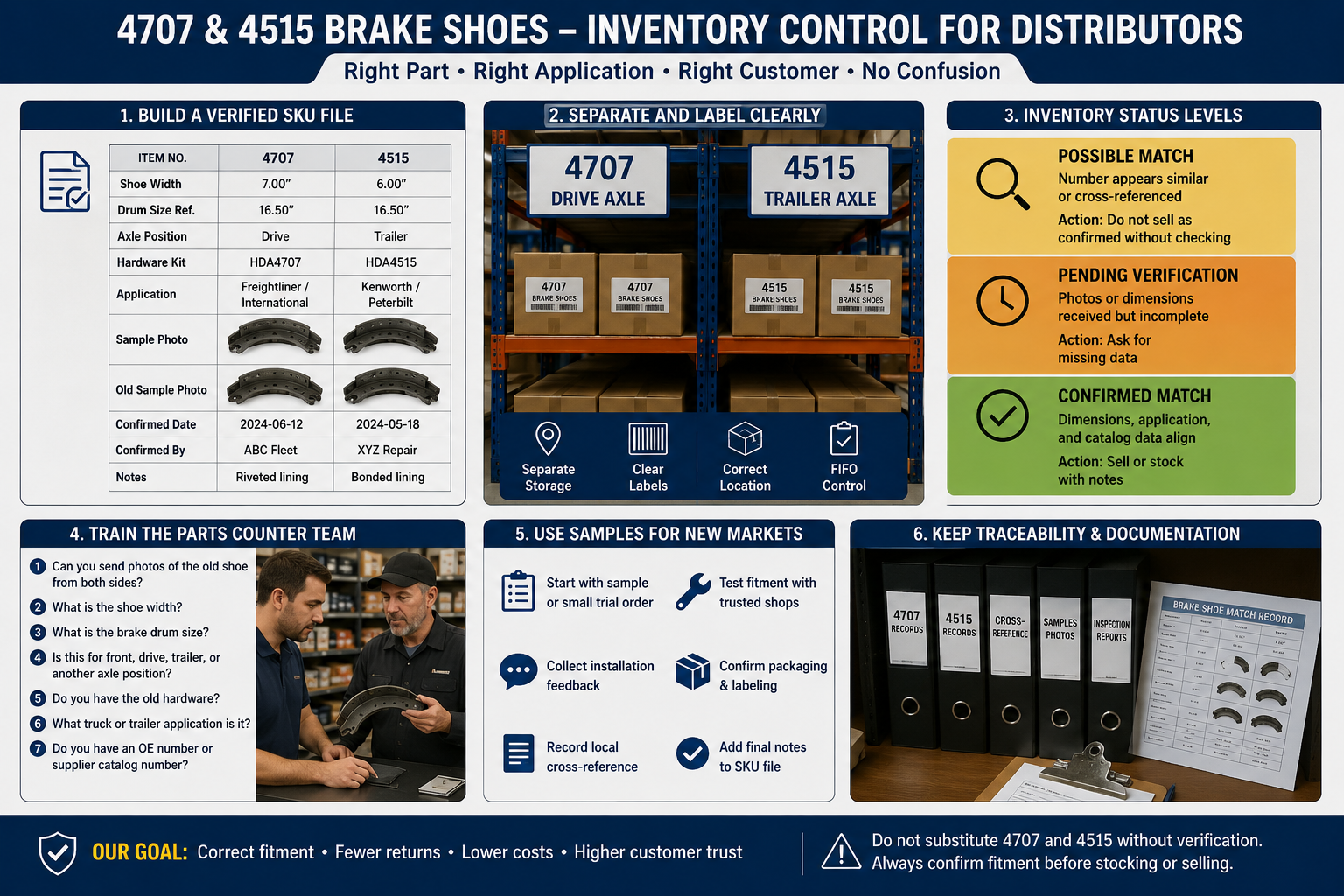
Distributors can avoid confusion with 4707 and 4515 brake shoes by creating verified SKU records, separating similar items, controlling cross-reference notes, training sales staff, using sample photos, and requiring fitment confirmation before substitution.
Build a verified SKU file
A strong distributor does not rely only on memory. I recommend building a digital SKU file for every brake shoe model. This file does not need expensive software at the beginning. A shared spreadsheet or product database can work if the team updates it consistently.
The file should include:
- Supplier item number
- Customer item number
- Known cross-reference numbers
- Photos of the product
- Photos of the old matched sample
- Shoe width
- Drum size reference
- Hardware kit notes
- Vehicle or axle application notes
- Packaging photos
- Inspection or approval date
- Buyer or customer who confirmed the match
- Warning notes for non-interchangeable items
This becomes very useful when staff change. It also helps when a customer asks for a repeat order six months later.
Separate “possible match” from “confirmed match”
This is one of the most important inventory rules. A possible match is not a confirmed match. A possible match means the number appears in a list or looks similar. A confirmed match means the buyer has enough evidence to support stocking or selling the part for that application.
I suggest using three internal status levels:
| Status | Meaning | Sales action |
|---|---|---|
| Possible match | Number appears similar or cross-referenced | Do not sell as confirmed without checking |
| Pending verification | Photos or dimensions received but incomplete | Ask for missing data |
| Confirmed match | Dimensions, application, and catalog data align | Sell or stock with notes |
This simple classification prevents a sales team from overpromising.
Train the parts counter team
A distributor’s sales team is often under pressure. Customers want quick answers. That pressure can lead to risky substitutions. Training should focus on simple questions that identify missing fitment data.
Parts counter staff can ask:
- “Can you send a photo of the old shoe from both sides?”
- “What is the shoe width?”
- “What is the brake drum size?”
- “Is this for front, drive, trailer, or another axle position?”
- “Do you have the old hardware?”
- “What truck or trailer application is it?”
- “Do you have an OE number or supplier catalog number?”
These questions are practical. They also show professionalism. A serious fleet or repair shop usually appreciates a supplier who prevents wrong installation.
Use samples for new markets
For South American and North American aftermarket distributors, local vehicle mix can vary a lot. Even when a part is common in one region, another region may use different axle specs, different hardware preferences, or different supplier cross-reference habits.
Before stocking a large quantity, I usually recommend:
- Start with a sample or small trial order
- Test fitment with trusted repair shop customers
- Collect installation feedback
- Confirm packaging and labeling requirements
- Record any local cross-reference numbers
- Add final notes to the SKU file
This method is slower than simply importing a full container, but it protects cash flow. It also helps the distributor build a smarter range.
Frequently Asked Questions
Can I replace 4707 brake shoes with 4515 brake shoes?
You should not replace 4707 brake shoes with 4515 brake shoes unless fitment is verified. Check the old shoe, drum size, shoe width, hardware, axle position, vehicle application, and trusted catalog data before treating them as interchangeable.
What information should I send to confirm the correct brake shoe?
You should send clear photos of both sides of the old shoe, all visible numbers, shoe width, drum size, hardware details, vehicle year and model, axle position, and any OE or cross-reference numbers. This helps the supplier confirm fitment with fewer assumptions.
Are brake shoe cross-reference lists always reliable?
Cross-reference lists are helpful, but they are not always enough. They may not show every lining option, hardware variation, regional application, or catalog difference. Buyers should verify physical dimensions and application details before ordering.
Why do two brake shoes look the same but have different part numbers?
Two brake shoes may look similar because the general shape is close, but they can differ in width, hole pattern, lining setup, hardware, or application. Small differences can affect fitment, installation, and product responsibility.
Should distributors stock both 4707 and 4515 brake shoes?
Distributors should stock both only after confirming market demand and fitment data. I recommend building verified SKU records, checking customer applications, reviewing supplier references, and starting with trial quantities before large inventory commitments.
Conclusion
The difference between 4707 and 4515 brake shoes is not just a number printed on a part. It is a fitment-verification decision that involves dimensions, drum size, shoe width, hardware, lining setup, axle position, and application data. I always recommend confirming the old part and supplier references before selling or stocking a substitute. If you want help checking the correct model, send us old brake shoe photos, current part numbers, drum size, shoe width, hardware details, vehicle information, and any OE or cross-reference numbers before ordering.
"Nev. Admin. Code § 484D.105 - Condition of brake system", https://www.law.cornell.edu/regulations/nevada/NAC-484D-105. Drum-brake design references describe the shoe, lining, drum, and return or anchor hardware as matched components, so changes in drum diameter, shoe width, lining construction, or hardware can affect assembly fit and braking contact. Evidence role: mechanism; source type: education. Supports: A brake-system textbook or university training source should explain that drum diameter, shoe width, lining, and hardware are matched to the brake assembly.. Scope note: The source would explain the mechanism generally rather than compare the specific 4707 and 4515 part numbers. ↩
"5.1.1 Brake Systems (Part 393 Subpart C) - CSA", https://csa.fmcsa.dot.gov/safetyplanner/MyFiles/SubSections.aspx?ch=22&sec=64&sub=130. Heavy-vehicle brake service guidance treats brake-shoe replacement as an application-specific task requiring confirmation of dimensions, drum compatibility, hardware, and lining characteristics rather than visual similarity alone. Evidence role: general_support; source type: institution. Supports: A neutral heavy-vehicle brake maintenance or standards source should support that brake shoe replacement is application-specific and cannot be confirmed by appearance or part number alone.. Scope note: This would support the general verification principle, not prove that every 4707 and 4515 brake shoe variant is non-interchangeable. ↩
"Theoretical and FEA Analysis of Brake Drum using ...", https://www.academia.edu/40286672/Theoretical_and_FEA_Analysis_of_Brake_Drum_using_Different_Materials. Technical descriptions of drum brakes explain that shoe radius, lining placement, anchor points, and return hardware determine shoe-to-drum contact and assembly alignment; mismatches can therefore impair seating or hardware installation. Evidence role: mechanism; source type: education. Supports: A neutral educational or technical source should support that incorrect shoe geometry or hardware can impair seating, lining contact, and assembly.. Scope note: This supports the stated failure modes in principle, not a documented incident involving these two part numbers. ↩
"5.1.1 Brake Systems (Part 393 Subpart C) - CSA", https://csa.fmcsa.dot.gov/safetyplanner/MyFiles/SubSections.aspx?ch=22&sec=64&sub=130. Commercial-vehicle brake regulations and inspection criteria evaluate brake components by condition, adjustment, and performance-related requirements, indicating that physical installation alone does not establish that a replacement component is correct. Evidence role: general_support; source type: government. Supports: A government inspection or regulation source should support that brake components must meet specified condition and performance requirements, not merely be installable.. Scope note: The source would provide regulatory context for brake correctness rather than a direct test of 4707-to-4515 interchangeability. ↩
"Catalog of brands - Catalog of brands - Parts-crossreference.com - Search ...", https://parts-crossreference.com/. Automotive aftermarket cataloging standards distinguish supplier part identifiers from application, attribute, and interchange data, reflecting that a number alone may not encode all market, lining, or package variations. Evidence role: historical_context; source type: institution. Supports: An aftermarket cataloging or data-standards source should support that part numbering and product attributes are managed across suppliers, applications, and data systems.. Scope note: This would support the broader catalog-data issue rather than document every numbering practice for brake shoes 4707 and 4515. ↩
"Agreement Addendum 89: Regulation No. 90", https://upcommons.upc.edu/bitstreams/6026220d-b103-49cb-92f3-759a250b4e17/download. Drum-brake references identify shoe width and shoe radius as fitment dimensions that must correspond to the brake drum and assembly geometry for proper contact and clearance. Evidence role: mechanism; source type: education. Supports: A brake-system educational source should support that brake shoe width and radius must correspond to the drum and brake assembly.. ↩
"Utah Admin. Code R714-162-11 - Brakes | State Regulations", https://www.law.cornell.edu/regulations/utah/Utah-Admin-Code-R714-162-11. Educational descriptions of drum-brake assemblies show that shoes interface with anchors, springs, rollers, and mounting points, so the shoe web pattern and attachment positions must correspond to the specific assembly. Evidence role: mechanism; source type: education. Supports: A neutral brake-system source should explain that the shoe web, anchor end, cam end, springs, and rollers are part of the drum-brake hardware interface.. Scope note: The source would support the mechanical relationship generally, not identify the exact hole patterns of 4707 and 4515 shoes. ↩
"Interpretation ID: 07-004380-3as", https://www.nhtsa.gov/interpretations/07-004380-3as. Brake-friction literature and friction-rating standards describe brake linings as material-specific components whose friction characteristics and attachment methods can vary by product design and service use. Evidence role: definition; source type: paper. Supports: A paper or standards reference should support that brake linings are classified by friction behavior and may use different materials and attachment methods.. Scope note: This supports the existence and relevance of lining variation, not the particular lining specifications of a named 4707 or 4515 product. ↩
"Class 8 Truck Tractor Braking Performance Improvement Study", https://www.nhtsa.gov/document/truck-tractor-braking-performance-improvement-study-0. Heavy-vehicle braking research relates brake energy and temperature to operating factors such as vehicle mass, grade, speed, and stop frequency, supporting the view that route and duty cycle affect brake-system demands. Evidence role: mechanism; source type: research. Supports: A transportation research or government source should support that grade, load, stop frequency, and operating cycle affect heavy-vehicle brake demand.. Scope note: The source would support duty-cycle effects generally rather than prescribe a specific lining choice for each fleet type. ↩
"Catalog of brands - Catalog of brands - Parts-crossreference ...", https://parts-crossreference.com/. Aftermarket cataloging guidance treats interchange or cross-reference information as one data element among application, attribute, and product-identification records, indicating that cross-references should be verified against fitment specifications. Evidence role: general_support; source type: institution. Supports: An aftermarket cataloging or maintenance source should support that cross-reference data must be checked against application and product attributes.. Scope note: This would support the cautious use of cross-references generally, not demonstrate a known error in a specific 4707 or 4515 list. ↩
"ISO 9001:2015 - Quality management systems — Requirements", https://www.iso.org/standard/62085.html. ISO describes ISO 9001 as a quality-management-system standard that sets requirements for consistent processes, customer focus, and continual improvement, making the certificate relevant to supplier due diligence. Evidence role: definition; source type: institution. Supports: An ISO source should support that ISO 9001 specifies requirements for a quality management system and is commonly used to demonstrate quality-management processes.. Scope note: ISO 9001 certification indicates a management system; it does not independently prove that a particular brake shoe batch is correctly specified or defect-free. ↩
"Federal Motor Vehicle Safety Standards No. 121; Air Brake ...", https://www.federalregister.gov/documents/2008/03/07/E8-4460/federal-motor-vehicle-safety-standards-no-121-air-brake-systems. Federal Motor Vehicle Safety Standard No. 121 sets performance and equipment requirements for air-brake systems on covered vehicles, providing regulatory context for requesting FMVSS-related documentation where applicable. Evidence role: definition; source type: government. Supports: A government standards source should support that FMVSS establishes brake-system requirements for applicable motor vehicles, while SAE references may define related technical classifications.. Scope note: FMVSS requirements apply by vehicle and component context; the citation would not mean every aftermarket brake shoe transaction requires the same documentation. ↩