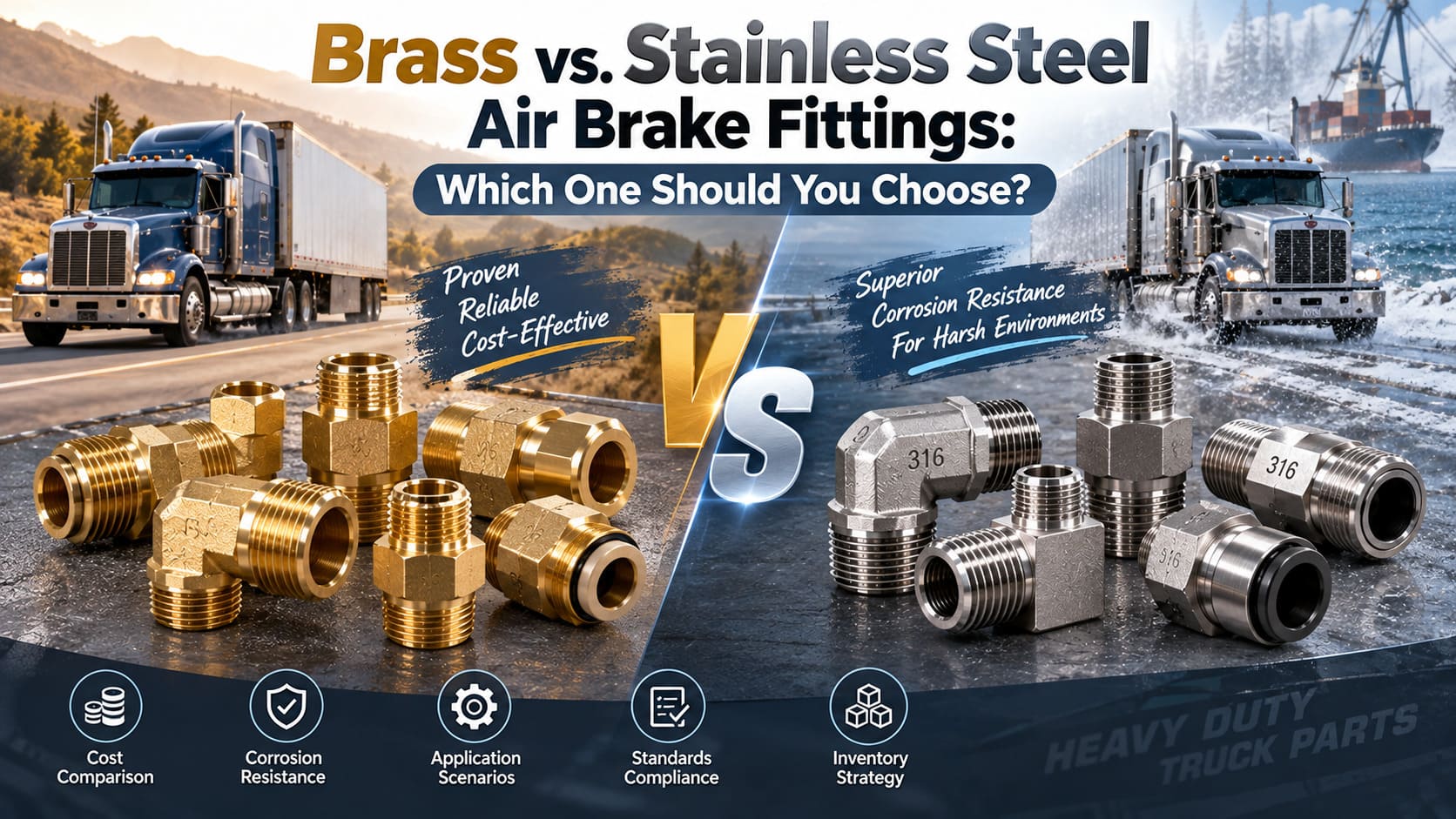
Choosing the wrong air brake fittings material is a procurement mistake that compounds quietly — wrong inventory builds up, installation complaints arrive, and returns erode margin before anyone names the root cause. Buyers evaluating brass vs. stainless steel air brake fittings often frame it as a quality question. It is actually a risk question.
The short answer: brass air brake fittings remain the practical default for most heavy-duty truck aftermarket applications in North and South America, because they align with established specifications, fleet familiarity, and stocking logic. Stainless steel is a targeted solution for high-corrosion environments or buyer-specified applications — not an automatic upgrade. The right choice depends on operating conditions, line compatibility, standards compliance, and total procurement risk, not material prestige.
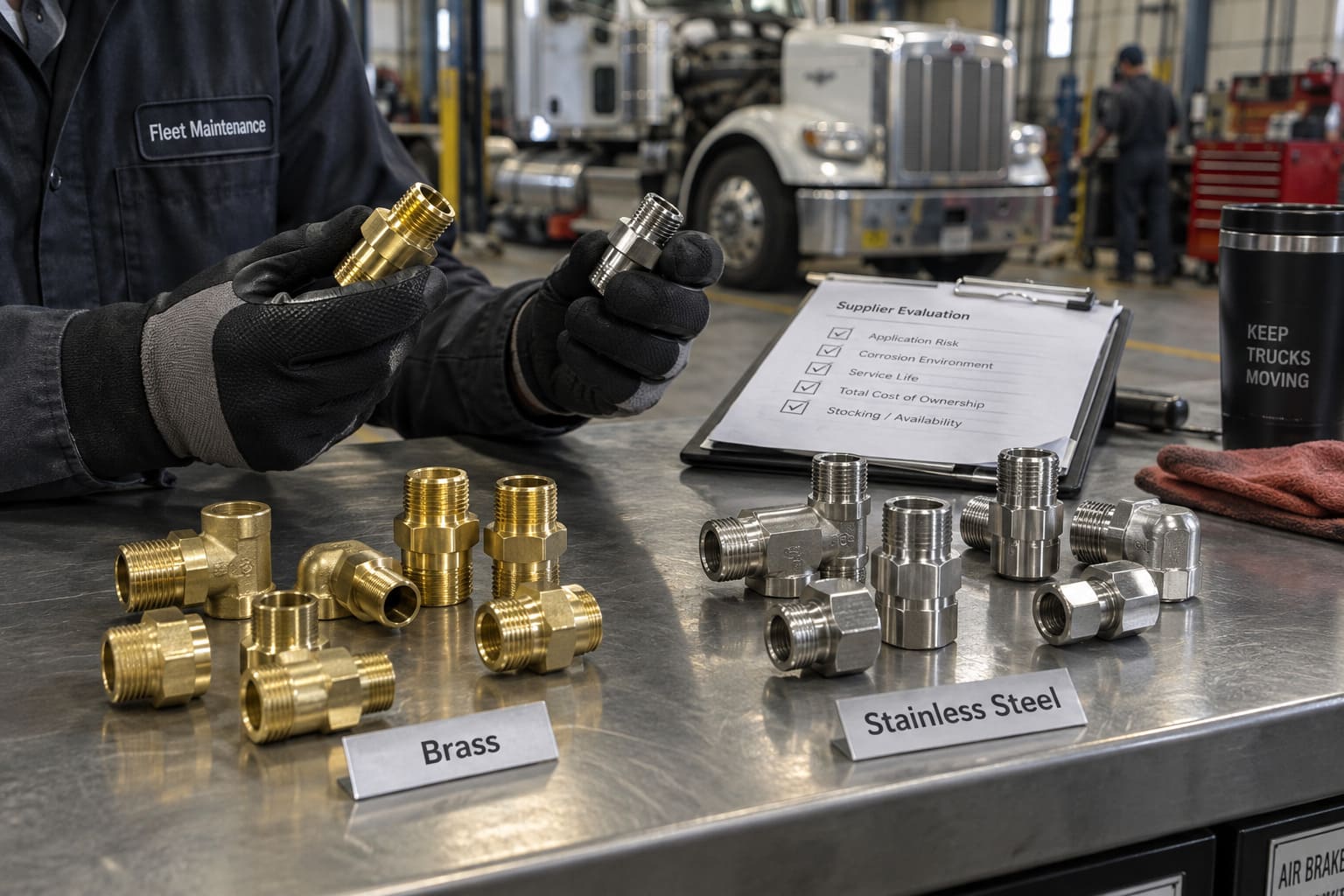
The material debate comes up regularly in procurement conversations — especially when buyers are sourcing for diverse fleet environments or trying to simplify their SKU range. Understanding what actually separates these two materials in real aftermarket use will help you stock smarter, reduce returns, and avoid a mismatch that looks invisible until it isn't.
Why Do Buyers Keep Asking About Brass vs. Stainless Steel Air Brake Fittings?
Many procurement managers inherit the question from a complaint — a fitting that corroded faster than expected, or a customer who returned an order citing "wrong spec." The comparison feels straightforward on the surface, but it carries real downstream consequences when you get it wrong.
The question keeps resurfacing because the two materials look similar, cost differently, and behave differently depending on environment. Buyers who select by price alone or by perceived quality alone frequently end up with inventory that doesn't move, or fittings that generate installation complaints. The decision needs a framework, not a guess.
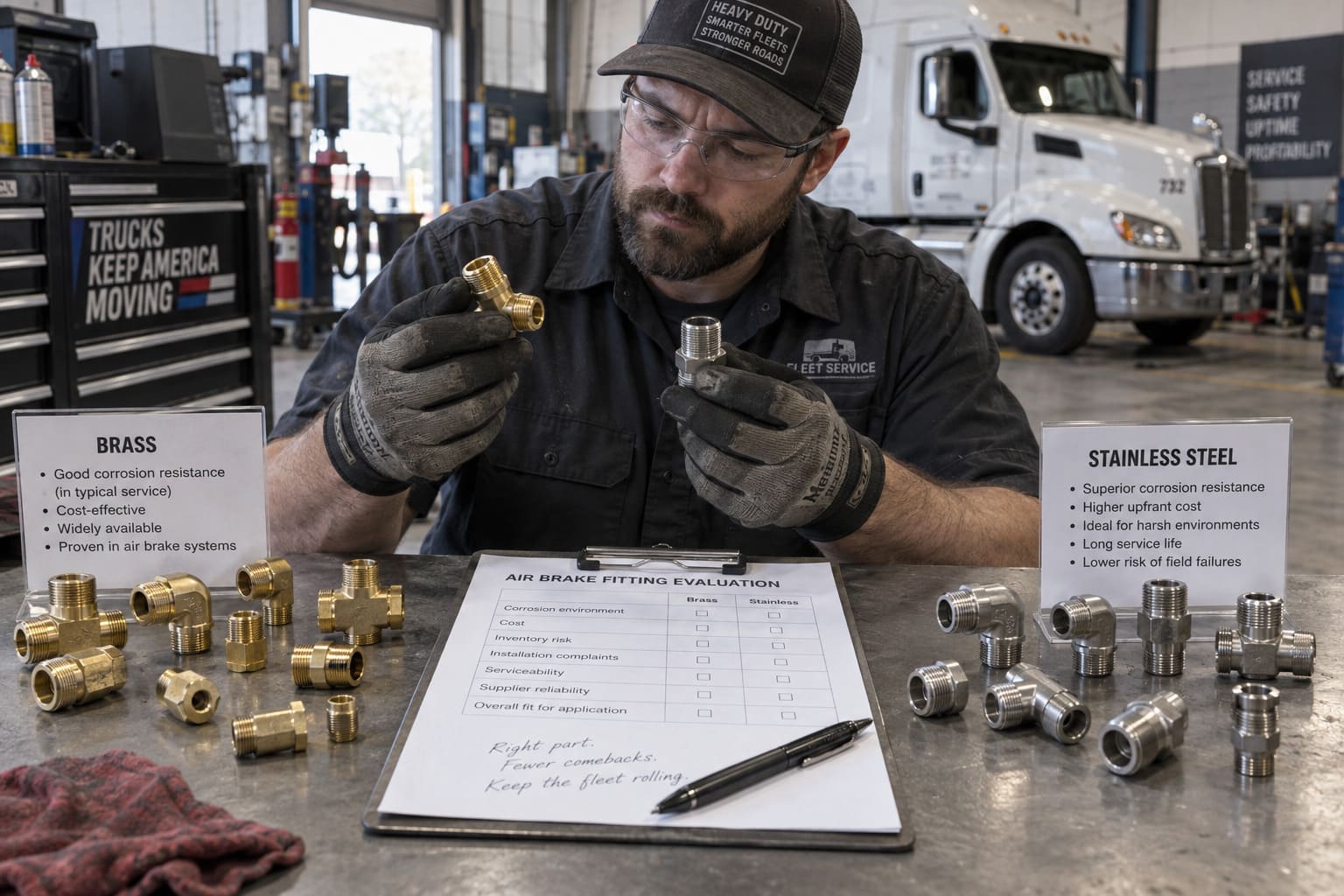
Material selection in the aftermarket isn't purely a technical decision. It has inventory, serviceability, and supplier reliability dimensions that matter just as much as corrosion resistance ratings. The sections below break this down by the specific factors that drive real procurement decisions.
What Makes Brass the Default Choice for Most Aftermarket Applications?
Walk into most heavy-duty parts distributors in North America, and brass air brake fittings dominate the shelves. There are practical reasons for that, and they go deeper than price.
Brass has been the standard material for air brake fittings in North American heavy-duty truck applications for decades.1 It machines well, seals reliably with nylon or polyurethane air lines, meets DOT and SAE specifications in verified formulations2, and is stocked and recognized across most distributor and fleet maintenance operations. For the majority of applications, brass offers a proven, serviceable fit.
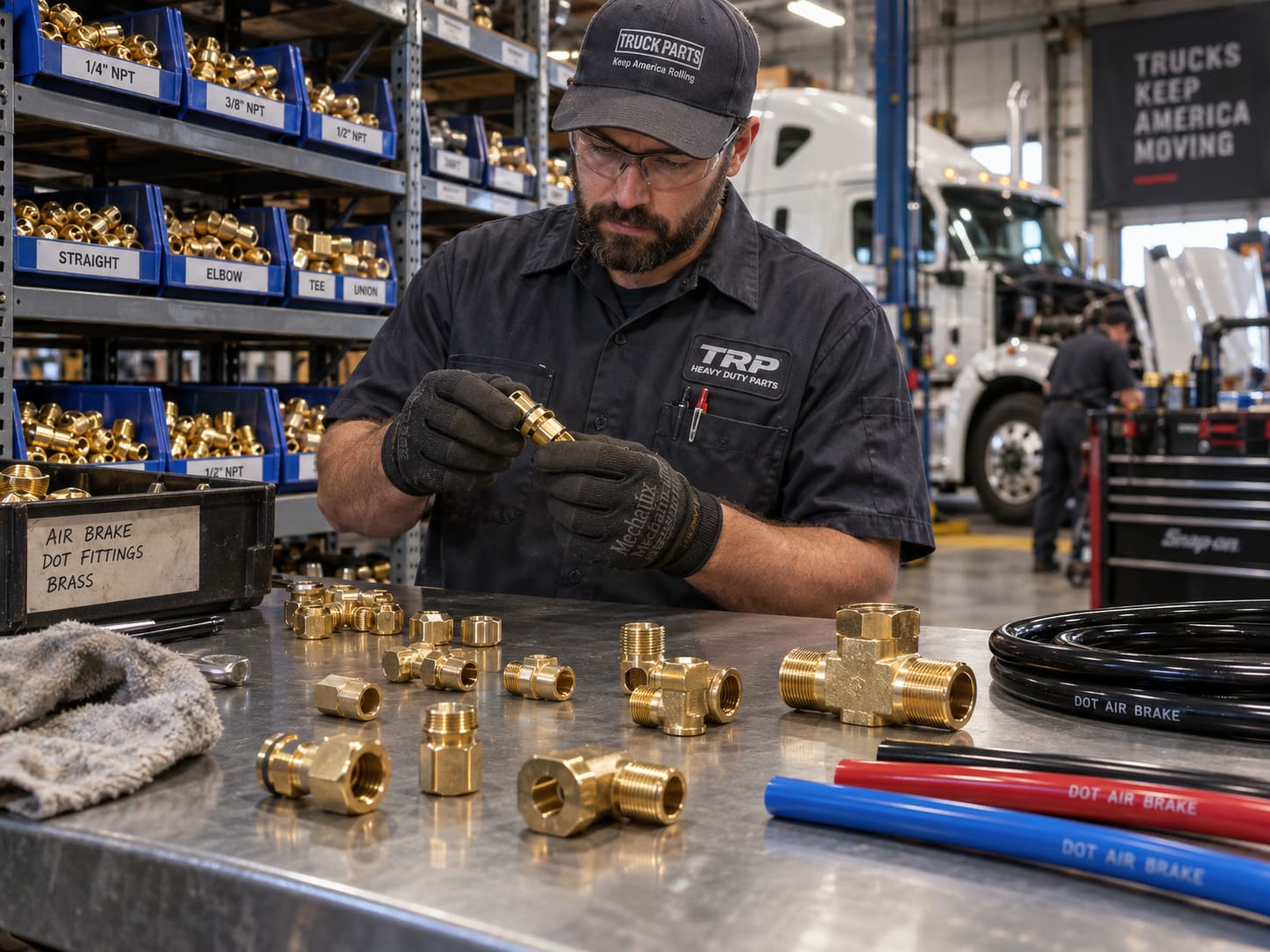
Why Brass Works in Aftermarket Stocking
The aftermarket supply chain runs on predictability. Brass fittings contribute to that in several concrete ways:
- Specification alignment. Most OEM air brake system designs in the North American market — across Freightliner, Kenworth, Peterbilt, International, Volvo, and Mack platforms — were developed with brass fittings as the baseline. Aftermarket replacements need to fit those specifications, not introduce variables.
- Installation familiarity. Technicians and shop mechanics are experienced with brass. They know torque feel, thread engagement, and how brass behaves when seating against air line tubing. Switching materials without a clear reason can introduce installation errors — over-tightening, improper seating, or mismatched ferrule compression.
- Sealing compatibility. Brass fittings are well-matched to standard DOT-rated nylon and polyurethane air lines.3 The compression mechanics, ferrule behavior, and thread sealing patterns are established. Introducing stainless steel without confirming compatibility with the specific line material is a risk that buyers sometimes overlook.
- Sourcing and stocking simplicity. Brass is widely available from multiple verified sources. Lead times are predictable. MOQ flexibility is generally better. For distributors stocking hundreds of SKUs, this reduces procurement friction.
- Cost structure. Brass is consistently less expensive than stainless steel for equivalent fitting configurations.4 For applications where the corrosion resistance premium of stainless steel does not translate into a real operating benefit, the cost difference does not justify the swap.
Where Brass Has Limitations
Being the practical default does not mean brass is suitable everywhere. In highly corrosive environments — coastal operations, chemical transport, persistent road salt exposure, high-humidity tropical climates — brass can oxidize and corrode faster than expected.5 This is not a product defect; it is a material property operating outside its intended range. When buyers in those environments request brass because it is familiar and cheaper, they sometimes generate the exact complaint cycle they were trying to avoid.
The right response is not to dismiss brass, but to identify the operating environment accurately before specifying the material.
When Does Stainless Steel Become the Right Choice for Air Brake Fittings?
Stainless steel carries a perception premium. It sounds more industrial, more durable, and more corrosion-resistant. Those associations are not wrong — but they do not automatically justify a specification change or a stocking strategy built around stainless.
Stainless steel air brake fittings make sense when the operating environment genuinely demands superior corrosion resistance: coastal fleets, heavy road-salt exposure regions, chemical or agricultural transport, or South American markets with high-humidity or tropical operating conditions. They also make sense when a buyer or fleet explicitly specifies them as a standard. Outside those conditions, the cost and stocking complexity rarely returns a net benefit.
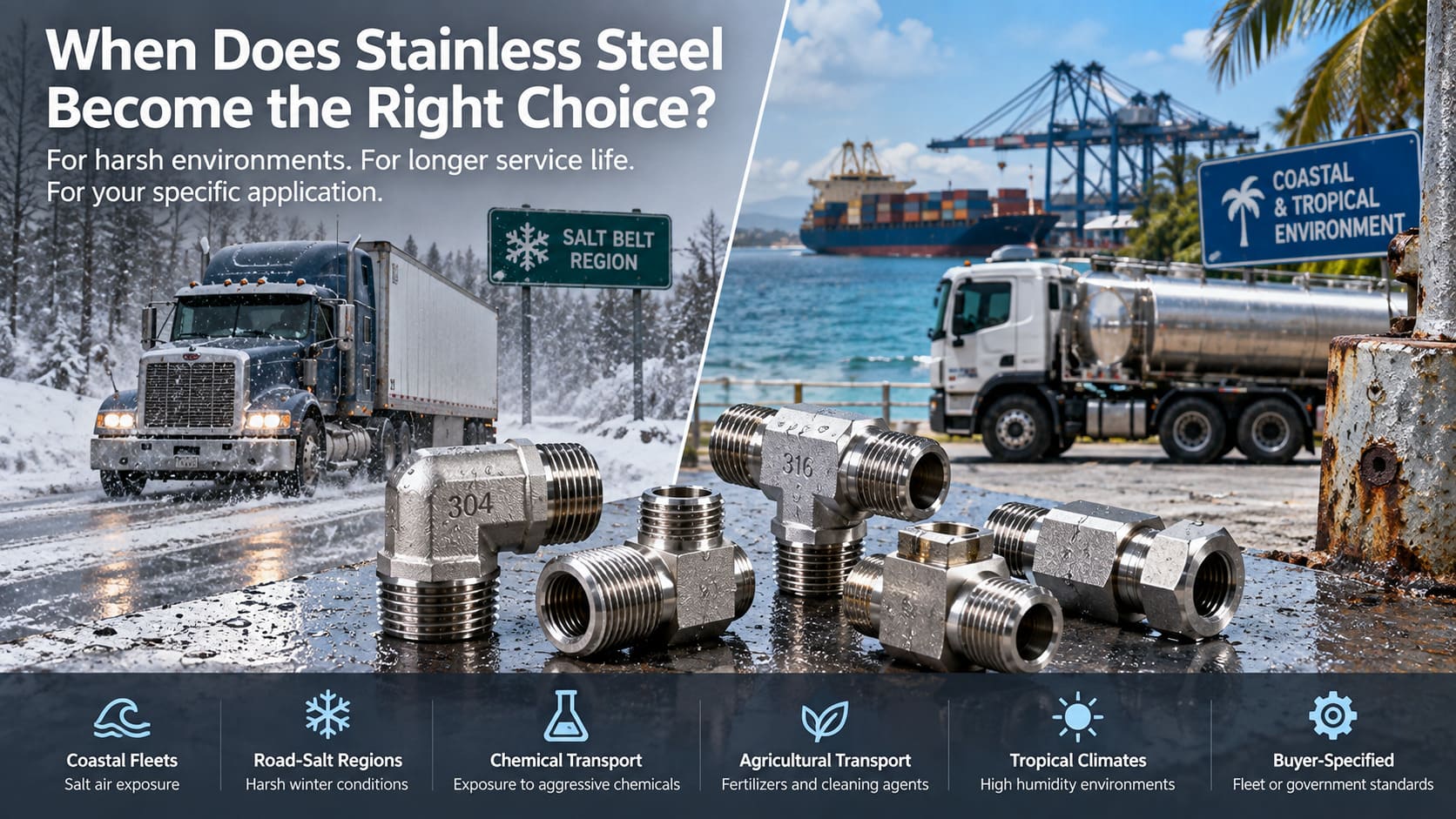
Where Stainless Steel Earns Its Place
Stainless steel fittings are a targeted solution. Here are the situations where specifying them is a defensible decision:
1. High-corrosion operating environments Fleets operating near coastlines, in salt-belt regions (heavily relevant to the U.S. Northeast and Midwest in winter), or in persistently humid tropical climates — common in parts of Brazil, Colombia, and other South American markets — face corrosion conditions that can accelerate brass degradation. Stainless steel's chromium oxide passive layer resists those conditions more reliably.6
2. Chemically aggressive exposure Agricultural transport, tanker fleets, and chemical carriers may expose undercarriage fittings to fertilizers, solvents, or cleaning agents.7 In those cases, the material premium of stainless steel may reduce replacement frequency enough to justify the higher unit cost.
3. Buyer-specified standards Some fleet operators, large transport companies, or government procurement programs specify stainless steel explicitly as part of their maintenance standards. In those scenarios, the procurement question is not which material is better — it is whether the supplier can meet the specification reliably and consistently.
4. Extended service interval designs In applications where fitting access is difficult or where maintenance intervals are long, the longer service life potential of stainless steel under corrosive conditions can reduce total lifecycle cost8. This is worth modeling — not assumed.
What Stainless Steel Does Not Solve
| Factor | Brass | Stainless Steel |
|---|---|---|
| Unit cost | Lower | Higher |
| Machinability | Excellent | More complex; tighter tolerancing required |
| OEM specification alignment (North America) | Strong | Varies — verify before specifying |
| Sealing compatibility with standard DOT air lines | Well-established | Confirm with specific line materials |
| Aftermarket availability | Wide | More limited; longer lead times in some markets |
| Technician familiarity | High | Lower; installation errors more likely if not trained |
| Corrosion resistance in harsh environments | Adequate to moderate | Superior |
| Stocking simplicity for mixed-SKU distributors | High | More complex |
Stainless steel does not improve air flow, pressure capacity, or mechanical performance in ways that matter to standard air brake operation.9 If a buyer is upgrading to stainless because it "seems better," that is a perception-driven decision, not an application-driven one. The result is often slower-moving inventory, higher per-unit carrying cost, and no measurable reduction in field complaints for the majority of their customer base.
How Does Material Choice Affect B2B Procurement Risk?
The wrong fitting material doesn't always cause a visible failure. More often, it creates quiet friction — slower inventory turns, a pattern of returns that's hard to trace, or customers who quietly switch suppliers without explaining why.
Material mismatch in air brake fittings creates downstream procurement risk that shows up as returns, installation complaints, slow-moving SKUs, and inventory imbalance. Even when the individual fitting is a certified, high-quality product, putting the wrong material into the wrong stocking context costs more than the unit price difference suggests.
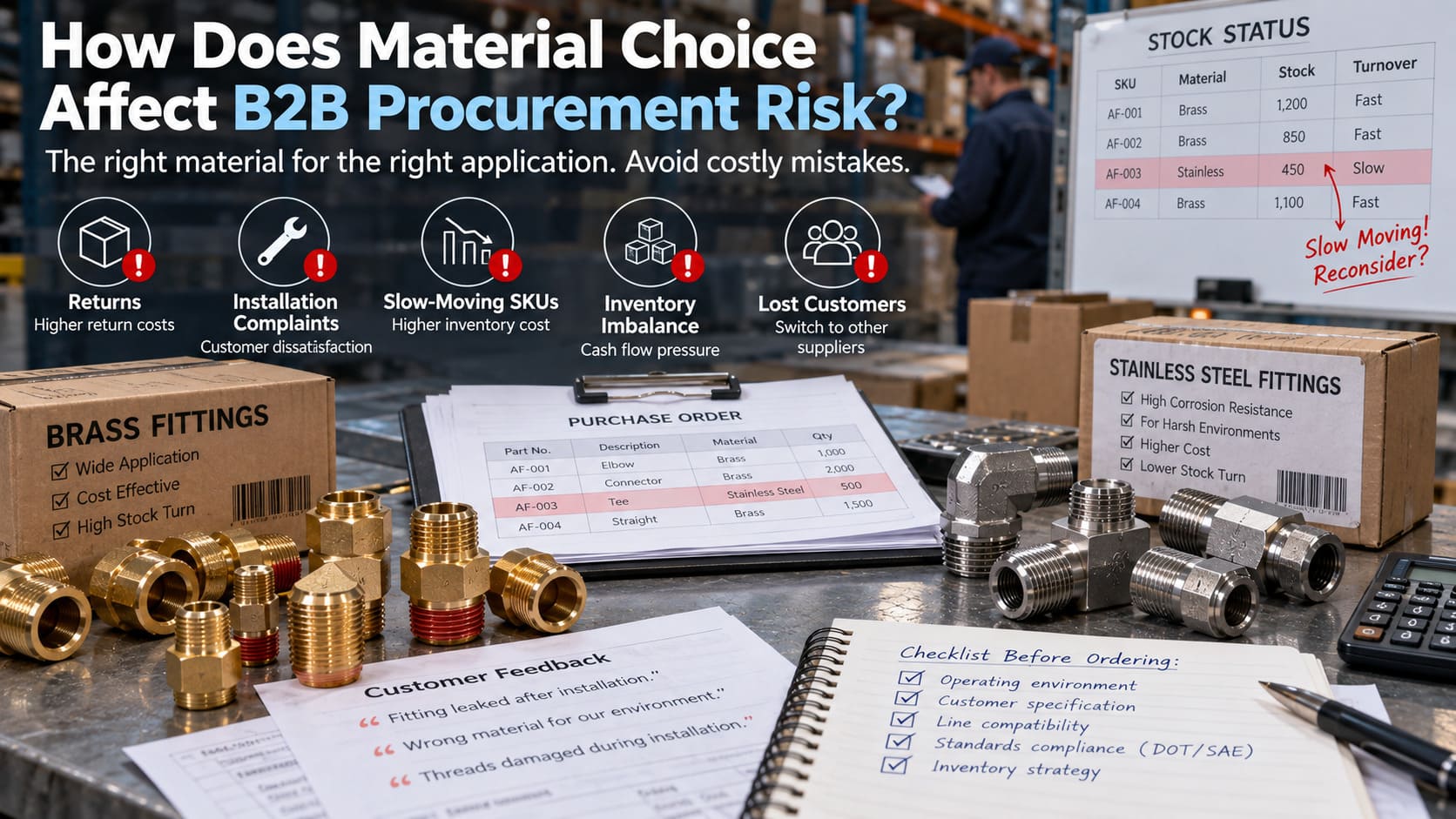
How Mismatch Compounds in Practice
From conversations with distributors and fleet parts managers, I consistently see three failure patterns when material selection isn't tied to application:
Pattern 1: The "upgrade" that doesn't move A buyer switches to stainless steel for a general stock line, expecting customers to appreciate the quality. Most customers order by part number or application fit, not material. The stainless SKUs sit while the brass equivalents are backordered. The buyer is now carrying higher-cost inventory with worse turns.
Pattern 2: The corrosion complaint from a mismatched spec A distributor in a coastal South American market stocks standard brass because it's available and priced well. A fleet customer using those fittings in high-humidity, salt-air conditions starts generating replacement and complaint patterns faster than expected. The fittings technically met spec — but not the operating environment. The supplier takes the blame.
Pattern 3: Installation complaints from unfamiliar material A shop switches to stainless fittings without notifying technicians. Stainless behaves differently under torque — it can gall on threads if not handled correctly, and it requires more attention to lubrication and torque limits during installation.10 A technician accustomed to brass over-torques a stainless fitting or misreads the seating feedback. A seal failure follows. The fitting gets returned as "defective."
What Buyers Should Evaluate Before Specifying
- Operating environment. Where do these fittings actually live? Coastal? Salt-belt? Tropical humidity? Dry inland? The answer changes the corrosion risk profile significantly.
- Fleet or customer specification. Does the end buyer have a documented standard? If so, follow it. If not, understand their maintenance environment.
- Line compatibility. Confirm that the fitting material, ferrule type, and compression geometry are compatible with the specific air line tubing in use.
- Standards compliance. Verify that fittings — in either material — carry appropriate certifications for the target market. In the U.S. market, DOT compliance is a baseline, not a bonus.11 Buyers should request documentation and verify it, not accept compliance claims at face value.
- Inventory strategy. Consider what portion of your SKU range needs this material. Stainless is a justified specialty stock position, not a default substitute for brass across the board.
Frequently Asked Questions
Are stainless steel air brake fittings DOT-compliant for U.S. heavy-duty trucks?
Compliance depends on the specific fitting, application, and how the product has been tested and certified — not simply on the material.12 Stainless steel fittings can be DOT-compliant, but buyers should request and verify documentation for each product. Material alone does not guarantee regulatory acceptance.
Can I mix brass and stainless steel fittings in the same air brake system?
In practice, many systems do run mixed materials, but buyers should verify compatibility — particularly around ferrule type, compression behavior, and sealing performance at the connection point. Consult the fitting manufacturer's installation guidance and, where applicable, a qualified technician before mixing materials in safety-critical applications.
Why do brass fittings sometimes corrode faster than expected?
Brass corrosion rate depends heavily on operating environment, alloy composition, and protective coatings. In high-humidity, coastal, or chemically aggressive environments, standard brass fittings may degrade faster than the application demands. If your fleet is seeing accelerated corrosion, evaluate the environment before assuming a product quality issue — material selection may be the root cause.
Is stainless steel always more expensive than brass for air brake fittings?
At the unit level, stainless steel is consistently more expensive than brass for equivalent fittings. However, total cost depends on replacement frequency, maintenance labor, and inventory efficiency. In highly corrosive environments, stainless steel may offer a better total lifecycle cost. In standard environments, brass typically wins on total cost.
What should I ask a supplier when evaluating air brake fittings in either material?
Ask for certification documentation (DOT, SAE, or equivalent), raw material traceability, quality inspection records, test reports covering pressure and air tightness, and application references in your target market. Evaluate the supplier's production capabilities and quality process — not just the product spec sheet.
Conclusion
The brass vs. stainless steel air brake fittings question doesn't have a universal answer — it has a context-dependent one. Brass remains the practical default for most North and South American heavy-duty truck aftermarket applications: it aligns with established specifications, supports reliable installation, and keeps your stocking strategy manageable. Stainless steel is a justified, targeted choice when operating conditions genuinely demand it — high-corrosion environments, chemical exposure, or explicit buyer specifications.
The risk isn't choosing the "wrong" material on paper. The risk is choosing a material without evaluating the operating environment, line compatibility, standards documentation, and inventory impact. Get those factors right, and the material decision becomes straightforward.
If you're sourcing air brake fittings for North or South American markets and want to evaluate the right specification for your stocking needs, contact the ROADSPOWER team — we're here to help you match product to application, not just fill a purchase order.
"49 CFR 571.106 -- Standard No. 106; Brake hoses.", https://www.ecfr.gov/current/title-49/subtitle-B/chapter-V/part-571/subpart-B/section-571.106. SAE and related North American vehicle standards have long included brass-type air-brake fitting configurations, supporting the characterization of brass as a conventional material in heavy-duty truck air-brake service. Evidence role: historical_context; source type: institution. Supports: A standards or technical history source should show that brass air-brake fitting designs have been common in North American heavy-duty vehicle air systems for many years.. Scope note: This would support industry convention, not prove that every OEM platform used brass as its exclusive baseline. ↩
"49 CFR 571.106 -- Standard No. 106; Brake hoses.", https://www.ecfr.gov/current/title-49/subtitle-B/chapter-V/part-571/subpart-B/section-571.106. Federal Motor Vehicle Safety Standard No. 106 sets performance requirements for brake hoses, brake hose assemblies, and end fittings, supporting the point that air-brake fitting compliance depends on verified design and testing rather than material description alone. Evidence role: general_support; source type: government. Supports: The source should document that brake hose fittings and assemblies are regulated by performance requirements and that compliance depends on tested product characteristics.. Scope note: FMVSS 106 does not itself establish brass as preferable; it supports the need for verified compliance. ↩
"49 CFR 571.106 -- Standard No. 106; Brake hoses.", https://www.ecfr.gov/current/title-49/subtitle-B/chapter-V/part-571/subpart-B/section-571.106. SAE standards for nonmetallic air-brake tubing and related fittings define performance and connection requirements for nylon air-brake lines, providing technical context for the use of brass fittings with standard DOT-rated tubing. Evidence role: mechanism; source type: institution. Supports: A standards source should support that nylon air-brake tubing is used with specified fitting systems and that brass fitting designs are among accepted configurations.. Scope note: The source would support compatibility in approved designs; it would not validate every brass fitting with every tubing formulation. ↩
"MINERAL COMMODITY SUMMARIES 2025", https://pubs.usgs.gov/periodicals/mcs2025/mcs2025.pdf. Government commodity and producer-price data show that stainless steel cost is influenced by alloying elements such as nickel and chromium and is generally higher than brass inputs, supporting the article’s cost comparison for comparable fittings. Evidence role: statistic; source type: government. Supports: A government commodity or producer-price source should show the relative cost drivers for brass and stainless steel materials.. Scope note: Commodity data support the material-cost direction but do not prove the exact price of every finished fitting configuration. ↩
"Marine Atmospheric Corrosion of Carbon Steel: A Review - PMC", https://pmc.ncbi.nlm.nih.gov/articles/PMC5506973/. Corrosion research on copper-zinc alloys shows that chloride-rich and humid environments can accelerate brass corrosion and dezincification, supporting the article’s warning about brass fittings in coastal, road-salt, and chemically aggressive service. Evidence role: mechanism; source type: paper. Supports: A corrosion study should explain how chloride-rich, humid, or chemically aggressive environments accelerate corrosion or dezincification of brass.. Scope note: The evidence is material-level corrosion evidence and may not measure a specific air-brake fitting design. ↩
"Stainless steel", https://en.wikipedia.org/wiki/Stainless_steel. Technical descriptions of stainless steel identify a chromium-rich passive oxide film as the principal mechanism of its corrosion resistance, supporting the claim that stainless fittings can be more resistant in corrosive environments. Evidence role: mechanism; source type: encyclopedia. Supports: The source should explain that stainless steel corrosion resistance is primarily due to formation of a chromium-rich passive oxide film.. Scope note: This supports the general mechanism; actual performance still depends on stainless grade, chloride concentration, temperature, and maintenance conditions. ↩
"How to reduce corrosion on a fertilizer transport truck", https://www.facebook.com/groups/truckinginternational/posts/2921883887971672/. Research on corrosion in agricultural and chemical-transport environments documents exposure to fertilizers, cleaning agents, and chemical residues, supporting the article’s identification of these fleets as higher-corrosion use cases. Evidence role: general_support; source type: research. Supports: The source should document that vehicles and equipment in agricultural or chemical transport can be exposed to corrosive fertilizers, cleaners, or chemical residues.. Scope note: The source may describe vehicle or equipment corrosion generally rather than air-brake fittings specifically. ↩
"Life Cycle Cost Analysis, Sustainability, and the Circular ...", https://www.atlantis-press.com/article/126020483.pdf. Lifecycle-cost studies of corrosion-resistant materials show that higher initial material costs can be offset by reduced maintenance and replacement in corrosive service, providing context for the potential lifecycle-cost advantage of stainless steel fittings. Evidence role: general_support; source type: paper. Supports: A lifecycle-cost or corrosion-engineering source should show that corrosion-resistant materials can reduce replacement and maintenance costs in harsh environments.. Scope note: This is contextual lifecycle-cost evidence and does not calculate savings for a specific air-brake fitting SKU or fleet. ↩
"49 CFR 571.106 -- Standard No. 106; Brake hoses.", https://www.ecfr.gov/current/title-49/subtitle-B/chapter-V/part-571/subpart-B/section-571.106. FMVSS No. 106 specifies performance tests for brake hoses, assemblies, and fittings, supporting the article’s point that pressure and leakage performance must be demonstrated by compliant design rather than assumed from stainless steel material alone. Evidence role: general_support; source type: government. Supports: The source should show that regulated brake-hose and fitting performance is measured by pressure, leakage, and assembly tests rather than by material prestige.. Scope note: The regulation supports the performance-testing framework but does not directly compare brass and stainless flow characteristics. ↩
"N93-10590", https://ntrs.nasa.gov/api/citations/19930001402/downloads/19930001402.pdf. Engineering guidance on stainless steel threaded components identifies galling as an adhesive-wear risk and notes that lubrication and controlled tightening can reduce thread damage, supporting the installation caution for stainless fittings. Evidence role: mechanism; source type: government. Supports: The source should explain galling in stainless steel threaded parts and the role of lubrication or torque control in reducing it.. Scope note: The evidence applies to stainless threaded components generally and may not be specific to air-brake fittings. ↩
"49 CFR 571.106 -- Standard No. 106; Brake hoses.", https://www.ecfr.gov/current/title-49/subtitle-B/chapter-V/part-571/subpart-B/section-571.106. 49 C.F.R. § 571.106 establishes federal performance requirements for brake hoses, brake hose assemblies, and brake hose end fittings, supporting the statement that DOT compliance is a baseline requirement in the U.S. market. Evidence role: definition; source type: government. Supports: The source should establish that brake hoses, brake hose assemblies, and fittings are subject to federal safety requirements in the United States.. ↩
"49 CFR 571.106 -- Standard No. 106; Brake hoses.", https://www.ecfr.gov/current/title-49/subtitle-B/chapter-V/part-571/subpart-B/section-571.106. FMVSS No. 106 defines performance requirements and test conditions for brake hoses, assemblies, and end fittings, supporting the statement that compliance turns on the tested product and application rather than material alone. Evidence role: general_support; source type: government. Supports: The source should show that compliance is based on meeting defined performance requirements for the product or assembly rather than on material identity alone.. ↩