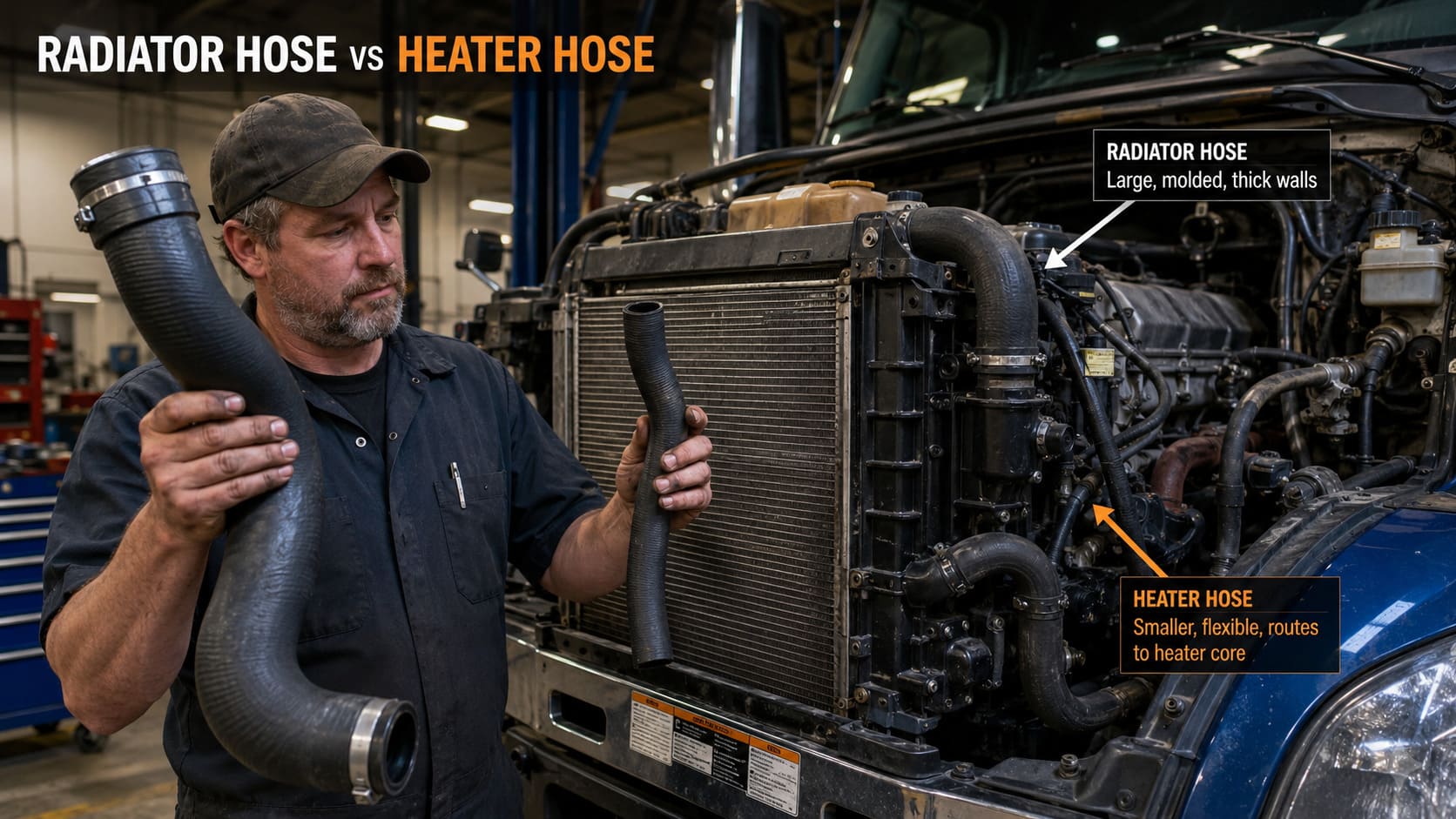
If you've ever ordered coolant hoses for a heavy-duty truck and ended up with the wrong part, you already know this problem. Radiator hose and heater hose sound like two simple categories — until a wrong shipment lands at a repair shop and creates a delay. Understanding the real differences protects your procurement decisions, your inventory, and your customers.
A radiator hose connects the engine to the radiator as part of the main cooling loop, while a heater hose routes coolant to and from the heater core or cab heating system.1 The two serve different positions in the cooling circuit, operate under potentially different temperature and pressure conditions, and are typically built to different dimensional and material specifications.2 Swapping them based on diameter alone is a common and costly mistake in heavy-duty truck aftermarket purchasing.
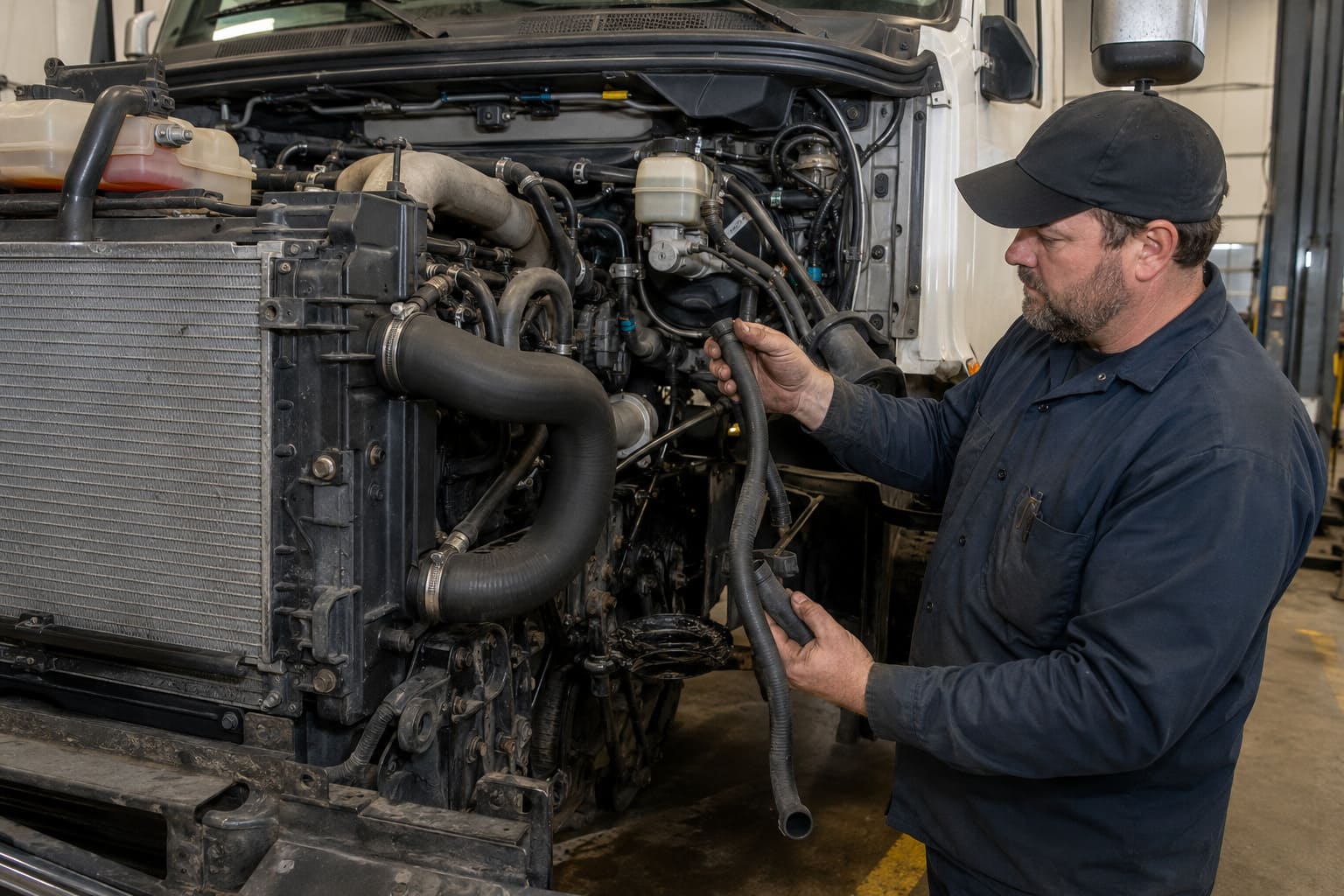
Those two definitions are the starting point, not the finish line. The real selection risk for distributors, repair shops, and fleet buyers goes much deeper — it involves hose geometry, material specification, operating conditions, and vehicle fitment. Let's break each factor down.
Where Does Each Hose Actually Connect?
Many buyers assume the names tell the whole story. They don't.
In aftermarket parts inquiries, we often see buyers focus on one number — usually the inner diameter — and assume the rest will work out. That assumption causes more return requests and fitment complaints than almost any other single factor in coolant hose orders.
The application position determines far more than the name does. A radiator hose typically connects the engine block or water pump outlet to the radiator inlet and outlet, carrying coolant through the main high-volume heat exchange circuit.3 A heater hose branches off that main circuit to direct a smaller coolant flow through the heater core inside the cab, then returns it to the engine or coolant reservoir.4

Understanding where each hose sits in the system is the first filter in any procurement decision — before you even look at dimensions.
The Main Cooling Loop vs. The Branch Circuit
Think of the cooling system as a tree. The trunk is the main coolant circuit: large-volume, high-flow passages connecting the engine and radiator. The branches are smaller circuits — including the heater circuit — that tap off that main flow.
Radiator hoses are the trunk. On heavy-duty trucks like Freightliner Cascadia, Kenworth T680, or Peterbilt 389, the upper and lower radiator hoses are large-diameter, high-volume components that carry the full engine coolant flow. They need to handle:
- High coolant flow rates
- Direct proximity to the engine block and radiator tanks
- Significant vibration and flex from the powertrain
- Elevated temperatures at the engine-side connection
Heater hoses are the branches. They carry a fraction of the total coolant volume, routed to the HVAC heater core or cab heating unit. On many North American Class 8 trucks, the heater hose circuit may also include additional connections to sleeper cab heating systems, auxiliary heaters, or DEF heating lines depending on the truck configuration.5
Why Position Creates Procurement Risk
Here is where things get practical for B2B buyers.
A distributor stocking hoses for a Freightliner Cascadia may be managing dozens of SKUs across multiple model years. If the naming in your inventory system says "coolant hose — 1.5 inch ID" without specifying application position, a technician at a repair shop can pull the wrong part, attempt installation, and discover the connection doesn't fit — or worse, it fits loosely and creates a future leak point.
I've seen inquiry sheets come through where the buyer lists an inner diameter and a rough length, then asks for a price. That information alone is not enough to confirm fitment for a specific application. The position in the circuit, the truck model, and the hose geometry all have to match.
Do Radiator Hoses and Heater Hoses Have Different Physical Specifications?
Buyers often ask: if both hoses carry coolant, why can't I use one in place of the other if the diameter matches?
The assumption that matching inner diameter equals interchangeability is one of the most common ordering errors we see in heavy-duty aftermarket procurement. Diameter is one dimension. Hoses have several.
Radiator hoses and heater hoses typically differ in inner diameter, wall thickness, overall length, and molded bend geometry.6 Radiator hoses on Class 8 trucks are generally larger in diameter and built to specific pre-formed shapes matching the routing space in the engine compartment. Heater hoses are usually smaller in diameter and may be straight or lightly formed. These differences make them non-interchangeable even when diameter appears similar.
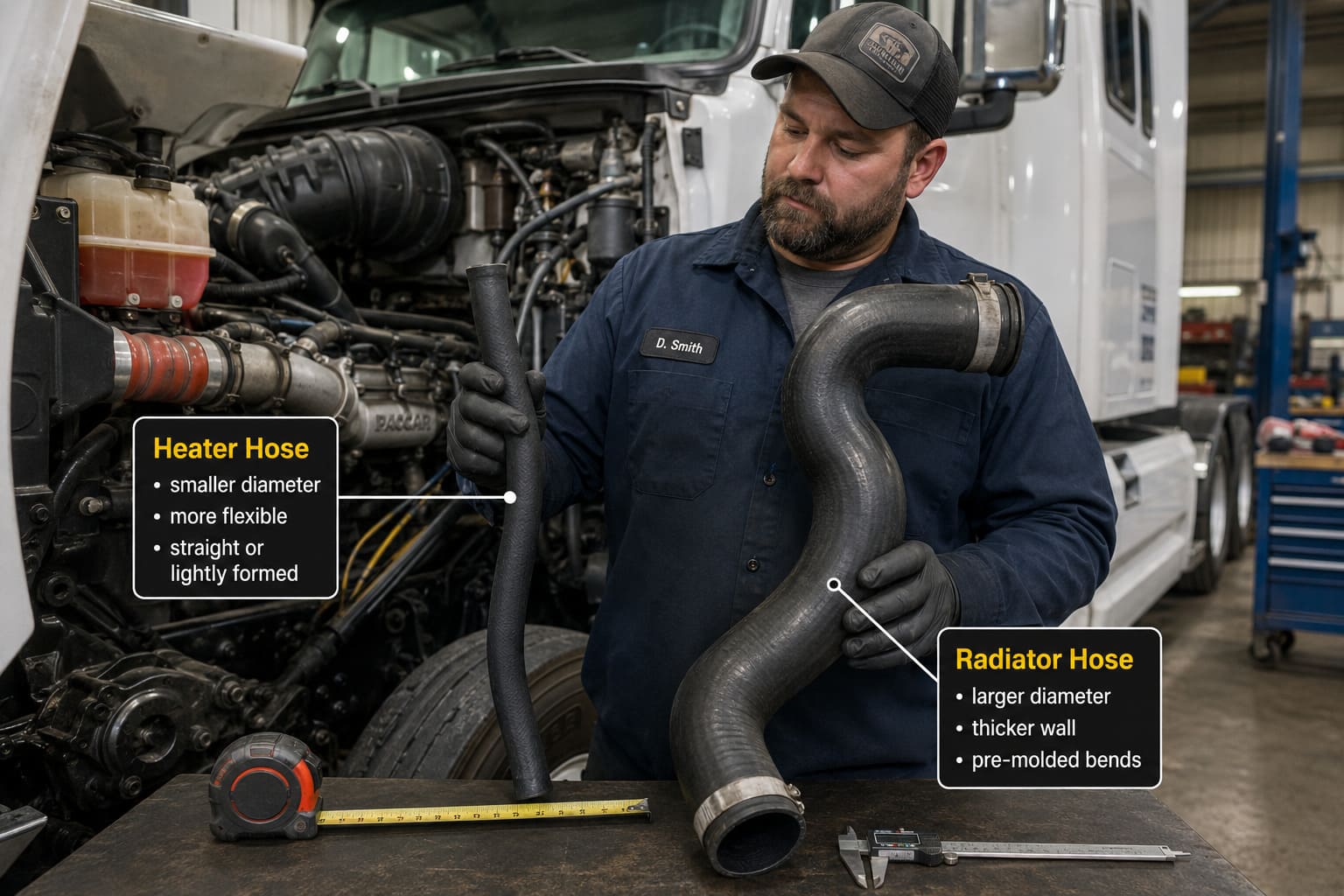
A Practical Look at the Key Physical Differences
| Specification | Radiator Hose (Typical Heavy-Duty) | Heater Hose (Typical Heavy-Duty) |
|---|---|---|
| [Inner diameter | 1.5 in – 2.5 in (38–64 mm) | 0.625 in – 1.0 in (16–25 mm)](https://www.amazon.com/Silicone-Reinforced-Temperature-Pressure-Transmission/dp/B0B8K1VY16)%%%FOOTNOTE_REF_7%%% |
| Form shape | Pre-molded, application-specific bends | Often straight or lightly curved |
| Wall thickness | Heavier, multi-layer construction | Thinner, moderate wall |
| Length | Shorter, fixed routing paths | Variable; sometimes supplied in bulk lengths |
| End connections | Fixed molded ends to match radiator/engine ports | Hose barb or clamp-over connections |
| Reinforcement | Heavy reinforcement layer for pressure and vibration | Standard reinforcement |
These are typical ranges, not universal rules. Actual specifications vary by truck platform, engine generation, and OEM design. Always confirm against the vehicle application before quoting or stocking.
Why Hose Shape Matters as Much as Diameter
On heavy-duty trucks, the engine compartment is tightly packaged. A Kenworth T680 or International LT Series doesn't have the same routing geometry as a Peterbilt 579. Radiator hoses are often pre-formed with specific bend angles so they route cleanly without kinking, contacting other components, or creating stress on the connection ports.8
If you substitute a straight hose where a molded hose belongs, you create tension at the end fittings. Under vibration from a running diesel engine, that tension accelerates wear at the connection points.9 This is a fitment failure that may not show up immediately — but it will show up.
Heater hoses, being smaller and often more flexible, tolerate some routing variation more readily. But they still have application-specific requirements, particularly where they connect to metal pipes or the heater core inlet and outlet ports.
Do Radiator Hoses and Heater Hoses Operate Under Different Conditions?
This is where the interchangeability myth causes the most risk. Both hoses carry coolant, so buyers sometimes conclude they operate under identical conditions.
The conditions vary depending on circuit position and truck design. Using a hose built for one set of conditions in a position with different demands — even if it fits physically — introduces a reliability risk that may not become obvious until a hose fails in service.
Radiator hoses and heater hoses can operate under different temperature and pressure conditions depending on their position in the cooling circuit and the specific truck application.10 Material specification, reinforcement, and wall construction should match the operating demands at the installation point — not just the coolant temperature range.
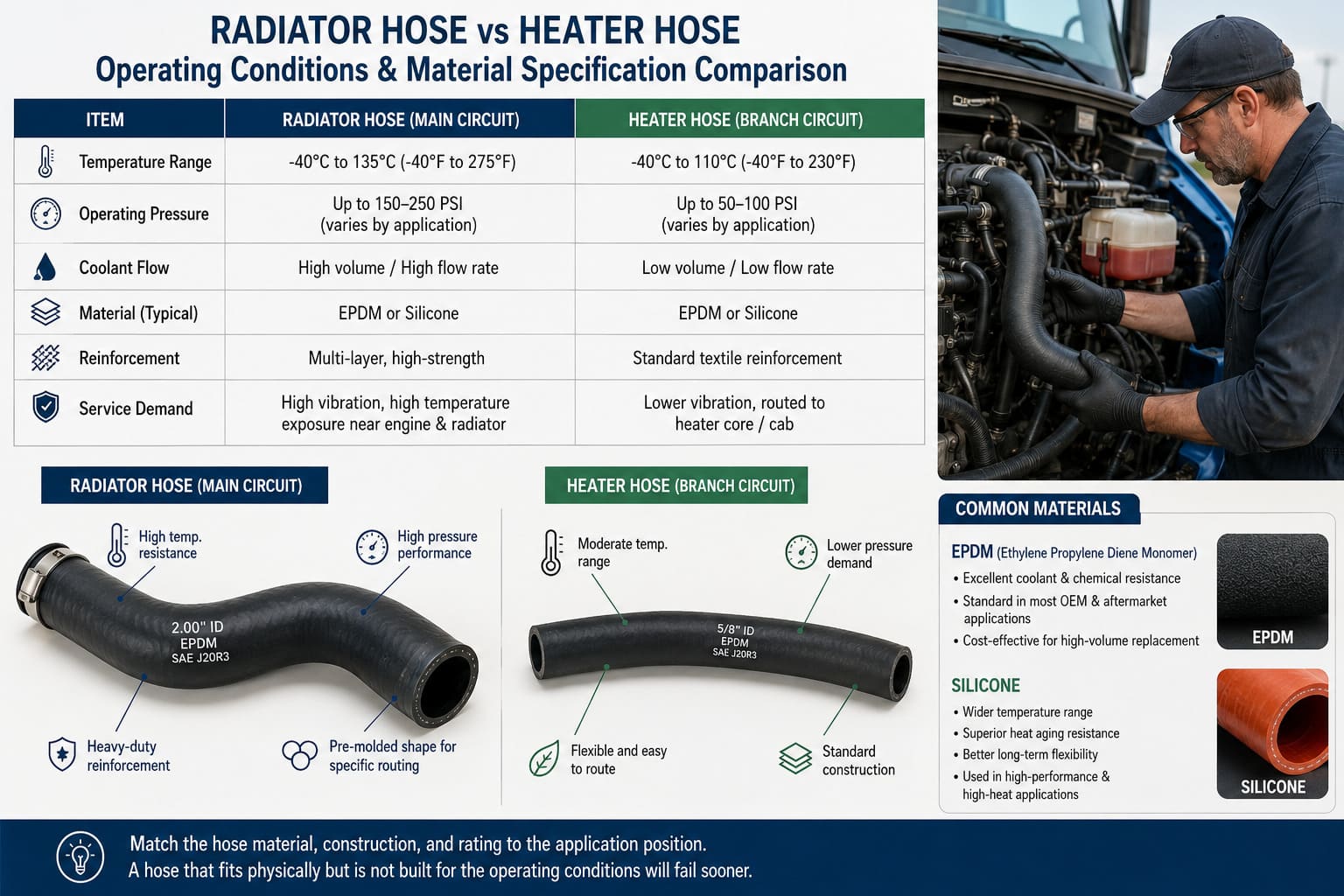
Material Specification for Heavy-Duty Applications
The two most common base materials used in heavy-duty truck coolant hoses are EPDM (Ethylene Propylene Diene Monomer) and silicone.11
EPDM is the standard material in most OEM and aftermarket heavy-duty coolant hoses.12 It offers:
- Good resistance to coolant chemistry (ethylene glycol, additive packages)
- Adequate temperature and pressure performance for most standard cooling applications
- Cost efficiency for high-volume replacement parts
Silicone hoses offer extended temperature range, better long-term flexibility retention, and superior heat aging resistance. They are increasingly used in high-performance aftermarket applications and in positions with extreme heat exposure, such as turbocharged engine layouts on modern Class 8 trucks.
Neither material is universally "better." The right material depends on the application position, the operating temperature range, the coolant type in use, and the customer's service interval expectations.
What This Means for Aftermarket Procurement
When a distributor or repair shop is sourcing coolant hoses for a specific truck model, material specification matters — not just shape and size. A hose that physically fits but is built to a lower material grade than the application demands will have a shorter service life. That creates warranty claims, repeat orders (not the good kind), and technician complaints.
At ROADSPOWER, we verify material specification against application position when processing OEM reference-based orders. Buyers who provide only a physical description — diameter and length — may receive a technically correct hose that still doesn't perform correctly in the application.
How Should You Confirm Which Hose You Actually Need?
This is the practical question that every distributor, repair shop owner, and fleet buyer eventually asks. And the answer is more specific than most buyers expect.
Matching by name or diameter alone is consistently the source of ordering errors. The right procurement process for coolant hoses requires more than two data points.
To correctly identify and order a radiator hose or heater hose for a heavy-duty truck, confirm the following: truck make and model, model year, engine make and displacement, OEM or cross-reference part number, inner diameter, overall length, hose form shape (straight or molded), end connection types, and material specification. A sample or technical drawing eliminates ambiguity for custom or cross-reference orders.
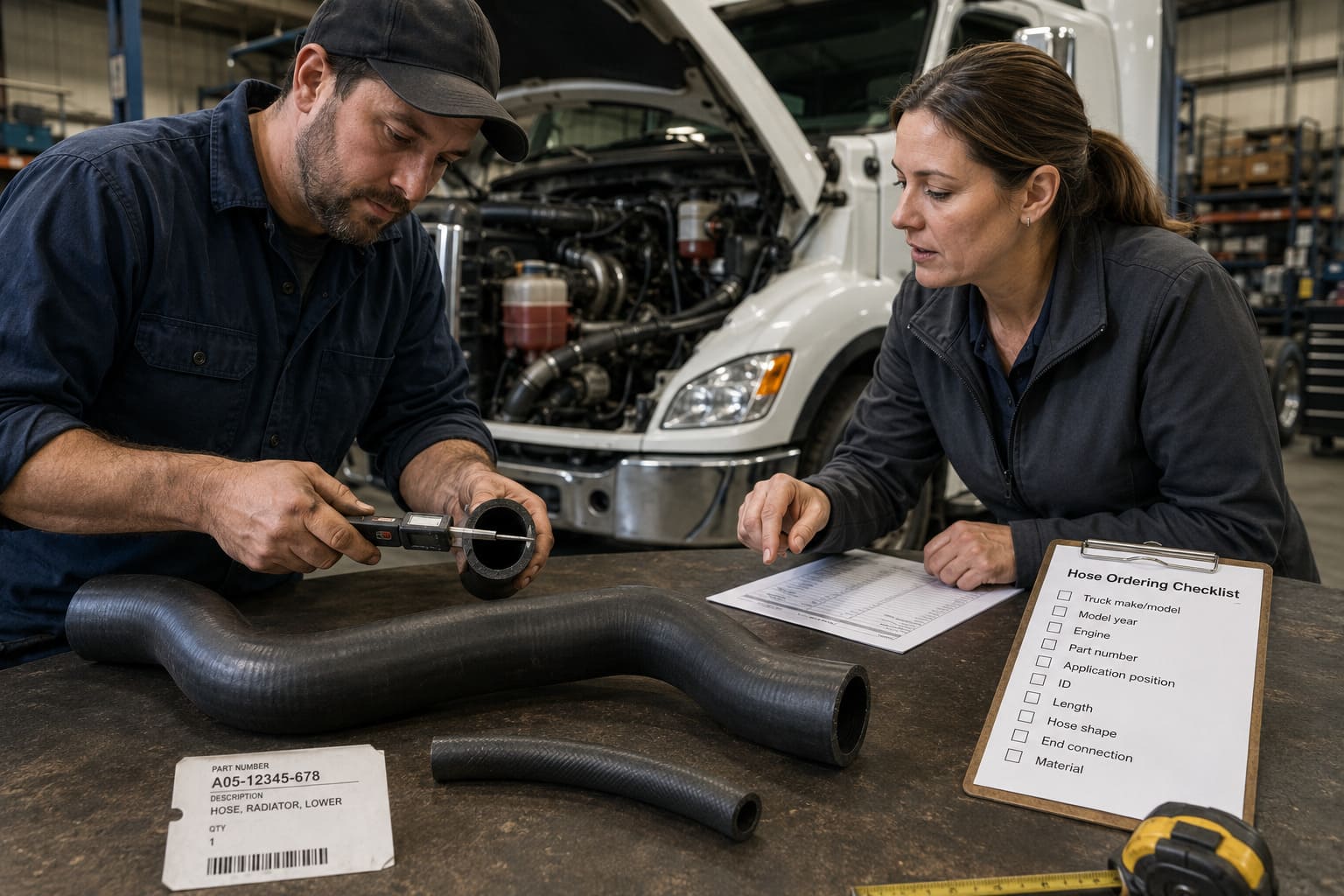
The Procurement Checklist
Before placing a coolant hose order — whether for a single repair or a stocking order of 500 sets — work through this list:
- Truck make and model — Freightliner, Kenworth, Peterbilt, International, Volvo, Mack, etc.
- Model year and cab configuration — Hose routing can change between model years on the same platform
- Engine make, model, and displacement — A Cummins X15 and a Detroit DD15 in otherwise similar trucks may use different hose routing
- Application position — Upper radiator, lower radiator, heater supply, heater return, coolant reservoir connection, or other
- OEM part number or cross-reference number — The most reliable starting point for accurate matching
- Inner diameter (ID) — Measured in millimeters or inches at both ends if the hose is stepped
- Overall length — Center-to-center or overall, depending on your supplier's measurement convention
- Hose form — Straight, pre-molded, flexible, or corrugated
- End connections — Clamp-over, push-on, quick-connect, or flanged
- Material requirement — EPDM standard or silicone upgrade
- Quantity and packaging — For distributor stocking orders, confirm bulk packaging and labeling requirements
For Custom and Cross-Reference Orders
If you are sourcing a hose that does not have a clean OEM number reference — common in South American markets or for older North American truck platforms — provide a physical sample or a dimensioned drawing. This is the most efficient way to avoid a wrong-fit shipment. At ROADSPOWER, custom orders processed with a sample or drawing have significantly fewer revision cycles than those processed from verbal descriptions alone.
Frequently Asked Questions
Can I use a heater hose in place of a radiator hose if the diameter is close?
Generally, no. Even if inner diameter is similar, radiator hoses and heater hoses differ in form shape, wall construction, end connection geometry, and often material specification. A substitution based on diameter alone carries a significant risk of fitment failure or premature hose wear in service.
What diameter are heater hoses on heavy-duty trucks?
Heater hoses on Class 8 trucks typically range from 5/8 inch (16 mm) to 1 inch (25 mm) inner diameter, depending on the application and truck model. This is noticeably smaller than the upper and lower radiator hoses on the same vehicle, which commonly range from 1.5 to 2.5 inches ID.
Why do some suppliers list "coolant hose" without specifying radiator or heater?
"Coolant hose" is sometimes used as a generic category label in distributor catalogs, particularly for bulk straight hose sold by the foot or meter. When ordering for a specific application position, always clarify whether the part is intended for main cooling circuit (radiator) use or heater circuit use, and confirm fitment against the vehicle application.
How do I know if a molded radiator hose is the correct bend shape for my truck?
The safest method is to match against the OEM part number for the truck model and year. If you are cross-referencing to an aftermarket part, compare the bend geometry using a physical sample or technical drawing. A hose with the correct diameter but wrong bend angle will not route cleanly and will put stress on connection fittings.
Do radiator hoses and heater hoses require different clamp specifications?
Yes, in most cases. Larger-diameter radiator hoses typically require appropriately sized heavy-duty hose clamps — often T-bolt or gear-driven styles for Class 8 truck applications. Smaller heater hoses use lighter clamps sized to the smaller diameter. Always match the clamp specification to the hose outer diameter and application pressure.
Conclusion
The difference between a radiator hose and a heater hose starts with application position — one belongs in the main cooling circuit, one serves the heater circuit — but it doesn't stop there. For heavy-duty truck aftermarket buyers, the real selection risk lies in geometry, material specification, operating conditions, and vehicle fitment. Matching by name or diameter alone leads to installation errors, shop rework, and inventory confusion.
When sourcing coolant hoses for Class 8 trucks, work from a confirmed OEM or cross-reference number, verify the full set of application variables, and provide a sample or drawing whenever the fitment is uncertain. ROADSPOWER supplies pre-formed and straight coolant hoses across North American and South American truck platforms. Contact us with your truck model, application position, and part reference to get an accurate quote and specification confirmation.
"Radiator (engine cooling)", https://en.wikipedia.org/wiki/Radiator_(engine_cooling). A general automotive cooling-system reference distinguishes the radiator coolant circuit from the heater-core circuit, identifying radiator hoses with engine-radiator coolant flow and heater hoses with coolant flow through the vehicle heater core. Evidence role: definition; source type: encyclopedia. Supports: The source should define radiator hoses as part of the engine-radiator coolant circuit and heater hoses as hoses carrying coolant to and from the heater core.. ↩
"SAE J20 Rubber Hose - Superior Performance for Coolant Systems", https://hannarubbercompany.com/wp-content/uploads/sites/22/2025/01/SAE-J20-Rubber-Hose-.pdf. Coolant-hose standards classify engine-cooling hoses by construction, dimensions, material, and performance properties, supporting the distinction between hose selection by application and selection by diameter alone. Evidence role: general_support; source type: institution. Supports: The source should show that coolant hoses are specified by service type, dimensions, construction, material, and performance requirements rather than by diameter alone.. Scope note: A hose standard would support the specification framework, but it may not directly compare every radiator-hose and heater-hose design used on Class 8 trucks. ↩
"Internal combustion engine cooling", https://en.wikipedia.org/wiki/Internal_combustion_engine_cooling. Educational materials on engine cooling systems describe coolant circulation from the engine through the radiator and back by way of the water pump and radiator hoses, establishing the radiator hose as part of the main heat-exchange loop. Evidence role: mechanism; source type: education. Supports: The source should explain that the water pump circulates coolant between the engine and radiator through radiator hoses as part of the main heat-rejection loop.. ↩
"Does coolant flow direction matter for the 2.5 heater core?", https://www.facebook.com/groups/791970574172653/posts/7838195042883469/. Automotive HVAC references describe the heater core as a small heat exchanger supplied by hot engine coolant through heater hoses, with coolant returned to the engine cooling circuit after heat transfer to the cabin air. Evidence role: mechanism; source type: education. Supports: The source should explain that a vehicle heater core receives hot engine coolant through heater hoses and returns coolant to the engine cooling system.. ↩
"All You Need to Know About Truck Parking Heaters", https://www.heatso.com/all-you-need-to-know-about-truck-parking-heaters. Government technical material on heavy-duty diesel emissions systems notes that DEF tanks and lines may require heating to prevent freezing, providing context for additional coolant-related routing on trucks equipped with such systems. Evidence role: general_support; source type: government. Supports: The source should support that heavy-duty diesel vehicles may use heated DEF components and additional cab-heating or auxiliary-heating circuits that affect coolant-hose routing.. Scope note: This would support the plausibility of DEF-heating connections but may not directly prove their prevalence across all North American Class 8 truck configurations. ↩
"sae-j20-specification-guide.pdf", https://spareco.com.au/wp-content/uploads/2021/12/sae-j20-specification-guide.pdf. Coolant-hose specifications and service references identify hose size, wall construction, reinforcement, length, and molded form as relevant selection characteristics, supporting the statement that radiator and heater hoses differ across more than inner diameter. Evidence role: general_support; source type: institution. Supports: The source should show that coolant hoses are specified by dimensions, wall construction, reinforcement, and molded shape or form.. Scope note: Such sources usually establish specification categories and examples; they may not document every individual heavy-truck platform. ↩
"KDP 5/8"X5T(ID:16MM) 1.5 M Silicone Heater Hose Coolant Radiator ...", https://www.amazon.com/Silicone-Reinforced-Temperature-Pressure-Transmission/dp/B0B8K1VY16. Technical hose specifications and application data list heater-hose inside diameters commonly in the 5/8-to-1-inch range and larger radiator-hose diameters commonly around 1.5 inches and above, consistent with the ranges summarized here. Evidence role: statistic; source type: institution. Supports: The source should substantiate the stated typical inner-diameter ranges for radiator hoses and heater hoses in heavy-duty truck or automotive coolant applications.. Scope note: The support would be typical-range evidence rather than a universal rule for every engine, chassis, or model year. ↩
"EASILY Bend Rubber Hoses Without Kinking Them!",
. Service and hose-design references describe molded coolant hoses as application-shaped components intended to preserve routing clearance and bend radius, reducing kinking and mechanical stress at hose connections. Evidence role: mechanism; source type: institution. Supports: The source should explain that molded coolant hoses are shaped for specific routing and that incorrect routing or bend radius can cause kinking, interference, or connection stress.. Scope note: The evidence would support the design principle generally; a model-specific service manual would be needed to prove the exact bend requirements for a particular truck. ↩"The Fatigue Wear Process of Rubber-Metal Shock Absorbers", https://pmc.ncbi.nlm.nih.gov/articles/PMC8953850/. Studies of rubber hose assemblies and elastomeric components under dynamic loading show that vibration and sustained mechanical strain can contribute to fatigue, abrasion, or joint degradation over time. Evidence role: mechanism; source type: paper. Supports: The source should support that mechanical vibration and installation strain contribute to fatigue or wear in rubber hose assemblies and their connections.. Scope note: A general fatigue or hose-assembly study would support the mechanism, but it may not test heavy-duty truck radiator hoses specifically. ↩
"How Engine Cooling System Works | Autotechlabs",
. Engine-cooling references describe the cooling system as a pressurized circuit with temperature gradients between the engine, radiator, and auxiliary heat exchangers, supporting the need to match hose specifications to installation position. Evidence role: mechanism; source type: education. Supports: The source should explain pressure and temperature behavior in vehicle cooling systems and how conditions vary across coolant passages and components.. Scope note: This supports the general mechanism of varying conditions; exact pressures and temperatures require model- and engine-specific service data. ↩"Rubber Heater Hose SAE J20 R3 - StrongFlex", https://www.strongflex.com/project/rubber-heater-hose/. Coolant-hose standards and technical references identify EPDM and silicone elastomers as principal materials used for automotive engine-coolant hose applications. Evidence role: general_support; source type: institution. Supports: The source should identify EPDM and silicone as recognized or commonly specified elastomers for automotive or heavy-duty coolant hoses.. Scope note: This supports recognized material use, but it may not quantify market share or prove that these are the two most common materials in every heavy-duty aftermarket segment. ↩
"HOSES PERFORM", https://s3-prod.rubbernews.com/2019-11/RPN%2011-04-19%20Tech%20Notebook.pdf. Materials literature on automotive elastomers identifies EPDM as a widely used rubber for coolant and radiator hose applications because of its heat-aging and coolant-resistance properties. Evidence role: general_support; source type: paper. Supports: The source should support that EPDM is widely used for automotive coolant and radiator hoses because of its resistance to heat, coolant, and aging.. Scope note: This would support widespread use and suitability, but a separate market or OEM-sourcing dataset would be needed to prove the word 'most' quantitatively. ↩