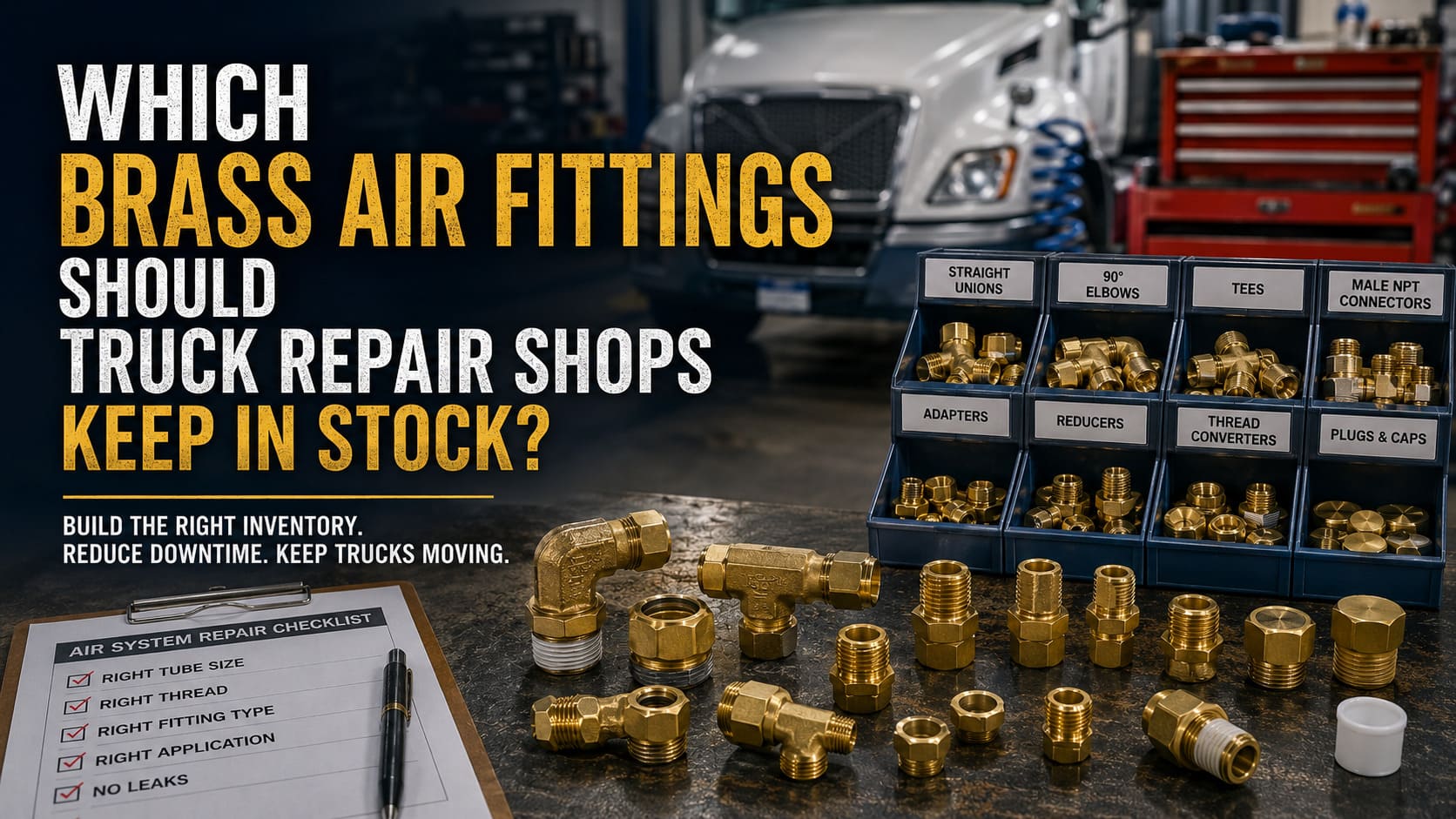
Brass air fittings are small parts — but the wrong one on the shelf causes real delays. Repair shops across the heavy-duty truck aftermarket struggle with the same problem: they stock what seemed popular, then face a mismatch the moment a specific repair comes in. The right stocking strategy is not about volume — it's about coverage.
Truck repair shops should keep a layered brass air fitting inventory built around fitting type, tube diameter, thread standard, and repair task — not size alone. Fast-moving categories like straight unions, elbows, and tees should stay in everyday stock. Adapters, reducers, thread converters, and specialty plugs can be replenished through a reliable supplier as needed, reducing both stockouts and slow-moving inventory.
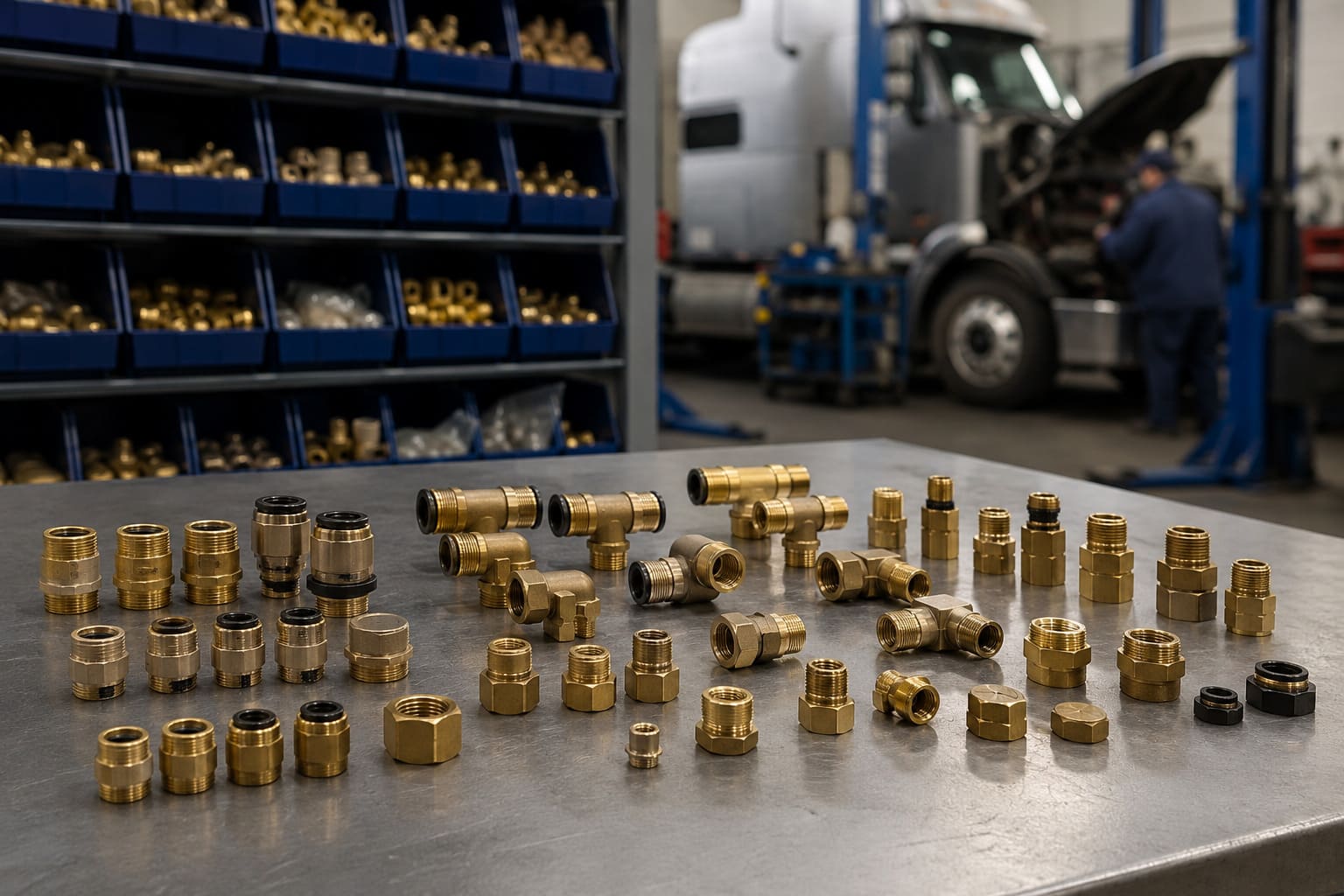
Understanding which fittings to stock is a different question from understanding how many to stock. To answer both, you need to think about fitting type, stocking frequency, mismatch risk, and supplier replenishment together — not as separate problems. Let's walk through each dimension.
Are You Stocking Fittings by Size — or by Repair Task?
Many shops reorder what ran out last month. That reactive approach sounds logical, but it quietly creates gaps.
Most stockouts in truck repair shops happen not because a size is unavailable, but because the right combination — tube diameter, thread type, and fitting shape — is missing. A shop may have 1/4" fittings in stock but still face a delay if the thread standard doesn't match the port or the shape doesn't fit the routing.
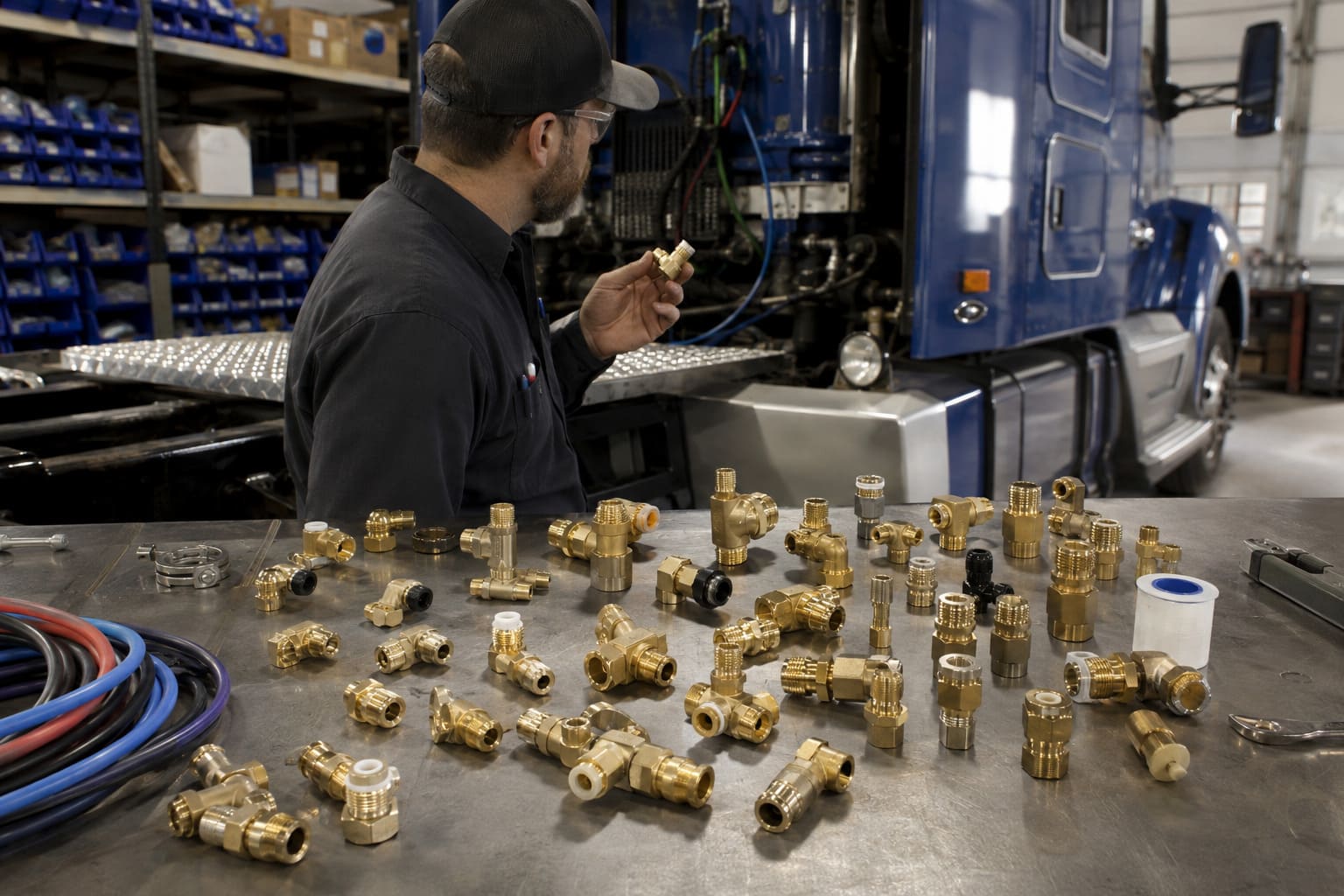
In customer stocking discussions, I've noticed that shops often ask first about "common sizes." That's a reasonable starting point — but size is only one variable. The real stocking question is: for the repairs you do most often, which specific fitting combinations do those jobs require?
The Four Variables That Define a Usable Fitting
Treating a brass air fitting as a single SKU is a common mistake. Every fitting is actually defined by at least four attributes:
- Tube OD (outside diameter): Typically 1/4", 5/16", 3/8", 1/2", and 5/8" in North American truck air systems1
- Thread type and standard: NPT (National Pipe Thread) is dominant in North America, but shops handling mixed fleets or South American trucks may also encounter BSP threads2
- Fitting shape: Straight, 45° elbow, 90° elbow, tee, union, male run tee — each serves a specific routing need
- Application position: Gladhand connection points, brake valve ports, air dryer lines, and cab supply lines each create different fitting geometry requirements
When one of these four variables doesn't match, the fitting is unusable — even if the other three are correct.3 That's how a shelf full of brass fittings can still leave a truck waiting.
Shifting from Size Logic to Repair-Task Logic
A more reliable stocking framework asks: what are the three to five repairs we do most often on air systems? Then, for each repair, map out the fitting combinations those jobs typically require.
For example:
- Air line replacement at the trailer glad hand: Likely needs a specific push-to-connect or compression fitting end, often 3/8" or 1/2" tube OD with NPT male thread
- Brake chamber line repair: Often uses 3/8" compression fittings, straight or 90° elbow, NPT thread
- Air dryer inlet/outlet service: May need a reducing fitting or an adapter if the replacement dryer has a different port size
This approach means your stock reflects actual repair frequency — not abstract popularity. Shops that shift to repair-task thinking tend to reduce both mismatch returns and emergency reorders.
Which Fitting Types Belong in Everyday Stock?
Every shop has limited shelf space and working capital. Not every brass air fitting deserves the same inventory depth.
High-turnover brass air fitting types — straight unions, 90° elbows, tees, and male connectors — should stay in everyday stock across the most common tube sizes.4 These shapes appear repeatedly across brake lines, air supply lines, and cab systems, making them the foundation of any reliable fitting inventory.
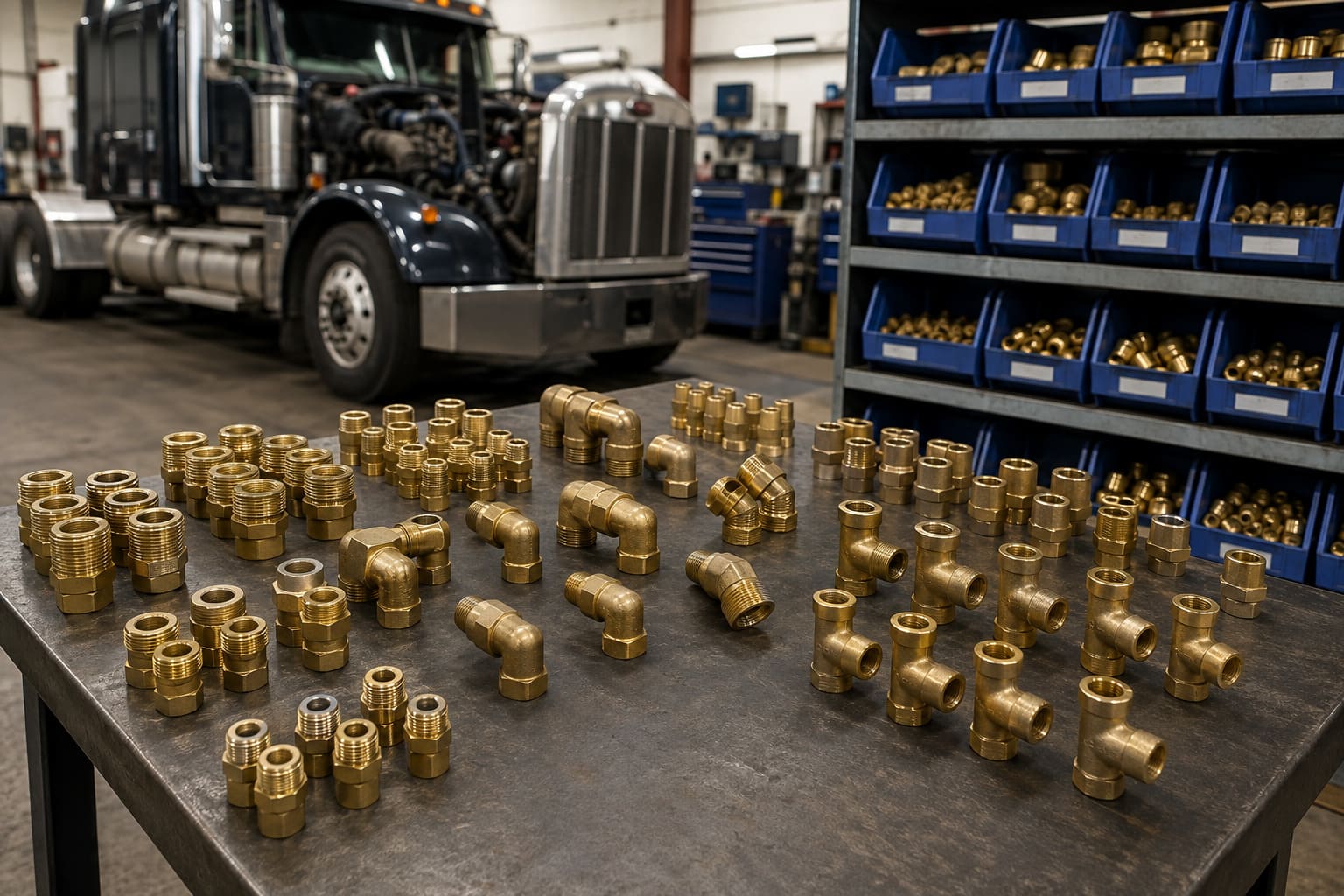
Based on what shops consistently reorder, the following fitting categories tend to move fastest.
Straight Unions and Couplings
Straight unions connect two tubes of the same diameter inline. They appear in almost every air line repair scenario — replacing a cracked section, extending a line, or reconnecting after component replacement. Shops should stock straight unions in at least three to four tube sizes (typically 1/4", 3/8", 1/2", and 5/8") and verify whether the thread end is NPT or the push-to-connect style matches their preferred tube type.
90° and 45° Elbows
Elbows handle direction changes in tight routing environments — a constant reality in truck cab and chassis air systems. The 90° elbow is by far the higher-turnover item, but 45° elbows appear often enough in brake and air dryer lines that most shops benefit from keeping at least a small quantity in the two or three most common sizes.
Male NPT Connectors and Run Tees
Male NPT connectors attach tube lines to threaded ports on valves, tanks, and components. Tees split a single air supply into two paths. Both show up in brake valve service, air tank connections, and auxiliary air supply work. These are the fittings shops tend to run out of first, because one repair job can consume multiple pieces.
A Practical Everyday Stock Reference
The table below reflects common stocking logic based on typical shop conversations — not a universal specification. Shops should verify actual repair frequency and application fit before setting final par levels.
| Fitting Type | Common Tube Sizes | Typical Thread | Recommended Stock Depth |
|---|---|---|---|
| Straight union | 1/4", 3/8", 1/2", 5/8" | NPT or push-to-connect | Medium–High |
| 90° elbow | 1/4", 3/8", 1/2" | NPT | Medium–High |
| 45° elbow | 3/8", 1/2" | NPT | Low–Medium |
| Male NPT connector | 1/4", 3/8", 1/2" | NPT | High |
| Equal tee | 3/8", 1/2" | NPT | Medium |
| Male run tee | 3/8", 1/2" | NPT | Low–Medium |
What About Adapters, Reducers, and Specialty Fittings?
Less frequent doesn't mean unimportant. A missing adapter can hold up a repair just as badly as a missing elbow.
Adapters, reducers, thread converters, plugs, and caps are lower-turnover brass air fittings, but they solve problems that everyday stock cannot. Shops handling mixed fleets or older equipment should keep a small assortment on hand and rely on supplier replenishment — rather than deep stocking — to cover less common combinations.
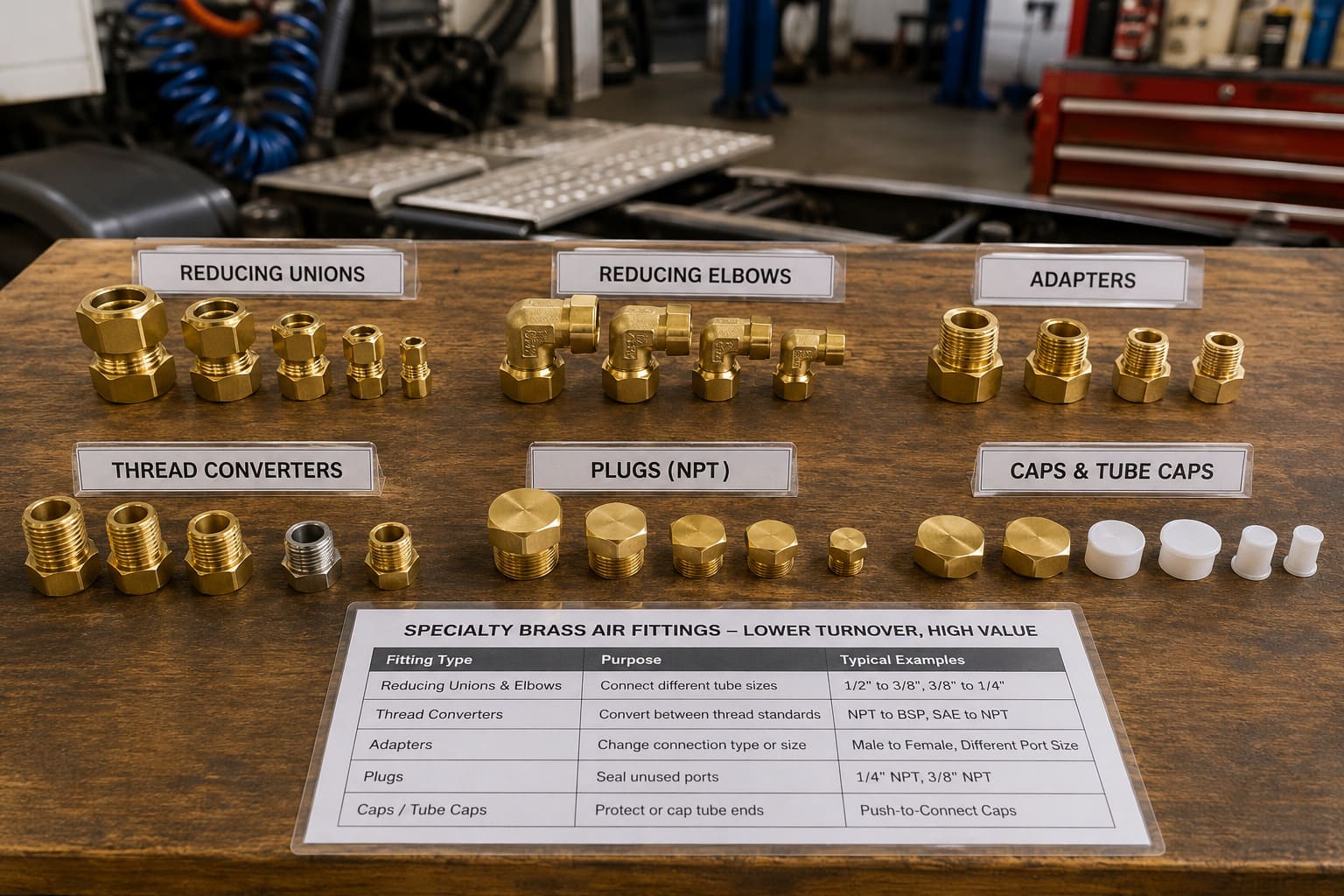
The temptation is to stock only what moves. But specialty fittings fail you at the worst moment: when a repair is already in progress and the truck is on the lift.
Reducing Fittings and Adapters
Reducing unions and reducing elbows connect two tubes of different diameters. They appear when a replacement component has a different port size than the original — common in cross-brand repairs or when aftermarket parts are substituted. Shops running mixed fleets (for example, servicing both Freightliner and Kenworth units) are more likely to encounter size transitions at air valves and tanks.
Stocking one or two pieces each of the most common reducing combinations (such as 1/2" to 3/8" and 3/8" to 1/4") is usually sufficient for low-frequency needs. The goal is to avoid a same-day emergency order, not to build a deep buffer.
Thread Conversion Fittings
NPT-to-BSP adapters or SAE-to-NPT adapters appear when a shop services trucks sourced from mixed markets or when imported replacement components carry a different thread standard. These are genuinely low-frequency items for most North American shops — but for operations handling South American fleets or imported equipment, they move more regularly.
In customer discussions, shops sometimes discover thread mismatches only when a fitting is partially assembled and won't seal. Keeping two or three thread adapters in the most likely conversion sizes prevents that situation from becoming a multi-day delay.
Plugs, Caps, and Emergency Small Parts
Plugs and caps seal unused ports during system modifications or temporary repairs. They're inexpensive but easy to overlook until needed. A handful of NPT plugs in 1/4" and 3/8" — along with a few push-to-connect tube caps — costs very little shelf space and prevents improvised workarounds that can compromise air system integrity.
Shops should treat these as consumable insurance. Reorder when the bin drops below a set minimum, not after the last piece is used.
Why Does Fitting Mismatch Cause So Much Trouble?
A brass air fitting is one of the smallest parts in a truck's air system. Its consequences, however, are not small.
Fitting mismatch — wrong thread, wrong tube size, wrong shape, or wrong application position — causes rework, repeat repairs, air leakage risk, and extended vehicle downtime.5 In a busy shop, a single mismatch event can affect scheduling, customer trust, and technician efficiency well beyond the cost of the part itself.
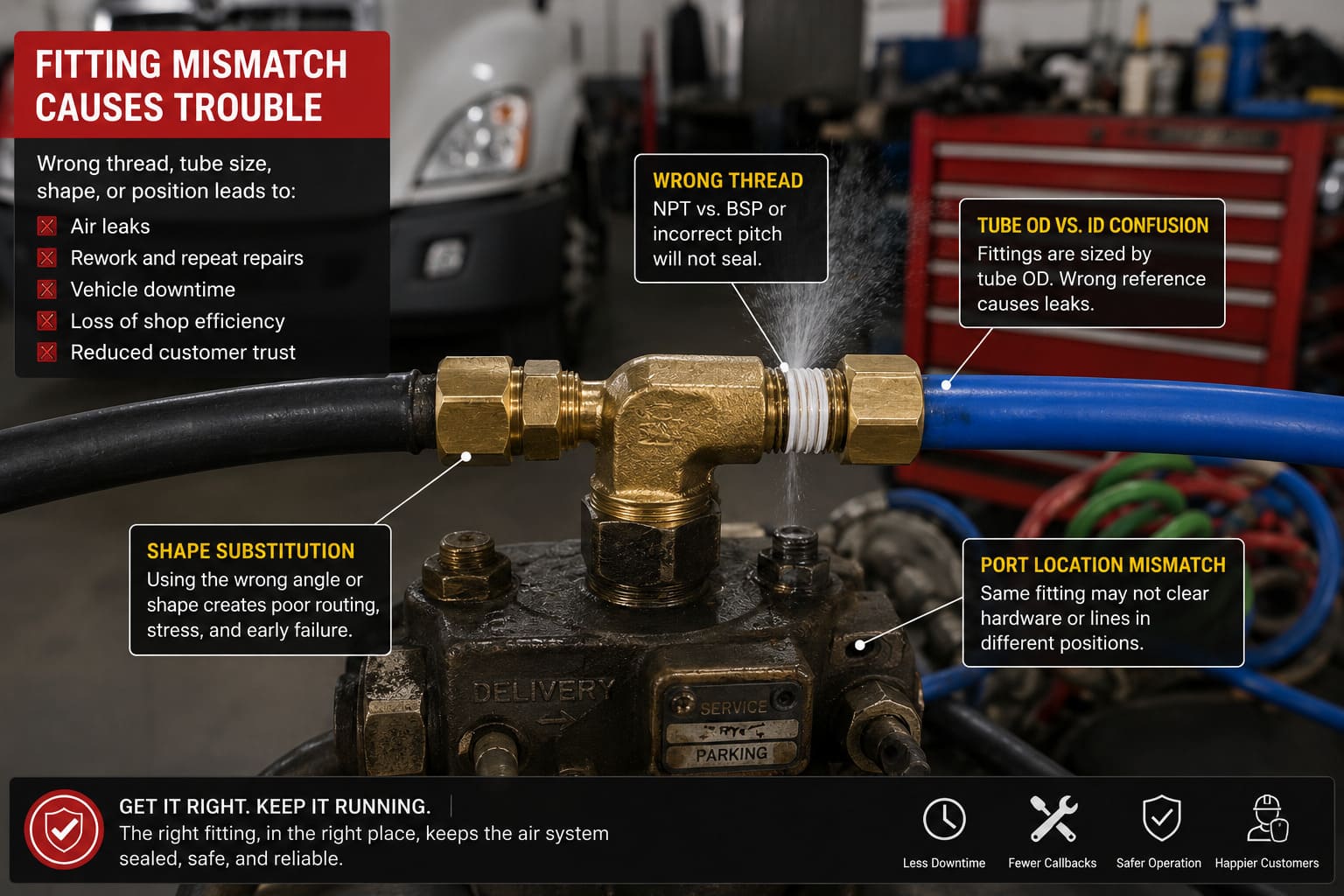
The Most Common Mismatch Scenarios
Through conversations with repair shops and fleet maintenance teams, a few mismatch patterns come up repeatedly:
Thread standard confusion: A fitting with the right tube diameter but the wrong thread (NPT vs. BSP, or incorrect pitch) will not seal under pressure.6 It may install partially, which is actually more dangerous than a fitting that won't start at all — because it creates a false sense of completion.
Tube OD vs. ID confusion: Some shops order by nominal size without confirming whether the spec refers to OD or ID. Brass compression fittings are sized by tube OD.7 Ordering the wrong reference dimension means the fitting won't grip correctly, creating a leak path even if the fitting appears secure.
Shape substitution under pressure: When the correct elbow is out of stock, a technician may substitute a straight fitting with a bent tube section, or use a different elbow angle to manage routing. These substitutions may work temporarily but often create stress on the line or poor routing geometry — both of which can lead to premature failure.8
Port location mismatch: The same nominal fitting may not clear surrounding hardware at every mounting position. A 90° elbow that fits perfectly on one valve port may interfere with a bracket or adjacent line at another position on the same truck. Application context matters.
How Quality Consistency Prevents Secondary Mismatch
Even when a shop orders the right fitting specification, inconsistent manufacturing tolerances create a secondary mismatch problem. A brass compression fitting that holds to tight dimensional tolerances will perform predictably. One with variable ferrule diameter or inconsistent thread pitch will behave differently across batches — even with the same part number.
This is why shops making ongoing purchases should pay attention to batch consistency, not just unit price. At ROADSPOWER, incoming material inspection, in-process sampling, and air tightness and pressure resistance testing are documented processes — because a shop's inventory is only as reliable as the consistency of what's in it. Shops should verify supplier quality practices against their own operational requirements before committing to a regular replenishment arrangement.
How Should Supplier Support Factor Into Your Stocking Strategy?
Inventory strategy doesn't end at the stockroom. For low-frequency fittings, your supplier relationship is part of the strategy.
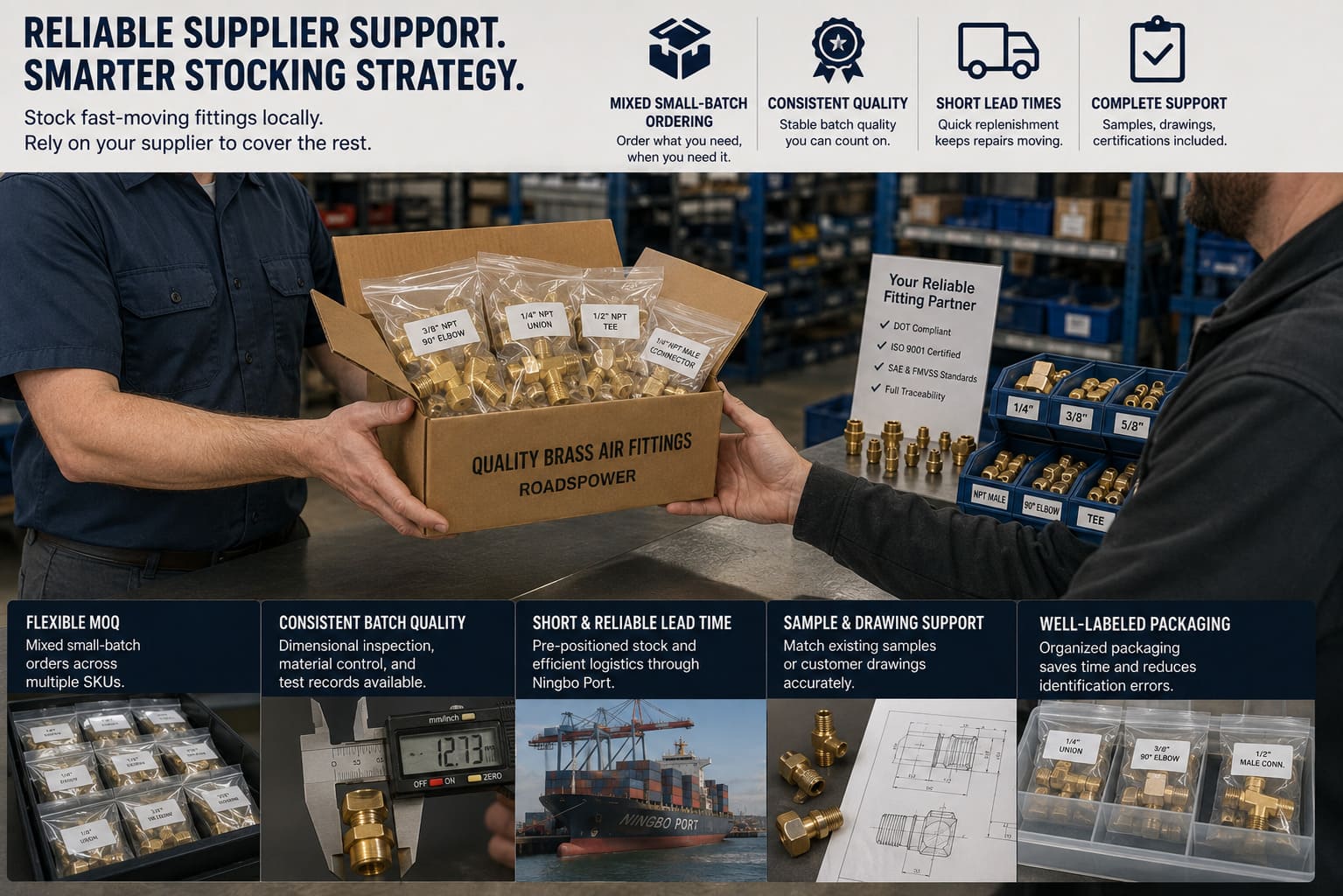
For high-turnover brass air fittings, shops should maintain local stock. For low-frequency SKUs, the better approach is a reliable supplier offering mixed small-batch ordering, consistent batch quality, and short replenishment lead times — rather than deep local stocking of items that move slowly and tie up capital.
Why Replenishment Strategy Matters as Much as Par Levels
A shop that tries to stock every possible fitting combination will either run out of shelf space or end up with slow-moving inventory that ties up cash.9 The more practical model separates two categories clearly:
- Stock locally: High-frequency fitting types and sizes that appear in most repairs
- Replenish on demand: Low-frequency adapters, reducers, thread converters, and specialty shapes that appear infrequently but cannot be substituted
This two-tier model only works if the replenishment supplier can reliably deliver small mixed batches with consistent quality and reasonable lead times.10 If the supplier's minimum order quantity forces the shop to overbuy, or if batch quality varies, the model breaks down.
What to Ask a Supplier Before Setting Up Replenishment
When evaluating a brass air fitting supplier for ongoing replenishment, shops and purchasing teams should ask:
- MOQ flexibility: Can the supplier ship mixed small batches across multiple SKUs, or does each SKU require a separate minimum?
- Batch consistency: How does the supplier document dimensional and material consistency across production batches? Are inspection records available?
- Lead time reliability: What is the realistic replenishment cycle for regular orders? For urgent needs?
- Sample and drawing support: If a shop needs a fitting matched to an existing sample or a customer drawing, can the supplier accommodate that?
- Certifications: Does the supplier hold DOT approval, ISO 9001 certification, or compliance with SAE and FMVSS standards? Shops should request and verify these documents independently.
At ROADSPOWER, we support mixed small-batch ordering and offer flexible MOQ for shops building out fitting assortments — because we see directly how stocking gaps create repair delays. Our facility near Ningbo Port maintains pre-positioned safety stock for common SKUs, with full traceability from raw material to shipment. Shops evaluating any supplier — including us — should verify these capabilities against their own requirements before making a decision.
Packaging and Organization Support
One underrated aspect of supplier support is how fittings arrive. Bulk mixed bags create sorting labor and identification errors. Well-labeled, organized packaging by fitting type and size saves time at the point of use.11 Shops working with larger volumes should ask whether a supplier can provide assortment kits or pre-organized packaging that matches their internal SKU system.
Frequently Asked Questions
How many SKUs of brass air fittings should a typical truck repair shop carry?
There is no single right number — it depends on fleet mix, repair volume, and supplier replenishment speed. In general, shops benefit from stocking eight to fifteen everyday SKUs across the highest-frequency fitting types and sizes, then relying on supplier replenishment for another ten to twenty lower-frequency items. Shops should verify actual repair frequency before setting final SKU counts.
Do I need to stock both NPT and BSP brass fittings?
Most North American shops working exclusively on domestic trucks can focus on NPT. Shops that service South American trucks, imported equipment, or mixed fleets may encounter BSP threads regularly enough to justify keeping thread adapters and a small BSP assortment. Verify thread requirements by application before purchasing.
What's the risk of using a brass fitting from a different batch if it has the same part number?
If a supplier maintains consistent manufacturing tolerances and dimensional specifications across batches, the risk is low. If tolerances vary, fittings from different batches may behave differently even with identical part numbers — especially on compression-style fittings where ferrule dimensions affect sealing. Shops should ask suppliers for batch inspection records and verify consistency over time.
Can I use push-to-connect brass fittings interchangeably with compression fittings?
No. Push-to-connect and compression fittings use different mechanisms to grip and seal the tube. They require compatible tube types and are not interchangeable in the field. Shops should stock each type separately and verify which style is correct for each application position before ordering.
How do I handle a fitting mismatch discovered mid-repair?
The safest approach is to stop and source the correct fitting rather than substitute. If a substitute must be used temporarily, document it and flag the vehicle for a proper repair at the next service interval. Air system integrity affects braking performance12 — shops should treat fitting mismatches as a technical issue, not just a parts inconvenience, and consult a qualified technician for application-specific guidance.
Conclusion
Stocking brass air fittings well is not about having the most inventory —
"Federal Motor Vehicle Safety Standards; Brake Hoses", https://www.federalregister.gov/documents/2004/12/20/04-27088/federal-motor-vehicle-safety-standards-brake-hoses. SAE J844 specifies dimensional and performance requirements for nonmetallic air-brake tubing, including nominal outside diameters used in vehicle air-brake systems; it supports the dimensional context of the listed sizes but does not establish individual shop stocking frequency. Evidence role: definition; source type: institution. Supports: A technical standard or institutional reference should confirm the nominal outside diameters used for vehicle air-brake tubing.. Scope note: Contextual support for standard sizes, not direct evidence of what every repair shop stocks. ↩
"National pipe thread - Wikipedia", https://en.wikipedia.org/wiki/National_pipe_thread. Reference works on pipe-thread standards identify National Pipe Thread as an American standard and British Standard Pipe as a separate thread family used in other markets; this supports the standards distinction but does not quantify the prevalence of either thread in truck repair inventories. Evidence role: historical_context; source type: encyclopedia. Supports: A neutral reference should identify NPT as an American pipe-thread standard and BSP as a distinct British/international pipe-thread family.. Scope note: Supports regional standards context, not measured shop-level encounter rates. ↩
"Identify Your Fitting", https://www.allprodiesel.net/pages/identify-your-fitting?srsltid. Engineering standards for tubing and pipe fittings define compatibility through dimensions, thread form, and sealing interface, supporting the claim that a mismatch in any required interface can prevent proper assembly or sealing; the source would not directly evaluate every possible vehicle mounting geometry. Evidence role: mechanism; source type: institution. Supports: A standards or engineering source should show that tubing fittings depend on correct dimensional and thread compatibility for sealing and assembly.. Scope note: Mechanistic support for compatibility, not a universal proof for every repair application. ↩
"Best Automotive Replacement Brake Fittings", https://us.amazon.com/Best-Sellers-Automotive-Replacement-Brake-Fittings/zgbs/automotive/346823011. A fleet-maintenance or vehicle air-system repair reference documenting recurring use of unions, elbows, tees, and male connectors would support their classification as core service fittings; such evidence would contextualize turnover but may not prove a specific stocking depth for all shops. Evidence role: general_support; source type: research. Supports: A maintenance reference or fleet-repair study should show that these fitting geometries recur across air-line repairs.. Scope note: Likely supports common use, not exact sales velocity. ↩
"The True Cost of Vehicle Downtime", https://www.model1.com/resources/blog/vehicle-downtime-cost/. Maintenance-reliability literature links incorrect parts, rework, and parts-availability problems to increased repair duration and equipment downtime, supporting the operational logic of the claim; such evidence would be contextual and may not isolate brass air fittings as the sole cause. Evidence role: general_support; source type: paper. Supports: A maintenance or reliability study should connect incorrect parts, rework, and parts availability problems with increased downtime.. Scope note: Contextual support from maintenance research, not fitting-specific downtime measurement. ↩
"NPT vs. BSP Threads: Key Differences and Applications", https://www.fluidtechpiping.com/npt-vs-bsp-threads-key-differences-and-applications-an-expert-guide-to-avoiding-5-common-mismatches-in-2025/. Engineering descriptions of pipe-thread systems show that sealing performance depends on compatible thread geometry, including pitch, angle, and taper or sealing surface; this supports the risk of leakage from NPT/BSP or pitch mismatch, though it does not test the specific fittings discussed in the article. Evidence role: mechanism; source type: education. Supports: An engineering reference should explain that pipe-thread sealing depends on compatible thread form, pitch, and taper or sealing surface.. Scope note: Mechanistic support rather than product-specific test evidence. ↩
"Compression fitting - Wikipedia", https://en.wikipedia.org/wiki/Compression_fitting. Government and standards specifications for compression tube fittings identify fitting size by the outside diameter of the tube to be joined, supporting the article's distinction between OD-based fitting selection and nominal pipe sizing. Evidence role: definition; source type: government. Supports: A government specification or technical standard should confirm that compression tube fittings are matched to tube outside diameter.. ↩
"Federal Motor Vehicle Safety Standards; Brake Hoses", https://www.federalregister.gov/documents/2004/12/20/04-27088/federal-motor-vehicle-safety-standards-brake-hoses. Vehicle tubing standards and maintenance guidance address bend radius, routing, kinking, and abrasion as factors in air-line durability, supporting the article's claim that improvised routing can increase stress and failure risk; the support is general rather than specific to any single substitution event. Evidence role: mechanism; source type: institution. Supports: A standards or vehicle-maintenance source should describe how bend radius, routing, kinking, abrasion, or stress affect air-brake tubing durability.. Scope note: General mechanism, not direct evidence for every substitute fitting. ↩
"Spare parts inventory management in warehouse: a lean ...", https://www.academia.edu/68521235/Spare_parts_inventory_management_in_warehouse_a_lean_approach. Inventory-management research describes how expanding SKU variety can increase carrying costs, storage requirements, and slow-moving stock, supporting the article's rationale for selective stocking; the evidence is general and not limited to brass air fittings. Evidence role: expert_consensus; source type: paper. Supports: Inventory-management literature should support the relationship between large SKU variety, slow-moving stock, storage constraints, and working-capital burden.. Scope note: General inventory principle, not a truck-shop-specific dataset. ↩
"A systematic literature review about dimensioning safety ...", https://www.sciencedirect.com/science/article/pii/S2214716021000142. Supply-chain and spare-parts inventory studies show that lead-time variability and supplier reliability influence safety stock, service levels, and replenishment performance, supporting the article's two-tier inventory logic; the literature may not specifically address brass air fittings. Evidence role: mechanism; source type: paper. Supports: Supply-chain research should show that replenishment lead time, variability, and supplier reliability affect service levels and the amount of local stock required.. Scope note: Contextual supply-chain support rather than direct evidence from truck repair shops. ↩
"What is Visual Management? Definitions & Examples For… | Tulip", https://tulip.co/blog/visual-management/. Studies of visual management, 5S, and warehouse labeling associate clear point-of-use organization with reduced search time and fewer identification or picking errors, supporting the article's packaging claim in a general operational sense. Evidence role: general_support; source type: paper. Supports: Human-factors, lean-management, or warehouse research should support that labeling and visual organization reduce search time and identification errors.. Scope note: General workplace and warehouse evidence, not a direct study of brass fitting packaging. ↩
"Federal Motor Vehicle Safety Standards No. 121; Air Brake Systems", https://www.federalregister.gov/documents/2008/03/07/E8-4460/federal-motor-vehicle-safety-standards-no-121-air-brake-systems. Federal Motor Vehicle Safety Standard No. 121 establishes performance requirements for air-brake systems, reflecting the dependence of braking function on properly maintained air pressure and system integrity. Evidence role: mechanism; source type: government. Supports: A government regulation or safety resource should show that air-brake performance depends on maintaining specified air-system pressure and function.. ↩