You have three quotes on your desk. All three say "3-in-1 air power line." The prices are different. The question is whether you are actually looking at the same product — and most of the time, you are not. Misreading a quote at this stage turns a "good deal" into a sourcing problem that costs far more than the price difference.
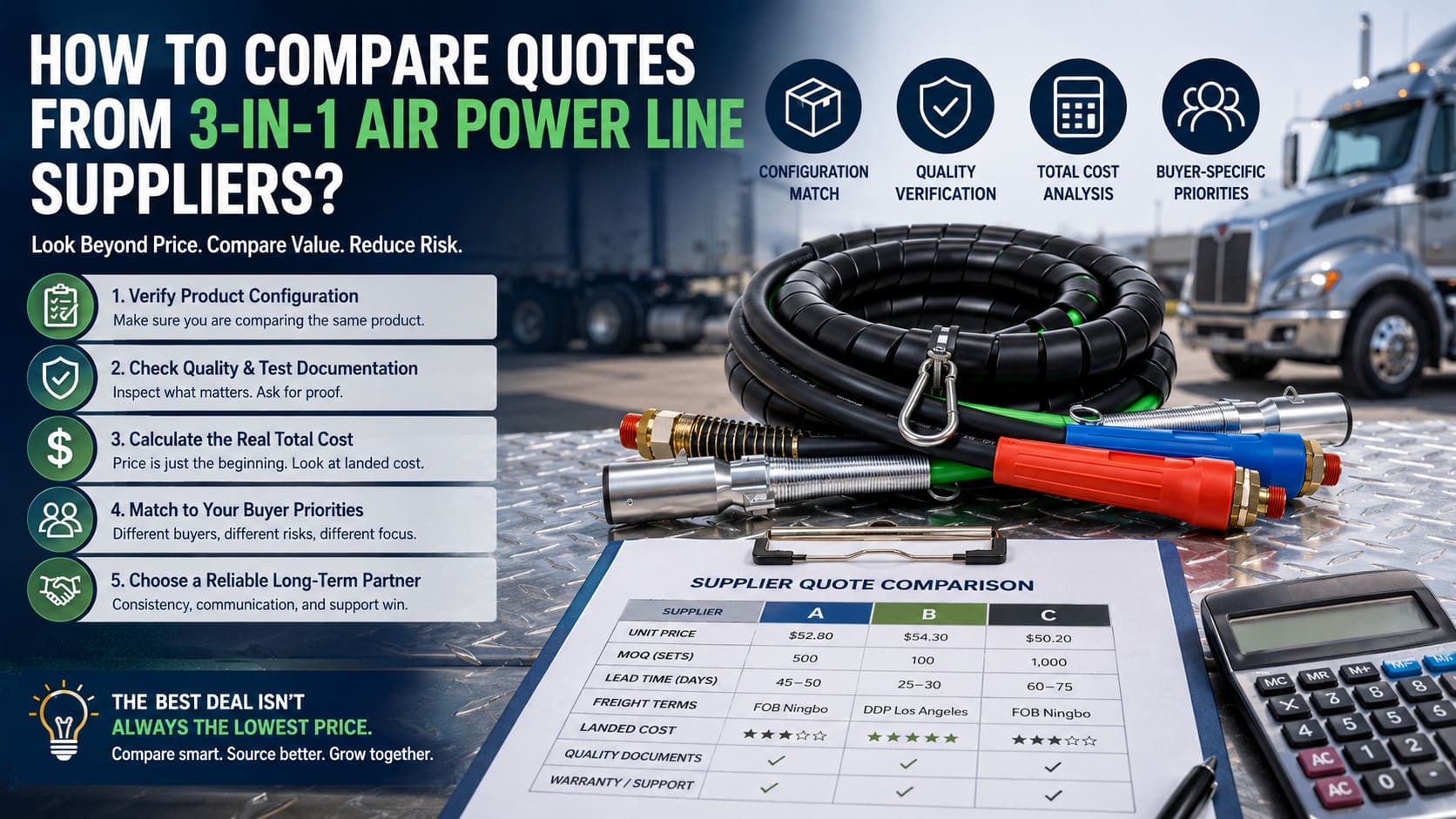
Comparing quotes from 3-in-1 air power line suppliers requires more than lining up unit prices. Before price means anything, buyers must verify that product configurations match, quality checks are documented, delivery terms are fully costed, and the supplier's reliability fits their specific resale, fitment, or fleet operation requirements. Only then does the lowest number become the best value.
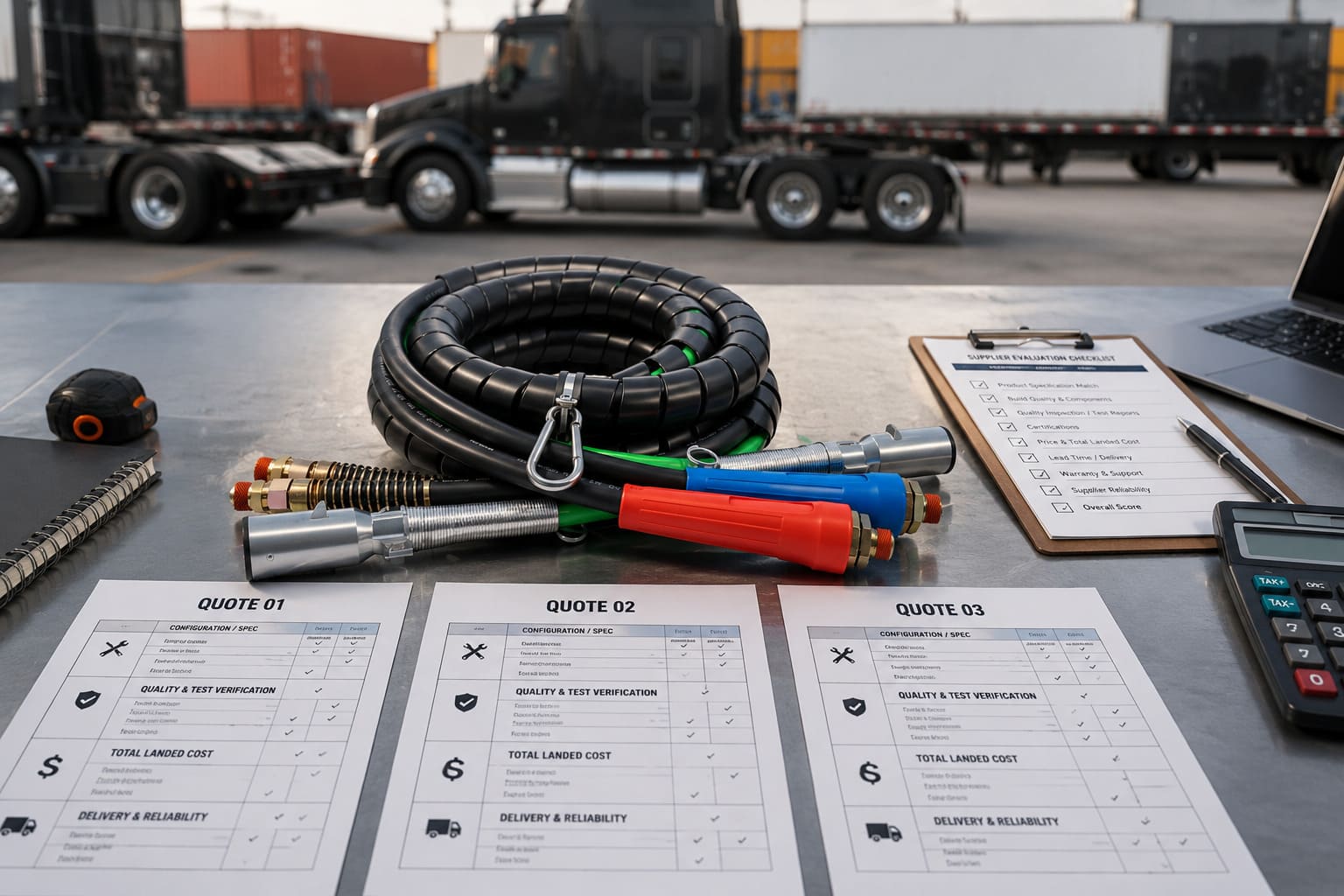
Most buyers already know that cheap quotes carry risk. What is harder to act on is knowing exactly where the risk hides. The sections below break down each comparison layer — configuration, quality verification, total cost, and buyer-specific priorities — so you can evaluate any quote with a consistent framework.
Are the Products in Your Quotes Actually the Same?
You receive two quotes with the same part description and significantly different prices. Your first instinct is to ask why one supplier is cheaper. The better first question is whether both suppliers are quoting the same product.
A "3-in-1 air power line" is not a standardized commodity.1 The description covers a wide range of material grades, dimensional specs, and construction choices. Until those variables are aligned, a direct price comparison has no meaningful foundation.
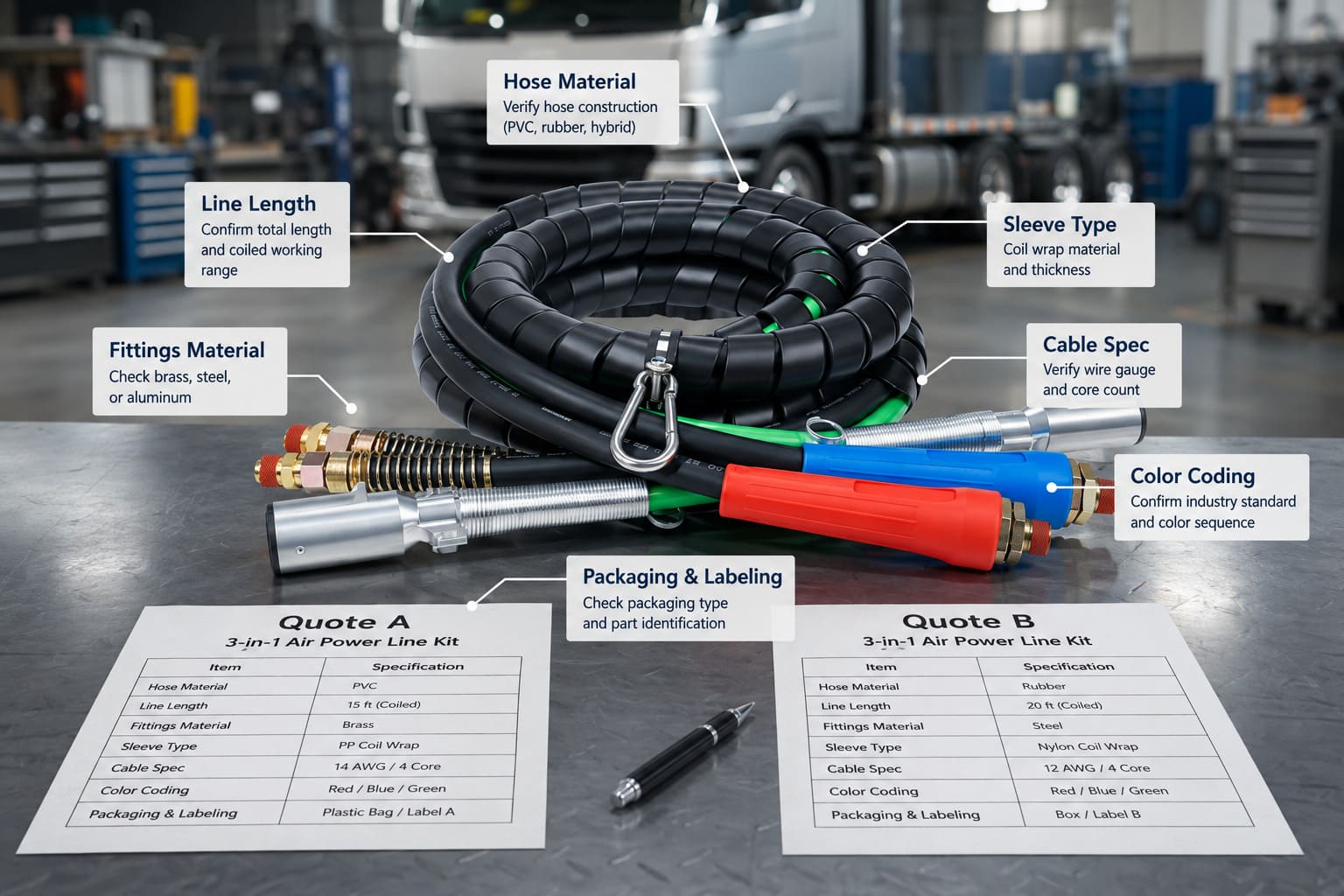
When I review quote comparisons that customers send me, the most common problem is not price manipulation — it is that both parties were quoting different things and neither side noticed until after the order arrived.
The Variables That Change What You Are Buying
Here are the configuration elements that must match before you compare prices:
Tubing and hose materials:
- PVC, rubber, and nylon-reinforced options carry different pressure ratings, temperature tolerances, and flex-fatigue lifespans.2
- A quote for a PVC line and a quote for a nylon-reinforced line at the same price point are not equivalent — the materials serve different operating conditions.
Line length and diameter:
- Standard North American configurations typically run 12 ft or 15 ft with specific diameter specs for service, emergency, and supply lines.3
- Confirm whether the quoted length matches your application or your customer's vehicle configuration. A small length difference affects both fitment and resale.
Fittings and end connections:
- Brass fittings versus zinc-alloy fittings behave differently under vibration, pressure cycling, and corrosion exposure.4
- Thread type, fitting geometry, and swaging or crimping method all affect seal integrity and installation ease.
Protective sleeve or coil cover:
- Spring guard, plastic coil, fabric braid, or no sleeve — each changes durability, aesthetics, and price.
- Buyers reselling into premium retail channels often need specific sleeve types to meet customer expectations.
Electrical cable (the "1" in 3-in-1):
- Number of conductors, wire gauge, connector type, and cable jacket material vary between quotes.
- Confirm whether the cable spec matches the trailer light systems your customers actually use.
Color coding:
- Blue/red/green is standard in most North American markets.5 Color conventions in South American markets may differ.
- Wrong colors cause installation errors at the shop level and customer complaints at the resale level.6
Packaging and labeling:
- Retail box, bulk bag, or neutral packaging changes your presentation cost and downstream resale flexibility.
- If you need private-label or branded packaging, confirm this is included in the quoted price or listed as a separate line item.
Practical step: Build a configuration checklist and require every supplier to fill it in before you accept their quote for comparison. If a supplier cannot or will not specify these variables, the quote is incomplete.
| Configuration Variable | What to Verify | Why It Matters |
|---|---|---|
| Hose material | PVC / rubber / nylon-reinforced | Pressure rating, temperature range, flex life |
| Line length | 12 ft / 15 ft / custom | Fitment compatibility |
| Fittings material | Brass / zinc alloy | Corrosion resistance, seal reliability |
| Sleeve type | Spring guard / coil / braid | Durability, appearance |
| Cable spec | Gauge, conductors, connector | Trailer electrical compatibility |
| Color coding | Blue / red / green / custom | Installation accuracy |
| Packaging | Retail / bulk / private label | Resale and presentation |
How Do You Verify Quality Claims in a Supplier Quote?
Most supplier quotes include some version of "high quality" or "ISO certified." These phrases are not wrong, but they are also not evidence. The real question is what specific quality controls the supplier can document — and whether those controls match the failure modes that matter to your business.
Quality in a 3-in-1 air power line is not a single test. It is a series of checkpoints across materials, production, and finished goods. A supplier who can describe each checkpoint is more credible than one who lists certifications without context.
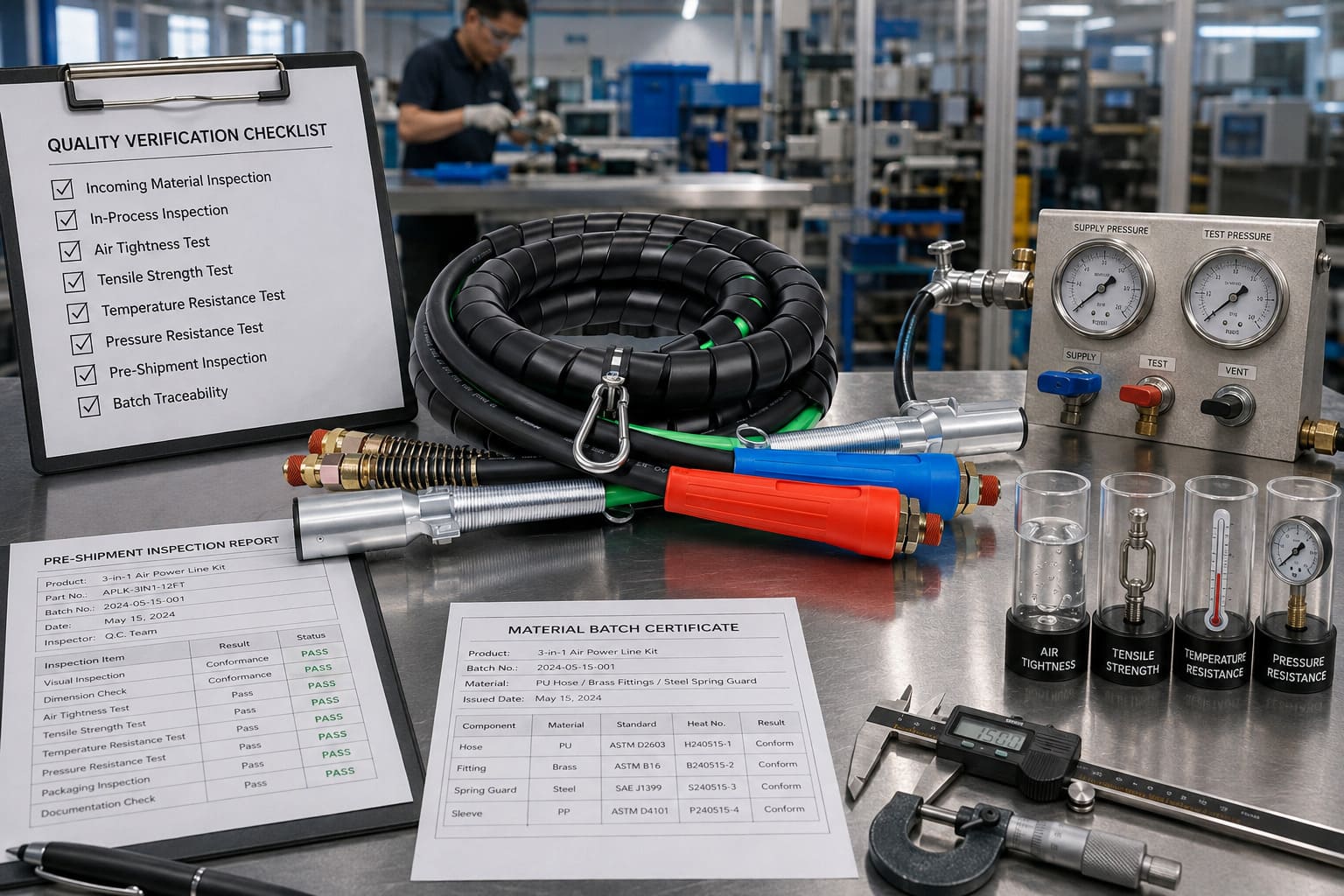
From my experience on the supply side, buyers who ask specific QC questions before ordering are far less likely to have complaints after delivery. The questions themselves signal to the supplier that you are a serious buyer who will hold them accountable.
What Quality Verification Looks Like in Practice
Incoming material inspection:
- Are raw materials — copper, rubber, nylon, steel — inspected at intake with batch compliance certificates?
- Can the supplier provide documentation on material grade and traceability?
In-process inspection:
- Are there sampling checks at multiple production stages, or only at the end of the line?
- Is there documented SOP coverage for each production node?
Performance testing: Ask specifically about:
- Air tightness testing — confirms the assembled line holds pressure without leakage
- Tensile strength testing — verifies fitting-to-hose connections resist pull-out forces
- Temperature resistance testing — confirms the line performs across the operating temperature range
- Pressure resistance testing — validates burst and working pressure ratings
Pre-shipment inspection:
- Is AQL sampling conducted before the batch is released?7
- Is there 100% final inspection on any components, or only statistical sampling?
- Can the supplier provide a pre-shipment inspection report with your order?
Certifications — treat them as a starting point, not a finish line:
DOT compliance and ISO 9001 certification are meaningful, but buyers should ask to see the actual certificates and check validity dates. Certifications document the quality management system; they do not replace product-specific inspection records.8
Note: ROADSPOWER operates under ISO 9001 and holds DOT certification, and we maintain full batch traceability from raw material intake to shipment. We recommend that all buyers — regardless of supplier — request documentation rather than accepting verbal quality assurances.
Questions to Ask Any Supplier About Quality
- Can you send a pre-shipment inspection report with each order?
- What is your process if a batch fails your own internal QC?
- Can you provide material certificates for the brass fittings and hose tubing?
- How do you handle defect claims after delivery?
- What is your defect rate, and how is it tracked?
A supplier who answers these questions with specific processes is a different level of risk than a supplier who answers with marketing language.
What Is the Real Total Cost Behind a Quoted Price?
Unit price is the number on the quote. Total cost is the number that actually affects your margin. The gap between the two is where sourcing decisions go wrong — and where lower-quoted suppliers often turn out to be more expensive than they first appeared.
When buyers send me competing quotes, the unit price difference is often the smallest part of the total cost difference. The larger differences are usually buried in MOQ structure, freight terms, lead time risk, and after-sales handling.
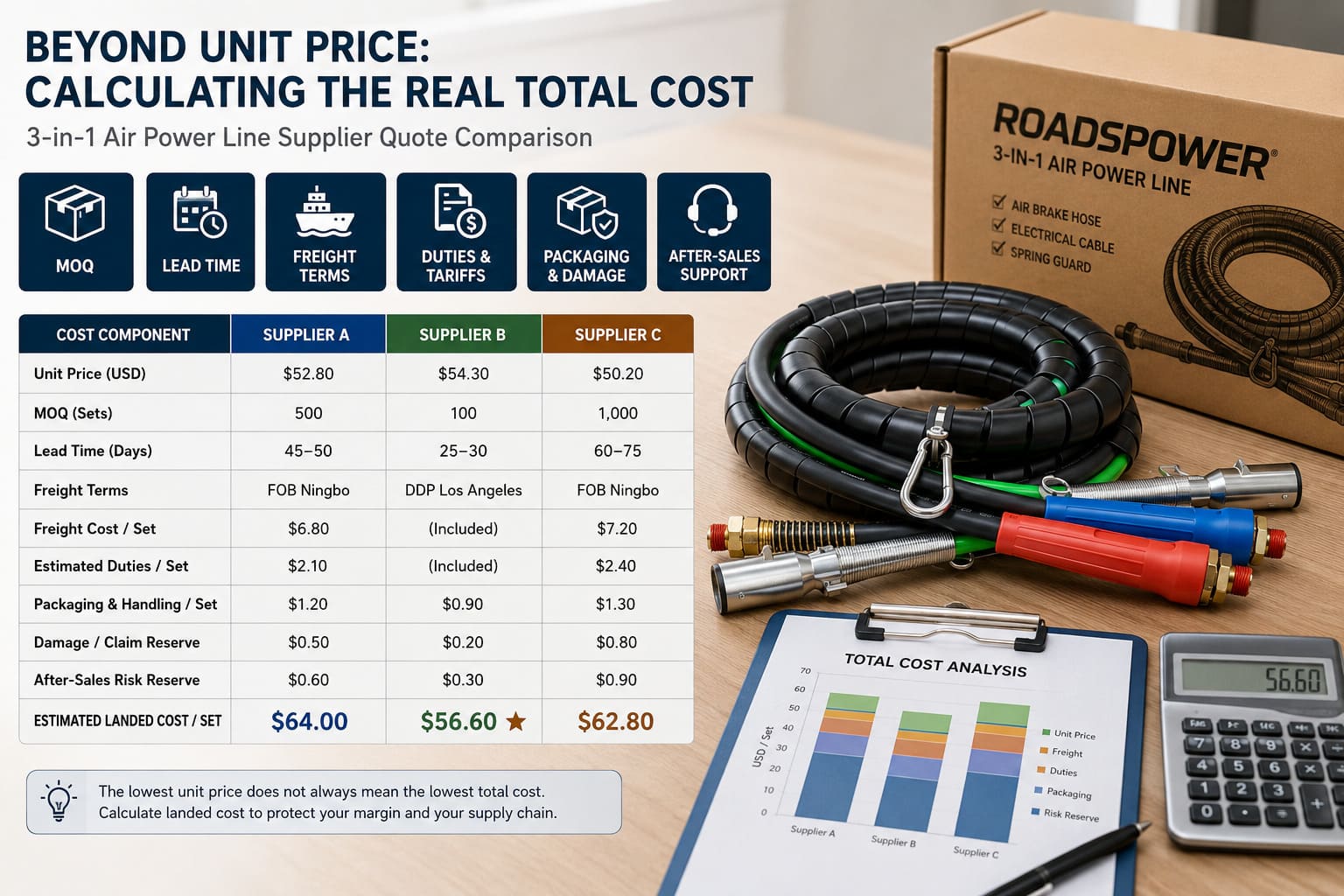
Breaking Down the Hidden Cost Variables
Minimum Order Quantity (MOQ):
- A lower unit price with a high MOQ may force you to overstock, tying up working capital and warehouse space.
- A slightly higher unit price with flexible MOQ may be more efficient for your actual replenishment cycle.
- Ask: does the quoted MOQ match how your customers actually order from you?
Lead time and replenishment stability:
- A supplier with a 60-day lead time creates a very different cash flow and stockout risk than one with 25–30 days.
- Ask whether the supplier maintains pre-positioned safety stock for high-velocity SKUs.
- Stockout on a fast-moving 3-in-1 air line kit is not just a lost sale — for a repair shop, it is a truck sitting idle.9
Freight and delivery terms:
- FOB Ningbo and DDP (Delivered Duty Paid) are fundamentally different cost structures.10
- An FOB price shifts freight, insurance, and customs duties to you. A DDP price bundles these costs but may include the supplier's freight margin.
- Calculate the landed cost — not the FOB price — before you compare quotes.
Import duties and tariff classification:
- Confirm the HS code the supplier uses. Different classifications carry different duty rates, and a misclassified product creates compliance risk at customs.11
- This is especially relevant for buyers importing into the United States under current tariff structures.
Packaging and damage risk:
- Under-packed shipments arrive with damaged coils, bent fittings, or soiled retail boxes — all of which create return costs and customer complaints.12
- Ask how the product is packed for ocean freight, and whether the supplier has handled high-volume shipments to your region before.
After-sales handling:
- If a batch has defects, how does the supplier respond? Credit, replacement, or dispute?
- A supplier with a clear, documented after-sales process reduces your financial exposure. A supplier with vague "we'll handle it" language increases it.
| Cost Factor | Low-Price Quote Risk | Better Evaluation Approach |
|---|---|---|
| MOQ | Forces overstock or broken cases | Match MOQ to your replenishment cycle |
| Lead time | Stockout and idle vehicle risk | Ask for standard and rush lead times |
| Freight terms | FOB understates true landed cost | Calculate landed cost at your port |
| Duties | HS code errors create compliance risk | Confirm HS code and applicable duty rate |
| Packaging | Damage claims and returns | Ask for freight packaging specs |
| After-sales | Dispute cost and response time | Request written defect handling policy |
Should Distributors, Repair Shops, and Fleets Compare Quotes the Same Way?
Not every buyer faces the same risk from the same quote. A 3-in-1 air line that is acceptable for one buyer type may be the wrong choice for another — not because the product is bad, but because the priorities are different.
Understanding your own procurement context makes your quote comparison more focused and more accurate.
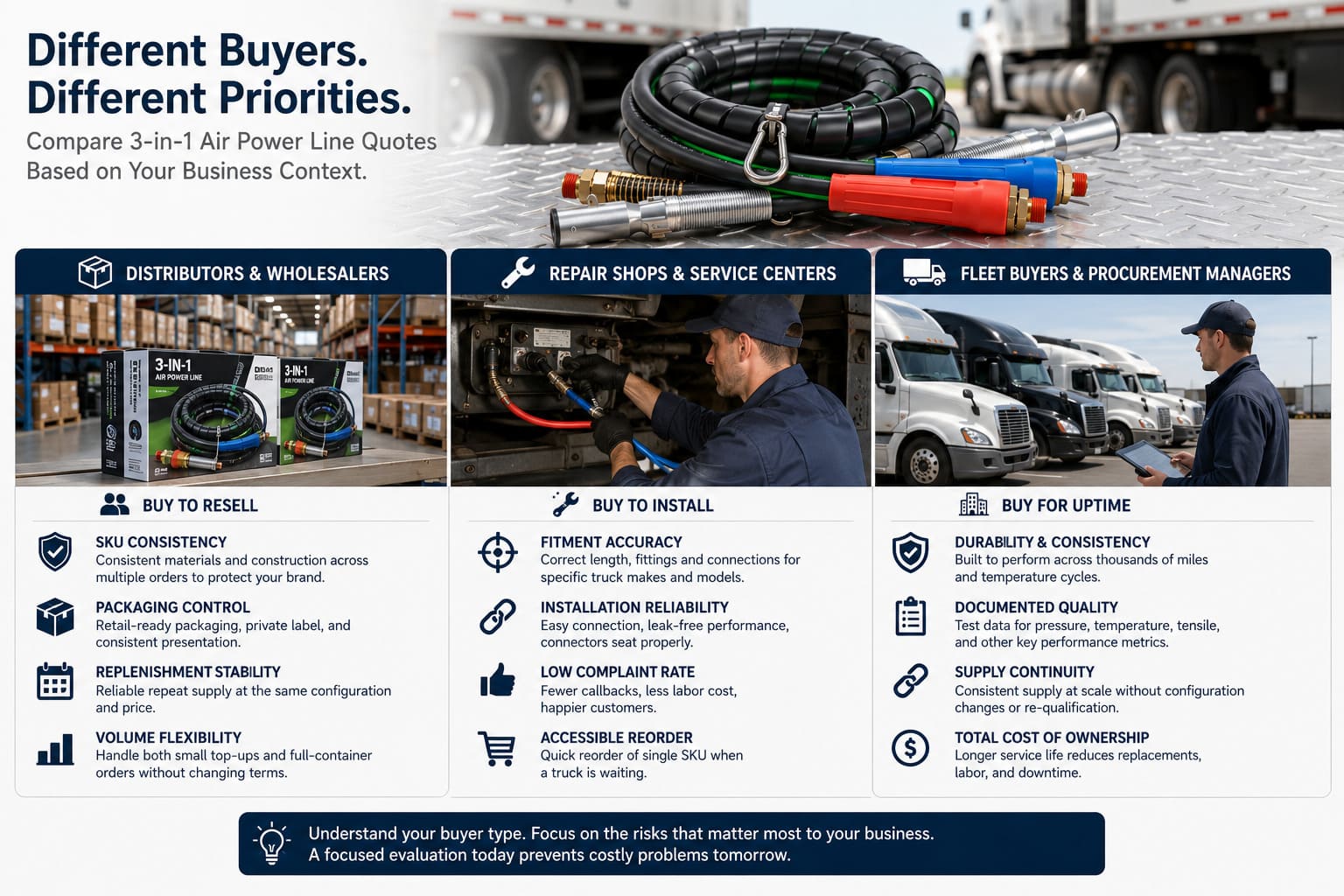
Distributors and Wholesalers
Distributors are buying to resell. Their primary risk is resale consistency — if SKUs change between orders, customers complain. If packaging looks different batch to batch, retail placement becomes difficult.
Key priorities for distributors:
- SKU consistency: Will the same part number produce an identical product across multiple orders?
- Packaging control: Is retail or shelf-ready packaging available? Can you specify box design, labeling, or private label?
- Replenishment stability: Can the supplier reliably fill repeat orders at the same configuration and price?
- Volume flexibility: Can the supplier handle both small top-up orders and full-container wholesale without changing terms?
A distributor who sources from a supplier that changes materials or packaging between batches will hear about it from their own customers. Configuration consistency over time is often more valuable than the lowest initial price.
Repair Shops and Service Centers
Repair shops are buying to install. Their primary risk is fitment failure and the associated labor cost and customer complaint.
Key priorities for repair shops:
- Fitment accuracy: Does the line actually fit the specific Freightliner, Kenworth, Peterbilt, International, Volvo, or Mack configuration their customer drives?
- Installation reliability: Are fittings easy to connect without leaks? Do connectors seat properly?
- Complaint rate: A callback because of a failed air line is a direct labor cost and a customer satisfaction problem.
- Accessible reorder: Can the shop reorder a single SKU quickly when a truck is waiting?
For a repair shop, a modestly higher unit price with better fitment accuracy and a lower complaint rate is almost always the right choice financially.
Fleet Buyers and Procurement Managers
Fleets are buying for uptime. Their primary risk is unplanned downtime and the maintenance cost that follows.
Key priorities for fleet buyers:
- Durability and consistency: Do the lines perform reliably across thousands of miles and temperature cycles?
- Documented quality: Is there test data — pressure, temperature, tensile — that supports the supplier's performance claims?
- Supply continuity: Can the supplier guarantee consistent supply at scale without configuration changes that require re-qualification?
- Total cost of ownership: A line that fails in 18 months instead of 36 months doubles your replacement frequency and labor exposure.
Fleets benefit from requesting sample orders and putting parts through their own internal evaluation before committing to volume. For application-specific or safety-critical use cases, engage a qualified engineer to review product specifications.
Frequently Asked Questions
What is a 3-in-1 air power line, and why do configurations vary so much between suppliers?
A 3-in-1 air power line combines a service line, an emergency line, and an electrical cable into a single assembly connecting a truck tractor to its trailer. Configurations vary because materials, lengths, fittings, sleeve types, and cable specs are chosen by each manufacturer independently. There is no single universal standard that governs every variable.
How do I know if a supplier's DOT or ISO certification is current and legitimate?
Ask the supplier to provide the actual certificate document, not just a logo. Check the issuing body, scope of certification, and expiration date. DOT certifications are tied to specific product categories; ISO 9001 covers the quality management system, not individual product performance. Treat both as a baseline — not a substitute for product-specific inspection documentation.
What is the minimum information I need from a supplier before I can make a valid price comparison?
At a minimum, you need: hose material and diameter, line length, fitting material and type, sleeve or cover type, cable specification, color coding, packaging format, MOQ, lead time, and delivery terms (FOB or DDP). Without these variables aligned across all quotes, unit price comparison is not meaningful.
Should I always choose the supplier with the longest warranty or the most certifications?
Not necessarily. A long warranty means little without a documented claims process and a supplier who has the financial and operational stability to honor it. More certifications do not automatically mean better product quality. Evaluate the substance behind each claim — ask how the warranty is exercised in practice and what the supplier's defect resolution process looks like.
How do I evaluate a new supplier I have never ordered from before?
Request a sample order before committing to volume. Ask for a pre-shipment inspection report, material certificates, and references from buyers in your market segment if available. Review the supplier's communication quality and response time — these are early indicators of how they will handle problems after the order ships.
Conclusion
Comparing quotes from 3-in-1 air power line suppliers is not a price-sorting exercise. It is a risk assessment. The buyer who gets the best outcome is the one who aligns product configurations first, verifies quality documentation specifically, calculates true landed cost, and weighs each quote against their own business priorities — whether that means resale consistency, fitment reliability, or fleet uptime.
The lowest unit price is rarely the lowest total cost. The most useful comparison is the one that makes the differences visible before the order is placed, not after it arrives.
At ROADSPOWER, we work regularly with North and South American distributors, repair shops, and fleet buyers who are navigating exactly this kind of multi-quote decision. If you have quotes in hand and want a second opinion on configuration alignment, hidden cost differences, or quality verification questions — send them over. We are happy to walk through them with you without any obligation.
"5.1.1 Brake Systems (Part 393 Subpart C) - CSA", https://csa.fmcsa.dot.gov/safetyplanner/MyFiles/SubSections.aspx?ch=22&sec=64&sub=130. Industry or regulatory technical materials describe tractor-trailer connections in terms of separate pneumatic and electrical components, supporting the view that a commercial "3-in-1" description is not itself a complete standardized specification. Evidence role: definition; source type: institution. Supports: A neutral technical or standards source should show that tractor-trailer air and electrical connections are defined by multiple component specifications rather than by the commercial phrase "3-in-1 air power line" alone.. Scope note: This would provide contextual support for the terminology issue, not prove that every supplier uses the phrase inconsistently. ↩
"Federal Motor Vehicle Safety Standards; Brake Hoses", https://www.federalregister.gov/documents/2003/05/15/03-11292/federal-motor-vehicle-safety-standards-brake-hoses. Materials-engineering references show that PVC, rubber, and reinforced nylon hose constructions differ in pressure rating, temperature tolerance, and fatigue performance, making material specification relevant to air-line quote comparison. Evidence role: mechanism; source type: research. Supports: A technical reference should support that polymer and rubber hose materials differ in pressure capacity, operating-temperature range, and fatigue behavior.. Scope note: General material-property sources may not test the exact commercial 3-in-1 assembly discussed in the article. ↩
"Federal Motor Vehicle Safety Standards; Brake Hoses", https://www.federalregister.gov/documents/2004/12/20/04-27088/federal-motor-vehicle-safety-standards-brake-hoses. Technical and fleet-maintenance sources identify 12-foot and 15-foot tractor-trailer air-line assemblies as common configurations and treat hose diameter as a specified performance and fitment parameter. Evidence role: general_support; source type: institution. Supports: A standards or fleet-maintenance source should establish that 12 ft and 15 ft tractor-trailer air-line assemblies are common North American configurations and that line diameter is specification-dependent.. Scope note: Such sources may document common industry practice rather than a universal North American requirement. ↩
"Brass - Wikipedia", https://en.wikipedia.org/wiki/Brass. Metallurgical literature reports different corrosion and mechanical-response characteristics for brass and zinc alloys, supporting the need to specify fitting material when comparing hose assemblies. Evidence role: mechanism; source type: paper. Supports: A materials-science or corrosion-engineering source should support differences between brass and zinc alloys in corrosion resistance and mechanical behavior.. Scope note: Material-level evidence may not directly quantify performance in a specific 3-in-1 air-line fitting design. ↩
"Air Line color | TruckersReport.com Trucking Forum", https://www.thetruckersreport.com/truckingindustryforum/threads/air-line-color.280080/. Trucking technical references commonly identify red and blue tractor-trailer air lines and green electrical connections, supporting the article’s statement about prevailing North American color conventions. Evidence role: general_support; source type: institution. Supports: A trucking safety, training, or technical reference should confirm common red, blue, and green color usage for tractor-trailer service, emergency, and electrical connections.. Scope note: The source may describe common practice rather than a legally mandatory color scheme in every jurisdiction. ↩
"Human Factors Design Guidelines for Advanced Traveler ...", https://www.fhwa.dot.gov/publications/research/safety/98057/ch03a.cfm. Human-factors research on labeling and color coding indicates that consistent visual coding can reduce selection and connection errors in maintenance tasks, providing contextual support for the risk of incorrectly colored air-line assemblies. Evidence role: mechanism; source type: paper. Supports: A human-factors or maintenance-safety source should support that color coding helps reduce connection or installation errors.. Scope note: The evidence may concern maintenance systems generally rather than 3-in-1 air power lines specifically. ↩
"ASQ/ANSI Quality Standards Z1.4 & Z1.9", https://asq.org/quality-resources/z14-z19?srsltid. Acceptance-sampling standards such as ISO 2859-1 and ANSI/ASQ Z1.4 define AQL-based sampling procedures for lot inspection, supporting the article’s use of AQL as a pre-release quality-control method. Evidence role: definition; source type: institution. Supports: A standards source should define AQL sampling and explain its use in lot acceptance inspection.. Scope note: AQL sampling establishes a statistical inspection framework but does not guarantee that every individual unit is defect-free. ↩
"ISO 9001:2015 - Quality management systems", https://www.iso.org/standard/62085.html. ISO guidance explains that ISO 9001 specifies requirements for an organization’s quality management system, not direct certification of individual product performance; product-specific inspection records are therefore still needed. Evidence role: expert_consensus; source type: institution. Supports: An ISO or accreditation-body source should state that ISO 9001 certifies a quality management system rather than specific product performance.. ↩
"Spare Parts Inventory Management System and ...", https://autosist.com/blog/spare-parts-inventory-management-system-maintenance-shop-guide/. Maintenance-management research links spare-parts availability to repair lead time and equipment downtime, supporting the article’s claim that a stockout can idle a vehicle rather than merely reduce sales. Evidence role: mechanism; source type: paper. Supports: A maintenance or operations-management source should show that spare-parts availability affects equipment downtime and service delays.. Scope note: The evidence may address spare-parts logistics broadly rather than the specific 3-in-1 air line kit category. ↩
"Know Your Incoterms", https://www.trade.gov/know-your-incoterms. Incoterms guidance distinguishes FOB from DDP by assigning different seller and buyer obligations for transport, risk transfer, import clearance, and duties, supporting the article’s warning that quoted prices are not directly comparable without delivery-term analysis. Evidence role: definition; source type: institution. Supports: An Incoterms or trade institution source should show that FOB and DDP assign logistics costs, customs duties, and risk differently between buyer and seller.. ↩
"Harmonized System (HS) Codes - International Trade Administration", https://www.trade.gov/harmonized-system-hs-codes. Customs authorities explain that Harmonized System classification determines applicable tariff treatment and that incorrect classification can lead to duty errors and enforcement consequences. Evidence role: general_support; source type: government. Supports: A customs authority or international trade source should support that HS classification determines applicable duties and that misclassification may result in compliance consequences.. ↩
"How much a damaged pack can really cost your business", https://www.amcor.com/insights/blogs/how-much-a-damaged-pack-can-really-cost-your-business. Packaging and logistics research shows that inadequate protective packaging increases damage risk during distribution, which can lead to returns, rework, and customer-service costs. Evidence role: mechanism; source type: research. Supports: A packaging research or testing institution source should support that packaging design affects freight damage and downstream loss or returns.. Scope note: The evidence would support the general logistics mechanism rather than documenting damage rates for this exact product. ↩