Truck brake shoes are a safety-critical component, yet procurement conversations often start with the wrong question. Buyers ask about material, but material names alone rarely tell you whether a shoe will perform safely, fit the application, meet North American compliance requirements, or hold up across a full service interval.
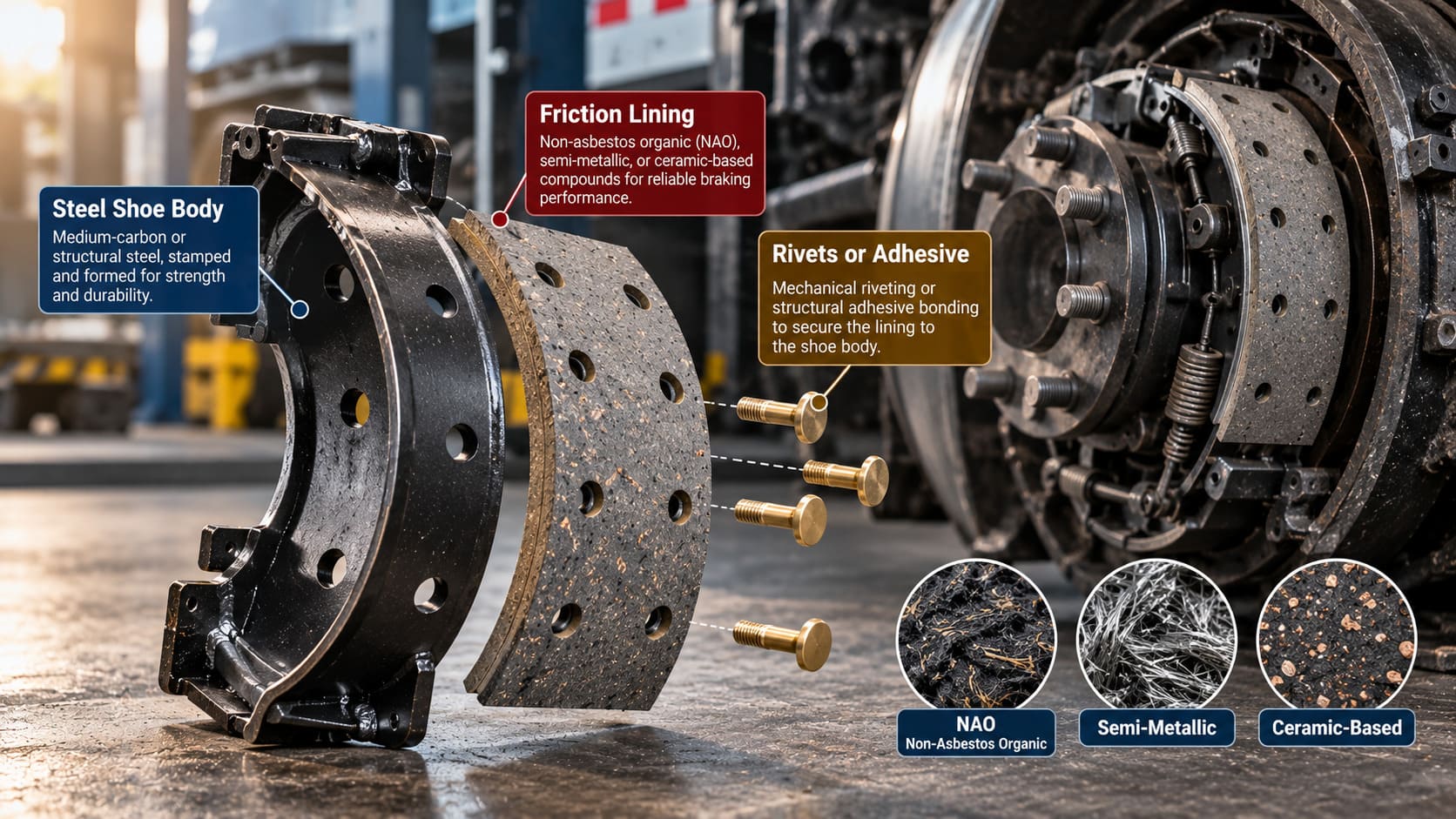
A truck brake shoe is typically made of three core elements: a steel shoe body (the backing plate or table), a friction lining, and a joining method — either rivets or adhesive bonding.1 The steel body provides structural support. The friction lining generates the stopping force. The joining method holds both together under repeated heat and mechanical stress. Real performance depends on how well each element is manufactured and how consistently those standards are maintained across production batches.
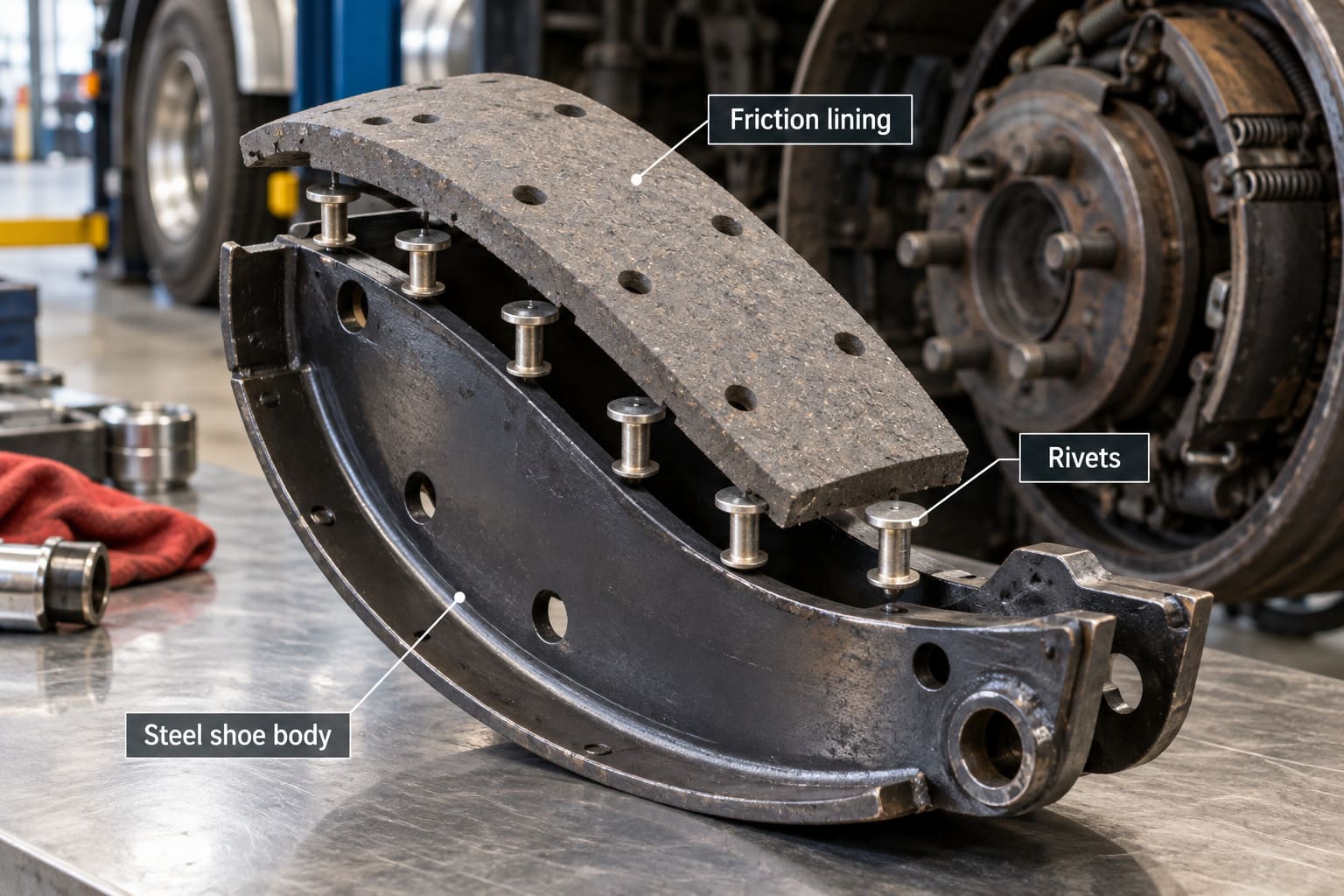
Knowing the names of the three layers is a starting point, not a purchasing decision. What actually separates a reliable brake shoe from a risky one — at similar price points, from different suppliers — comes down to material grade, process control, dimensional consistency, and whether the product meets the compliance standards your market requires. The sections below work through each of those dimensions.
What Is the Steel Body of a Truck Brake Shoe Made Of?
The steel shoe body is the foundation of the assembly, and it carries loads that most buyers underestimate. Cheap-looking and interchangeable on the surface, the backing plate is where dimensional and metallurgical differences between suppliers become structurally meaningful.
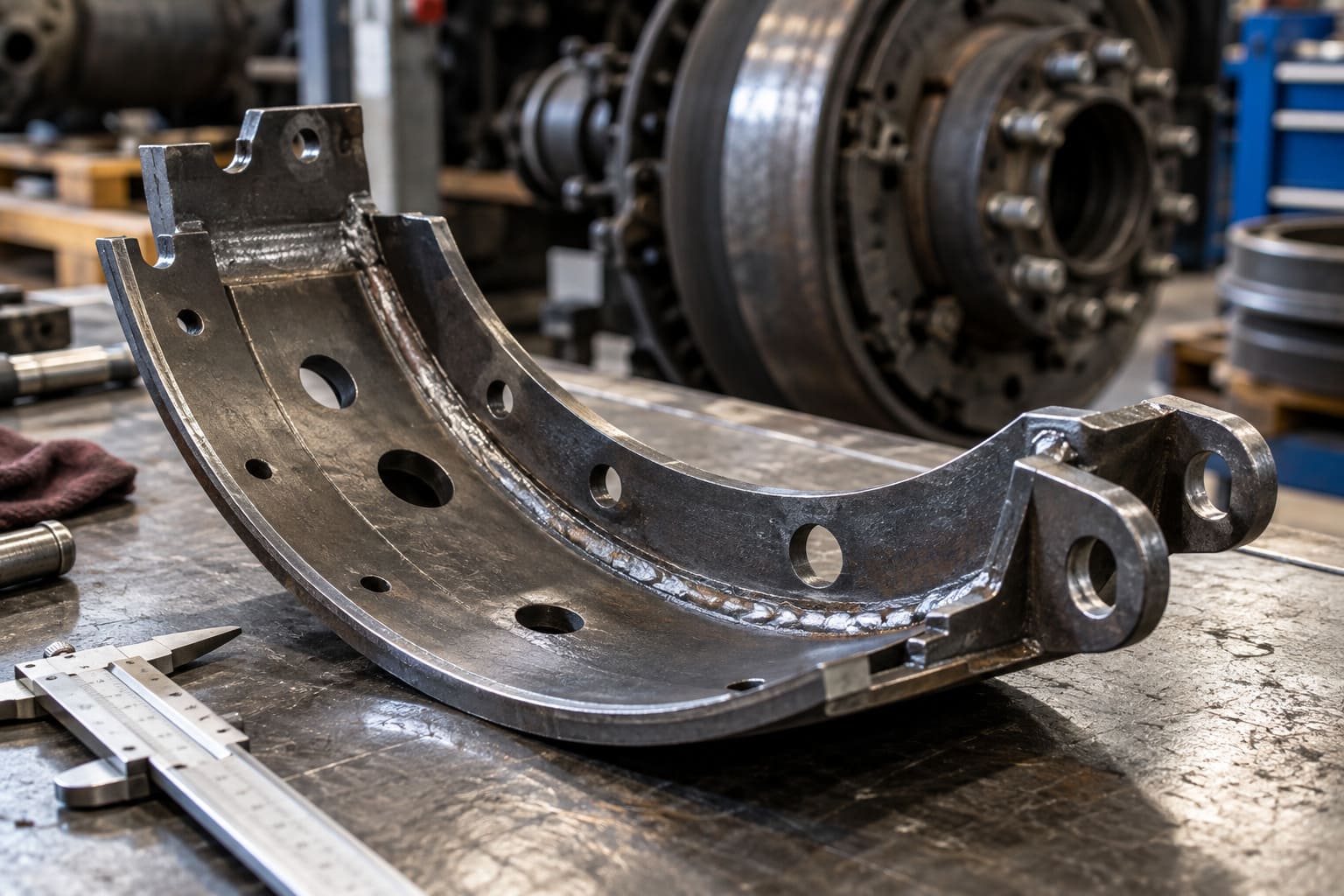
A truck brake shoe's steel body is typically formed from medium-carbon or structural steel, stamped or pressed into a curved table and web profile that matches the brake drum geometry. The steel must resist deformation under repeated thermal cycling and mechanical load.2 Grade selection, forming precision, and weld quality all affect how the shoe performs over its service life.
Why Steel Grade Matters More Than Weight
A heavier shoe body does not automatically mean a better one.3 I have seen buyers use weight as a proxy for quality — and it is an understandable shortcut — but steel weight is a function of thickness, geometry, and material density, not performance grade.
What matters in practice:
- Yield strength and hardness: Lower-grade steel deforms under high-load braking cycles. Once the table warps slightly, the lining contact pattern changes, and uneven wear accelerates.
- Forming tolerance: The table's curvature must match the drum diameter within tight tolerances. Dimensional deviation causes lining-to-drum misalignment, which reduces effective contact area and braking force.4
- Weld integrity at the web-to-table joint: The web transfers force from the anchor pin to the table. A weak or inconsistent weld here is a structural failure risk under repeated load.
- Surface condition before lining attachment: Rust, mill scale, or contamination on the bonding surface affects adhesive strength. In a riveted design, hole position and burr removal matter for long-term rivet retention.
In procurement conversations, I find that buyers who ask for material certificates or steel grade documentation are the ones who catch quality inconsistencies early. A supplier who cannot produce that documentation is worth noting.
What to Ask a Supplier About the Steel Body
| Question | Why It Matters |
|---|---|
| What steel grade or standard do you use? | Confirms material specification is controlled |
| Do you provide incoming material inspection records? | Shows batch traceability |
| What is the forming tolerance for table curvature? | Affects fitment and lining contact |
| How are web-to-table welds inspected? | Structural integrity checkpoint |
| Is the surface treated before lining attachment? | Affects bond strength and corrosion resistance |
What Are Truck Brake Shoe Friction Linings Made Of?
The friction lining is the component most buyers focus on — and it is genuinely important. But friction material selection involves trade-offs between stopping power, wear rate, heat tolerance, noise, and regulatory compliance. No single lining material wins across all of those dimensions in every operating environment.
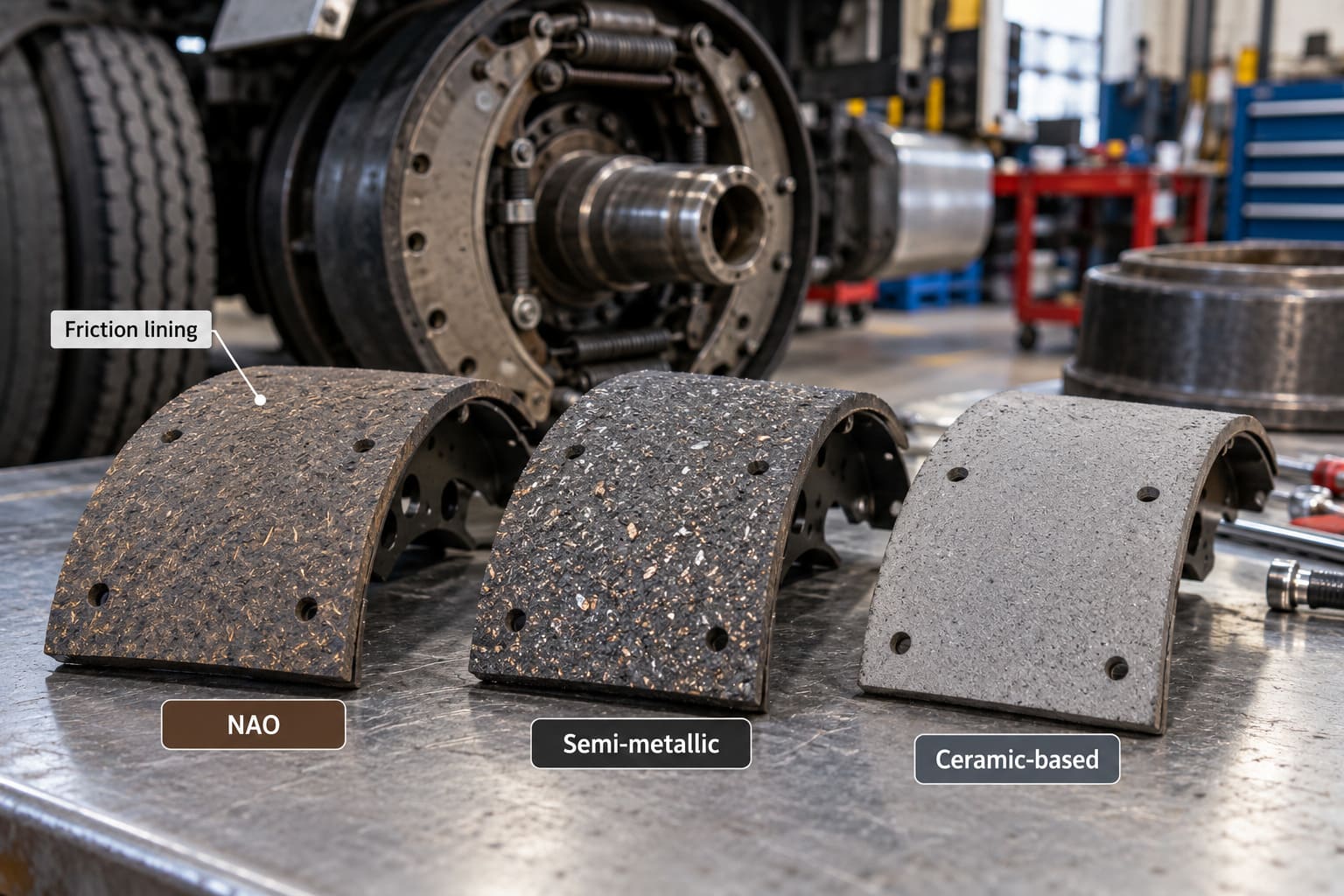
Truck brake shoe friction linings are generally made from one of three broad material categories: non-asbestos organic (NAO), semi-metallic, or ceramic-based compounds.5 Each uses a binder, reinforcing fibers, fillers, and friction modifiers. The specific formulation determines how the lining behaves under heat, load, and moisture — and whether it complies with regulations in your target market.
Non-Asbestos Organic (NAO) Linings
NAO linings replaced asbestos formulations as the industry standard after asbestos was phased out for health and environmental reasons.6 They typically use aramid fibers, glass fibers, or other organic reinforcements in a resin binder matrix.
Characteristics:
- Generally softer on drum surfaces
- Moderate heat tolerance compared to semi-metallic options
- Lower noise tendency in normal operating conditions
- More common in lighter-duty or mixed-service applications
NAO is a broad category. Formulation quality varies significantly between suppliers, and the "NAO" label alone does not guarantee performance consistency.
Semi-Metallic Linings
Semi-metallic linings incorporate steel wool, iron powder, or other metallic fibers into the compound.7 This increases thermal conductivity and wear resistance.8
Characteristics:
- Higher heat tolerance — relevant for heavy-load or mountain routes
- Typically harder on drum surfaces than NAO
- Greater friction stability at elevated temperatures
- Can generate more noise under certain conditions
For North American Class 7–8 trucks operating under FMVSS 121 brake performance requirements, semi-metallic linings are common in severe-duty configurations.9
Ceramic-Based Linings
Ceramic compounds are used in higher-performance or specialty applications. They offer good heat dissipation and low dust generation, but cost and availability vary.
A note on material names in supplier conversations:
In my experience, friction material names are often used loosely in supplier quotations. "Semi-metallic" on a product sheet does not confirm a specific metallic content percentage, binder quality, or friction coefficient range. Buyers evaluating a new supplier should request friction coefficient test data (typically expressed as a µ value range) and ask which standards the testing references — FMVSS 121, SAE J66110, or others depending on the market.
Friction Lining — Procurement Evaluation Table
| Factor | What to Look For |
|---|---|
| Material category | NAO, semi-metallic, ceramic — ask for clarification |
| Friction coefficient range | µ value range at operating temperatures |
| Heat resistance rating | Especially relevant for heavy-load or severe-duty routes |
| Applicable standards | FMVSS 121 (US), SAE J661, or regional equivalents |
| Asbestos-free certification | Required for US, Canadian, and most SA markets |
| Wear rate data | Estimated service life under defined conditions |
How Are Friction Linings Attached to the Shoe Body?
The joining method holds the friction lining to the steel body under repeated cycles of heat, pressure, and vibration. This is not a detail — it is a failure mode.
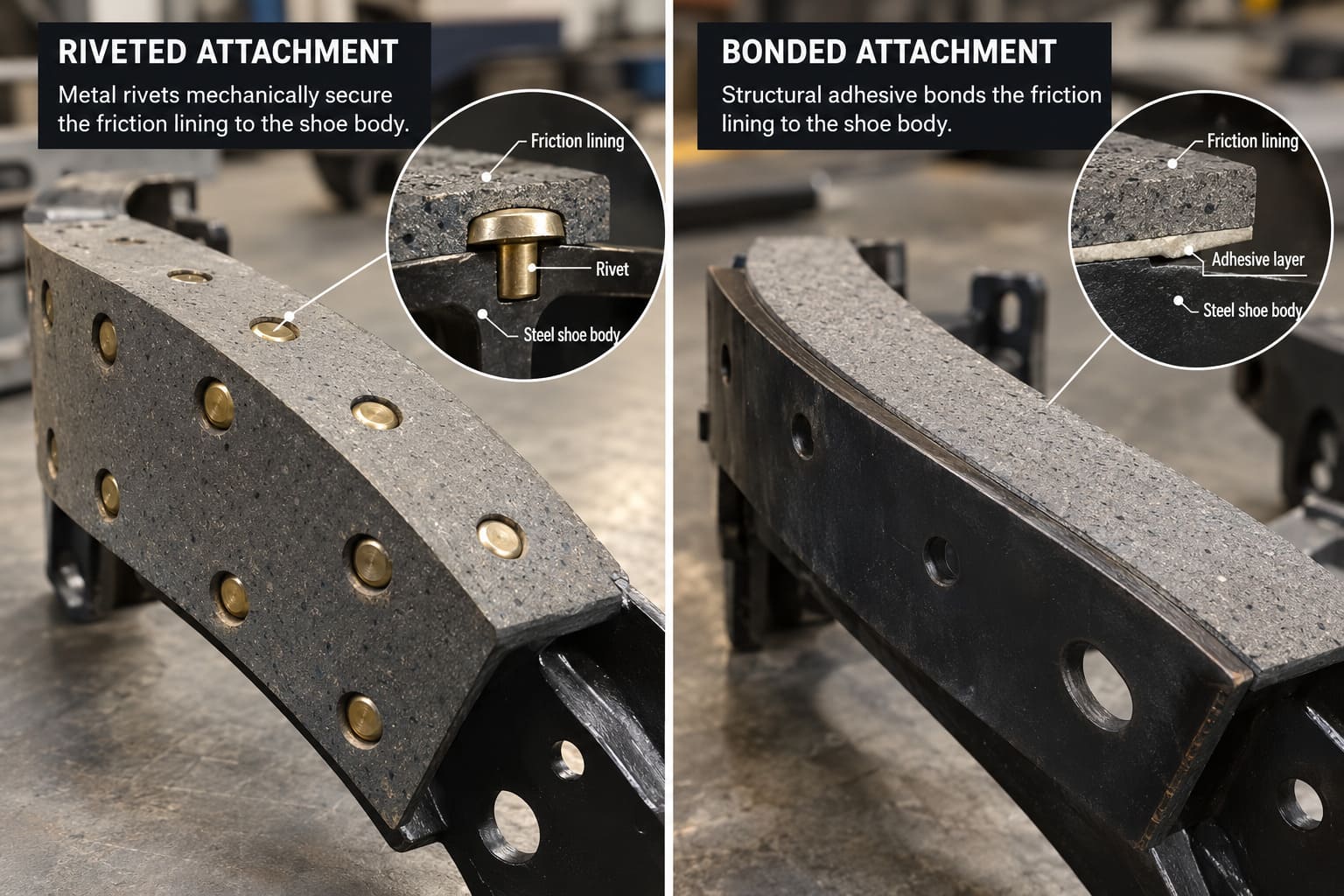
Friction linings are attached to the truck brake shoe body using either mechanical riveting or adhesive bonding. Each method has different performance characteristics, suitable use cases, and inspection criteria. The choice affects heat resistance, lining replacement options, and failure mode when the lining approaches the end of its service life.
Riveted Attachment
Riveting uses metal fasteners — typically brass or aluminum rivets — to mechanically secure the lining to the shoe table.
Advantages:
- Visible inspection possible: rivet head depth indicates remaining lining thickness
- Lining can theoretically be replaced without scrapping the shoe body (in a reline operation)
- Reliable performance at high temperatures — no adhesive degradation risk
Risks to watch:
- Rivet hole placement must be precise. Misaligned holes cause stress concentration in the lining.
- Rivet material compatibility with lining hardness matters — wrong rivet material can crack the lining during installation.
- Loose rivets create a noise and performance issue before visible wear becomes obvious.
Bonded Attachment
Bonded (glued) attachment uses structural adhesive to join the lining to the shoe table. It is common in many aftermarket applications and some OEM configurations.
Advantages:
- Full contact surface bonding — no rivet holes that interrupt contact area
- Cleaner installation process in automated production
- Generally adequate for standard operating temperature ranges
Risks to watch:
- Adhesive bond quality is invisible post-production. It depends entirely on surface preparation, adhesive grade, cure process, and quality control.
- High-heat or severe-duty applications can exceed adhesive temperature limits, leading to lining separation — a serious safety failure mode.
- Bond quality is harder for a buyer to verify without destructive testing or supplier process documentation.
What to Ask About the Joining Method
- What adhesive grade or rivet specification is used?
- What is the maximum continuous operating temperature rating for the bond?
- How is bond quality or rivet retention tested in production?
- Is 100% inspection performed, or is AQL sampling used?
A supplier with documented process controls and a clear answer to these questions is demonstrating the kind of consistency that actually matters at volume.
Why Do Truck Brake Shoe Prices Vary So Much?
Price variation in truck brake shoes confuses many buyers — especially when two products look nearly identical. The visible geometry is similar. The weight is close. The product sheet says the same friction material category. But the prices differ by 20%, 40%, or more.
The price of a truck brake shoe reflects the combined cost and quality of its steel grade, lining formulation, joining process, dimensional control, batch inspection rigor, and the supplier's overhead for maintaining consistent standards. Buyers who focus only on unit price often discover the cost of inconsistency later — through returns, warranty claims, or fitment issues at scale.
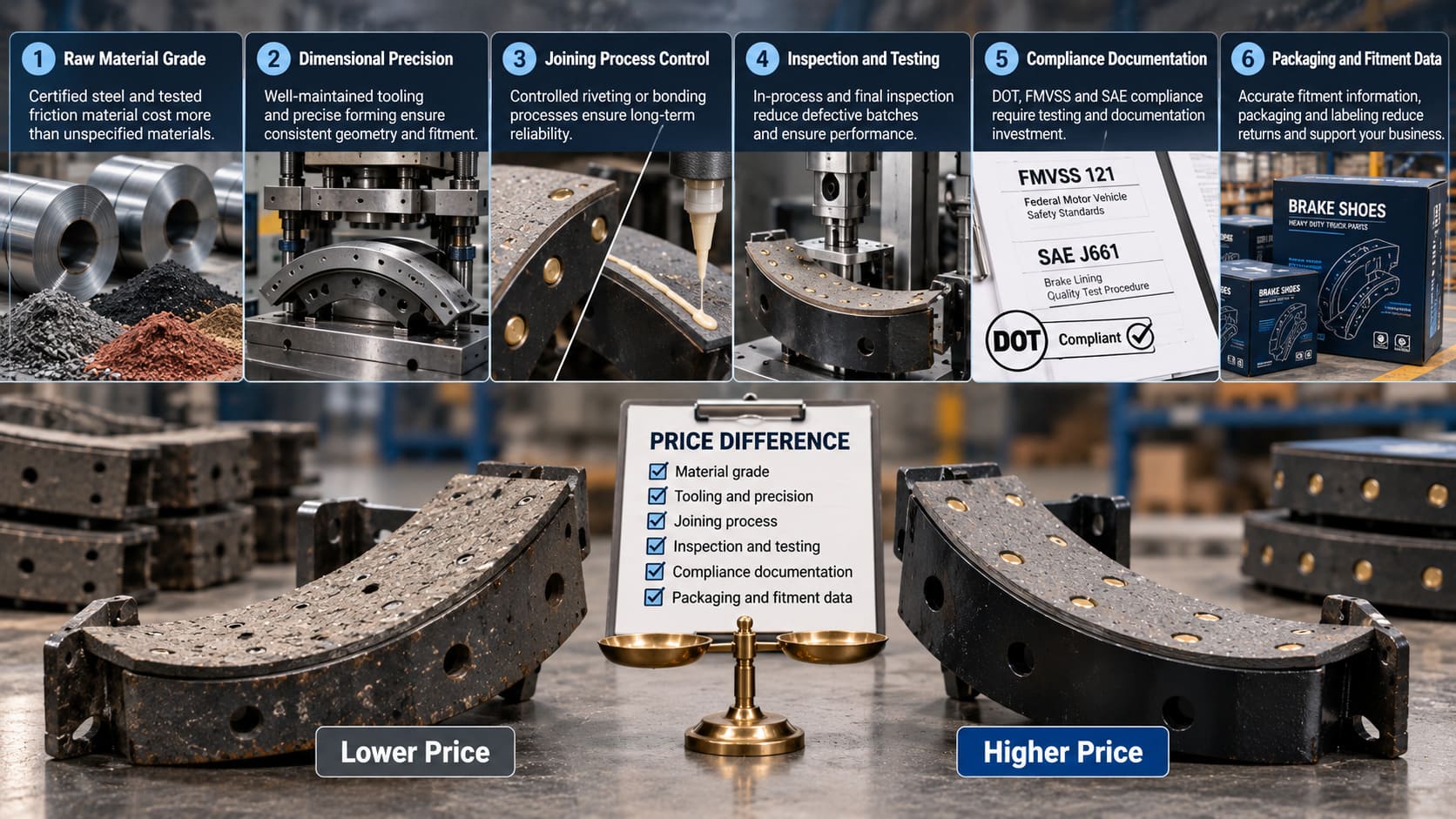
Where the Cost Differences Actually Come From
1. Raw material grade Steel and friction material inputs have meaningful price tiers. A supplier using certified, traceable steel and tested lining compounds carries higher input costs than one using unspecified materials.
2. Dimensional precision and tooling investment Consistent shoe geometry requires well-maintained stamping dies and forming tooling. Tooling investment is ongoing. Suppliers who defer tooling maintenance produce shoes with cumulative dimensional drift — which buyers see as fitment complaints.
3. Bonding or riveting process control Adhesive bonding requires controlled surface preparation, adhesive application, and curing conditions.11 Cutting corners on any of these steps is invisible in the finished product — until the lining separates.
4. In-process and final inspection Multi-node inspection, AQL sampling, and performance testing (pressure resistance, heat cycling, tensile pull on bonded linings) all add cost. They also reduce the probability of a defective batch reaching your customer.
5. Compliance documentation DOT certification, FMVSS compliance documentation, and SAE standard references require investment in testing, documentation, and audit processes. That cost is built into a compliant supplier's pricing.
6. Packaging, labeling, and OEM cross-reference accuracy For distributors, incorrect cross-reference numbers or vague fitment charts create costly returns. Accurate fitment data requires investment in vehicle application research.
The practical implication: when evaluating a lower-priced quotation, ask which of these cost areas the supplier has reduced — and whether you are comfortable accepting the corresponding risk.
Frequently Asked Questions
Are heavier truck brake shoes always better quality?
Not necessarily. Weight reflects geometry, steel thickness, and material density — not performance grade. A heavier shoe made from lower-grade steel may deform faster under load than a lighter shoe made from higher-specification material. Evaluate steel grade, dimensional tolerance, and process documentation rather than weight alone.
What does "non-asbestos" mean on a brake shoe product sheet?
It confirms the friction lining does not contain asbestos fibers, which are banned or restricted in most major markets including the US, Canada, and most of South America. However, "non-asbestos" is a minimum compliance statement — it does not specify lining formulation quality, friction coefficient, or heat resistance. Buyers should ask for additional material and performance data.
How do I know if a truck brake shoe meets FMVSS 121 requirements?
Ask the supplier for documentation specifically referencing FMVSS 121 compliance. Certification claims should be verifiable — look for test reports, DOT certification numbers, or documentation that identifies the testing body. Do not accept a product sheet statement alone as confirmation. For application-specific compliance decisions, involve a qualified technical advisor.
Can I use the same brake shoe specification across different truck models?
Not automatically. Truck brake shoes are application-specific. The shoe table geometry, web profile, lining thickness, and friction material must match the brake system specification for each axle position and vehicle model. Using an incorrect specification — even one that physically fits — can affect brake balance and stopping performance.12 Always verify the correct part number and fitment against the vehicle's service documentation.
What is the difference between riveted and bonded brake shoes for a buyer?
Riveted shoes allow visual inspection of remaining lining depth and can be relined in some operations. Bonded shoes offer full contact area but rely entirely on adhesive quality — which is harder to inspect externally. For high-heat or severe-duty applications, ask specifically about the adhesive temperature rating on bonded shoes.
Conclusion
Truck brake shoes are made of a steel shoe body, a friction lining, and a joining method — but understanding those three components is only the beginning of a sound procurement decision. The more useful questions involve steel grade, lining formulation and compliance, joining process quality, dimensional consistency, and whether the supplier's quality control can deliver that consistency across batches. Price differences between suppliers almost always trace back to one or more of these areas.
As a buyer focused on the North American or South American heavy-duty aftermarket, the goal is not the cheapest brake shoe or the most technically impressive-sounding lining material. The goal is a product that fits correctly, performs consistently, meets the compliance requirements of your market, and comes from a supplier whose process controls you can verify.
If you are evaluating brake shoe suppliers or working through a specification question for a specific truck application, we are glad to walk through the details. Contact our team to discuss fitment, compliance documentation, and sourcing options for your market.
"Brake lining for transit buses : bonded vs. bolted", https://rosap.ntl.bts.gov/view/dot/11507/dot_11507_DS1.pdf. A technical automotive reference describes drum brake shoes as metal supports carrying friction linings, with linings commonly attached by rivets or bonding methods. Evidence role: definition; source type: education. Supports: A source should describe the main components of a drum brake shoe and the common methods used to attach friction lining to the shoe body.. Scope note: The source may describe brake shoes generally rather than heavy-duty truck brake shoes specifically. ↩
"Thermo-stress-wear multiphysics coupling mechanism in ...", https://www.sciencedirect.com/science/article/abs/pii/S0301679X25003998. Research on drum brake components indicates that braking loads and frictional heating create coupled thermal and mechanical stresses that can influence component deformation and contact behavior. Evidence role: mechanism; source type: paper. Supports: A source should explain that braking creates heat and mechanical loading that can affect brake component deformation or dimensional stability.. Scope note: The evidence supports the underlying mechanism and may not test the exact shoe designs discussed in the article. ↩
"Mechanical properties of structural steel", https://www.govinfo.gov/content/pkg/GOVPUB-C13-8620f9e60cbfd1c3ac9e0bf55ba3770c/pdf/GOVPUB-C13-8620f9e60cbfd1c3ac9e0bf55ba3770c.pdf. Materials engineering references distinguish component mass from mechanical performance, noting that strength and deformation resistance depend on properties such as yield strength, hardness, geometry, and processing. Evidence role: general_support; source type: education. Supports: A source should establish that performance of steel components depends on mechanical properties, design geometry, and manufacturing tolerances rather than mass alone.. Scope note: This is contextual support from general materials engineering rather than a brake-shoe-specific comparative test. ↩
"IRJET- Effect of Changing Drum Brakes Lining Form on the ...", https://www.academia.edu/39649306/IRJET_Effect_of_Changing_Drum_Brakes_Lining_Form_on_the_Brake_Performance. Brake-system studies show that lining contact distribution in drum brakes affects frictional force generation and wear behavior, making dimensional alignment relevant to braking performance. Evidence role: mechanism; source type: paper. Supports: A source should connect drum brake geometry or shoe alignment with lining contact distribution and braking performance.. Scope note: The source may evaluate modeled or laboratory brake systems rather than all commercial truck shoe variants. ↩
"Differences in Wear and Material Integrity of NAO and Low ...", https://pmc.ncbi.nlm.nih.gov/articles/PMC8509441/. Reviews of automotive brake friction materials commonly classify non-asbestos organic, semi-metallic, and ceramic formulations as major friction-material categories. Evidence role: definition; source type: paper. Supports: A source should identify NAO, semi-metallic, and ceramic formulations as recognized categories of brake friction materials.. Scope note: Some sources discuss brake pads and linings broadly, so the classification may be general to friction brakes rather than limited to truck brake shoes. ↩
"Guidance For Preventing Asbestos Disease Among Auto ...", https://nepis.epa.gov/Exe/ZyPURL.cgi?Dockey=20012LJK.TXT. Government occupational-health and environmental sources document historical asbestos use in brake friction materials and the subsequent shift toward non-asbestos alternatives because asbestos exposure is hazardous. Evidence role: historical_context; source type: government. Supports: A source should document that asbestos was historically used in brake friction materials and restricted or replaced because of recognized health hazards.. Scope note: The source may address asbestos control and replacement broadly rather than naming NAO as the exclusive successor formulation. ↩
"Compositions, Functions, and Testing of Friction Brake ... - INFO", https://info.ornl.gov/sites/publications/Files/Pub57043.pdf. Technical literature on brake friction materials describes semi-metallic formulations as mixtures containing metallic fibers or powders, often including steel or iron constituents, within a binder matrix. Evidence role: definition; source type: paper. Supports: A source should describe the composition of semi-metallic brake friction materials and identify metal fibers or powders as constituents.. Scope note: Exact formulations vary by manufacturer, so the source supports the material category rather than a specific product recipe. ↩
"Temperature Influence on Brake Pad Friction Coefficient ...", https://pmc.ncbi.nlm.nih.gov/articles/PMC10779514/. Tribology studies of brake friction materials report that metallic constituents can improve heat conduction and influence wear resistance in friction composites. Evidence role: mechanism; source type: paper. Supports: A source should explain how metallic additives in brake friction materials affect heat conduction and wear behavior.. Scope note: The effect depends on formulation, operating temperature, and counterface material, so it should be cited as a general mechanism rather than a universal outcome. ↩
"Federal Motor Vehicle Safety Standards No. 121; Air Brake ...", https://www.federalregister.gov/documents/2008/03/07/E8-4460/federal-motor-vehicle-safety-standards-no-121-air-brake-systems. FMVSS No. 121 establishes federal performance and equipment requirements for air brake systems on covered heavy vehicles in the United States. Evidence role: general_support; source type: government. Supports: A source should verify that FMVSS 121 applies brake performance requirements to vehicles with air brake systems, including heavy trucks.. Scope note: A government source will verify the regulatory framework but may not directly substantiate the prevalence of semi-metallic linings in severe-duty aftermarket configurations. ↩
"J661_202110 : Brake Lining Quality Test Procedure", https://www.sae.org/standards/j661_202110-brake-lining-quality-test-procedure. SAE J661 is identified by SAE as a test procedure for evaluating the friction characteristics of brake lining materials under specified test conditions. Evidence role: definition; source type: institution. Supports: A source should identify SAE J661 as a brake lining friction-material test procedure or standard used to characterize friction behavior.. Scope note: Access to the full SAE standard may be restricted, and the standard’s test conditions may not replicate every vehicle operating condition. ↩
"Towards Reliable Adhesive Bonding - PMC - NIH", https://pmc.ncbi.nlm.nih.gov/articles/PMC12195023/. Adhesive-bonding research shows that surface preparation, adhesive application control, and curing conditions are key determinants of joint strength and durability. Evidence role: mechanism; source type: research. Supports: A source should explain that adhesive bond strength and reliability depend on surface preparation, adhesive application variables, and curing conditions.. Scope note: The support is general to structural adhesive bonding and may not directly test brake shoe adhesive systems. ↩
"Air Brake Systems", https://www.nhtsa.gov/document/121stoppingdistancefrpdf. Heavy-vehicle brake safety guidance indicates that brake component condition and compatibility affect braking effectiveness, balance, and stopping performance. Evidence role: general_support; source type: government. Supports: A source should support that brake component condition, compatibility, and friction performance influence brake balance and stopping performance in heavy vehicles.. Scope note: The source may address brake maintenance and compliance broadly rather than the exact scenario of a visually fitting but incorrectly specified shoe. ↩