Sourcing brass air fittings for heavy-duty truck applications looks straightforward on paper — dimensions match, price fits the budget, delivery window works. But raw brass quality is one of the most overlooked upstream variables in fitting reliability, and poor material consistency can quietly drive up leakage claims, warranty returns, and emergency reorder costs long after the initial purchase decision is made.
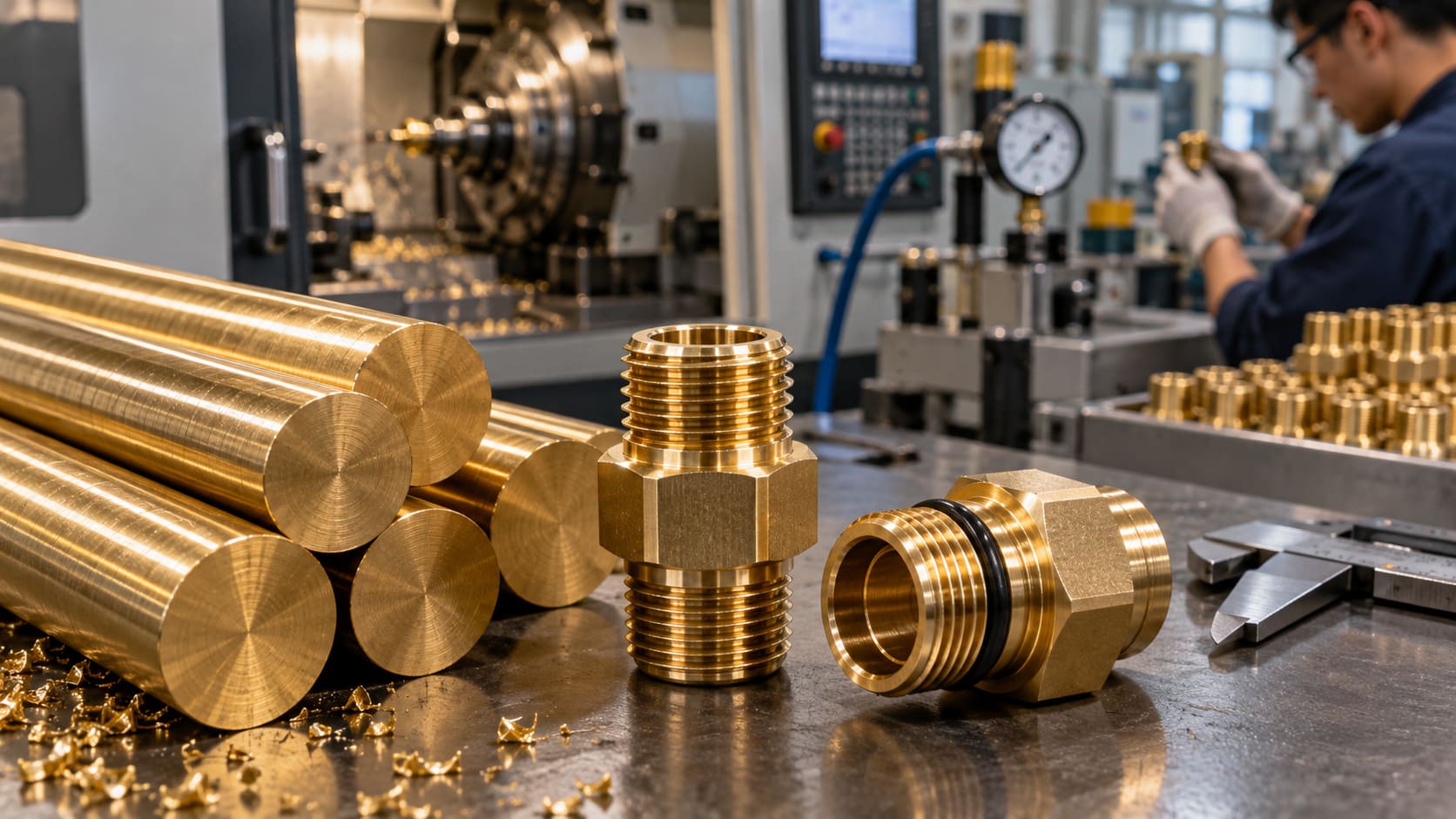
Raw brass quality directly affects how consistently an air fitting can be machined, threaded, and sealed.1 Inconsistent alloy composition, inclusion levels, or mechanical properties in incoming brass rod stock can create instability during turning, thread forming, and sealing surface finishing2 — risks that may not appear until fittings are in service under pressure and temperature cycling. Buyers cannot eliminate this risk through price comparison alone; they need to evaluate how a supplier controls and documents incoming material and process consistency.
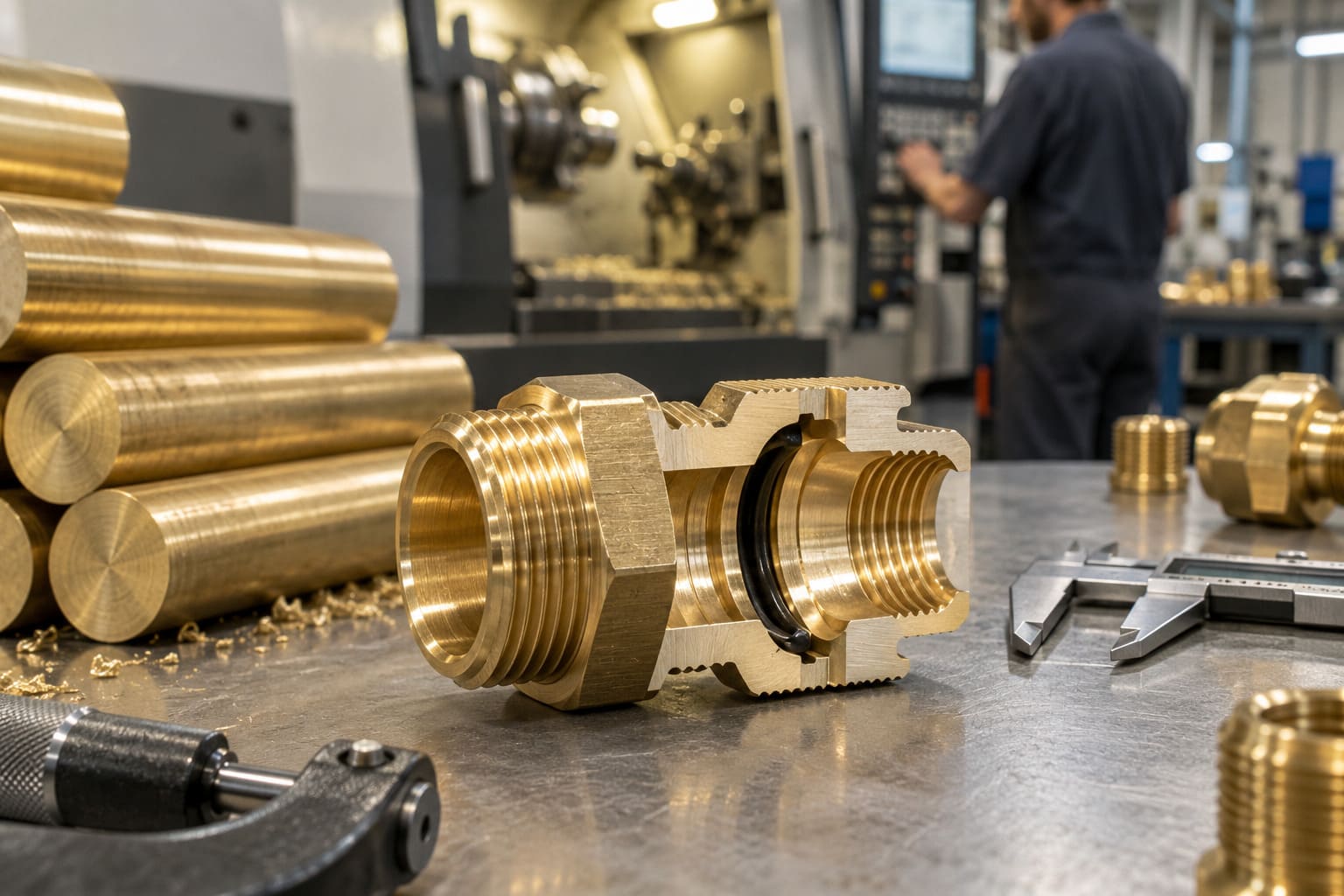
Understanding how raw brass affects fitting performance requires looking at the full production chain — from incoming rod stock through machining, inspection, and assembly. The sections below break down each stage where material quality plays a role, and what procurement teams can reasonably ask about when evaluating suppliers.
Does Brass Alloy Composition Actually Matter for Air Fittings?
Procurement managers evaluating brass air fittings often focus on dimensions, pressure ratings, and certifications. The alloy composition behind the part number rarely appears on a purchase order. But the specific brass alloy used, and how consistently it is controlled batch to batch, can affect everything that happens downstream in the machining process.
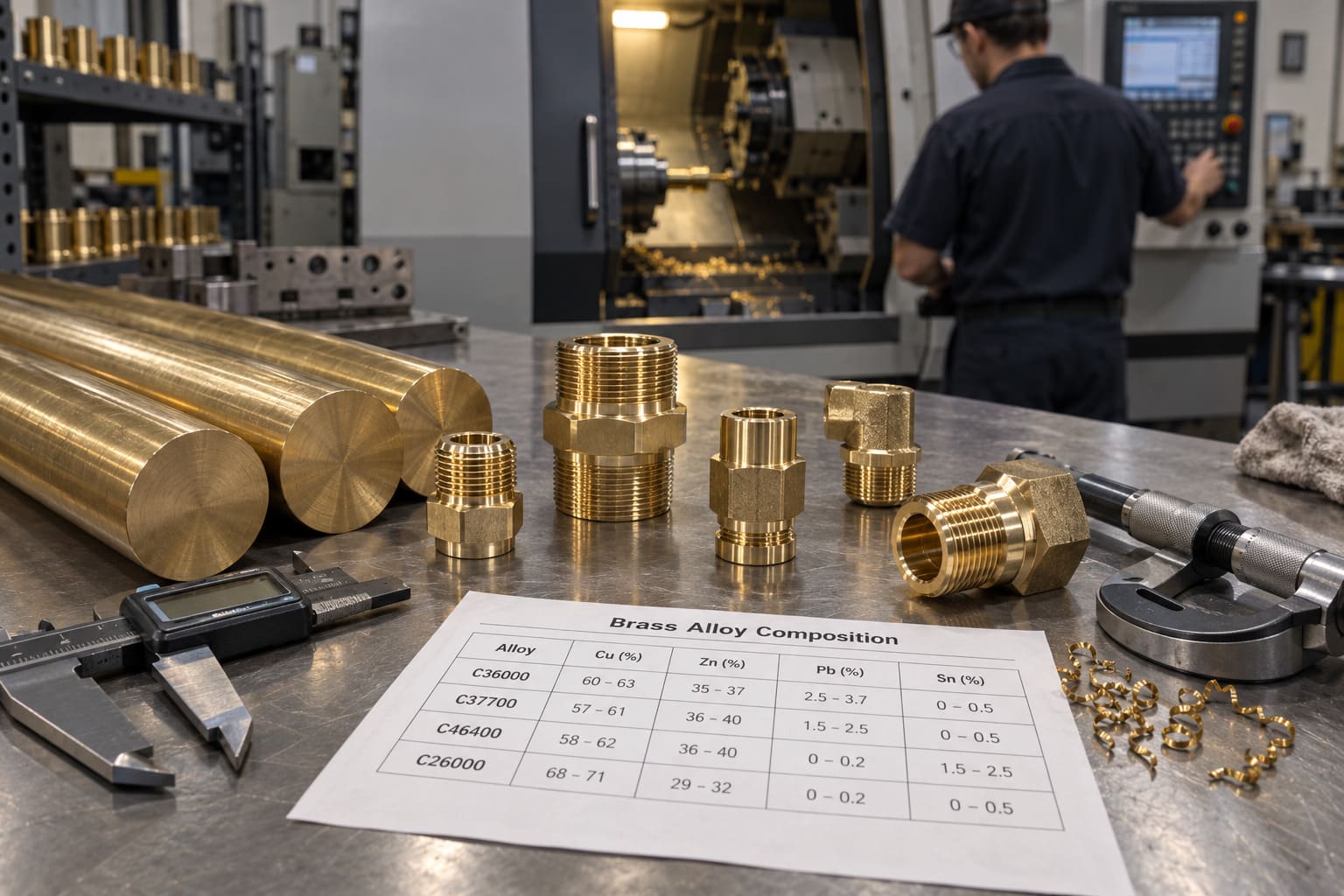
Brass alloys used in air fittings are typically copper-zinc formulations, often with small additions of lead or other elements to improve machinability.3 The specific composition ratio affects material hardness, chip formation during turning, and how well threads and sealing surfaces finish.4 Inconsistent alloy composition between batches can produce variable machining behavior, which in turn can affect dimensional accuracy and surface quality — even when tooling and process parameters stay the same.
Most buyers will never see a material certificate unless they ask for one. That gap is worth closing.
Common Brass Alloys in Air Fitting Production
Different brass grades serve different performance requirements. The table below shows alloys commonly encountered in heavy-duty pneumatic fitting applications:
| Alloy | Composition (approx.) | Key Characteristic | Common Use |
|---|---|---|---|
| C36000 (Free-Cutting Brass)5 | 61.5% Cu, 35.5% Zn, 3% Pb | Excellent machinability | Threaded fittings, valves |
| C37700 (Forging Brass)6 | 59% Cu, 38% Zn, 2% Pb | High forgeability | Forged bodies |
| C46400 (Naval Brass)7 | 60% Cu, 39.2% Zn, 0.8% Sn | Corrosion resistance | Marine/harsh environment use |
| C26000 (Cartridge Brass)8 | 70% Cu, 30% Zn | High ductility | Drawn parts |
For most threaded and compression-style air fittings used in North and South American heavy-duty truck pneumatic systems, free-cutting brass grades dominate — because machinability directly affects production yield, thread quality, and sealing surface finish. When incoming rod stock deviates from specification, even by a small margin, it can change the way material behaves under cutting tools.
What "Inconsistent Composition" Looks Like in Practice
From our incoming inspection experience at ROADSPOWER, batches of brass rod that arrive without mill certificates or with unverified composition data introduce unpredictability at the machining stage. This can appear as:
- Variable chip formation — material that machines cleanly in one batch may produce longer, stringy chips in another, which can affect surface finish
- Inconsistent hardness — softer or harder material than expected can cause dimensional drift during high-volume turning runs
- Surface porosity or inclusions — internal material defects not visible on the rod surface can become exposed during machining, creating leak paths on sealing surfaces
None of these effects are guaranteed from a single bad batch. But their probability increases when composition control and incoming verification are absent. For a buyer ordering 10,000+ fittings per shipment, even a low defect rate translates into real field exposure.
How Does Raw Brass Quality Affect Machining and Thread Quality?
Thread quality is one of the most critical functional attributes of a pneumatic air fitting. A fitting with poor threads may install and initially hold pressure — then develop a slow leak under thermal cycling, vibration, or repeated make-and-break connections.9 Machining quality is the direct cause, but raw brass quality is an upstream enabler or constraint.
Brass machinability is not fixed — it depends on alloy grade, material consistency, and whether the rod stock was produced and stored to specification. When raw material properties vary, machining parameters set for one batch may not produce the same result on the next. Thread form accuracy, sealing taper finish, and hex body dimensions can all drift, increasing the risk of poor fit, cross-threading during installation, and sealing failure under operating pressure.
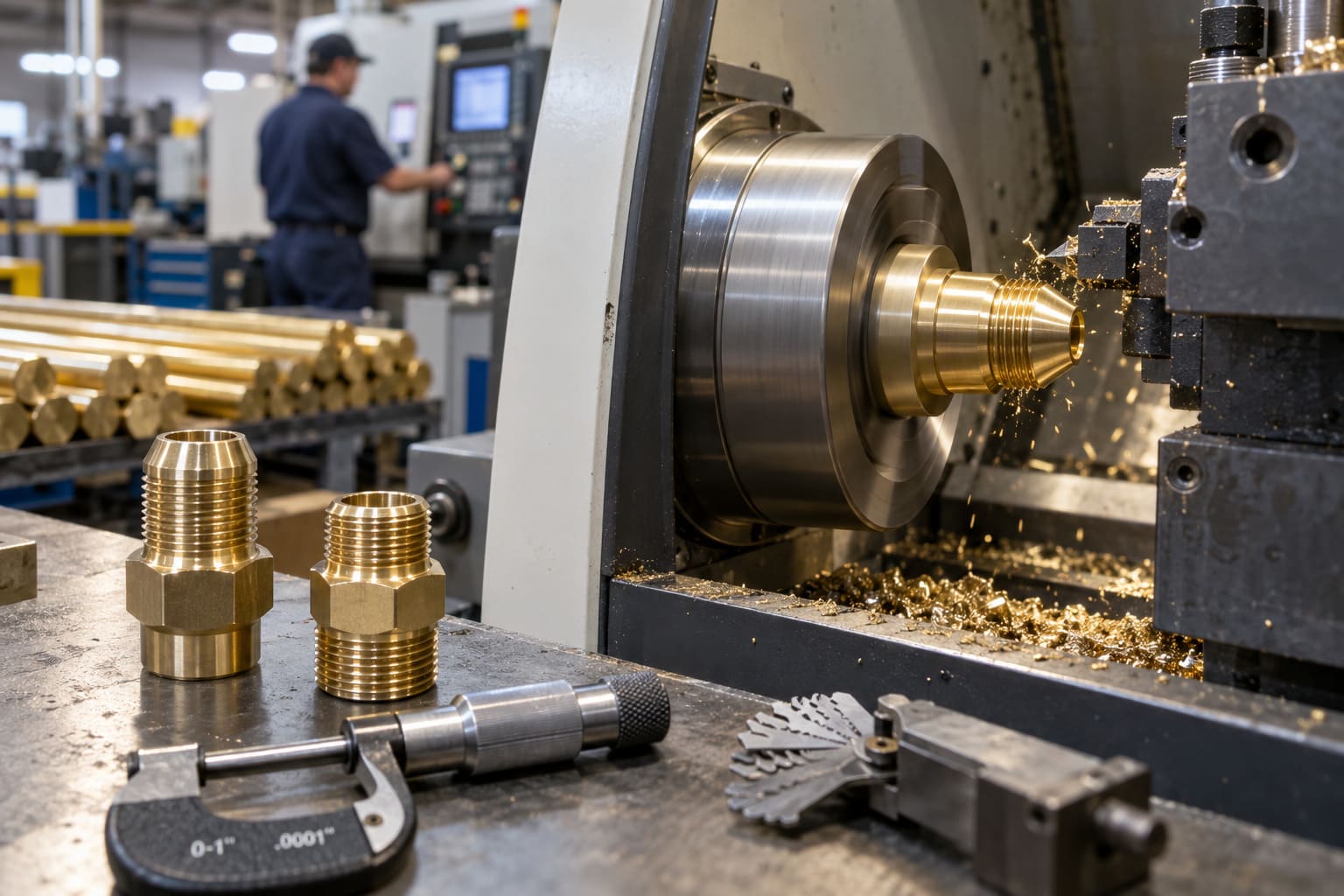
Machining quality and raw material quality are not the same variable — but they interact closely.
Thread Standards and Why Dimensional Accuracy Matters
Heavy-duty truck pneumatic systems in North America use well-established thread standards. Most air fitting connections follow:
- NPT (National Pipe Tapered Thread) — the most common standard in North American truck air systems
- NPTF (Dryseal) — a tighter tolerance variant designed for metal-to-metal sealing without sealant
- SAE straight threads with O-ring sealing
Each standard has defined tolerance bands.10 Fittings that machine within tolerance will engage correctly with mating components. Fittings at the edge of tolerance — or outside it — may appear to install correctly but fail to seal predictably.
The Material-to-Thread Quality Link
From a production standpoint, maintaining thread accuracy across a high-volume run requires material that behaves consistently under the cutting tool. When incoming brass rod:
- Has variable hardness across a batch
- Contains internal inclusions that interrupt the cut
- Has inconsistent grain structure due to poor rod production
...the result is dimensional variation that accumulates. Thread pitch, taper angle, and sealing surface roughness can all be affected. Good CNC tooling and experienced operators reduce this risk — but they cannot fully compensate for material that is fundamentally inconsistent.
This is why, at ROADSPOWER, incoming material inspection is not a formality. Batch compliance certificates are verified, and sampling is conducted before rod stock enters production. It is not a guarantee of zero defects, but it reduces the probability of material-sourced machining variation reaching finished product.
What Testing Should Buyers Expect From a Brass Fitting Supplier?
Knowing that raw brass can affect reliability is useful background. The practical question for a procurement manager is: what testing and documentation should a qualified supplier be able to show? Certifications matter, but they are documents representing a point-in-time audit, not a continuous production guarantee.
Brass air fitting suppliers serving safety-critical truck pneumatic systems should be able to demonstrate ongoing production testing — not just a certification certificate. Relevant tests include air tightness testing, pressure resistance testing, tensile strength verification, and temperature resistance evaluation.11 Batch traceability from incoming material to finished product allows defects to be isolated and root-caused rather than discovered through field returns.
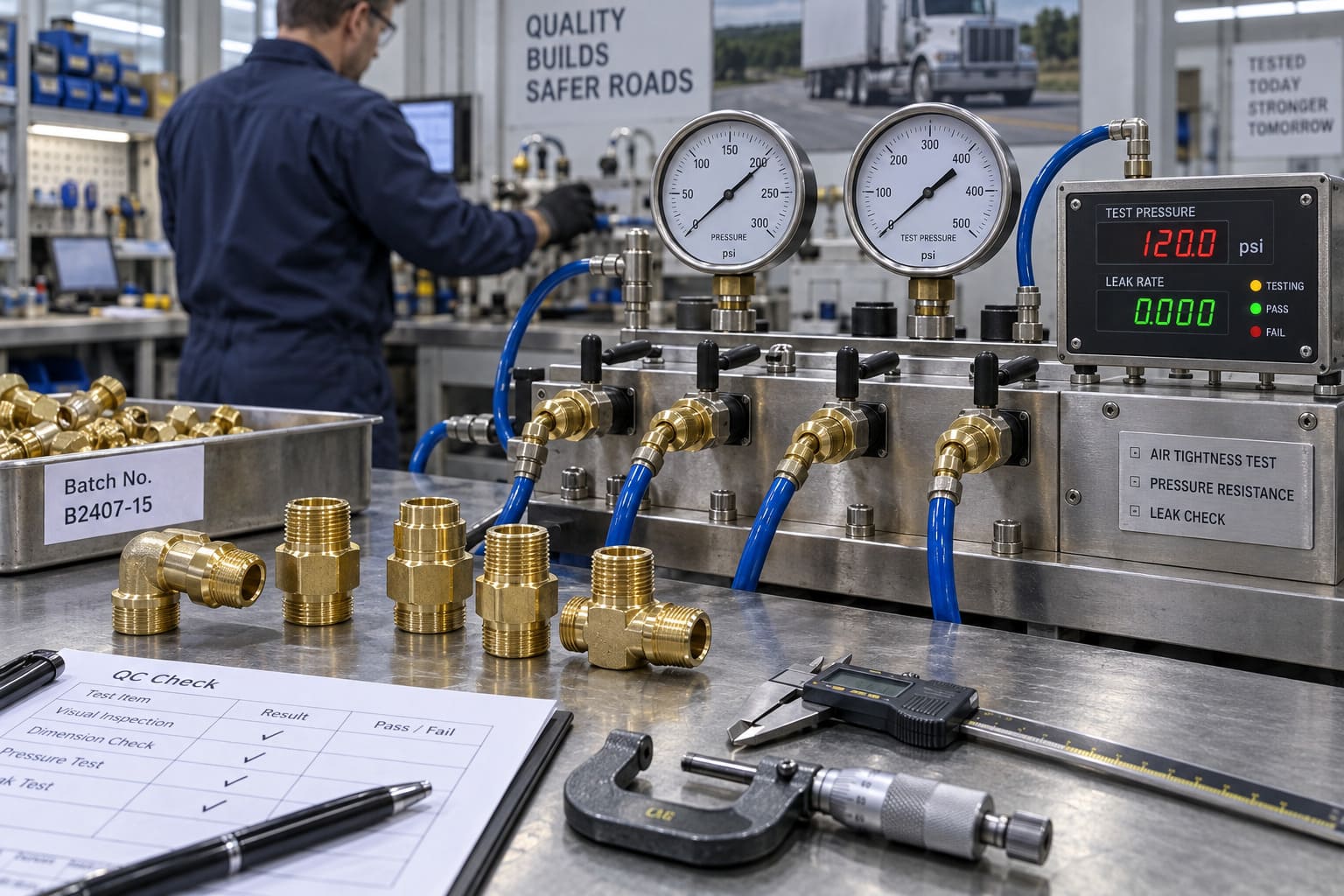
A supplier who cannot explain their testing regimen at the product level — not just point to an ISO certificate — should prompt follow-up questions.
A Practical Supplier Evaluation Checklist
When evaluating brass fitting suppliers for heavy-duty truck pneumatic applications, procurement teams should consider asking about the following:
Incoming Material Control
- Does the supplier verify mill certificates or batch compliance documents for incoming brass rod?
- Is incoming material sampled and inspected before entering production — or taken on trust from the mill?
- Is there a documented incoming inspection SOP with records that can be shared?
In-Process Quality Control
- How frequently is in-process sampling conducted during turning and threading runs?
- Are dimensional checks performed against thread standard tolerances (NPT, NPTF, SAE)?
- How are out-of-spec parts flagged and separated before they reach assembly?
Finished Product Testing
- What is the air tightness testing protocol? What pressure and duration?
- Is pressure resistance testing conducted on a sampling or 100% basis for critical fittings?
- Are temperature resistance evaluations part of product qualification?
Traceability and Documentation
- Can a specific batch of fittings be traced back to incoming material records?
- What documentation accompanies a shipment — test reports, batch records, COA?
- In the event of a field return, can the supplier identify the production batch and investigate root cause?
Certifications — With Context
- DOT certification (for U.S. market air brake components) establishes a baseline but should be verified as current and applicable to the specific product
- ISO 9001 certification documents a quality management system — not the quality of any individual batch
- SAE and FMVSS compliance should be tied to specific product lines, not assumed to cover an entire catalog
Important note: Certifications and test reports are starting points for supplier evaluation, not substitutes for it. Buyers should request batch-specific documentation, ask how repeat order consistency is managed, and — where volume justifies it — conduct or commission incoming inspection on received goods.
Does Batch Consistency Matter More Than a Single Test Result?
A supplier who can pass a pressure test on a qualification sample is not necessarily the same supplier who will deliver consistent quality on the 20th repeat order. Batch-to-batch consistency is arguably the most practical quality concern for distributors and procurement managers placing ongoing orders.
Batch consistency in brass air fittings depends on whether the same raw material inputs, machining parameters, and inspection standards are applied systematically across every production run — not just when a new customer is being qualified. Inconsistent batches lead to mixed-quality inventory, variable installation performance, and unpredictable warranty return rates that are difficult to diagnose and expensive to manage.
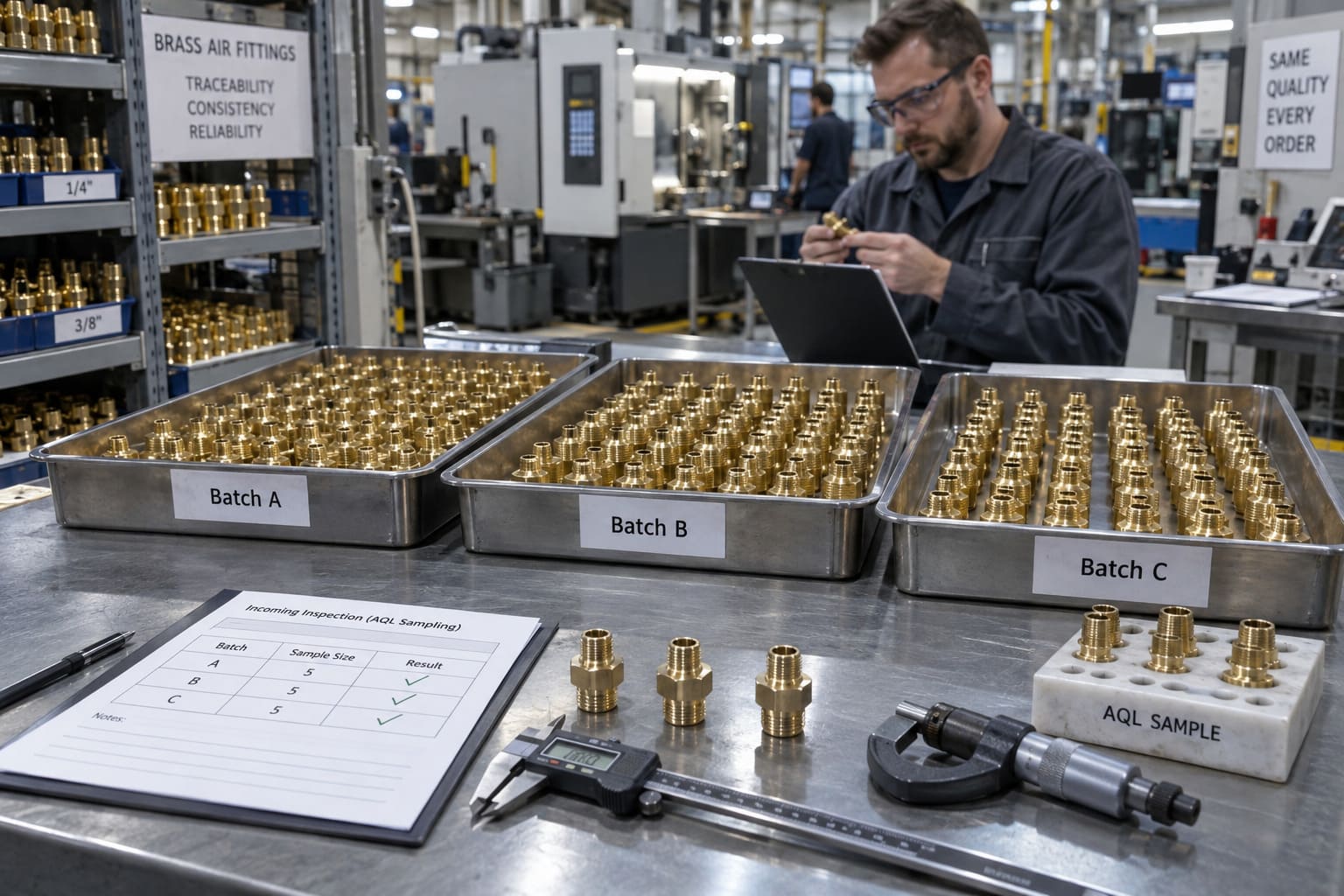
The cost of inconsistency is not always visible at the point of purchase. It accumulates in the field.
Where Batch Variability Shows Up for Distributors
Distributors and repair shops operating in North and South American heavy-duty truck markets often describe the same problem: a supplier's first container performs well, but quality varies on subsequent orders. This pattern is consistent with suppliers who:
- Do not maintain stable incoming material sources
- Adjust raw material procurement based on price rather than specification
- Lack documented process controls that enforce consistency across production runs
- Do not archive batch records in a way that allows repeat performance to be verified
From our experience managing production runs for ongoing distributor accounts, the investment in pre-positioned safety stock, batch traceability, and repeat-order SOP compliance pays back in reduced emergency reorders and fewer field complaint investigations.
Key Indicators of Batch Control Capability
| Indicator | What It Suggests |
|---|---|
| Verified batch certificates for incoming brass | Material inputs are controlled, not assumed |
| In-process sampling records archived by batch | Process deviations can be identified and isolated |
| AQL sampling before warehousing | Outgoing quality is verified, not just assumed from process compliance |
| 100% final inspection on critical products | High-risk items get individual screening |
| Batch-level traceability to shipment | Field returns can be root-caused to a specific production run |
| Consistent performance across repeat orders | Systematic process control, not one-time qualification luck |
Frequently Asked Questions
Can I judge brass fitting quality by the color or appearance of the fitting?
No. Visual inspection of color, shine, or surface finish cannot reliably indicate alloy composition, internal material quality, or machining accuracy. These characteristics require documented material verification, dimensional inspection, and functional testing. Appearance may reflect surface treatment or plating, not underlying material quality.
Are DOT-certified brass fittings automatically safe for heavy-duty truck air brake systems?
DOT certification establishes that a product meets defined performance requirements at the time of certification. It does not continuously verify every production batch. Buyers should confirm that certification applies to the specific product, verify it is current, and still request batch documentation and test records for ongoing orders.
What is the most common cause of brass air fitting leaks in the field?
Leaks in service typically result from a combination of factors: thread quality, sealing surface condition, assembly practices, installation technique, and operating conditions. Raw brass quality can contribute upstream — particularly through effects on machining accuracy — but it is rarely the sole cause. Root-cause investigation should examine the full chain before assigning cause.
How should procurement managers evaluate a new brass fitting supplier?
Focus on verifiable process controls rather than price or visual product review. Ask for incoming material inspection procedures, in-process sampling records, finished product test protocols, and batch traceability documentation. Request test reports tied to specific batches, not just a product certification on file.
Does ISO 9001 certification guarantee consistent brass fitting quality?
ISO 9001 certifies that a quality management system is in place and has been audited against a defined standard. It does not certify the quality of any individual batch or production run. It is a meaningful starting point for supplier evaluation — but batch records, in-process controls, and finished product testing are what actually protect against inconsistent output.
Conclusion
Raw brass quality is not a cosmetic variable or a price-tier distinction — it is an upstream reliability factor that shapes machining consistency, thread quality, sealing surface integrity, and ultimately the leak and return risk that reaches your inventory and your customers. Dimensional specs and unit prices are necessary inputs to sourcing decisions, but they are not sufficient on their own. The most important questions for evaluating a brass air fitting supplier are process-level ones: how is incoming material controlled, how is batch consistency maintained, and what documentation travels with each shipment?
If you are sourcing brass air fittings for North or South American heavy-duty truck applications and want to understand how ROADSPOWER manages material control, in-process inspection, and finished product testing across repeat orders, contact us to request batch documentation or discuss your specific procurement requirements.
"Investigation on the effect of cutting fluid pressure ...", https://www.sciencedirect.com/science/article/abs/pii/S0263224115006752. Materials-engineering literature describes brass machinability as dependent on alloy composition and microstructure, with these factors affecting chip formation, tool interaction, dimensional control, and machined surface finish. Evidence role: mechanism; source type: research. Supports: A neutral materials-engineering source should explain that brass alloy composition and material condition influence machinability, surface finish, and dimensional consistency during machining.. Scope note: Such a source would support the general material-to-machining mechanism, not prove failure rates for this specific supplier or product line. ↩
"The Effect of Different Non-Metallic Inclusions on ... - PMC - NIH", https://pmc.ncbi.nlm.nih.gov/articles/PMC5455271/. Studies of metal cutting report that workpiece composition, inclusions, and mechanical-property variation can influence cutting forces, chip formation, tool wear, and machined surface integrity. Evidence role: mechanism; source type: paper. Supports: A peer-reviewed manufacturing or materials paper should support that inclusions, hardness variation, and alloy composition affect cutting stability, tool wear, dimensional accuracy, or surface finish.. Scope note: The evidence is expected to be general to machining and brass or metallic materials, rather than a direct field study of truck air fittings. ↩
"Brass", https://en.wikipedia.org/wiki/Brass. Reference descriptions of brass define it as a copper-zinc alloy and identify lead additions in free-machining brasses as a means of improving machinability. Evidence role: definition; source type: encyclopedia. Supports: A reference source should define brass as a copper-zinc alloy and note that leaded brasses are used where machinability is important.. Scope note: This supports the material definition and general machinability rationale, not the exact alloy selection of every air-fitting manufacturer. ↩
"Machinability characteristics of lead free-silicon brass ...", https://www.sciencedirect.com/science/article/pii/S2090447912000639. Machining research on brass alloys shows that alloy chemistry, including copper-zinc balance and lead content, affects hardness, chip morphology, and surface roughness after cutting. Evidence role: mechanism; source type: paper. Supports: A technical paper should support that brass alloy composition and lead content affect hardness, chip breakage, and surface finish during machining.. Scope note: The evidence would be mechanistic and may use test coupons or standard alloys rather than finished pneumatic fittings. ↩
"C36000 Alloy - Copper.org", https://alloys.copper.org/alloy/C36000. Alloy reference data for UNS C36000 identify it as free-cutting brass with a nominal copper-zinc-lead composition and high machinability relative to many other copper alloys. Evidence role: definition; source type: institution. Supports: An alloy database or copper-industry source should verify the UNS C36000 designation, approximate composition, and free-machining characterization.. Scope note: The source would verify the alloy designation and properties, not establish that C36000 is used in all truck air fittings. ↩
"C37700 Alloy - Copper.org", https://alloys.copper.org/alloy/C37700. Copper-alloy reference data classify UNS C37700 as forging brass and list a nominal copper-zinc-lead composition consistent with its use in forged brass parts. Evidence role: definition; source type: institution. Supports: An alloy reference should confirm the C37700 designation, approximate composition, and classification as forging brass.. Scope note: This supports the material classification and composition, not the prevalence of this alloy in any particular supplier's catalog. ↩
"C46400 Alloy - Copper.org", https://alloys.copper.org/alloy/C46400. Alloy reference sources describe UNS C46400 naval brass as a copper-zinc-tin brass developed for improved corrosion resistance in marine environments. Evidence role: definition; source type: institution. Supports: An alloy reference should confirm C46400 naval brass composition and the role of tin in corrosion resistance for marine service.. Scope note: This supports the general alloy property, not its necessity for standard heavy-duty truck pneumatic fittings. ↩
"Cartridge Brass UNS C26000", https://www.azom.com/article.aspx?ArticleID=6341. Copper-alloy data identify UNS C26000 cartridge brass as a nominal 70 percent copper and 30 percent zinc alloy valued for ductility and formability. Evidence role: definition; source type: institution. Supports: An alloy reference should verify the C26000 designation, nominal 70/30 copper-zinc composition, and ductility characteristics.. Scope note: The source would confirm alloy properties, not demonstrate that this grade is commonly selected for threaded truck air fittings. ↩
"Leakage Rate Measurement and Durability Testing of Field ...", https://docs.lib.purdue.edu/cgi/viewcontent.cgi?article=2939&context=iracc. Research on threaded mechanical joints and pipe connections shows that thread geometry, surface condition, vibration, and thermal cycling can affect joint preload and sealing integrity over service life. Evidence role: mechanism; source type: paper. Supports: A research or engineering source should support that threaded joints can lose sealing integrity due to poor thread form, vibration, temperature cycling, or repeated assembly.. Scope note: The evidence may be drawn from threaded joints generally, so it would contextualize rather than directly quantify leakage in brass truck air fittings. ↩
"TYPES OF THREAD", https://web.mae.ufl.edu/designlab/Lab%20Resources/Types_of_threads.pdf. Thread standards such as ASME pipe-thread specifications and SAE straight-thread specifications define thread geometry and permissible dimensional tolerances for compatible assembly. Evidence role: general_support; source type: institution. Supports: A standards source should confirm that pipe and straight-thread standards specify dimensions and tolerances for thread form, pitch, taper, and fit.. Scope note: The source would support the standards framework, not independently measure the article's example fittings. ↩
"49 CFR 571.106 -- Standard No. 106; Brake hoses.", https://www.ecfr.gov/current/title-49/subtitle-B/chapter-V/part-571/subpart-B/section-571.106. U.S. Federal Motor Vehicle Safety Standard No. 106 specifies performance tests for brake hose assemblies, including requirements related to leakage, burst or pressure performance, tensile strength, and temperature exposure. Evidence role: general_support; source type: government. Supports: A government regulation or recognized vehicle-safety standard should show that brake hose and fitting assemblies are evaluated for pressure, leakage, tensile strength, and temperature-related performance.. Scope note: FMVSS 106 applies to regulated brake hose assemblies and related components; it supports the relevance of these tests but may not map one-to-one to every standalone brass fitting SKU. ↩