Sourcing air brake hoses sounds straightforward until a batch fails pressure testing, a hose leaks at the fitting after installation, or a customer calls back with a warranty dispute. SAE J1402 shows up on product listings and supplier quotes constantly — but knowing what the standard actually covers, and how to use it as a procurement tool, makes the difference between a reliable supply relationship and an expensive mistake.
SAE J1402 is a performance and specification standard published by SAE International that defines requirements for air brake hoses, hose assemblies, and end fittings used in automotive air brake systems.1 It covers dimensional requirements, construction, performance tests — including pressure resistance, temperature resistance, and tensile strength — and marking requirements.2 It is a product specification reference, not a standalone certification document3, and it does not replace fitment evaluation, regulatory compliance checks, or supplier quality verification.
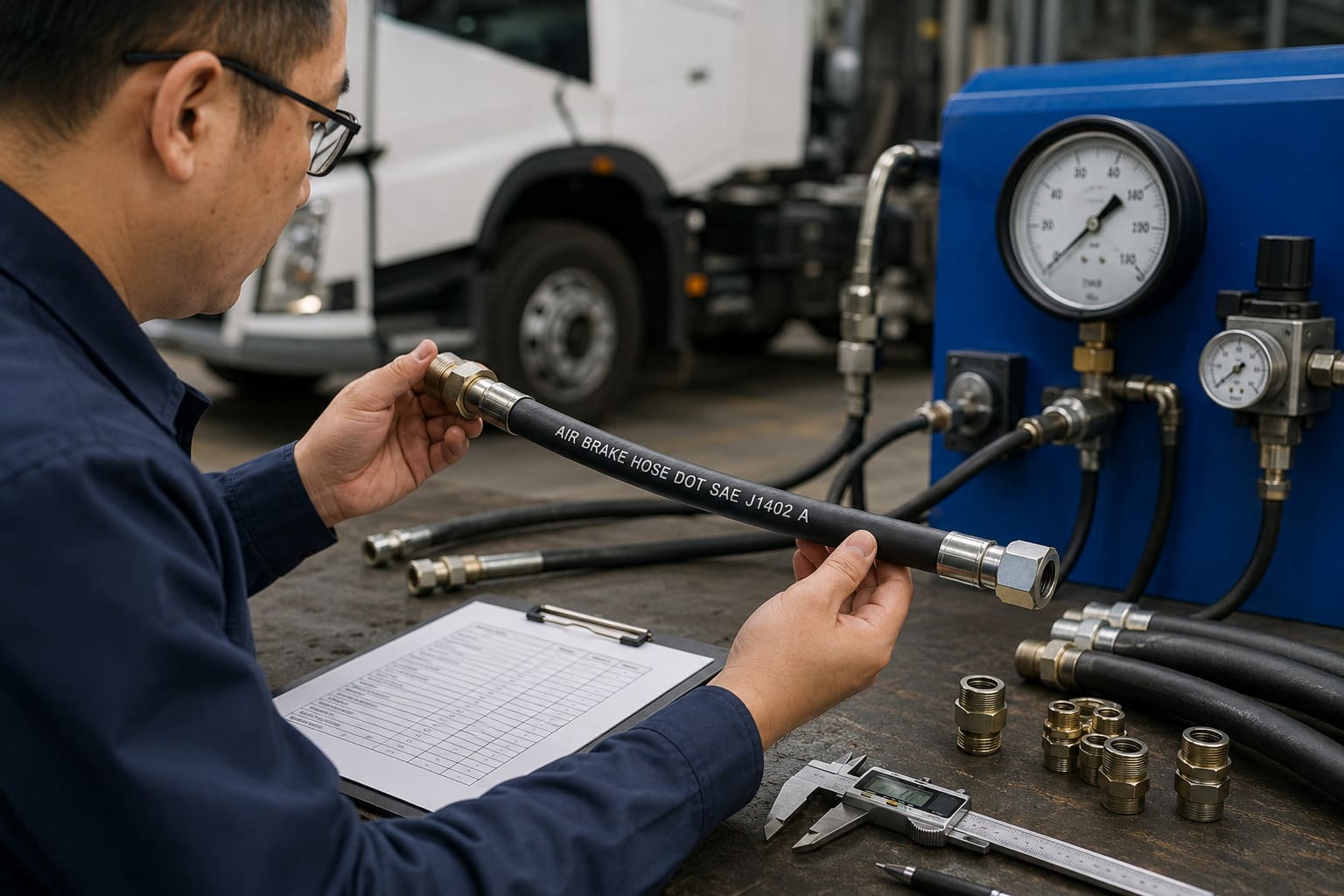
Understanding what SAE J1402 does and does not cover helps buyers ask the right questions — about specifications, markings, test documentation, and supplier QC — before placing a volume order. The sections below break each of those questions down.
What Does SAE J1402 Actually Specify for Air Brake Hoses?
Buyers often treat SAE J1402 as a yes/no label. That framing misses what the standard is really doing — and it creates blind spots in procurement evaluation.
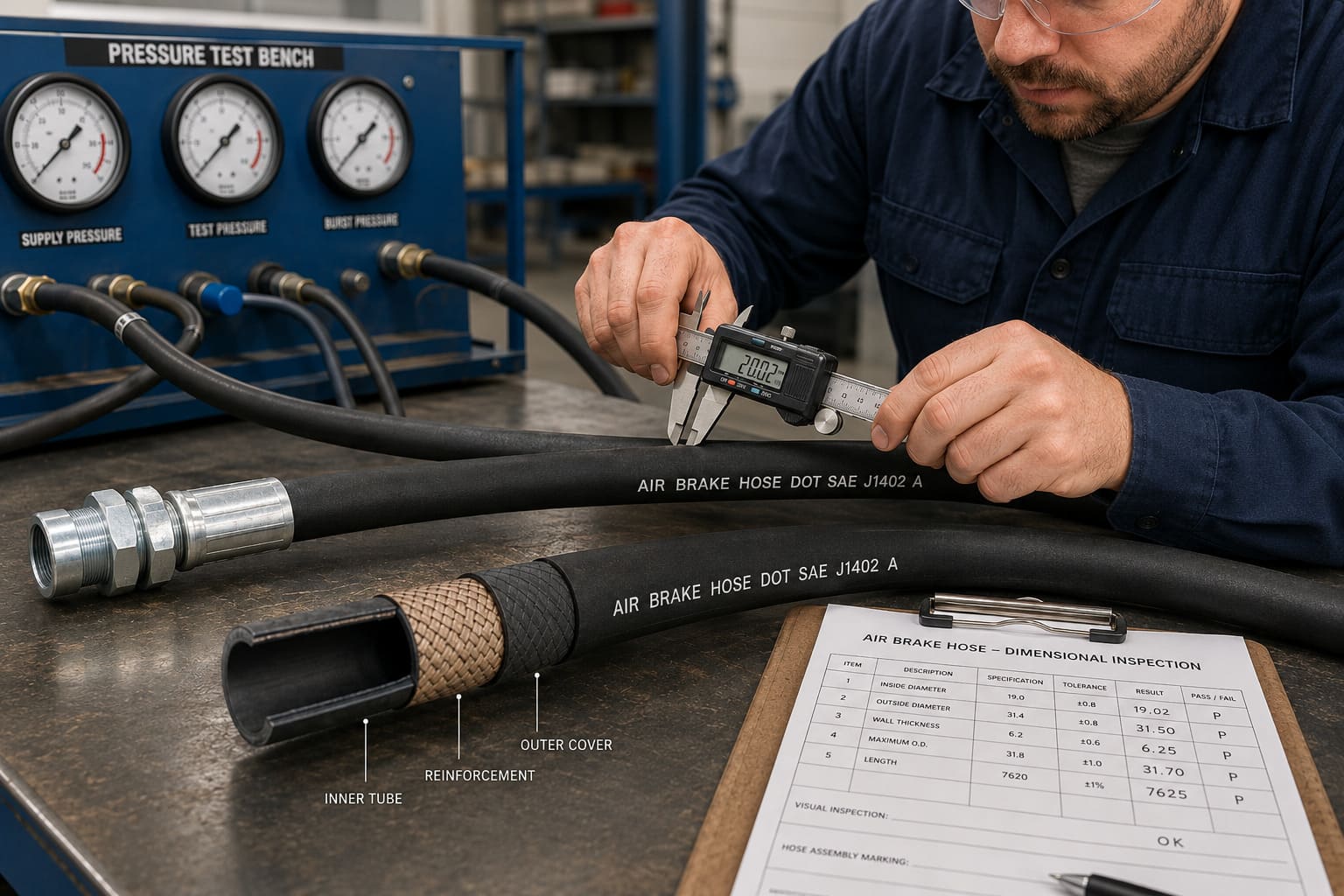
SAE J1402 defines the construction requirements, dimensional tolerances, performance thresholds, and marking conventions that an air brake hose or hose assembly must meet to be considered compliant with the standard. It establishes a common technical language between manufacturers, distributors, and end users.
Performance Tests Covered by SAE J1402
The standard is built around verifiable performance, not just material declarations. Key test categories include:
- Proof pressure testing4 — verifying that the hose withstands pressure above its rated working pressure without leakage or deformation
- Burst pressure testing — confirming the hose does not rupture below a defined minimum burst threshold
- Vacuum resistance — relevant for certain air brake circuit configurations
- Temperature resistance — exposure to both high and low temperature extremes without loss of function
- Tensile strength of hose assemblies5 — the pull-apart resistance of the hose-to-fitting connection
- Bend radius compliance — ensuring the hose does not kink or collapse under specified routing conditions
- Oil resistance — resistance to degradation from contact with petroleum-based fluids
Grade Classifications Within the Standard
SAE J1402 is not a single uniform specification. It defines hose types and grades based on application range and construction. Two commonly referenced grades are:
| Grade | Typical Use | Temperature Range |
|---|---|---|
| Type A | Standard highway air brake applications | –40°F to +212°F (–40°C to +100°C)6 |
| Type B | Applications requiring higher temperature resistance | –40°F to +257°F (–40°C to +125°C)7 |
This matters in procurement because the grade must match the application. A hose meeting SAE J1402 requirements for one grade is not automatically rated for a higher-temperature environment. When someone asks whether a hose is "SAE J1402 compliant," the next question should be: which grade, and for what operating conditions?
What SAE J1402 Does Not Do
This is worth stating directly:
- SAE J1402 is not a government regulation. It is a voluntary industry standard published by SAE International.8
- It does not replace DOT requirements, which are federal regulations enforced by the U.S. Department of Transportation.
- It does not guarantee that a specific hose fits a specific truck model, installation position, or air brake circuit configuration.
- A supplier claiming SAE J1402 compliance is making a product specification claim — buyers should verify that claim through documentation, markings, and, where appropriate, independent testing.
How Do SAE J1402, DOT, and FMVSS Relate to Each Other?
Buyers frequently encounter SAE J1402, DOT markings, and FMVSS references on the same product or in the same supplier conversation. These three are often conflated, and that confusion creates real procurement risk.
SAE J1402, DOT, and FMVSS are different instruments with different scopes. Treating them as interchangeable shorthand for "this hose is compliant" is an oversimplification that can lead to stocking the wrong product.
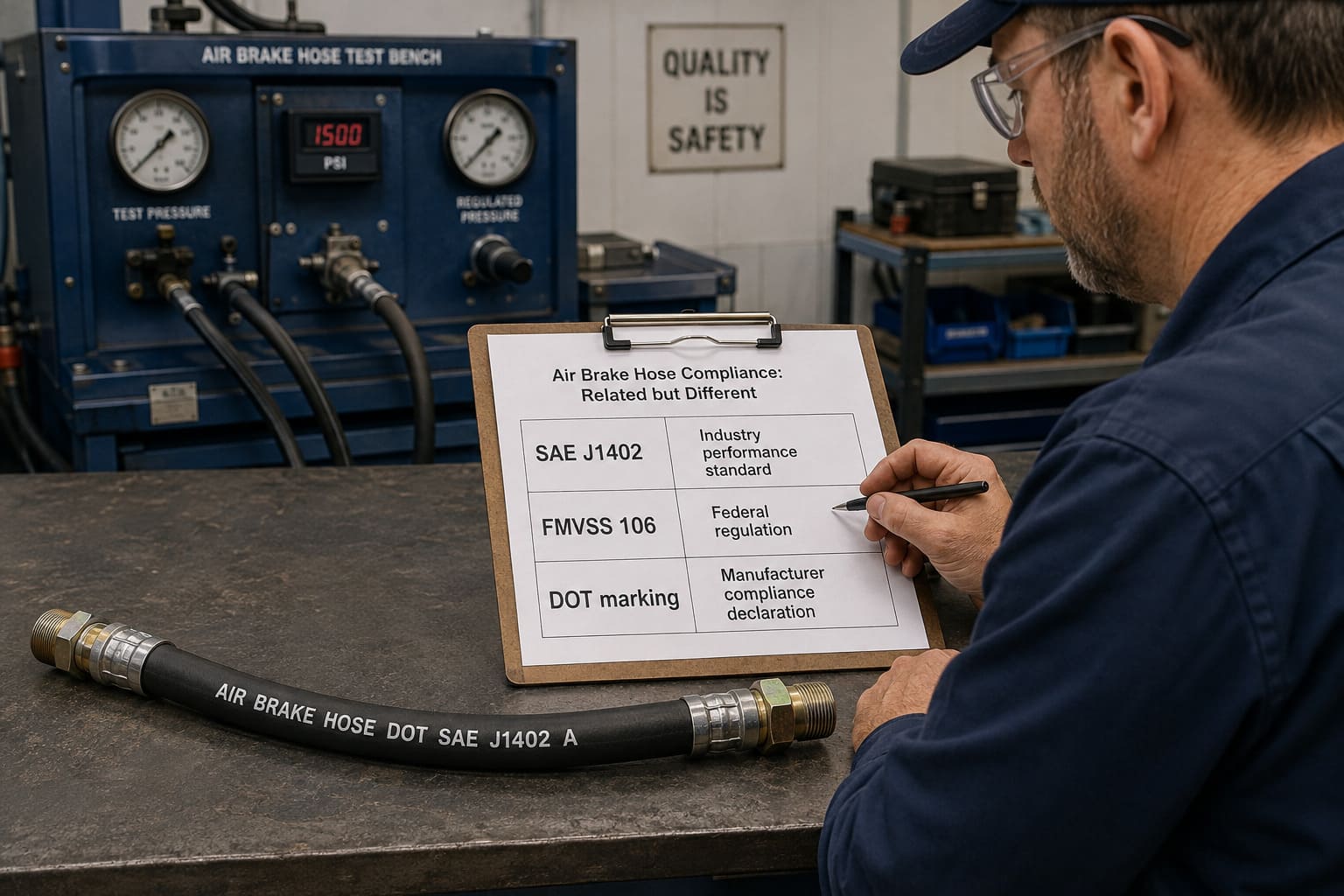
Breaking Down the Three References
SAE J1402 — Industry Performance Standard
SAE International is a professional standards organization. SAE J1402 is a technical document that defines performance requirements and test methods for air brake hose. Manufacturers use it as a design and production target. Buyers use it as a specification reference when evaluating and comparing products. It is not issued or enforced by a government agency.
DOT — Federal Regulatory Authority
DOT, in the context of air brake hoses, refers to compliance with U.S. Department of Transportation requirements. Under FMCSA regulations, vehicles operated in interstate commerce must use brake hose that meets applicable federal standards.9 DOT markings on hose indicate the manufacturer's declaration of regulatory compliance.10 Buyers operating in or supplying to regulated U.S. fleet markets should treat DOT marking as a baseline check — and should ask suppliers about the documentation behind that declaration.
FMVSS 106 — The Federal Motor Vehicle Safety Standard
FMVSS 106 is the specific federal standard governing brake hose, brake hose end fittings, and brake hose assemblies.11 It sets mandatory minimum performance requirements for motor vehicles sold in the United States. Air brake hose intended for the U.S. market is generally expected to meet FMVSS 106 requirements, and the standard references SAE J1402 test methods in some areas12.
How They Work Together in Practice
| Reference | Type | Enforced By | Scope |
|---|---|---|---|
| SAE J1402 | Industry standard | SAE International (voluntary) | Performance specs and test methods |
| FMVSS 106 | Federal regulation | NHTSA / DOT | Mandatory minimum for U.S. market vehicles |
| DOT marking | Compliance declaration | Manufacturer self-certification | Indicates manufacturer's FMVSS compliance claim |
The practical takeaway for distributors and fleet buyers: a hose marked DOT is the manufacturer's declaration, not a government-issued certification. Buyers should request supporting documentation and understand that SAE J1402 test performance and FMVSS 106 regulatory requirements are related but distinct references. When in doubt, consult a qualified compliance professional for your specific application and market.
What Should Buyers Actually Check When Evaluating an Air Brake Hose?
Knowing that a hose "meets SAE J1402" is a starting point, not a conclusion. I've seen procurement decisions go wrong when buyers treat a single compliance phrase as sufficient due diligence.
The real evaluation work happens when buyers systematically check markings, specifications, documentation, and supplier quality processes — especially for volume supply where batch-to-batch consistency matters.
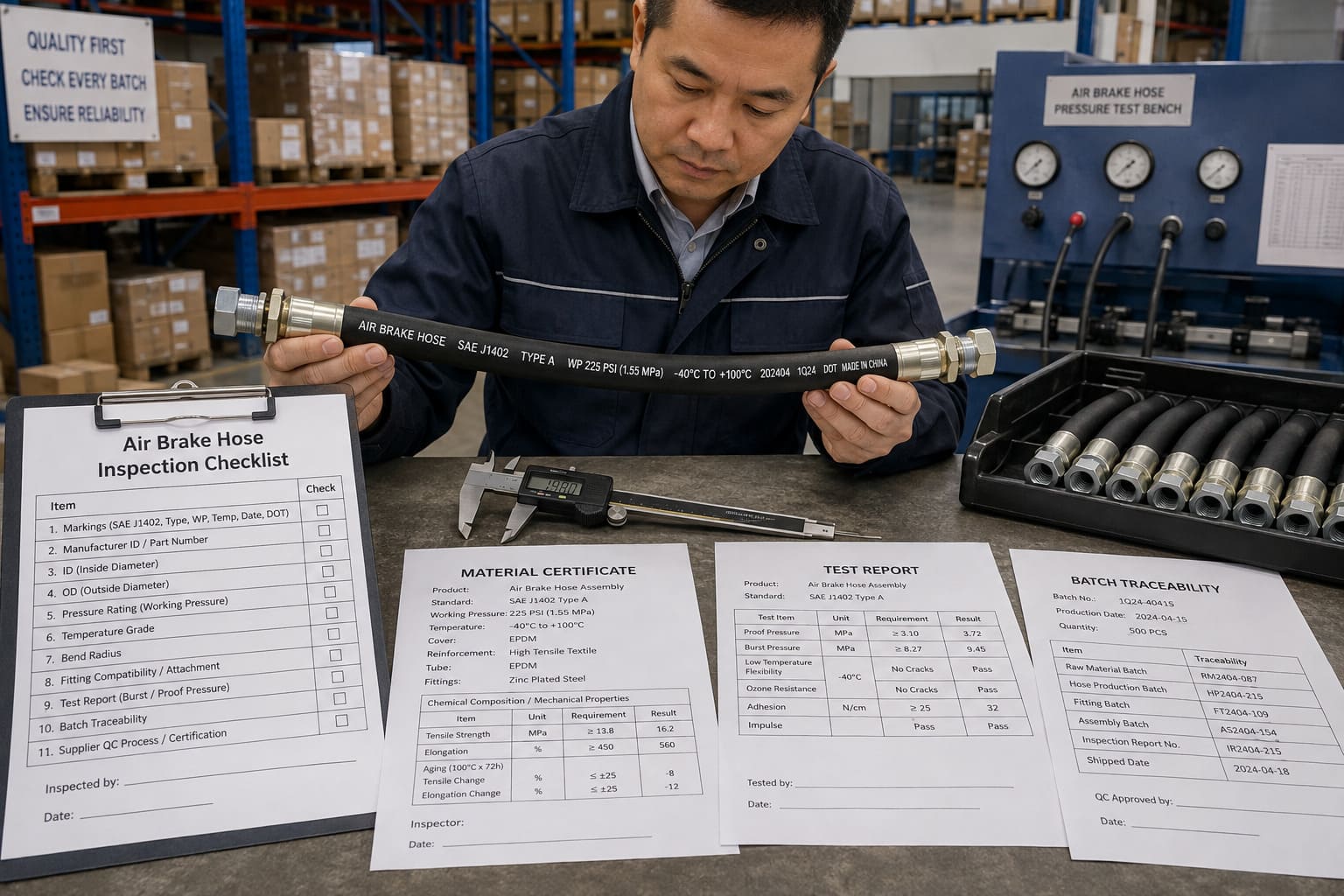
Start With the Hose Markings
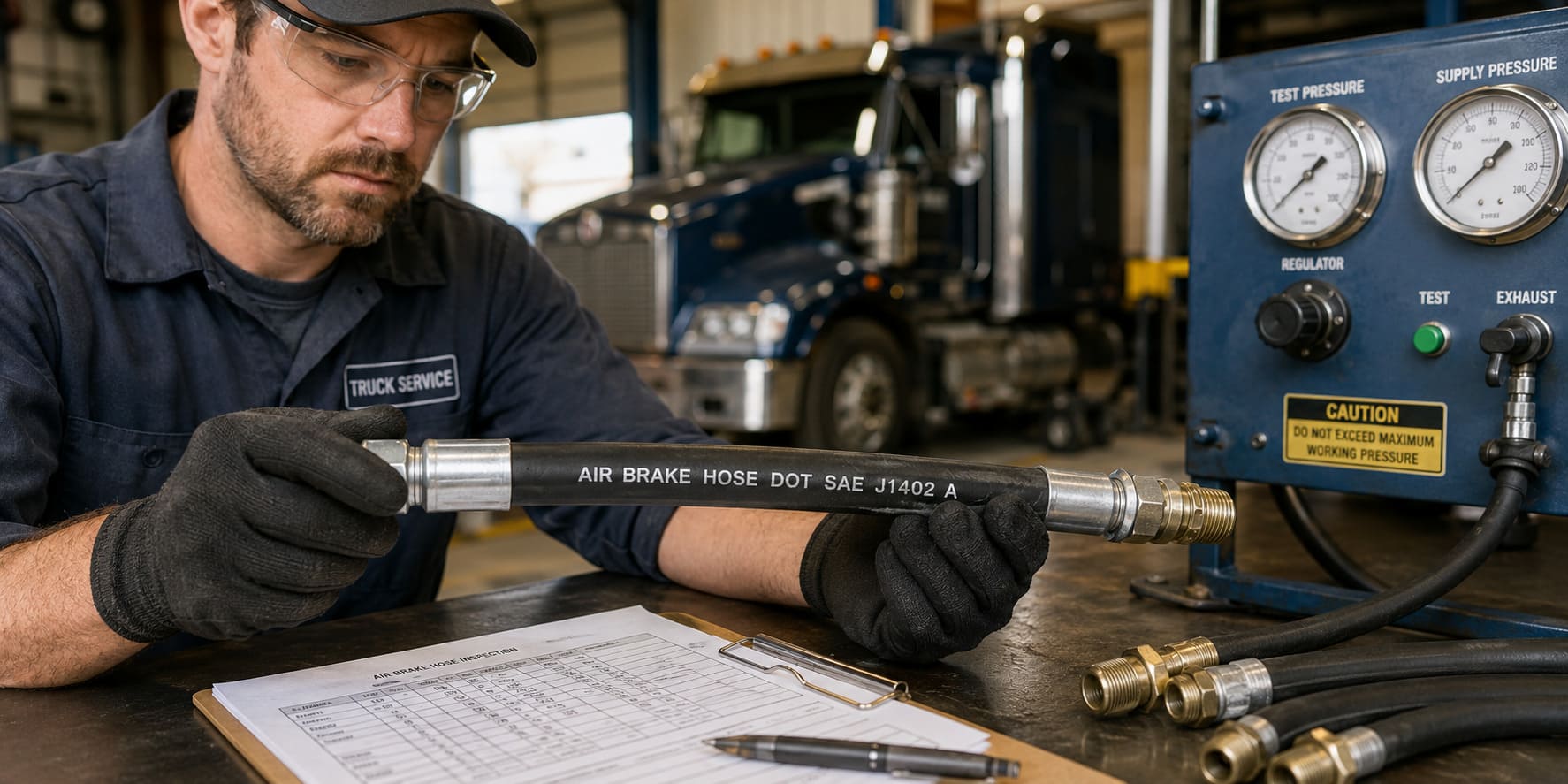
SAE J1402 requires specific information to be marked on the hose at defined intervals. These markings are your first quick-check in the field or warehouse. A compliant hose should show:
- Manufacturer identification
- SAE J1402 designation and applicable grade
- Working pressure rating
- Date of manufacture or cure date code (relevant for rubber hose aging)
- DOT symbol if the manufacturer is claiming FMVSS compliance
If markings are missing, incomplete, or inconsistent with the product data sheet, that is a flag worth raising before placing a large order.
Confirm the Specification Matches the Application
This is the question buyers skip most often: does this specific hose specification match the vehicle, the installation position, and the air brake circuit it will be used in?
Key specification checks include:
- Inside diameter (ID) — matched to fitting and system flow requirements
- Outside diameter (OD) — relevant for clamps, brackets, and routing
- Working pressure rating — must meet or exceed system operating pressure
- Temperature grade — matched to underhood or chassis environment
- Bend radius — compared against the actual routing geometry on the vehicle
- End fitting compatibility — hose and fitting must be specified as a matched assembly
A mismatch on any of these dimensions is a functional problem regardless of what standard the hose claims to meet.
Ask for Test Documentation and Batch Traceability
For volume orders, the relevant question is not just whether the product was tested once during development — it is whether the supplier has documented inspection controls that apply to every production batch.
Useful documents to request from suppliers include:
- Material compliance certificates for rubber compound, reinforcement, and end fittings
- In-process inspection records or sampling plans
- Performance test reports (pressure, temperature, tensile) with batch or lot references
- Pre-shipment inspection reports
- ISO 9001 certification (as an indicator of documented quality management processes)
Batch traceability matters because it determines whether a problem with one lot can be isolated and investigated without condemning an entire inventory.
Evaluate Supplier Quality Control Processes
From our experience managing air brake-related product supply — including air tightness testing, pressure resistance testing, temperature resistance testing, and tensile testing across production batches — the quality controls that exist on the manufacturing floor are what make compliance claims meaningful in practice.
Buyers evaluating suppliers should ask:
- How is incoming raw material — rubber, copper, steel — inspected and batch-documented?
- At what stages of production are in-process samples taken and checked?
- What performance tests are run, and are results recorded per batch?
- How is the pre-shipment inspection structured, and is it 100% or AQL sampling?
- What happens when a non-conformance is detected?
A supplier that can answer these questions with specific documented procedures is in a materially different position than one that simply states a compliance label on a product listing.
Why Does This Matter for Distributors, Repair Shops, and Fleets?
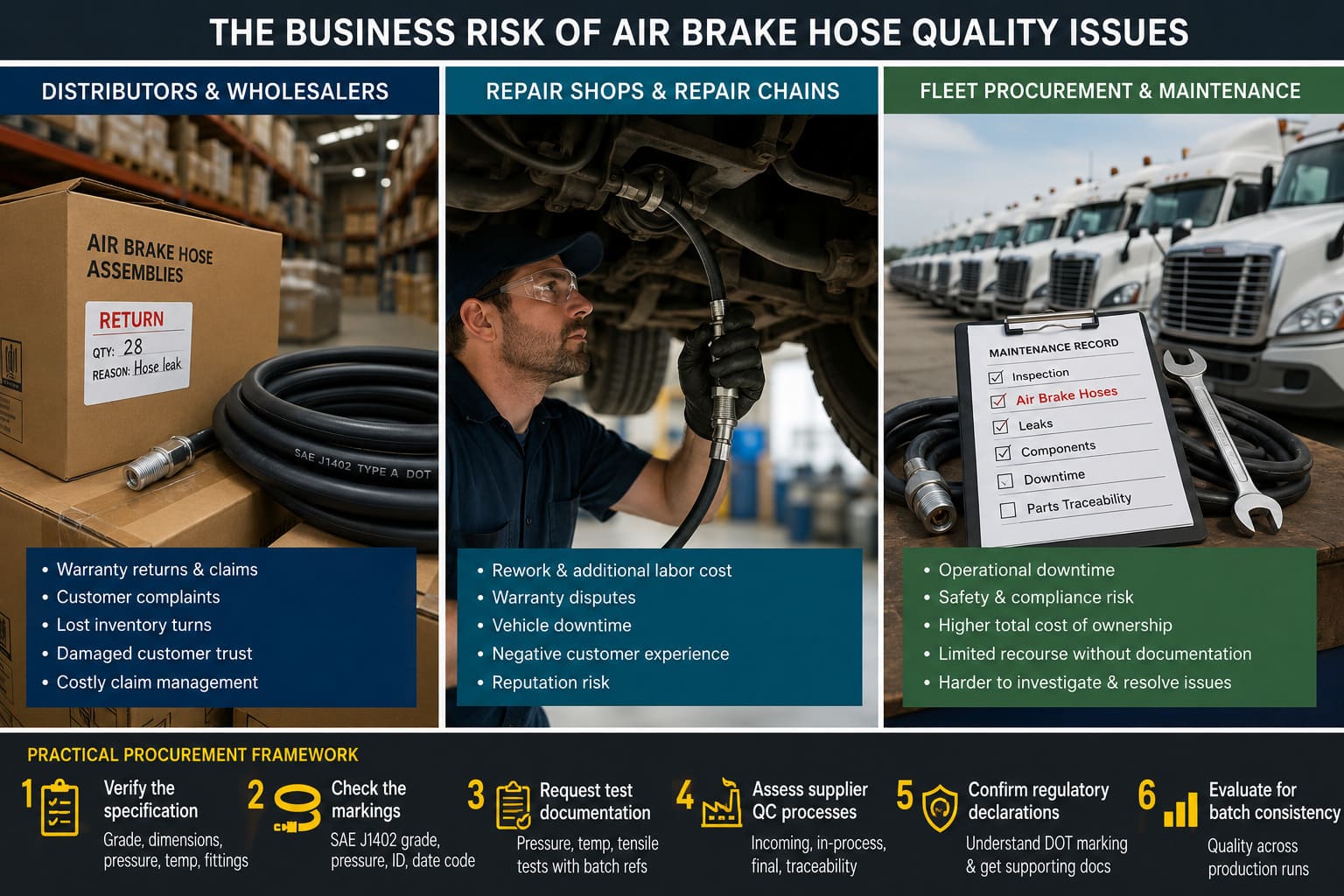
The air brake hose question is ultimately a business risk question. Distributors, repair shops, and fleet procurement teams are not trying to become SAE standards experts — they are trying to reduce returns, avoid installation disputes, prevent downtime, and build reliable supply chains.
Inconsistent or non-compliant air brake hoses create predictable problems across all three buyer types.
The Cost of Getting It Wrong
For distributors and wholesalers:
Stocking a product that moves well initially but generates warranty returns, customer complaints, or field failures is a direct cost. It affects inventory turns, customer trust, and the time your team spends managing claims. Batch inconsistency — where one shipment performs fine and the next generates failures — is particularly damaging because it is hard to predict and hard to explain to customers.
For repair shops and repair chains:
A hose that passes installation and then develops a leak or fitting failure creates a rework event, a warranty dispute, and a reputational issue with the vehicle operator. Repair shops are in a difficult position: they cannot test every hose before installation, so they depend on reliable supply chain documentation and supplier quality processes to stand behind the product.
For fleet procurement and maintenance managers:
Air brake system downtime is a serious operational cost. Fleets that specify parts by brand name or part number without maintaining documentation of the underlying specification and compliance basis have limited recourse when problems occur. Procurement teams that maintain supplier QC documentation, incoming inspection records, and material traceability records are in a stronger position to investigate, escalate, and replace problem sources quickly.
The Practical Procurement Framework
To summarize the evaluation approach in practical terms:
- Verify the specification — confirm grade, dimensions, pressure rating, temperature range, and end fitting match the application
- Check the markings — confirm SAE J1402 grade, working pressure, manufacturer ID, and date code are present
- Request test documentation — ask for pressure, temperature, and tensile test records with batch references
- Assess supplier QC processes — incoming material, in-process sampling, final inspection, and traceability
- Confirm regulatory declarations — understand what DOT marking means and ask for supporting documentation
- Evaluate for batch consistency — for volume supply, ask how quality is maintained across production runs, not just prototype or initial batches
Frequently Asked Questions
Is SAE J1402 a certification that suppliers receive?
No. SAE J1402 is a performance and specification standard, not a certification issued by SAE International to individual manufacturers. Suppliers declare conformance to the standard based on their own testing and quality controls. Buyers should request test documentation and batch records rather than treating a compliance statement as a certificate.
Do all air brake hoses sold in the United States need to meet SAE J1402?
Not exactly. FMVSS 106 is the relevant federal regulatory requirement for brake hose in U.S. motor vehicles. SAE J1402 is a referenced industry standard that overlaps significantly with FMVSS 106 test requirements, but they are not identical instruments. Buyers supplying the U.S. market should confirm both FMVSS 106 and SAE J1402 applicability for their specific product and application. Consult a qualified compliance professional for regulatory questions.
What does the cure date code on an air brake hose mean for buyers?
Rubber-based air brake hoses have a defined service life. The cure date code identifies when the rubber compound was cured during manufacturing. Buyers managing inventory should track date codes to avoid stocking hose that is approaching the end of its useful shelf life before installation. Most manufacturers and regulatory references provide guidance on maximum storage and service life for rubber brake hose.
Can I use a hose that meets SAE J1402 Type A in a high-temperature underhood installation?
Not necessarily. SAE J1402 Type A is rated for a maximum temperature of approximately 212°F (100°C). Certain underhood or close-to-exhaust routing positions may exceed that threshold. In those applications, a Type B hose rated to 257°F (125°C) or a hose with additional thermal shielding may be required. Always match the hose grade to the actual operating environment, not just the nominal specification.
What should I do if a supplier cannot provide batch traceability or test documentation?
Treat that as a significant procurement risk indicator, especially for volume orders. Suppliers with documented quality management systems — such as ISO 9001 certification — maintain records that allow them to trace performance test results to specific production batches. If a supplier cannot provide this documentation on request, you have limited ability to investigate or isolate problems if failures occur in the field.
Conclusion
SAE J1402 is a meaningful technical reference for evaluating air brake hoses — but it works as a procurement tool, not a shortcut. The standard defines performance requirements, test methods, grade classifications, and marking conventions that buyers can use to compare products, question suppliers, and specify the right hose for the right application. It does not replace fitment evaluation, regulatory compliance verification, or supplier quality assessment.
For distributors, repair shops, and fleets supplying or maintaining North and South American heavy-duty trucks, the practical work is in the details: checking hose markings, confirming specifications match the application, requesting test documentation with batch traceability, and evaluating whether a supplier's quality controls are documented and consistent across production runs.
At ROADSPOWER, our air brake-related products are manufactured and inspected under documented processes that include incoming material checks, in-process sampling, air tightness testing, pressure and tensile testing, and pre-shipment inspection — with ISO 9001 and DOT compliance as part of our quality framework. If you are evaluating suppliers for air brake hose supply in volume, we are ready to walk through the documentation and QC processes in detail. Contact our team to discuss your application requirements and request product documentation.
"Federal Motor Vehicle Safety Standards; Brake Hoses", https://www.federalregister.gov/documents/2004/12/20/04-27088/federal-motor-vehicle-safety-standards-brake-hoses. SAE International identifies SAE J1402 as a standard for automotive air brake hose, hose assemblies, and end fittings, supporting its use as the relevant industry specification for those components. Evidence role: definition; source type: institution. Supports: SAE J1402 is an SAE International standard specifying requirements for automotive air brake hose, hose assemblies, and end fittings.. Scope note: Public SAE pages may summarize the standard's scope but may not reproduce the full copyrighted technical text. ↩
"Federal Motor Vehicle Safety Standards; Brake Hoses", https://www.federalregister.gov/documents/2004/12/20/04-27088/federal-motor-vehicle-safety-standards-brake-hoses. SAE International's description of J1402 describes the standard as setting requirements for air brake hose construction, performance, and identification, which supports the article's summary of the standard's coverage. Evidence role: general_support; source type: institution. Supports: The source should confirm that SAE J1402 includes dimensional, construction, performance, and identification or marking requirements.. Scope note: A standards abstract supports the categories covered but may not verify every individual test condition without access to the full standard. ↩
"Tenth (2006) Annual Report on Federal Agency Use of Voluntary ...", https://www.nist.gov/document/addendum-tenth-annual-report-federal-agency-use-voluntary-consensus-standards-and. SAE International describes its technical standards as consensus documents developed for industry use, supporting the distinction between a product specification standard and a separate certification of a specific supplier. Evidence role: definition; source type: institution. Supports: SAE standards provide technical requirements but are distinct from third-party certification of individual manufacturers or products.. Scope note: This support is contextual unless the source expressly states that SAE J1402 itself is not a certification program. ↩
"49 CFR 571.106 -- Standard No. 106; Brake hoses.", https://www.ecfr.gov/current/title-49/subtitle-B/chapter-V/part-571/subpart-B/section-571.106. FMVSS No. 106 sets pressure-performance requirements and test procedures for brake hoses and assemblies, providing regulatory context for proof-pressure testing as a brake-hose performance control. Evidence role: mechanism; source type: government. Supports: Federal brake-hose rules or incorporated SAE test methods include pressure-based performance testing for brake hose assemblies.. Scope note: FMVSS 106 is a federal regulation rather than SAE J1402 itself, so it supports the relevance of pressure testing but may not match every SAE J1402 parameter. ↩
"49 CFR 571.106 -- Standard No. 106; Brake hoses.", https://www.ecfr.gov/current/title-49/subtitle-B/chapter-V/part-571/subpart-B/section-571.106. FMVSS No. 106 includes strength requirements for brake hose assemblies, supporting the article's identification of tensile performance as a relevant criterion for hose-to-fitting integrity. Evidence role: mechanism; source type: government. Supports: Brake hose assembly standards include tensile or pull-resistance requirements for hose-to-fitting integrity.. Scope note: The federal requirement supports the general test category; the exact SAE J1402 threshold should be checked in the full SAE standard. ↩
"Aeroquip SAE J1402A Air Brake Hose EC03808-250R", https://www.hydraulic-supply.com/sae-j1402a-air-brake-hose-ec03808-250r.html?srsltid=AfmBOooARXrvIoPuj9cAXdLRDPd02LYA9df-2oPBp2g4G5FYnsWiX1mG. The SAE J1402 specification identifies temperature classifications for air brake hose types, supporting the stated Type A operating-temperature range when verified against the standard text. Evidence role: general_support; source type: institution. Supports: The source should confirm the Type A temperature rating specified for SAE J1402 air brake hose.. Scope note: Because the precise range is a standard-specific value, the full SAE J1402 document is the preferred source for direct verification. ↩
"End of year sale on Multi-Purpose Air and Water hose! Call today for pricing ...", https://www.instagram.com/p/DS5ZpiFE_Ri/?hl=bg. The SAE J1402 specification provides temperature classifications for air brake hose types, supporting the stated Type B temperature range when checked against the standard. Evidence role: general_support; source type: institution. Supports: The source should confirm the Type B temperature rating specified for SAE J1402 air brake hose.. Scope note: A public summary may not list the numerical Type B range; direct confirmation may require the full SAE standard. ↩
"Twenty-Fifth Annual Report on Federal Agency Use of ...", https://www.nist.gov/document/nistir8438fy21. U.S. guidance on voluntary consensus standards recognizes standards developed by organizations such as SAE as non-governmental standards that may be used by agencies or industry, supporting the distinction between SAE J1402 and federal regulation. Evidence role: definition; source type: government. Supports: SAE standards are voluntary consensus standards developed outside government regulation unless incorporated by reference.. Scope note: This is contextual support for the legal status of SAE standards generally, not a direct legal interpretation of every use of SAE J1402. ↩
"5.1.1 Brake Systems (Part 393 Subpart C) - CSA", https://csa.fmcsa.dot.gov/safetyplanner/MyFiles/SubSections.aspx?ch=22&sec=64&sub=130. FMCSA brake-system regulations in 49 CFR Part 393 require brake hose and tubing on commercial motor vehicles to conform to applicable federal motor vehicle safety requirements, supporting the article's statement about federally regulated vehicles. Evidence role: general_support; source type: government. Supports: FMCSA equipment regulations require commercial motor vehicle brake hoses or tubing to meet applicable federal safety standards.. Scope note: Applicability can depend on vehicle type, operation, and regulatory jurisdiction. ↩
"Interpretation ID: 04-009159drn", https://www.nhtsa.gov/interpretations/04-009159drn. NHTSA's FMVSS framework relies on manufacturer certification of compliance, and FMVSS No. 106 specifies brake-hose labeling requirements, supporting the interpretation of DOT marking as a manufacturer's compliance declaration. Evidence role: definition; source type: government. Supports: The DOT symbol or marking on brake hose reflects the manufacturer's certification that the product complies with FMVSS requirements.. Scope note: The source supports the regulatory meaning of certification markings but does not independently verify any individual manufacturer's product. ↩
"49 CFR 571.106 -- Standard No. 106; Brake hoses.", https://www.ecfr.gov/current/title-49/subtitle-B/chapter-V/part-571/subpart-B/section-571.106. 49 CFR § 571.106, Federal Motor Vehicle Safety Standard No. 106, states that it applies to brake hoses, brake hose end fittings, and brake hose assemblies, directly supporting the article's description of the standard's scope. Evidence role: definition; source type: government. Supports: FMVSS No. 106 specifies federal requirements for brake hoses, brake hose end fittings, and brake hose assemblies.. ↩
"49 CFR 571.106 -- Standard No. 106; Brake hoses.", https://www.ecfr.gov/current/title-49/subtitle-B/chapter-V/part-571/subpart-B/section-571.106. The text of FMVSS No. 106 includes references to SAE J1402 in connection with brake-hose requirements, supporting the article's statement that the federal standard and SAE test methods overlap in specific areas. Evidence role: historical_context; source type: government. Supports: FMVSS No. 106 incorporates or references SAE J1402 in relation to brake-hose testing or specifications.. Scope note: The citation supports the existence of references, not equivalence between all FMVSS 106 and SAE J1402 requirements. ↩