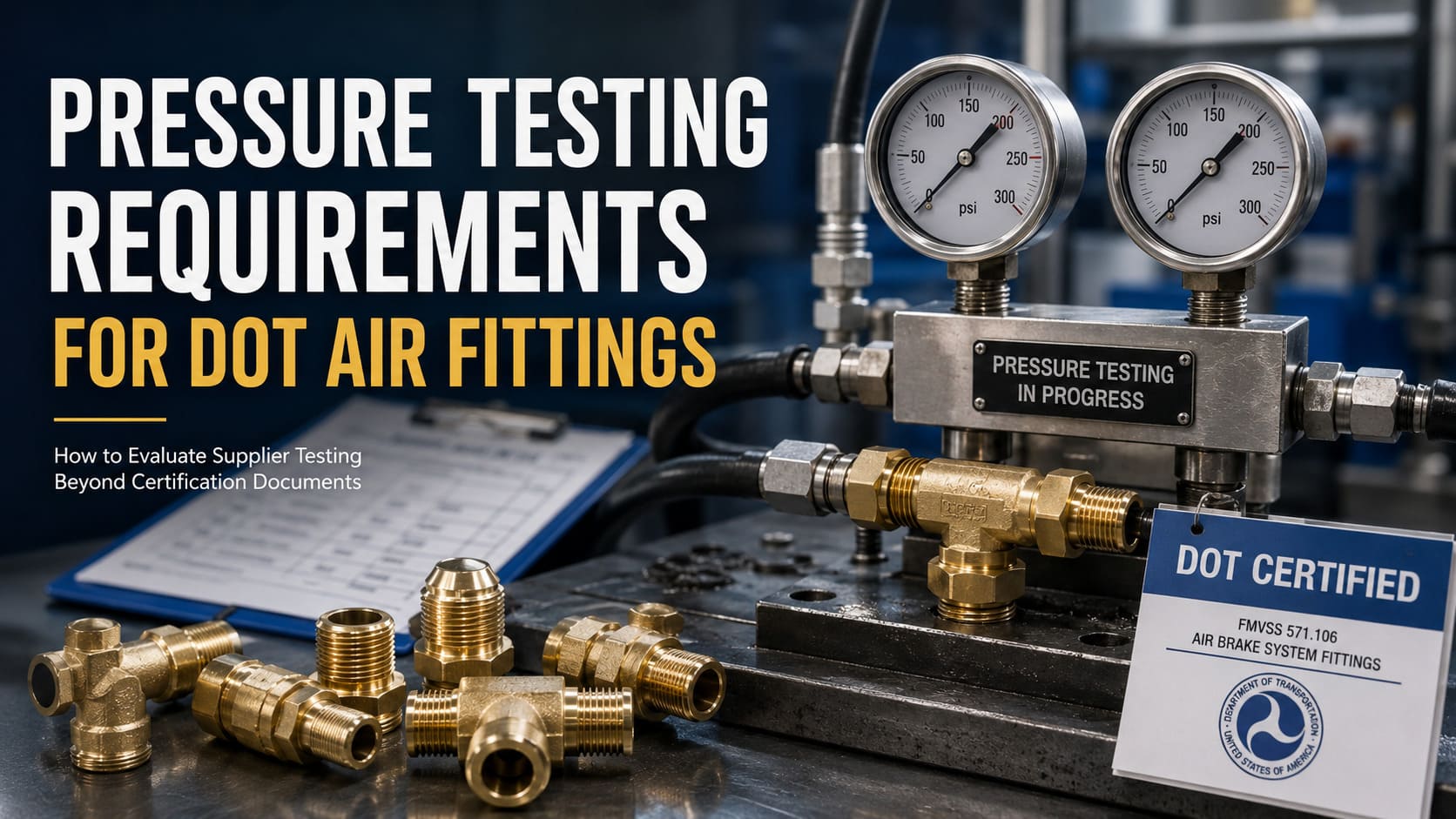
When you're sourcing DOT air fittings for the North American heavy truck market, pressure testing requirements are the first thing buyers ask about — and often the least understood. A failed fitting in a brake air circuit isn't a warranty inconvenience; it's a liability event. Yet most supplier conversations stop at "we're DOT certified," which tells you almost nothing about whether the fittings in your next container will hold up under sustained field pressure.
DOT air fittings must meet minimum pressure performance requirements to enter the North American market, but certification alone doesn't tell procurement managers whether a supplier tests every batch, what their internal pass/fail thresholds are, or how they handle non-conforming parts. Evaluating a supplier's pressure testing process — not just their certificate — is how you separate a credible source from a compliance checkbox.
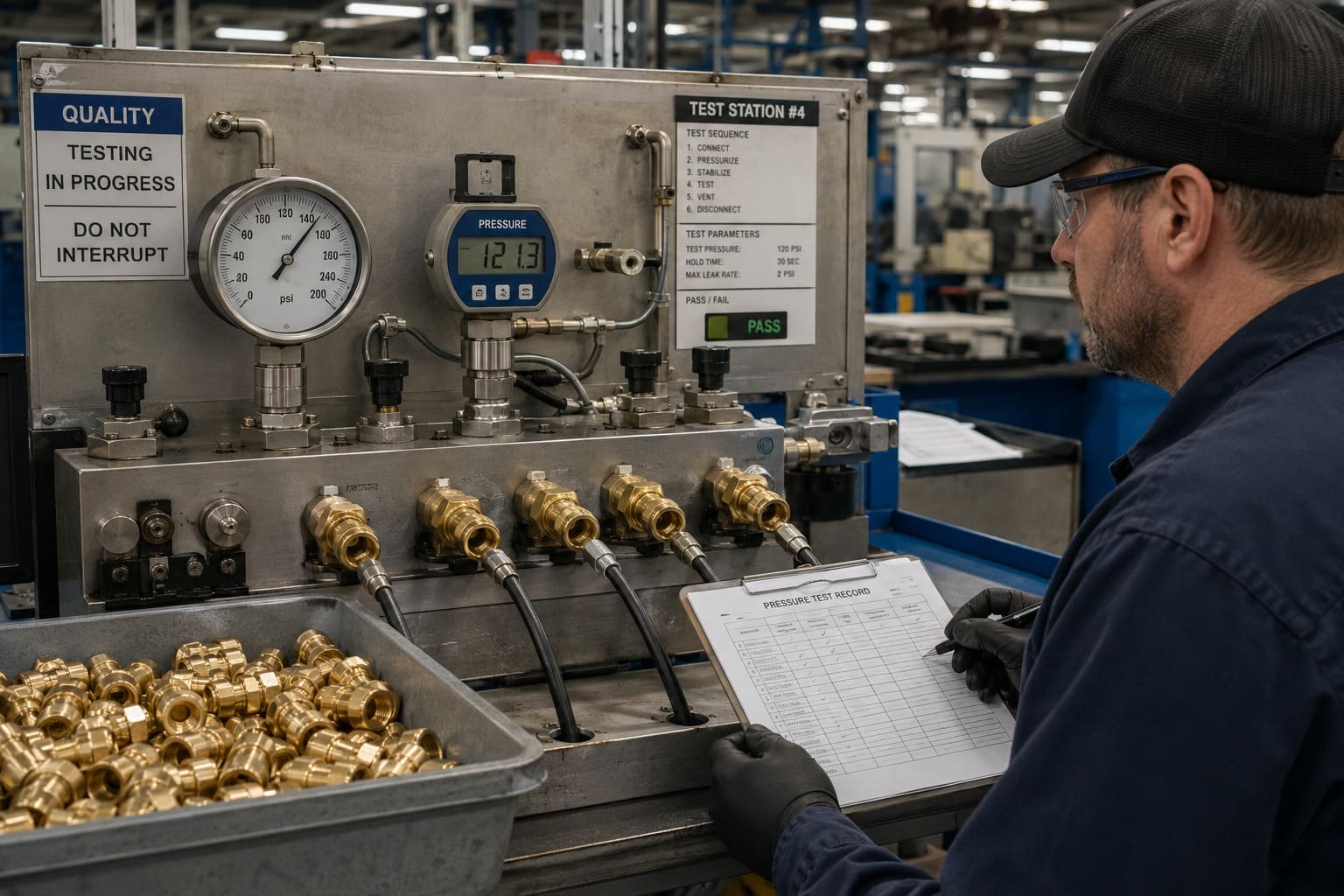
There's a meaningful gap between a fitting that passed a certification test once and a fitting that reliably performs across 500 units in a production batch. The sections below break down how to think about that gap — from how test pressure relates to real operating conditions, to what failure patterns actually signal about manufacturing quality.
What Does "DOT Certified" Actually Mean for Pressure Testing?
Procurement managers often treat a DOT certificate as a pressure testing result. It isn't. The certificate confirms a product met minimum regulatory requirements at a specific point in time — during type approval or initial qualification. What it doesn't tell you is what happens on the production floor next Tuesday when the 400th fitting rolls off the line.
DOT certification for air fittings establishes that a product design met federal minimum performance standards, including pressure resistance benchmarks, during qualification testing.1 It does not guarantee that every production unit is tested, nor does it define a manufacturer's ongoing in-process pressure testing protocol.2 Buyers should request test protocols and batch-level test records separately from certification documents.
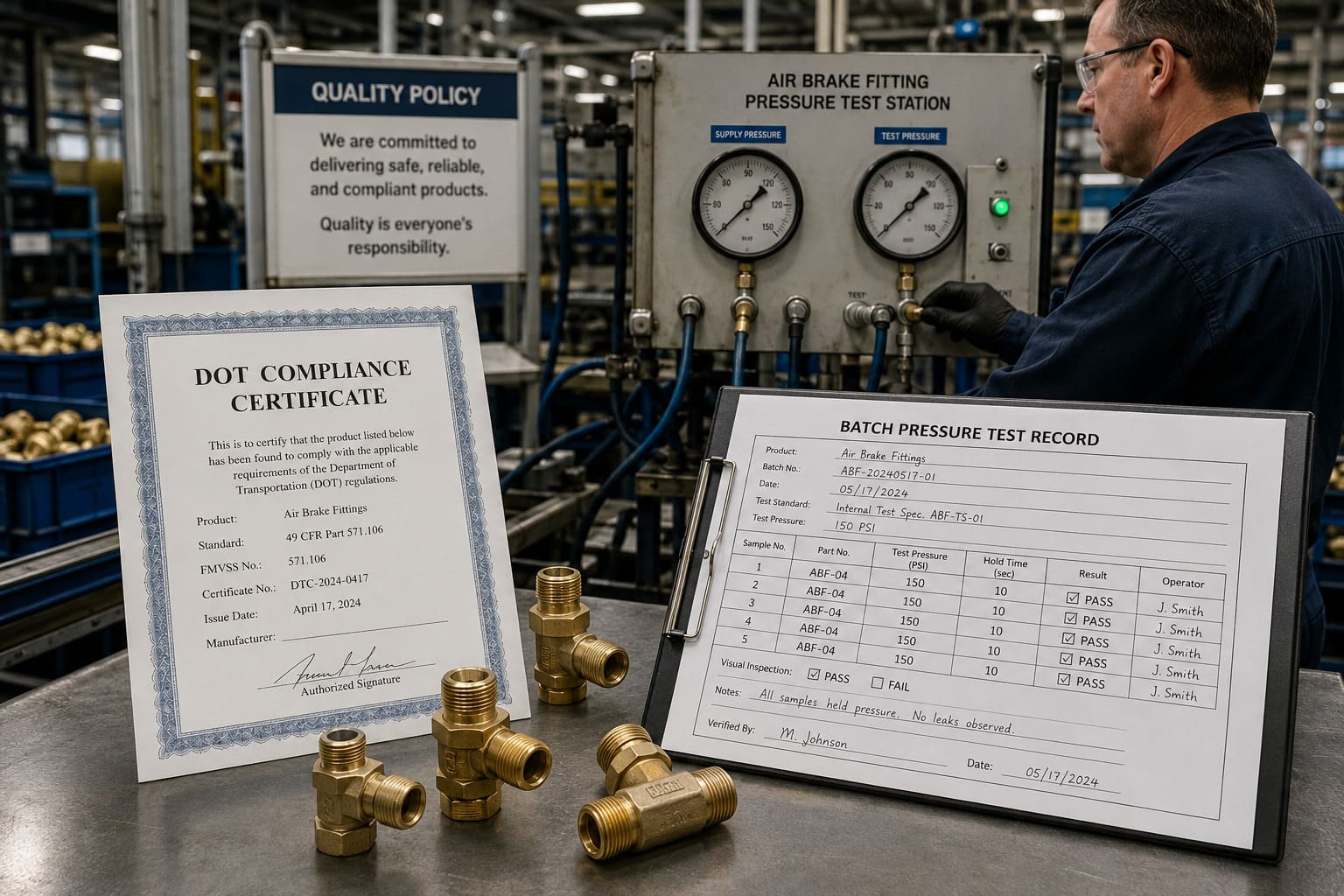
Understanding this distinction changes how you qualify a supplier. A certificate is a starting point. A test protocol is the real conversation.
What Certification Testing Covers — and What It Doesn't
DOT-related standards for air brake system components typically require that fittings demonstrate pressure performance under controlled laboratory conditions.3 Based on what we've seen in our own qualification processes and in the questions buyers bring to us, the certification process generally evaluates:
- Burst pressure — the point at which the fitting fails catastrophically
- Proof pressure — a sustained hold at elevated pressure without leakage or permanent deformation
- Leak performance — whether any measurable leakage occurs at rated working pressure
What it typically does not evaluate on an ongoing basis:
- Every production batch
- Fittings made from a new raw material lot
- Units assembled after a tooling change or process adjustment
Why the Gap Matters to Procurement
I've spoken with purchasing managers who received a legitimate DOT certificate from a supplier, placed a large order, and then saw field returns within two seasons. The certificate wasn't fraudulent. The production process just wasn't consistent with the conditions under which the qualification sample was built.
The right question to ask a supplier isn't "do you have DOT certification?" It's:
"What pressure tests do you run on production batches, and can you share your internal test protocol and recent batch records?"
A supplier who can answer that question specifically — with pass/fail thresholds, sample sizes, and a description of what happens to non-conforming parts — is operating a different quality system than one who hands you a certificate and changes the subject.
How Does Test Pressure Relate to Real-World Operating Conditions?
Pressure specs quoted without context are nearly meaningless. "We test to 300 PSI" sounds reassuring until you ask: what is the rated working pressure of this fitting in a brake air circuit, and how does 300 PSI relate to that?
For DOT air fittings used in heavy truck brake systems, the test pressure used in qualification and in-process testing must be evaluated relative to the fitting's rated working pressure and the actual operating pressures of the target system. A supplier who cannot explain that relationship — typically expressed as a proof pressure multiplier or a burst pressure ratio — is signaling a knowledge gap that matters in high-stakes procurement decisions.
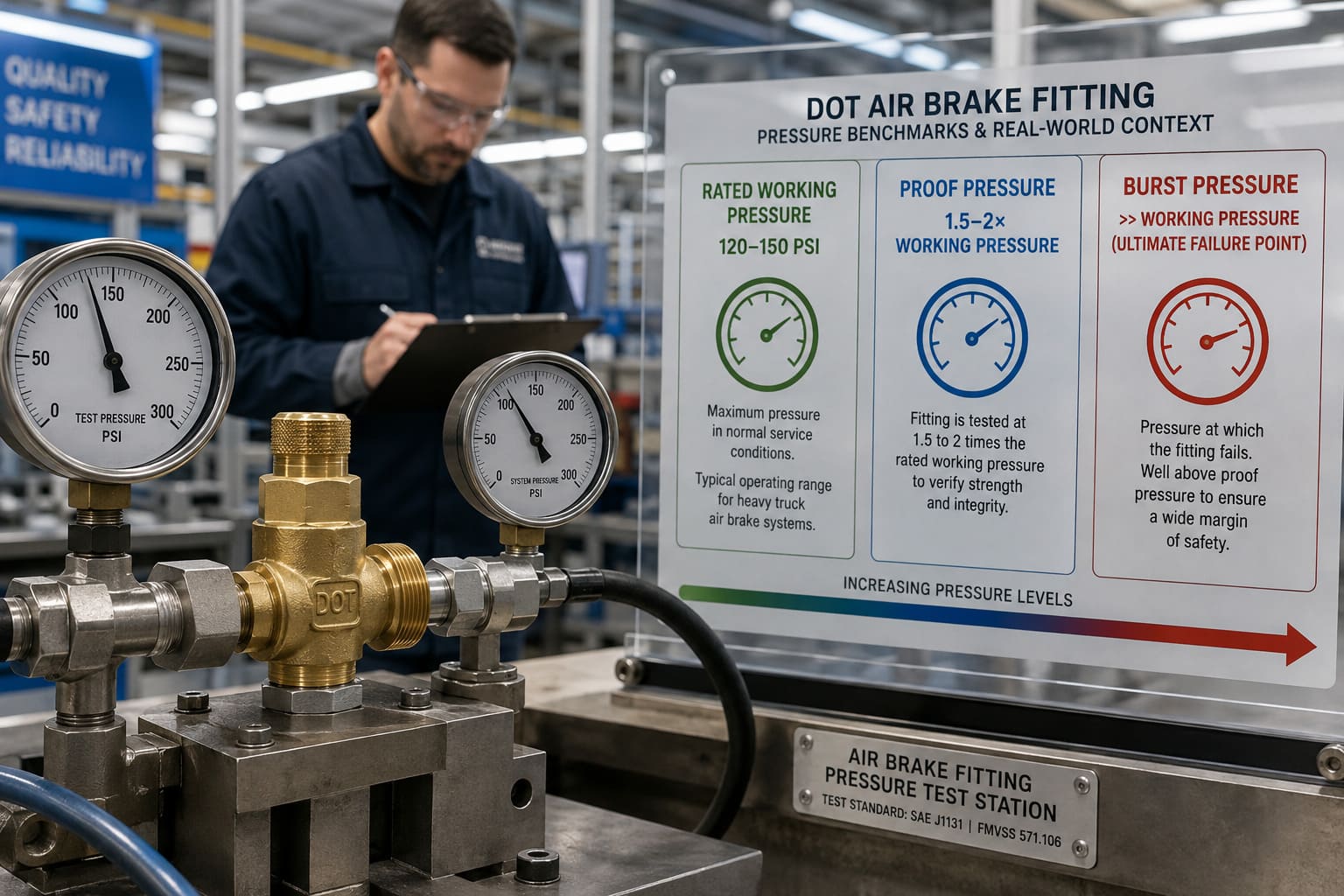
The numbers only mean something when you understand the system they're designed for.
The Three Pressure Benchmarks You Should Be Asking About
When we work through technical qualification with a new customer, we find it helps to separate three distinct pressure references:
| Pressure Type | What It Means | Why It Matters |
|---|---|---|
| Rated Working Pressure | The maximum pressure the fitting is designed to handle in normal operation | Sets the baseline for all other specs |
| Proof Pressure4 | A sustained test pressure (typically 1.5–2× working pressure5) applied without causing leakage or deformation | Confirms structural integrity under elevated load |
| Burst Pressure | The pressure at which catastrophic failure occurs | Defines the safety margin above normal and surge conditions |
In North American heavy truck air brake systems, typical supply circuit pressures run in the range of 120–135 PSI, with some systems operating up to 150 PSI during compressor cut-in.6 Any fitting spec that doesn't relate back to that operating reality needs to be questioned.
Application Context Changes What "Adequate" Means
Not all fittings in a heavy truck pneumatic system are under the same pressure demand. A fitting in the primary brake circuit faces different requirements than one in a suspension air bag line or an auxiliary system. We always ask customers to tell us the specific application before we confirm whether a fitting's test parameters are appropriate.
This matters because:
- Brake air lines carry high-pressure primary and secondary circuits where failure has direct safety consequences. Proof pressure requirements here are stringent.
- Suspension and air ride systems may see lower operating pressures but experience more frequent pressure cycling, making fatigue resistance as important as peak burst strength.
- Auxiliary pneumatic circuits (air horns, door controls, etc.) often operate at lower pressures — but using an undersized fitting to save cost in a brake circuit is a category error some buyers make when sourcing broadly.
A supplier who asks you where the fitting is going before quoting a pressure spec is paying attention. One who gives you a single number for all applications probably isn't.
What Do Failure Patterns Reveal About a Manufacturer's Process?
Failures in pressure testing aren't random. When we see a fitting fail in our lab, the failure tells us something specific about where the production process broke down. That diagnostic relationship between failure pattern and root cause is something most buyers never ask about — but should.
The most common failure modes in DOT air fittings under pressure testing — stress cracking in the fitting body, seal degradation under sustained hold, and micro-leaks at the union interface7 — each trace back to specific production variables: raw material grade, molding or machining consistency, and assembly torque control. A supplier who can describe their non-conformance patterns is demonstrating active quality tracking. One who can't is likely not measuring.
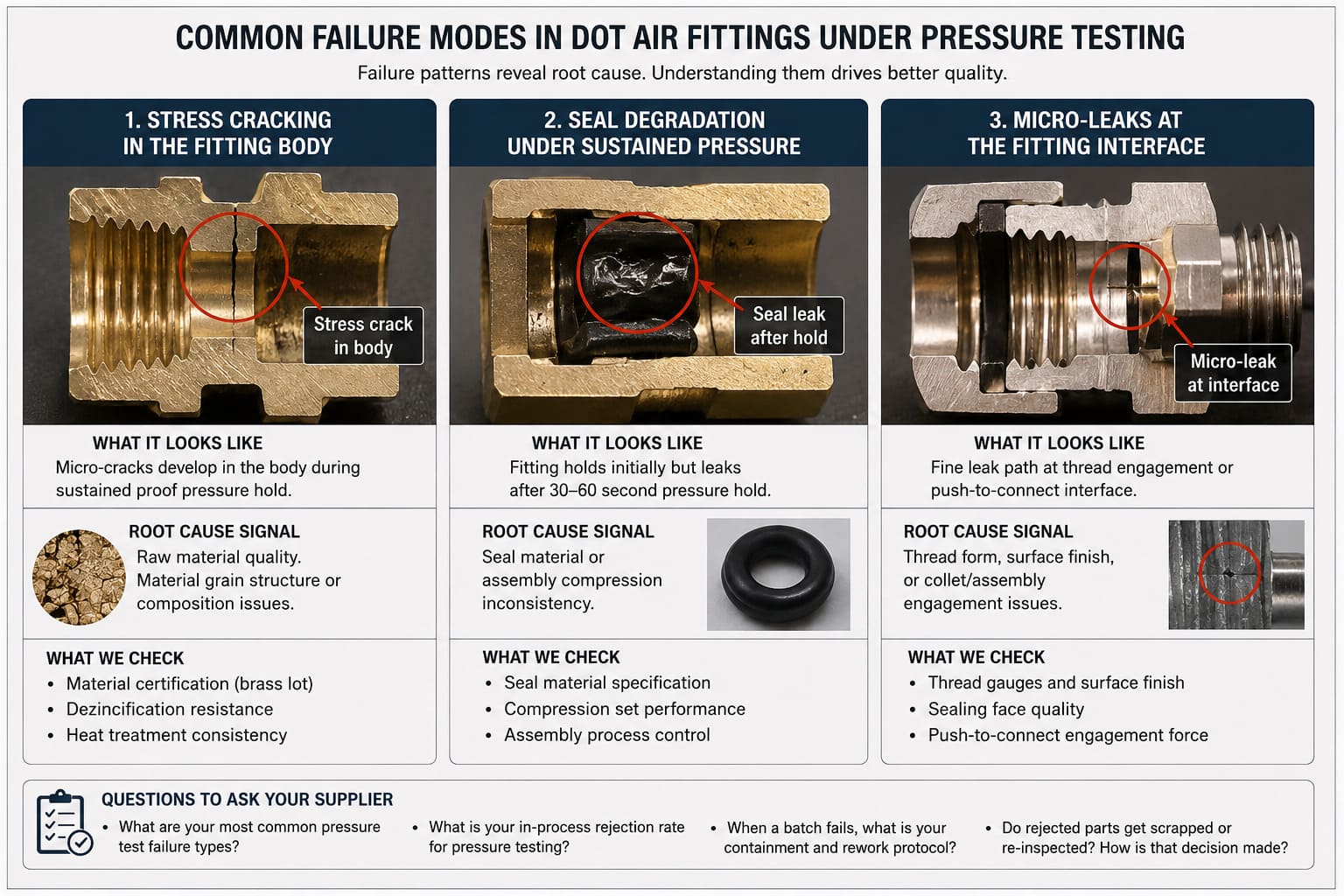
Understanding failure modes helps procurement managers ask better qualification questions — and recognize vague answers for what they are.
The Three Failure Patterns We Watch For
In our in-house pressure testing, we track non-conformances by failure type. Here's what each failure pattern typically indicates:
1. Stress Cracking in the Fitting Body
This typically appears during sustained proof pressure holds, not instantaneous burst tests. The body doesn't fail immediately — it develops micro-fractures under held load.
Root cause signal: Raw material quality. In brass fittings, dezincification resistance and grain structure affect how the metal behaves under sustained stress.8 If we see a spike in body cracking in a batch, the first thing we check is the incoming material certificate for that copper lot.
2. Seal Degradation Under Sustained Pressure
When a fitting holds initially but begins to leak after a 30–60 second pressure hold, the issue is almost always in the seal element — either the material grade is wrong for the operating temperature range, or the seal geometry was compromised during assembly.
Root cause signal: Either the rubber compound specification wasn't met on that batch, or assembly compression was inconsistent.9 We track seal failures separately from body failures because the corrective action is different.
3. Micro-Leaks at the Fitting Interface
These are the hardest to catch and the most common cause of field returns. The fitting passes visual inspection and even a brief pressure check, but under sustained pressure in a real system, a fine leak path develops at the thread engagement or push-to-connect interface.
Root cause signal: Thread form consistency, surface finish on sealing faces, or push-to-connect collet engagement. This is where assembly process consistency matters as much as raw material quality.
What to Ask a Supplier About Their Non-Conformance Data
A credible supplier should be able to answer these questions without hesitation:
- What are your most common pressure test failure types?
- What is your in-process rejection rate for pressure testing?
- When a batch fails, what is your containment and rework protocol?
- Do rejected parts get scrapped or re-inspected? How is that decision made?
If a supplier tells you they "rarely have failures," that's not reassuring — it means they either aren't testing enough units to find them, or they aren't tracking what they find.
Is Batch-Level Testing the Right Standard for Procurement Decisions?
A single test report — even a detailed one with impressive pressure numbers — proves the sample that was tested. It says nothing about the 480 units next to it in the container. For procurement managers managing their own warranty exposure and customer relationships, batch-level testing traceability isn't a premium feature to negotiate for. It's a minimum benchmark.
Procurement managers sourcing DOT air fittings for North American distribution should require batch-level pressure test records, not sample-based certification documents alone. This means asking suppliers to confirm their AQL sampling level for pressure testing, whether every production batch generates a test record, and how long those records are retained. Batch traceability is the mechanism that connects a customer complaint back to a specific production run.
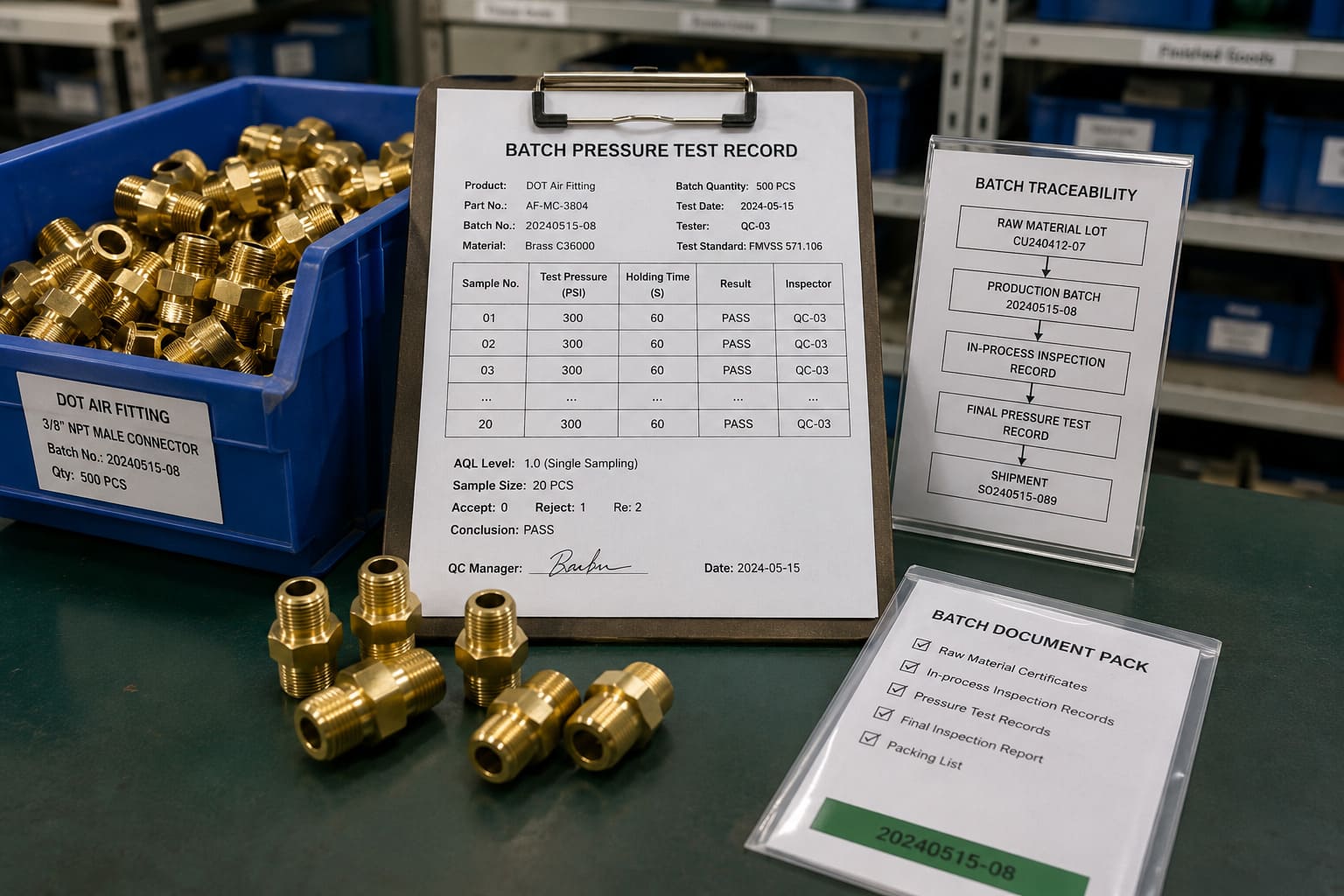
This is one of the areas where asking the right question before placing an order saves considerably more trouble than chasing it down after a field return.
What Batch-Level Testing Should Look Like
In our own QC system, every production batch goes through multi-node testing — not just a final check before shipment. Here's how we think about it:
Incoming material stage:
- Copper, rubber, and metal components inspected with batch compliance certificates verified
- Material traceability linked to the production batch before processing begins
In-process stage:
- Sampling at defined intervals during production with documented SOP
- Any deviation from process parameters triggers a hold, not a rework-on-the-fly
Pre-shipment stage:
- AQL-based sampling for pressure performance on completed fittings
- 100% final inspection on key product lines where application risk justifies it
- Test records archived and linked to the outgoing batch number
This isn't how every manufacturer operates. But it's how you should expect a supplier to operate if they're supplying safety-critical components into brake air systems.
AQL Levels: What the Numbers Mean
AQL (Acceptable Quality Level) is the statistical standard that governs how many units are sampled from a batch and what rejection threshold applies. For pressure testing of safety-critical fittings, buyers should understand the basic framework:
| AQL Level | General Application | Implication |
|---|---|---|
| AQL 0.65 | Critical safety characteristics | Very low tolerance for defects; large sample sizes |
| AQL 1.0 | Major functional characteristics | Moderate-low tolerance; commonly used for performance testing |
| AQL 2.5 | General dimensional and functional | Widely used for non-critical features |
| AQL 4.0+ | Minor/cosmetic characteristics | Not appropriate for pressure-bearing components |
For DOT air fittings going into brake circuits, I'd be skeptical of any supplier whose pressure testing operates at AQL 2.5 or looser. Ask specifically what AQL level they apply to pressure performance — not just overall product inspection.
The Traceability Question Nobody Asks
One question I find most procurement managers haven't thought to ask: "If I get a field return six months from now, can you trace it back to the production batch and pull the corresponding test record?"
That question separates a supplier with a QC system from one with a QC document. The answer should be yes, immediately, with a specific retention period for records. If it requires investigation to answer, that's informative.
Frequently Asked Questions
Does a DOT certificate confirm that every fitting was pressure tested?
No. DOT certification typically confirms that a product design met minimum federal performance standards during qualification testing. It does not require that every production unit be individually pressure tested. Buyers should separately request a supplier's in-process testing protocol and batch-level test records to understand ongoing production quality control.
What pressure should DOT air fittings be tested to?
The appropriate test pressure depends on the application. For heavy truck brake air systems, operating pressures typically range from 120–150 PSI. Proof pressure testing is generally performed at a multiple of the rated working pressure — often 1.5 to 2 times — while burst pressure tests establish the maximum failure point. Buyers should verify that a supplier's test parameters are referenced to the specific application's working pressure, not stated in isolation. Consult the relevant SAE and FMVSS standards, or a qualified engineer, for application-specific requirements.
How do I know if a supplier tests every batch or just keeps one certificate on file?
Ask directly for batch test records from recent shipments — not a sample report or a certificate. A supplier running genuine batch-level pressure testing should be able to provide records linked to specific production lots, with documented sample sizes, pass/fail results, and test dates. If a supplier provides only a single generic test report, treat that as a gap in their quality system.
What failure modes should I ask about when qualifying a supplier?
Ask about stress cracking in the fitting body, seal degradation under sustained pressure hold, and micro-leaks at the fitting interface. These are the most common pressure-related failure patterns in production. A supplier who can describe which failure types they see, how frequently, and what triggers rework or rejection is demonstrating active quality tracking — which is more meaningful than a claim that failures are rare.
Is AQL sampling sufficient for safety-critical air fittings, or should I require 100% testing?
AQL sampling is a statistically valid approach to batch inspection, but the AQL level applied matters significantly. For pressure performance on brake-circuit fittings, an AQL of 1.0 or tighter is more appropriate than the commonly used AQL 2.5. Some manufacturers apply 100% final inspection to highest-risk product lines. Ask your supplier which approach they use and for which specific test parameters.
Conclusion
Evaluating a supplier on DOT air fittings pressure testing comes down to three questions: Do they test to pressure parameters that are appropriate for the application? Are their pass/fail criteria defined and documented? And do they test consistently across production batches — not just on qualification samples?
A DOT certificate is where the conversation starts, not where it ends. The suppliers worth working with can tell you their proof pressure thresholds, describe the failure patterns they track, cite their AQL level for pressure performance, and pull a batch test record on request. That level of specificity is what protects your inventory pipeline, your customer relationships, and your warranty exposure in the North American heavy truck aftermarket.
If you're qualifying a new supplier for DOT air fittings — or benchmarking your current source — we're ready to walk through our testing process in detail. Contact ROADSPOWER to request technical documentation or discuss your application requirements directly.
"49 CFR 571.106 -- Standard No. 106; Brake hoses.", https://www.ecfr.gov/current/title-49/subtitle-B/chapter-V/part-571/subpart-B/section-571.106. NHTSA regulations under the Federal Motor Vehicle Safety Standards specify performance requirements for brake hoses and related assemblies and place certification responsibility on manufacturers, supporting the point that DOT marking reflects compliance with federal minimum requirements rather than an independent guarantee of all production units. Evidence role: definition; source type: government. Supports: The source should define the applicable DOT/NHTSA certification framework and the pressure-performance requirements for brake hose assemblies or fittings used in motor vehicle air brake systems.. Scope note: The regulation may address brake hose assemblies and motor vehicle equipment more broadly, so it provides regulatory context rather than a direct audit of any specific air-fitting supplier. ↩
"Understanding NHTSA's Regulatory Tools", https://www.nhtsa.gov/sites/nhtsa.gov/files/documents/understanding_nhtsas_current_regulatory_tools-tag.pdf. NHTSA describes the U.S. vehicle-safety compliance system as manufacturer self-certification to applicable FMVSS requirements, which supports the distinction between regulatory compliance marking and a supplier's separate production-level quality-control testing. Evidence role: general_support; source type: government. Supports: The source should support that U.S. DOT/NHTSA compliance is generally based on manufacturer self-certification to FMVSS requirements, not routine government testing of every unit or mandated supplier batch protocols.. Scope note: This supports the regulatory model generally; it may not enumerate every possible production-test obligation for every component category. ↩
"49 CFR 571.106 -- Standard No. 106; Brake hoses.", https://www.ecfr.gov/current/title-49/subtitle-B/chapter-V/part-571/subpart-B/section-571.106. FMVSS No. 106 specifies laboratory performance tests for brake hoses and assemblies, including pressure-related criteria, supporting the statement that DOT-related brake component standards evaluate pressure performance under controlled conditions. Evidence role: general_support; source type: government. Supports: The source should document that applicable brake hose or air brake component standards include laboratory pressure tests such as constriction, leakage, or burst-strength requirements.. Scope note: The standard is framed around brake hose assemblies; its relevance to standalone fittings depends on how the fitting is incorporated into a regulated assembly. ↩
"Pressure - NASA", https://www.nasa.gov/reference/jsc-pressure/. Engineering pressure-system guidance defines proof pressure as a verification pressure above normal operating pressure that a component must withstand without leakage or structural damage, distinguishing it from maximum working pressure and burst pressure. Evidence role: definition; source type: institution. Supports: The source should define proof pressure as a specified pressure above normal working pressure used to verify integrity without causing failure or permanent deformation.. Scope note: Definitions may come from general pressure-system guidance rather than a DOT air-fitting-specific standard. ↩
"46 CFR Part 56 Subpart 56.97 -- Pressure Tests", https://www.ecfr.gov/current/title-46/chapter-I/subchapter-F/part-56/subpart-56.97. Pressure-system standards commonly specify proof testing as a multiple of rated or maximum allowable working pressure, with common multipliers in the range of roughly 1.5 to 2 times, supporting the article's use of this range as a general engineering benchmark. Evidence role: general_support; source type: institution. Supports: The source should show that proof-test pressures in engineering standards are commonly specified as a multiplier above working or maximum allowable pressure, often in the 1.5x to 2x range depending on the standard.. Scope note: The exact multiplier is standard- and application-specific, so this evidence should not be read as establishing a universal requirement for all DOT air fittings. ↩
"Motorcoach Brake Systems and Safety Technologies | FMCSA", https://www.fmcsa.dot.gov/carrier-safety/carrier-safety-resources/motorcoach-brake-systems-and-safety-technologies. Commercial driver and air-brake guidance commonly describes truck air-brake governor cut-out and system operating pressures in the approximate 120–140 psi range, with warning and operational thresholds defined around these pressures, supporting the article's operating-pressure context. Evidence role: statistic; source type: government. Supports: The source should provide typical air brake reservoir or governor pressure ranges for commercial vehicles, including values around 120 psi and upper ranges near 150 psi.. Scope note: Published ranges vary by vehicle configuration and jurisdictional training material; the source supports typical operating context rather than a universal specification for every truck. ↩
"49 CFR 571.106 -- Standard No. 106; Brake hoses.", https://www.ecfr.gov/current/title-49/subtitle-B/chapter-V/part-571/subpart-B/section-571.106. Independent failure-analysis and pneumatic-connector literature identifies cracking of fitting bodies, degradation of elastomeric seals, and leakage at threaded or push-to-connect interfaces as recognized failure modes in pressurized pneumatic connections, supporting the article's classification of likely pressure-test failures. Evidence role: general_support; source type: research. Supports: The source should identify leakage, seal failure, cracking, or interface failure as recognized failure modes in pneumatic fittings or brake-line connectors.. Scope note: The evidence may concern pneumatic fittings broadly, so it contextualizes rather than quantitatively proves these are the most common modes for all DOT air fittings. ↩
"Corrosion Behavior and Susceptibility to Stress Corrosion Cracking ... - PMC", https://pmc.ncbi.nlm.nih.gov/articles/PMC8746281/. Materials science studies of brass corrosion and failure show that alloy composition, dezincification susceptibility, and microstructural features influence cracking and loss of mechanical integrity under stress, supporting the article's link between raw-material quality and fitting-body failures. Evidence role: mechanism; source type: paper. Supports: The source should explain how brass composition, dezincification susceptibility, and microstructure affect mechanical integrity or cracking under stress and corrosive conditions.. Scope note: The mechanism is well established for brass alloys generally; direct applicability depends on the fitting alloy, environment, and manufacturing process. ↩
"What Is Compression Set? Why It Matters for Seal Design", https://waynerubber.com/blog/what-is-compression-set-why-it-matters-for-seal-design/. Elastomer seal engineering references identify material selection, compression set, and installation compression as key determinants of leakage performance under pressure, supporting the article's explanation that seal failures can arise from compound nonconformance or inconsistent assembly compression. Evidence role: mechanism; source type: research. Supports: The source should explain that elastomer material properties, compression set, compatibility, and installation compression affect seal leakage under pressure.. Scope note: The source may discuss elastomer seals generally rather than DOT air-fitting seals specifically. ↩