Unexpected air system failures on heavy-duty trucks rarely announce themselves in advance. A 3-in-1 air power line assembly looks intact right up until the moment it causes a roadside breakdown, a failed DOT inspection, or a trailer that won't respond. When that happens, the cost — towing, downtime, dispatch disruption — often dwarfs the price of the part itself.
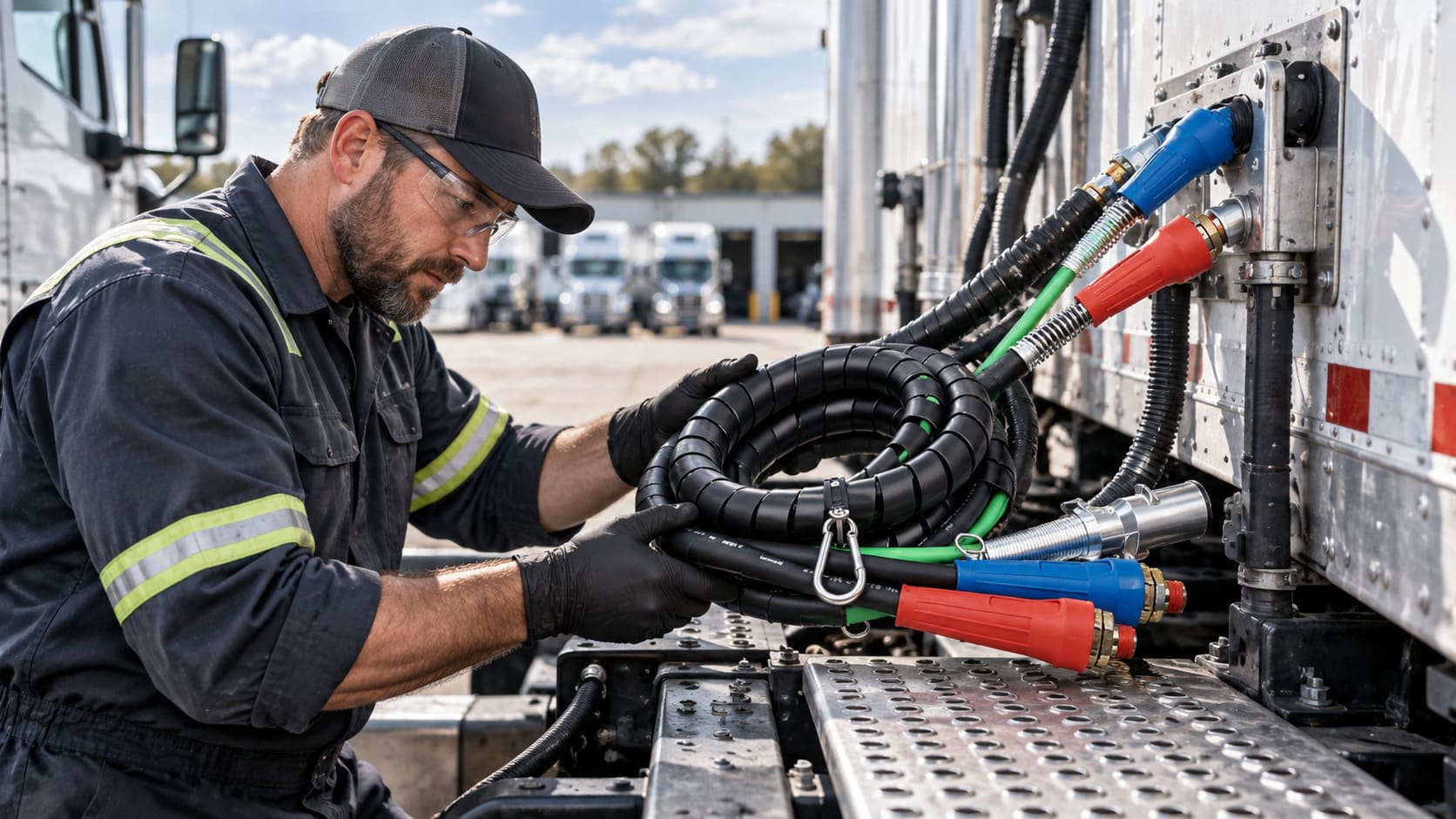
A 3-in-1 air power line assembly combines two pneumatic air lines and one electrical cable into a single routed assembly connecting a tractor to its trailer1. Maintaining it correctly means inspecting for hidden failure risks — air tightness, fitting integrity, cable recovery, connector condition, abrasion points, and material aging — not just visible outer jacket damage. Each inspection point ties directly to a specific failure mode and a measurable business consequence.
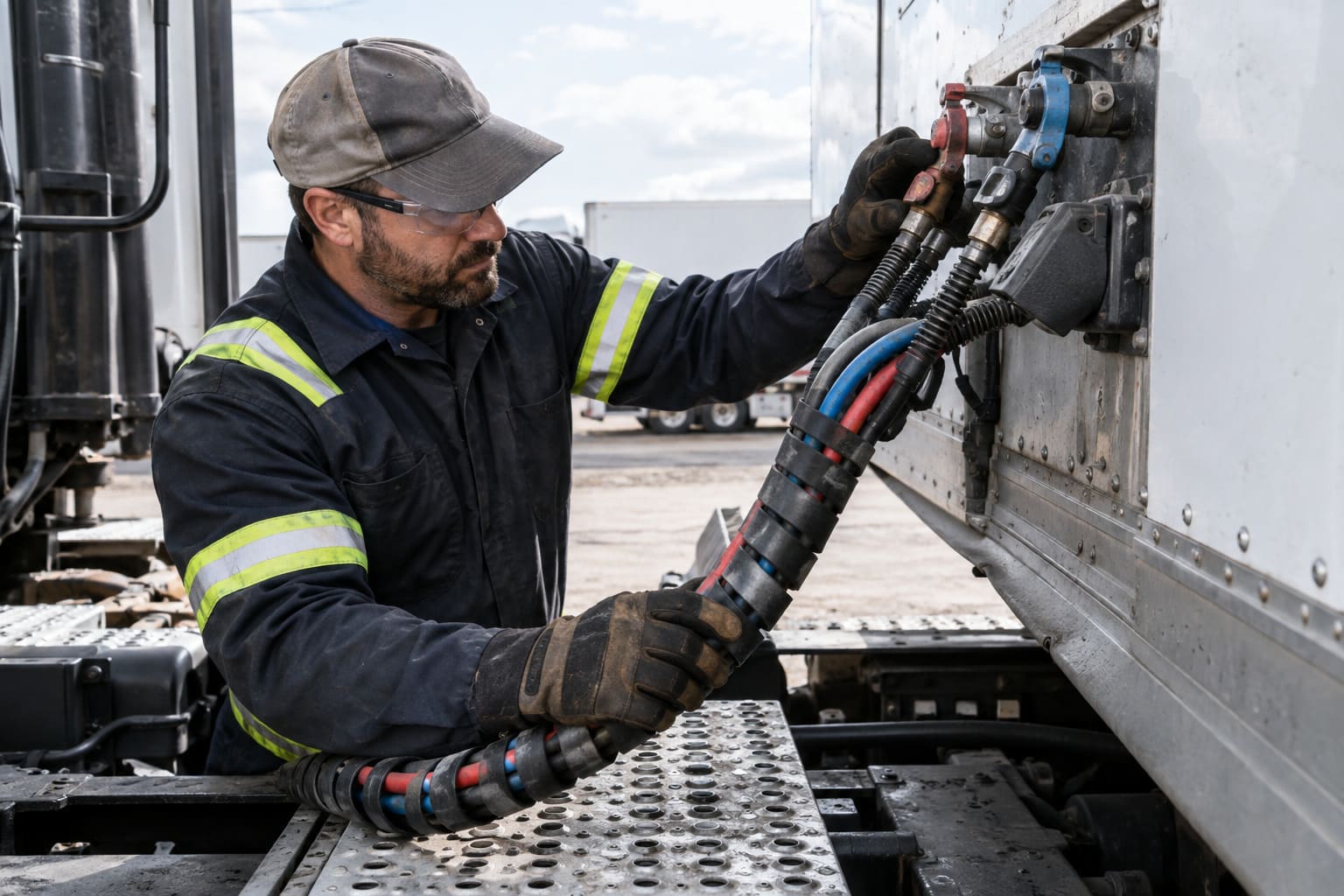
Most maintenance teams already know to look for obvious cuts or broken fittings. The harder challenge is understanding what to look for before visible damage appears — and how to tell whether a developing problem is a product issue, a routing issue, or an installation issue. The sections below work through both.
Why Do 3-in-1 Air Power Line Assemblies Fail Before They Look Damaged?
Visible damage is a lagging indicator.2 By the time you see a cracked jacket or a broken fitting, the functional failure has often already happened — or is seconds away. Fleet maintenance teams that rely on visual-only inspection routinely replace assemblies reactively rather than preventively.
The gap between visible condition and functional condition exists because most failure mechanisms in a 3-in-1 air power line assembly are internal or progressive. Micro-leaks form at fitting seats. Coil memory weakens under repeated thermal cycling. Abrasion begins on the inner layers of the jacket before breaking through to the surface. Electrical contacts oxidize inside sealed connectors. None of these look like a problem until they become one.
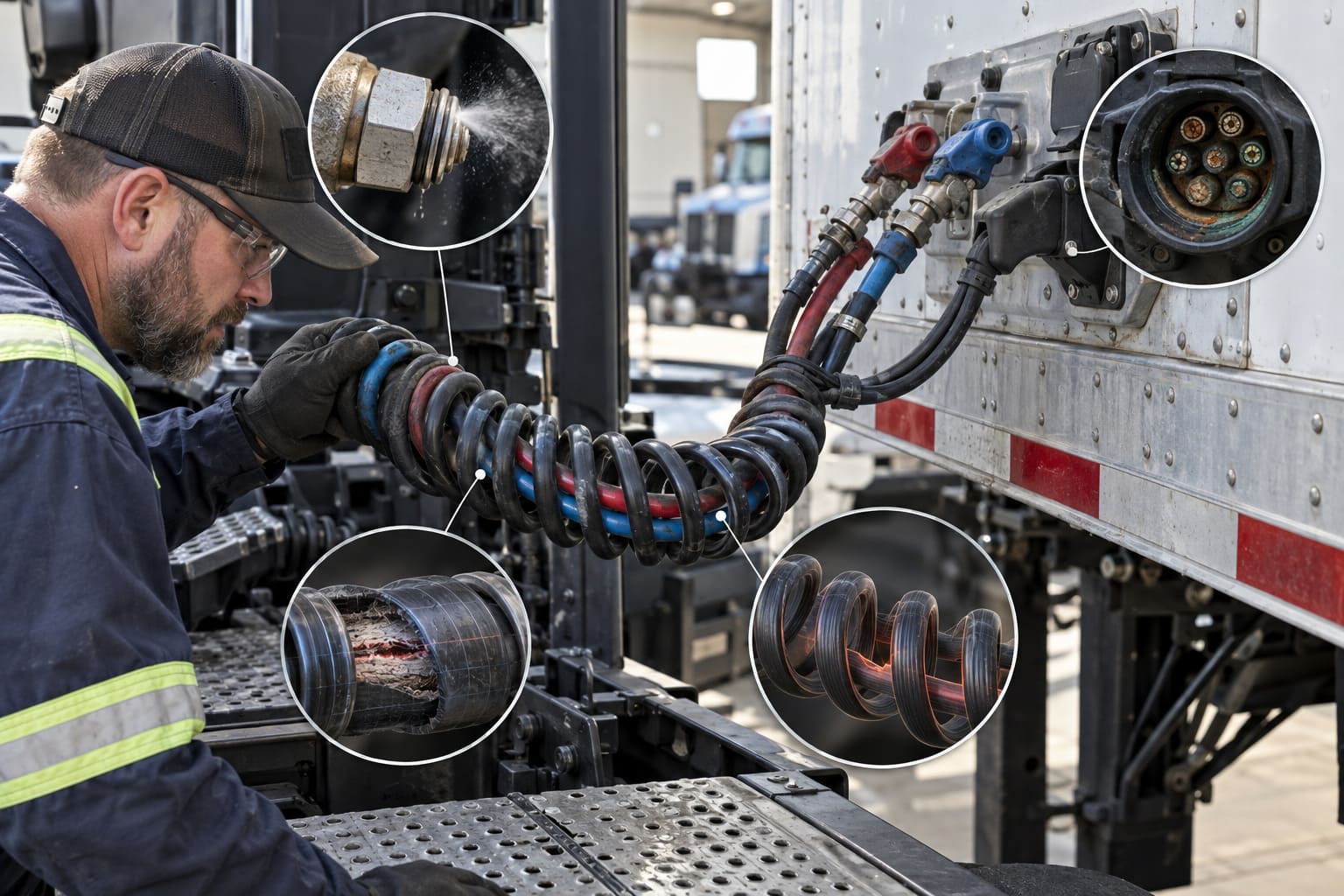
Understanding the gap between appearance and function changes how you structure your inspection program. It also changes how you evaluate replacement parts — because two assemblies that look identical on a shelf can perform very differently under operating conditions.
The Three Layers of Failure Risk
A 3-in-1 assembly has three functional systems running in parallel, and each carries its own failure risk profile:
- Pneumatic system — the two air lines (emergency and service) responsible for brake actuation3
- Electrical system — the cable and connectors supplying lighting and ABS signals
- Mechanical system — the fittings, coils, routing hardware, and jacket that hold everything together under movement and load
Failures in any one layer can immobilize a trailer or trigger a roadside inspection violation.4 Failures that interact across layers — for example, a fitting failure that also pinches the electrical cable — are harder to diagnose and more expensive to repair.
Why Operating Environment Accelerates Hidden Degradation
Several operating conditions accelerate the gap between visible and functional condition:
- Temperature cycling — repeated expansion and contraction weakens coil memory and fatigues fitting seats over time
- Road debris and splash — abrasive contamination works into contact surfaces and connector seals
- Ozone and UV exposure — degrades rubber and PVC jacket compounds, particularly at lower-quality material grades
- Vibration — works connections loose and creates micro-movement at fixed mounting points that eventually causes chafe damage
From feedback patterns we see in supplier-customer communication, assemblies installed in high-cycle, high-mileage applications or severe climates tend to surface problems faster than identical assemblies in lighter-duty use. That operating-condition variable matters when you're setting inspection frequencies and evaluating whether a part failure was premature.
What Should a Preventive Inspection Actually Cover?
Generic checklists exist everywhere. The more useful question is: what failure risk does each inspection point address, and what is the business consequence of missing it?
A preventive inspection of a 3-in-1 air power line assembly should cover seven areas: outer jacket condition, coil memory and extension range, fitting connection integrity, air tightness under pressure, electrical connector condition, routing and tension geometry, and mounting hardware security.5 Each area corresponds to a specific failure mode that causes either a safety event, a DOT violation, or an unplanned repair.
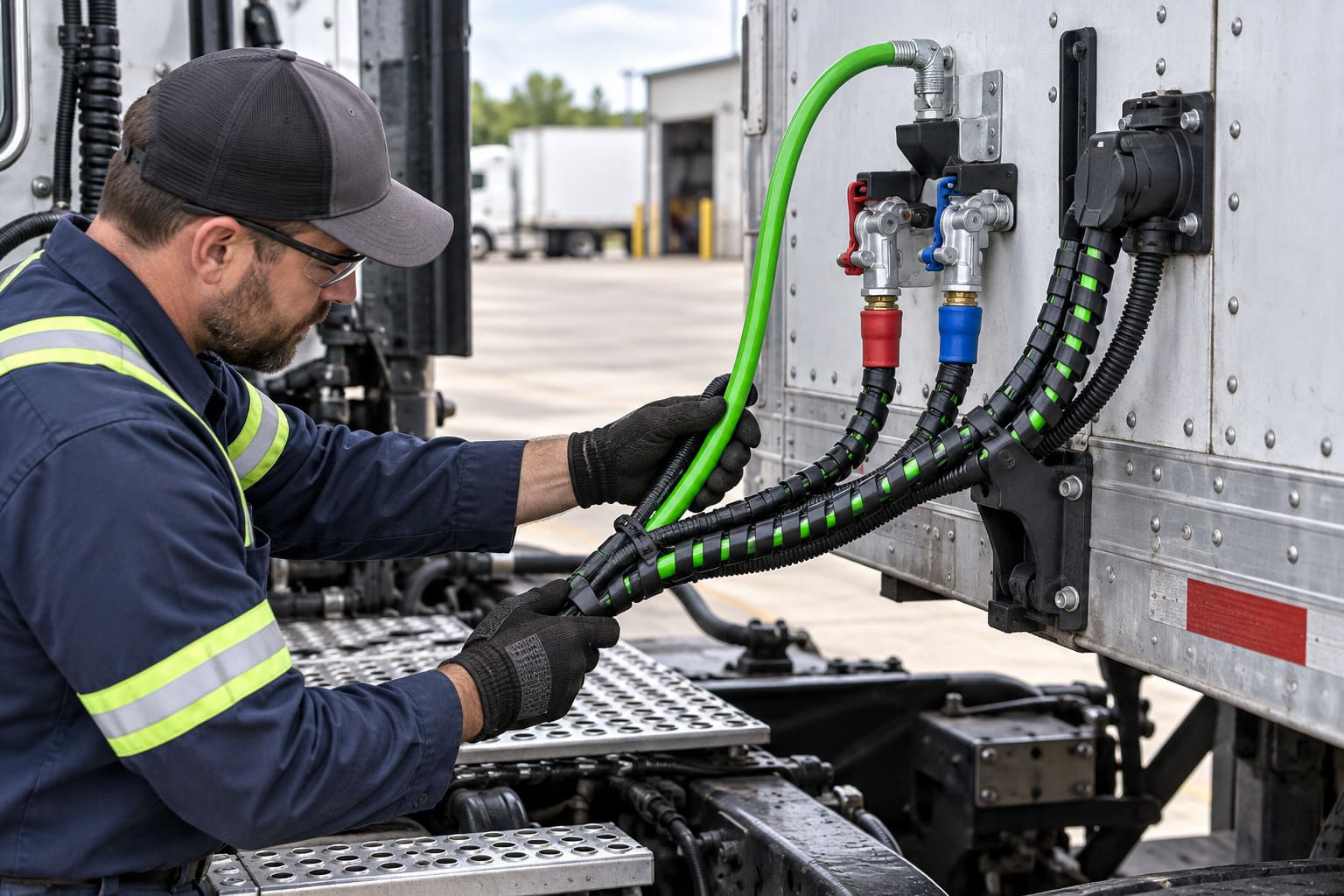
Running through each one with its underlying failure logic gives your maintenance team a reason to look carefully — not just a box to check.
Outer Jacket Condition
What to look for: Cuts, cracks, surface crazing, unusual stiffness, discoloration, or soft spots that suggest internal damage.
Failure risk: A compromised jacket exposes the air lines and electrical cable to moisture ingress, road debris, and chemical contamination. Jacket degradation is often a leading indicator of accelerated internal aging in lower-grade materials.
Business consequence: Undetected jacket damage leads to progressive internal failure — typically discovered at the worst time, during a DOT inspection or a roadside breakdown.
Coil Memory and Extension Range
What to look for: Does the coil extend smoothly to working length without kinking? Does it retract without dragging on the ground or tangling? Are there flat spots, permanent sets, or sections that won't recover?
Failure risk: Lost coil memory means the assembly hangs lower than designed, increasing exposure to road debris, tire contact, and pinch points. Kinks create stress concentrations that accelerate jacket cracking and internal tubing fatigue.
Business consequence: Ground drag leads to abrasion failure. Kinking leads to air line fatigue and eventual cracking. Both are preventable with early coil-condition monitoring.
Fitting Connection Integrity
What to look for: Physical security of gladhand and push-to-connect fittings. Evidence of seepage, staining, or corrosion around fitting seats. Ease of coupling and decoupling without excessive force or play.
Failure risk: Fitting failure is one of the most common reported failure types we hear about in aftermarket air line support discussions. It can occur from over-torquing at installation, from incompatible fitting materials, or from fitting seats that were never properly sealed in manufacture. A fitting that appears connected can still leak at 100 PSI.
Business consequence: Fitting air leaks cause brake system pressure loss. Depending on severity, this can trigger low-pressure warning systems, reduce braking response, or cause a complete brake failure event.
Air Tightness Under Pressure
What to look for: This cannot be assessed visually. Air tightness requires pressure testing — either with dedicated shop equipment or by monitoring system pressure drop during a static test.
Failure risk: Micro-leaks at fitting seats, tubing joins, or jacket penetrations may not produce audible hissing under ambient conditions but will cause measurable pressure loss under operating pressure (typically 120–135 PSI in North American brake systems)6.
Business consequence: Slow air leaks are insidious. They deplete the air reservoir gradually, can cause compressor overrun, and may not trigger driver awareness until pressure drops below a critical threshold.7
Electrical Connector Condition
What to look for: Corrosion, bent pins, moisture infiltration, damaged locking tabs, and signs of arcing or heat discoloration on the 7-way connector.
Failure risk: Degraded electrical connections cause intermittent ABS faults, tail light failures, and turn signal issues. Intermittent faults are particularly problematic because they may not reproduce during shop diagnostics.
Business consequence: ABS faults can trigger CSA (Carrier Safety Administration) violation points in North America. Lighting failures are an immediate roadside inspection violation.8
Routing and Tension Geometry
What to look for: Is the assembly routed with appropriate slack for fifth-wheel articulation? Is it rubbing against chassis components, exhaust systems, or other hardware? Does the routing path create a pinch point at maximum turn radius?
Failure risk: This is one of the most underdiagnosed causes of assembly failure. A well-made assembly installed on a poor routing path will fail prematurely — and the failure will look like a product problem rather than an installation problem.
Business consequence: Repeat failures on the same vehicle almost always warrant a routing audit before replacing the assembly again. Replacing the part without addressing routing geometry means the replacement will fail by the same mechanism.
Mounting Hardware Security
What to look for: Are coil hangers, brackets, and cable ties secure and correctly positioned? Are there sharp edges where mounting hardware contacts the assembly?
Failure risk: Loose mounting hardware allows the assembly to move beyond its designed range, creating abrasion points and tension events. Sharp hardware edges cut jacket material during vibration.
Business consequence: Mounting hardware failures are inexpensive to correct. Missing them early leads to jacketing failure and, eventually, internal tubing or cable damage.
How Do You Separate a Product Failure From an Installation or Routing Problem?
This is a question that comes up in nearly every warranty or after-sales discussion we're involved in. When an assembly fails, attributing it correctly matters — because the wrong diagnosis leads to the wrong fix.
Before concluding that a 3-in-1 air power line assembly has a product defect, evaluate the installation routing, tension conditions, fitting compatibility, connector interface, and operating environment. Many failures that appear to be product failures are caused by incompatible fittings, incorrect routing, excessive tension, or application mismatch. Product failure and installation failure produce different evidence patterns on a failed assembly.
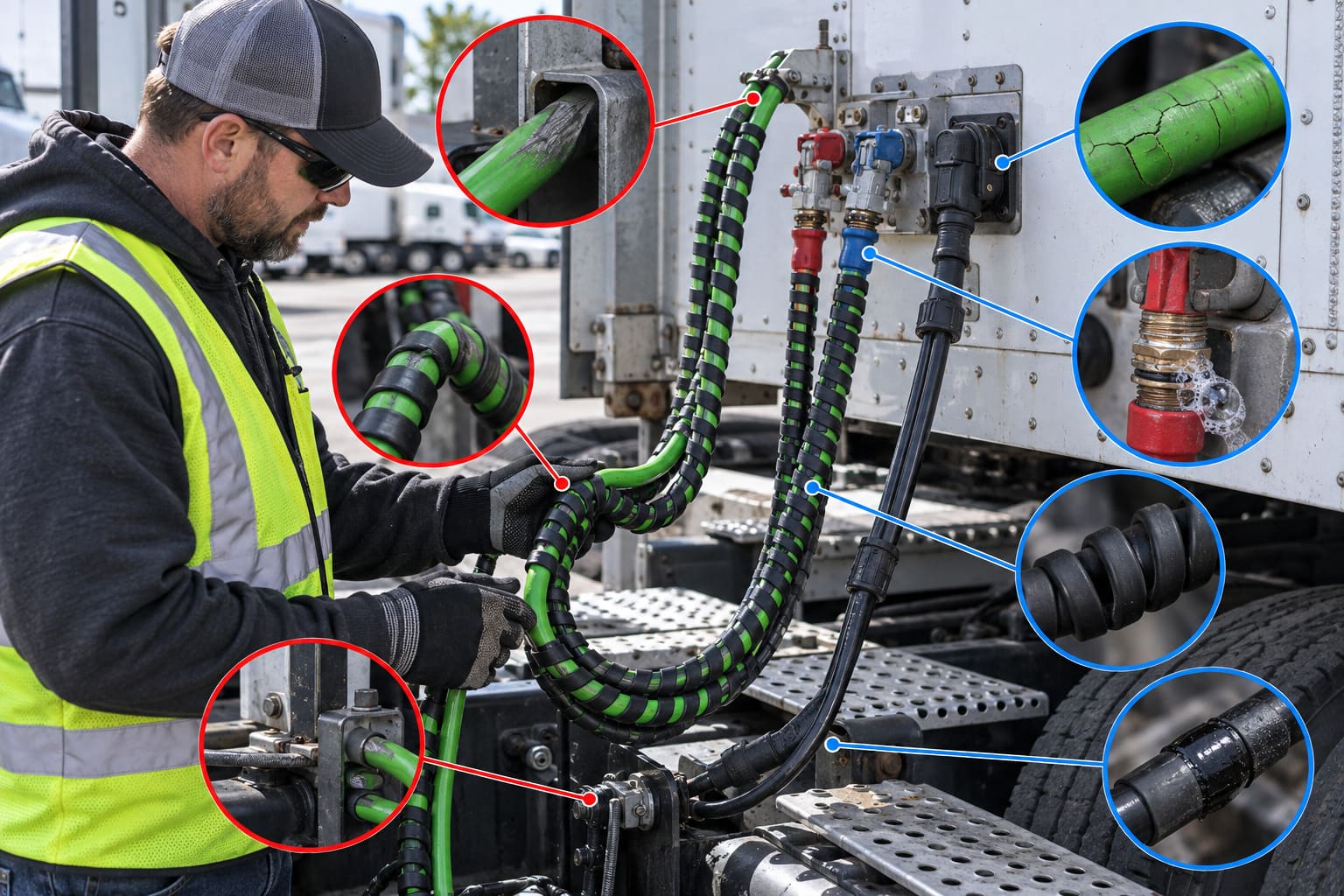
Evidence Patterns That Point to Installation or Routing Issues
| Failure Location | Most Likely Cause |
|---|---|
| Failure at a fixed mounting point | Abrasion from routing hardware; sharp edge contact |
| Failure near the tractor-side fitting | Excessive tension at maximum articulation; routing too short |
| Consistent failure at same point across multiple units | Routing geometry problem, not product problem |
| Kink damage in mid-coil section | Over-extension events; coil length mismatch for application |
| Connector damage on electrical end | Incompatible connector interface; forced coupling |
| Fitting leak on otherwise intact assembly | Installation torque error; incompatible fitting seat material |
Evidence Patterns That Point to Product Quality Issues
| Failure Characteristic | Possible Product Issue |
|---|---|
| Jacket cracking without abrasion damage | Sub-grade PVC or rubber compound; inadequate UV/ozone resistance |
| Fitting leak without visible installation damage | Poor fitting seat machining; inadequate sealing material |
| Loss of coil memory at moderate mileage | Insufficient material grade for temperature range |
| Air leaks at tubing joints, not fittings | Internal tubing quality; joint integrity in manufacture |
| Multiple failures across different vehicles | Batch quality issue; specification non-compliance |
When multiple assemblies fail in similar ways across different vehicles and routing configurations, that pattern points toward a product quality issue that warrants escalation to your supplier with failure samples. When failures cluster on specific vehicles or specific routing paths, the investigation should start with installation conditions.
Does Procurement Quality Actually Affect Maintenance Outcomes?
The short answer is yes — and the relationship is more direct than many fleet procurement processes acknowledge. Assemblies that appear visually identical at purchase can perform very differently over time.
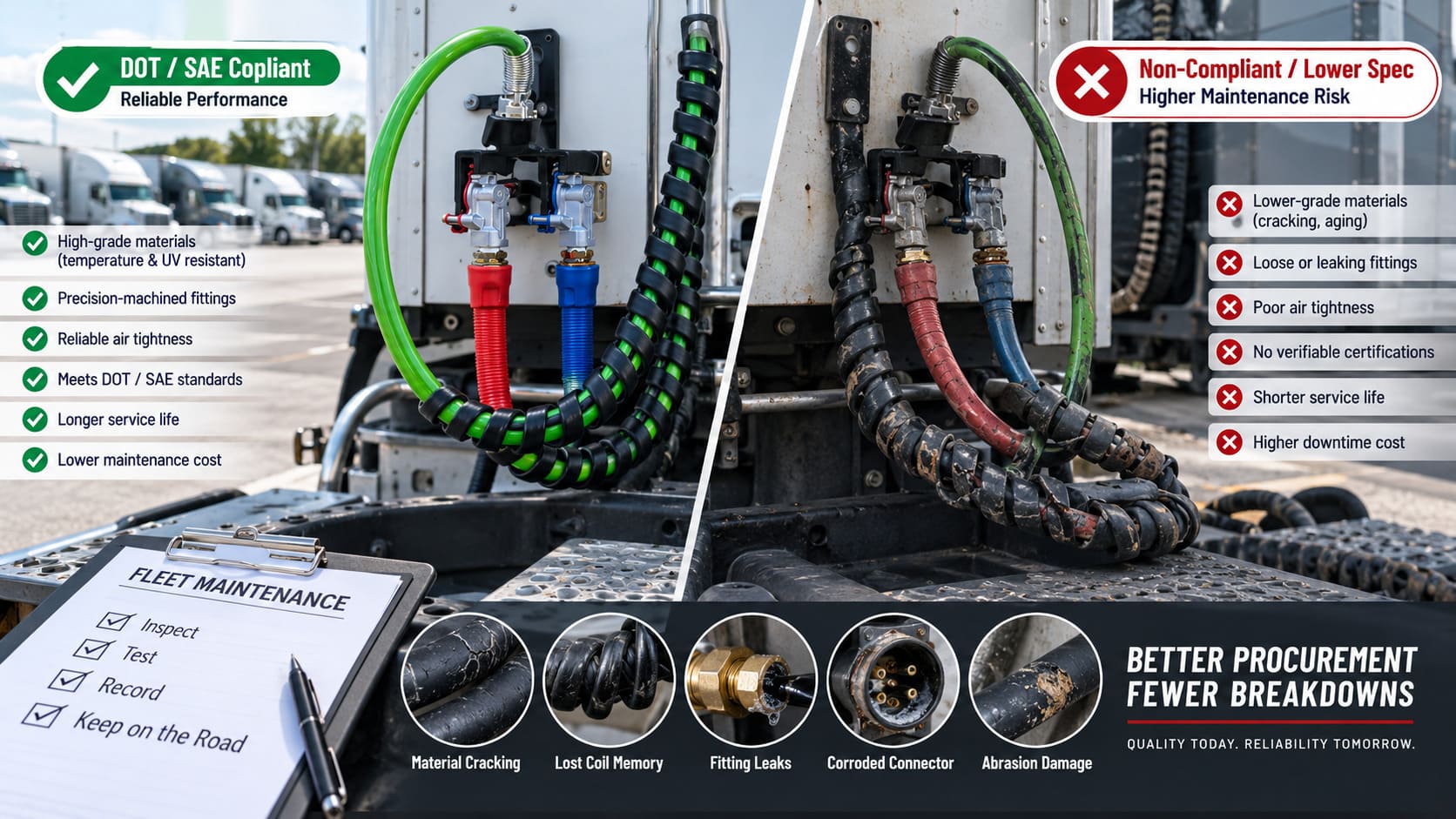
Procurement quality affects maintenance outcomes because material grade, fitting machining tolerances, air tightness specification, temperature and pressure resistance, and standards compliance all differ between manufacturers — even when outer appearance is similar. An assembly that does not meet DOT or SAE performance specifications may pass visual inspection but fail under operating conditions that a compliant part would handle normally.9
What Specification Differences Look Like in Practice
From our experience handling quality discussions with customers, here are common areas where lower-specification assemblies create downstream maintenance problems:
Material-grade issues:
- PVC or rubber compounds that stiffen significantly at low temperatures, leading to jacket cracking in winter climates
- Coil materials with poor memory recovery after thermal cycling, leading to premature hang-down
- Fittings machined from lower-grade brass alloys that corrode faster or seat less accurately
Air tightness issues:
- Assemblies that pass a basic bench check but don't hold pressure consistently at operating PSI
- Fitting seats that seal adequately at installation but degrade with the thermal expansion cycles of normal operation
Compliance documentation issues:
- Parts represented as DOT-compliant without verifiable certification documentation
- SAE specification references on packaging that don't reflect actual tested performance
We recommend that buyers request batch-level compliance documentation — not just a product-level certificate — and verify that the certification covers the specific performance parameters (pressure rating, temperature range, air tightness) relevant to their application. This is particularly important for North American markets where FMVSS and DOT requirements are actively enforced.
The Maintenance Cost Equation
Consider two assemblies priced 20% apart. If the lower-cost assembly requires replacement at 60% of the service interval of the compliant alternative, the cost-per-mile economics reverse. Add in the labor cost of each replacement, plus any towing or downtime events, and the procurement price difference becomes a relatively small number.
This is not an argument for premium pricing — it is an argument for verified specification compliance as the procurement baseline, with price comparison happening within that qualified tier.
Frequently Asked Questions
How often should 3-in-1 air power line assemblies be inspected?
There is no universally verified fixed interval. Inspection frequency should be based on operating conditions, mileage, climate, and application severity. Most fleet maintenance programs include air line assembly inspection as part of regular trailer brake and lighting checks. Higher-cycle or severe-environment applications warrant more frequent attention.
Can I reuse fittings from a failed assembly on a new one?
This is generally not recommended. Fittings from a failed assembly may have damaged seat surfaces, fatigue stress, or corrosion that is not visible. Reusing fittings introduces an unknown reliability variable into a new assembly. The cost of replacement fittings is small relative to the risk of a fitting-induced air leak.
What is the correct way to test for air leaks in the field?
A soapy water solution applied to fittings and joints under system pressure is a widely used field method for detecting active leaks.10 It identifies gross leaks but may not detect slow micro-leaks. For more rigorous testing, a static pressure drop test over a timed period provides a better picture of overall air tightness. Consult your maintenance SOP or a qualified technician for application-specific procedures.
How do I know if an assembly I'm buying is genuinely DOT-compliant?
Request documentation — specifically, a certificate that identifies the certifying body, the standard tested against, and the test parameters. A DOT marking on the product itself is a manufacturer's self-declaration11; independent verification requires a traceable test report or third-party certification document. Treat certification claims as documents to be verified, not statements to be accepted.
What are the most common symptoms of a developing air line assembly problem?
Symptoms that warrant immediate inspection include: gradual air pressure loss in the trailer system, intermittent ABS or lighting faults, visible coil hang-down or dragging, unusual stiffness in cold weather, audible hissing near fittings or joints, and difficulty coupling gladhand connections. Any of these symptoms observed before visible damage appears suggests an internal or fitting-level issue that should be investigated rather than monitored.
Conclusion
Maintaining 3-in-1 air power line assemblies effectively means going beyond visual inspection. The real risks — micro-leaks, weakened coil memory, fitting degradation, oxidized connectors, abrasion at routing contact points — develop before they are visible. Each inspection point in a well-structured program maps to a specific failure mode and a direct business consequence: downtime, DOT violation, repeat repair, or warranty dispute.
When a failure does occur, correct diagnosis matters. Separate product-origin issues from routing, tension, fitting compatibility, and installation conditions before drawing conclusions. Patterns across multiple vehicles point toward procurement quality; patterns on specific vehicles point toward installation and routing.
Finally, the quality of the assemblies you procure directly affects your maintenance burden downstream. Specification compliance — air tightness, pressure and temperature resistance, material grade, and standards documentation — is the foundation of a predictable maintenance outcome.
If you're evaluating 3-in-1 air power line assembly suppliers or have questions about specification compliance and documentation for your fleet or distribution operation, we're glad to walk through the details. Contact ROADSPOWER to discuss your application requirements.
"YiaChuii 15ft 3 in 1 ABS & Power Air Line Hose Kit", https://www.amazon.com/YiaChuii-Trucks-Electric-Tractor-Trailer/dp/B09MB188T5. An industry or standards source describing tractor-trailer connections identifies the assembly as combining service and emergency pneumatic brake lines with an electrical cable for trailer power and signals; this supports the component definition, although product configurations may vary by manufacturer. Evidence role: definition; source type: institution. Supports: The source should define or illustrate the tractor-trailer connection as including service and emergency air lines plus an electrical connector/cable.. Scope note: Contextual support; it establishes the component layout but may not use the exact marketing term “3-in-1.” ↩
"19VAC30-70-440. Service brakes. - Virginia Law", https://law.lis.virginia.gov/admincode/title19/agency30/chapter70/section440/. Government commercial-vehicle inspection guidance treats air-brake hoses and lines as safety-critical components that must be checked for leaks, chafing, restrictions, and insecure connections, supporting the point that visible exterior condition alone is not a complete indicator of function. Evidence role: general_support; source type: government. Supports: The source should show that brake hoses/lines can have functional defects such as leaks, chafing, or deterioration that require more than superficial visual inspection.. Scope note: Contextual support; it applies to commercial-vehicle brake lines generally rather than specifically to 3-in-1 assemblies. ↩
"Oregon Commercial Driver Manual - Section 5", https://www.oregon.gov/odot/dmv/pages/online_cdl_manual_2/section_5.aspx. Commercial-driver air-brake manuals describe trailer systems as using a service line to transmit brake application pressure and an emergency or supply line to charge the trailer reservoirs and support emergency braking functions, supporting the article’s description of the two pneumatic lines. Evidence role: definition; source type: government. Supports: The source should explain the role of the service and emergency/supply lines in trailer air-brake operation.. ↩
"eCFR :: 49 CFR Part 393 -- Parts and Accessories Necessary ...", https://www.ecfr.gov/current/title-49/subtitle-B/chapter-III/subchapter-B/part-393. Federal motor carrier equipment rules and North American roadside inspection criteria identify defective brake hoses, inadequate brake-system condition, and required lighting defects as inspection violations, supporting the claim that failures in these systems can have immediate enforcement consequences. Evidence role: general_support; source type: government. Supports: The source should show that brake-line defects, lighting defects, and unsafe equipment conditions are roadside inspection issues and may place vehicles out of service.. Scope note: Contextual support; the source may not specifically address combined 3-in-1 assemblies as a single component. ↩
"5.1.1 Brake Systems (Part 393 Subpart C) - CSA", https://csa.fmcsa.dot.gov/safetyplanner/MyFiles/SubSections.aspx?ch=22&sec=64&sub=130. Commercial-vehicle inspection manuals and safety regulations require attention to brake-line condition, leakage, chafing, secure attachment, and required electrical lighting connections, supporting the main categories in the preventive inspection checklist. Evidence role: expert_consensus; source type: government. Supports: The source should support the major inspection categories for brake hoses/lines, connectors, routing, chafing, leaks, and secure mounting.. Scope note: Contextual support; the seven-part checklist is an editorial synthesis rather than a single standardized checklist quoted from one authority. ↩
"Oregon Commercial Driver Manual - Section 5", https://www.oregon.gov/odot/dmv/pages/online_cdl_manual_2/section_5.aspx. Government air-brake training materials commonly describe compressor governor cut-out pressures in the range of about 120 to 135 psi, supporting the article’s stated operating-pressure range for North American heavy-vehicle air-brake systems. Evidence role: statistic; source type: government. Supports: The source should state the typical air-brake governor cut-out or system operating pressure range for heavy vehicles.. Scope note: Contextual support; actual set points vary by vehicle specification and jurisdictional training materials. ↩
"Oregon Commercial Driver Manual - Section 5", https://www.oregon.gov/odot/dmv/pages/online_cdl_manual_2/section_5.aspx. Commercial air-brake manuals explain that leaks reduce reservoir pressure, require the compressor to rebuild system pressure, and activate low-air warning devices when pressure falls below prescribed thresholds, supporting the described failure mechanism. Evidence role: mechanism; source type: government. Supports: The source should explain how air leaks reduce reservoir pressure, require compressor recovery, and activate low-pressure warnings at specified thresholds.. ↩
"eCFR :: 49 CFR 393.55 -- Antilock brake systems.", https://www.ecfr.gov/current/title-49/subtitle-B/chapter-III/subchapter-B/part-393/subpart-C/section-393.55. FMCSA Safety Measurement System materials and roadside inspection rules classify certain ABS-warning-lamp and required-lighting defects as vehicle-maintenance violations that can be recorded in carrier safety data; this supports the enforcement consequence, although CSA refers to Compliance, Safety, Accountability rather than “Carrier Safety Administration.” Evidence role: general_support; source type: government. Supports: The source should show that ABS warning-lamp and required lighting defects are inspection violations and may be reflected in FMCSA CSA/SMS data.. Scope note: Direct support for the violation mechanism, with a terminology limitation noted. ↩
"49 CFR 571.106 -- Standard No. 106; Brake hoses.", https://www.ecfr.gov/current/title-49/subtitle-B/chapter-V/part-571/subpart-B/section-571.106. SAE and federal brake-hose standards specify performance tests for air-brake tubing and hose assemblies, including pressure, leakage, temperature, and durability criteria, supporting the distinction between visual appearance and verified operating performance. Evidence role: general_support; source type: institution. Supports: The source should identify performance requirements for air-brake tubing or brake hoses, such as pressure, temperature, burst, leakage, and durability testing.. Scope note: Contextual support; the cited standards may cover individual hoses or tubing rather than every combined 3-in-1 assembly design. ↩
"Air Brake Systems", https://www.fmcsa.dot.gov/sites/fmcsa.dot.gov/files/docs/brake_safety_systems_02-14.pdf. Air-brake maintenance and training materials describe applying a soap solution to pressurized fittings or joints and observing bubble formation as a practical method for locating active air leaks, supporting the field-test procedure. Evidence role: mechanism; source type: education. Supports: The source should describe the use of soap solution or bubbles to detect leaks in pressurized air systems or air-brake fittings.. Scope note: Contextual support; this method detects active leaks at accessible points and does not by itself quantify total system leakage. ↩
"Interpretation ID: 07-001408as", https://www.nhtsa.gov/interpretations/07-001408as. NHTSA guidance explains that manufacturers certify compliance with applicable Federal Motor Vehicle Safety Standards under a self-certification system rather than receiving advance agency approval, supporting the statement that a DOT marking is a manufacturer certification claim. Evidence role: definition; source type: government. Supports: The source should explain the U.S. self-certification framework for motor vehicle equipment and DOT markings.. ↩