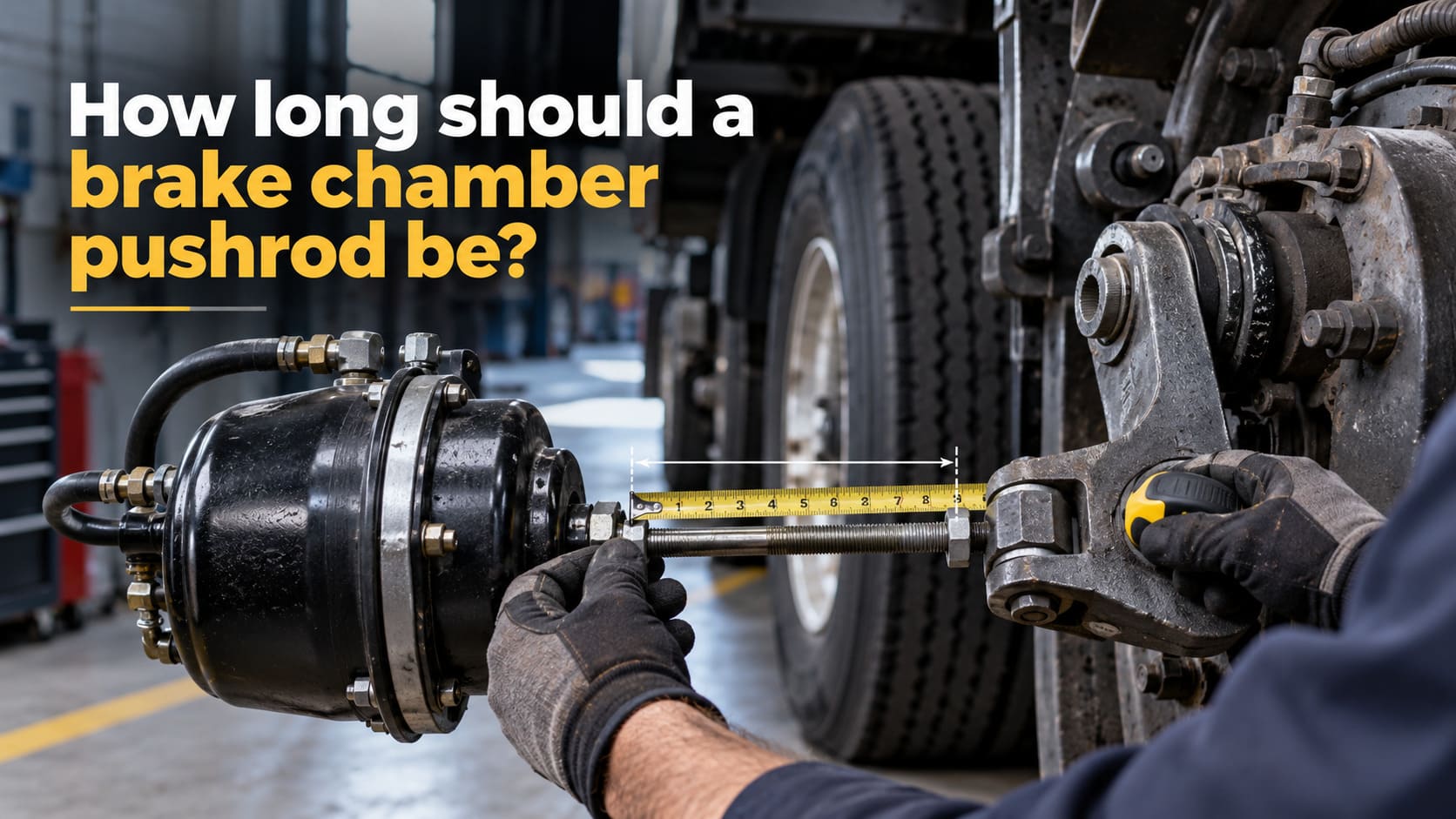
Brake chamber pushrod length is one of those questions that sounds simple until you realize the answer depends on your specific truck, chamber type, mounting bracket, clevis position, and a handful of other variables. Order the wrong length, and you're looking at a failed installation, a safety concern, or an expensive return shipment.
There is no single correct pushrod length that applies to all brake chambers.1 The right length depends on the brake chamber type, the mounting bracket geometry, the clevis position, the slack adjuster arm, and the specific axle position on the vehicle2. Before anyone can give you a reliable answer, they need your application details — not just a number off a worn-out part.
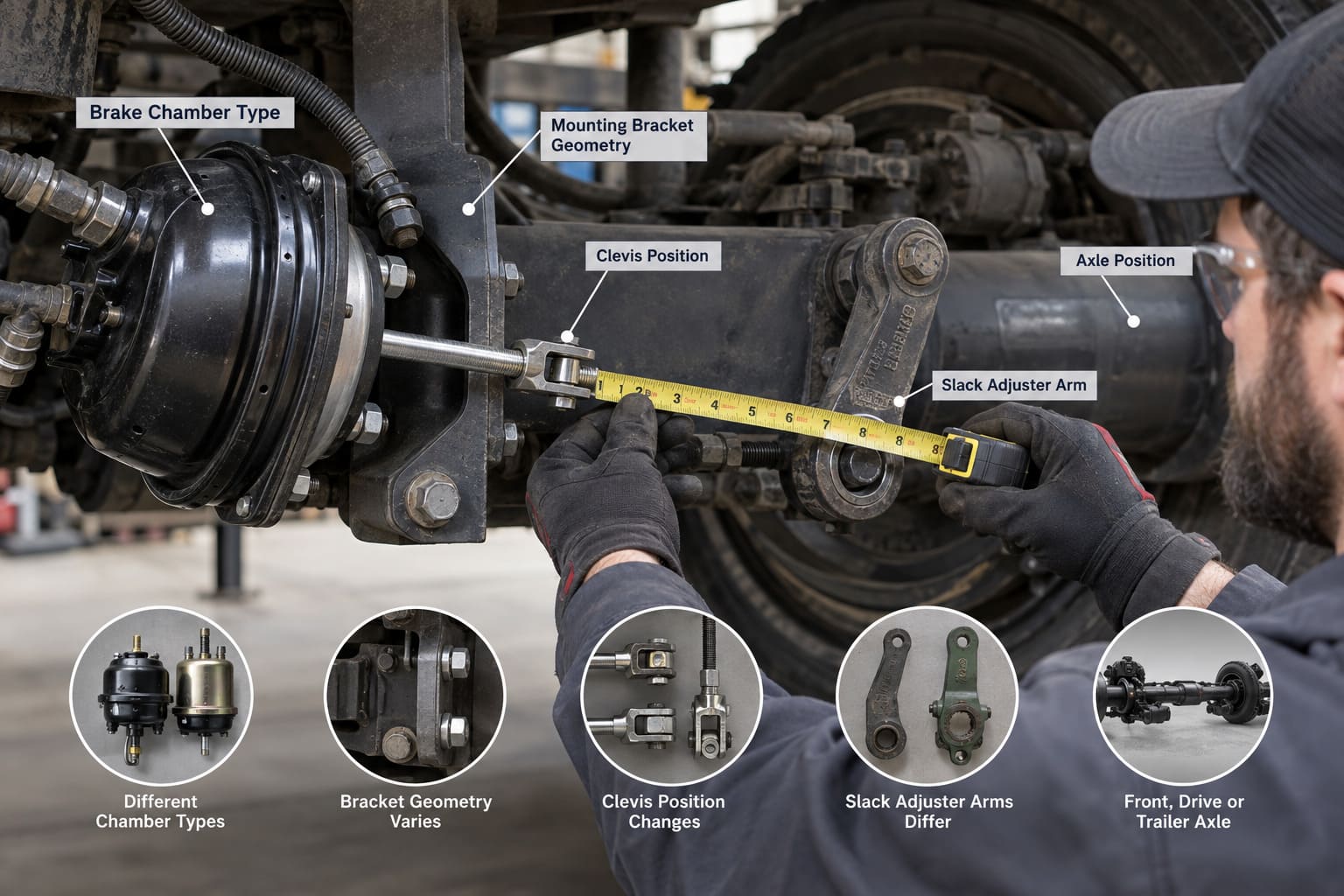
Most buyers who contact us lead with a length measurement. I understand the instinct — it feels like the most concrete thing you can measure. But in almost every case, I need to ask at least four or five follow-up questions before we can confirm the right part. The sections below explain exactly why, and what you should have ready before you buy.
What does "pushrod length" actually mean?
This sounds like a basic question, but it's where most ordering confusion begins. Different people measure different things and call them all "pushrod length."
Pushrod length, exposed pushrod length, pushrod stroke, and brake adjustment are four related but distinct terms.3 Mixing them up is one of the most common causes of wrong-part orders we see from first-time buyers.
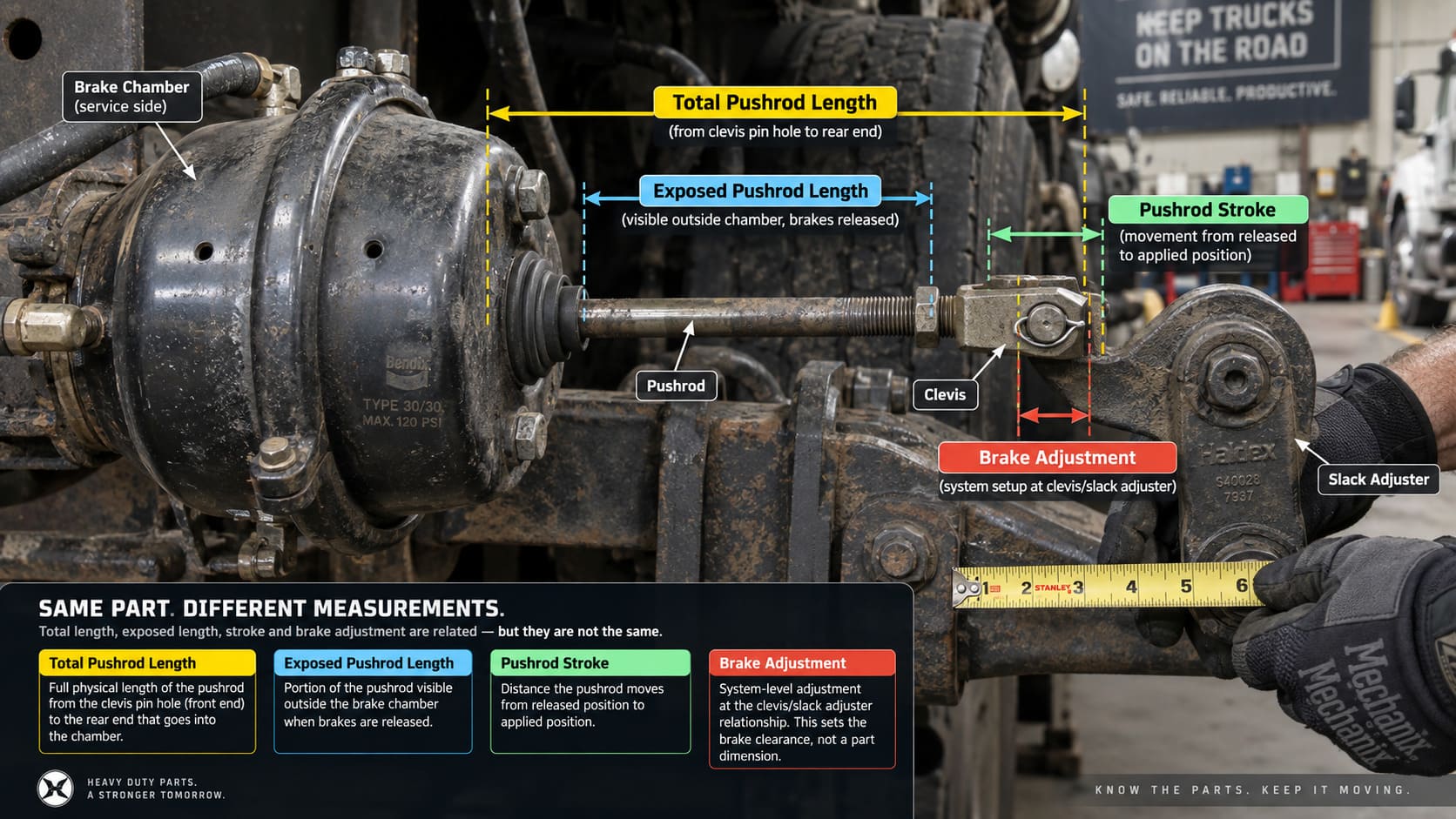
Pushrod total length vs. exposed length
Total pushrod length is the full dimension of the rod from end to end — typically measured from the clevis pin hole to the back end that sits inside the chamber.
Exposed pushrod length is what you can see outside the chamber body when the brakes are released. This is what most people measure when they pull a worn part off the truck. The problem is that exposed length changes depending on how the clevis is threaded onto the rod and where the adjuster nut sits4. Two identical pushrods can show different exposed lengths depending on how they were assembled.
Pushrod stroke vs. pushrod length
These two terms are frequently confused, and the confusion creates real risk.
- Pushrod stroke is the distance the rod travels when the brake is applied — from released position to full application.
- Pushrod length is a fixed physical dimension of the part itself.
A chamber rated for a specific stroke (say, Type 30 with a 3-inch stroke limit) is a performance specification, not a pushrod length specification. You can have a pushrod of the correct physical length that still produces an out-of-adjustment stroke if the brake system is worn or the slack adjuster is improperly set.
Important: Stroke limits, adjustment procedures, and inspection criteria are governed by FMCSA regulations, CVSA out-of-service criteria, and individual vehicle service manuals.5 Always verify current values with the applicable documentation or a qualified brake technician before making any adjustment decisions.
Why the distinction matters for procurement
| Term | What It Is | Who Needs to Know |
|---|---|---|
| Total pushrod length | Physical part dimension | Parts buyer, warehouse staff |
| Exposed pushrod length | Assembly-dependent measurement | Technician doing installation |
| Pushrod stroke | Operating travel distance | Technician, compliance inspector |
| Brake adjustment | System-level setting | Qualified brake technician |
When a distributor orders by "length" without specifying which measurement they mean, there is a real chance the supplier ships a part that looks close but doesn't fit the application correctly. That's a return, a delay, and in a worst case, a safety issue on a customer's truck.
Why can't you give one standard pushrod length?
This is the question I get most often, usually with some frustration behind it. The honest answer is that a pushrod is a matched component — it only makes sense in the context of the assembly it belongs to.
Every brake chamber application has geometry that determines how long the pushrod needs to be. Change any one variable, and the required length changes too.
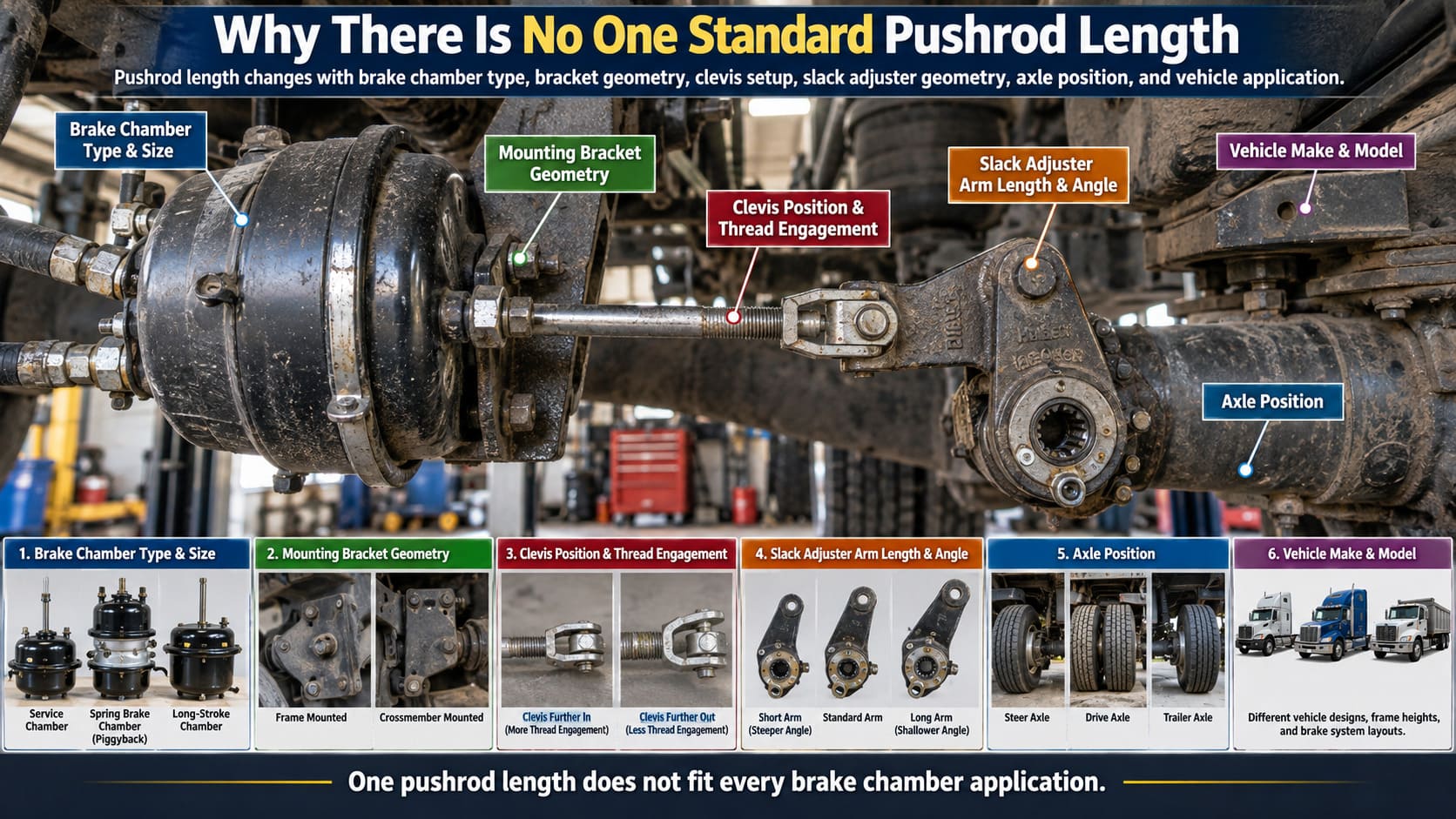
Variables that determine the required pushrod length
1. Brake chamber type and size
Service chambers, spring brake chambers (piggyback units), and long-stroke chambers all have different internal dimensions.6 A Type 24 and a Type 30 are not interchangeable, and neither are their pushrods.7 Even within the same type designation, there are dimensional differences between manufacturers that affect how the rod sits inside the chamber.
2. Mounting bracket geometry
The bracket positions the chamber at a fixed distance from the slack adjuster. If a fleet has modified a bracket, or if the bracket is non-standard on a particular axle configuration, the required pushrod length changes. I've seen customers come to us with what looked like a straightforward replacement, only to discover the bracket on their truck was a non-OEM fabricated unit that changed the geometry completely.
3. Clevis position and thread engagement
The clevis threads onto the pushrod end. How far it is threaded on affects the effective working length of the assembly. There is a minimum thread engagement requirement for safe operation — going too shallow creates a failure risk.8 This means there's a range of adjustment available, but it's not unlimited, and it's not a substitute for getting the base rod length right.
4. Slack adjuster arm length and angle
The slack adjuster converts the linear push of the rod into rotational force on the camshaft.9 Its arm length and the angle at which the pushrod meets it at full stroke both affect how the geometry works. An overly short or overly long pushrod changes the pushrod angle at application, which reduces mechanical efficiency and can cause uneven brake force.10
5. Axle position on the vehicle
Steer axle, drive axle, and trailer axle applications often use different chamber sizes and different bracket configurations.11 The pushrod for a front steer axle service chamber is not the same as the rod for a rear drive axle spring brake. Confirming the axle position is one of the first things I ask.
6. Vehicle make and model
Freightliner, Kenworth, Peterbilt, International, Volvo, and Mack trucks use different chassis geometries.12 Even within the same brand, model year changes and variant configurations can affect brake chamber placement. A part that fits a Kenworth T680 will not necessarily fit a Peterbilt 389, even if both are equipped with the same chamber type designation.
What information do you actually need before buying?
This is the practical section. Whether you're a distributor building stock, a fleet parts manager sourcing a replacement, or a repair shop trying to match a customer's worn part, here is the confirmation checklist I use before recommending a pushrod assembly.
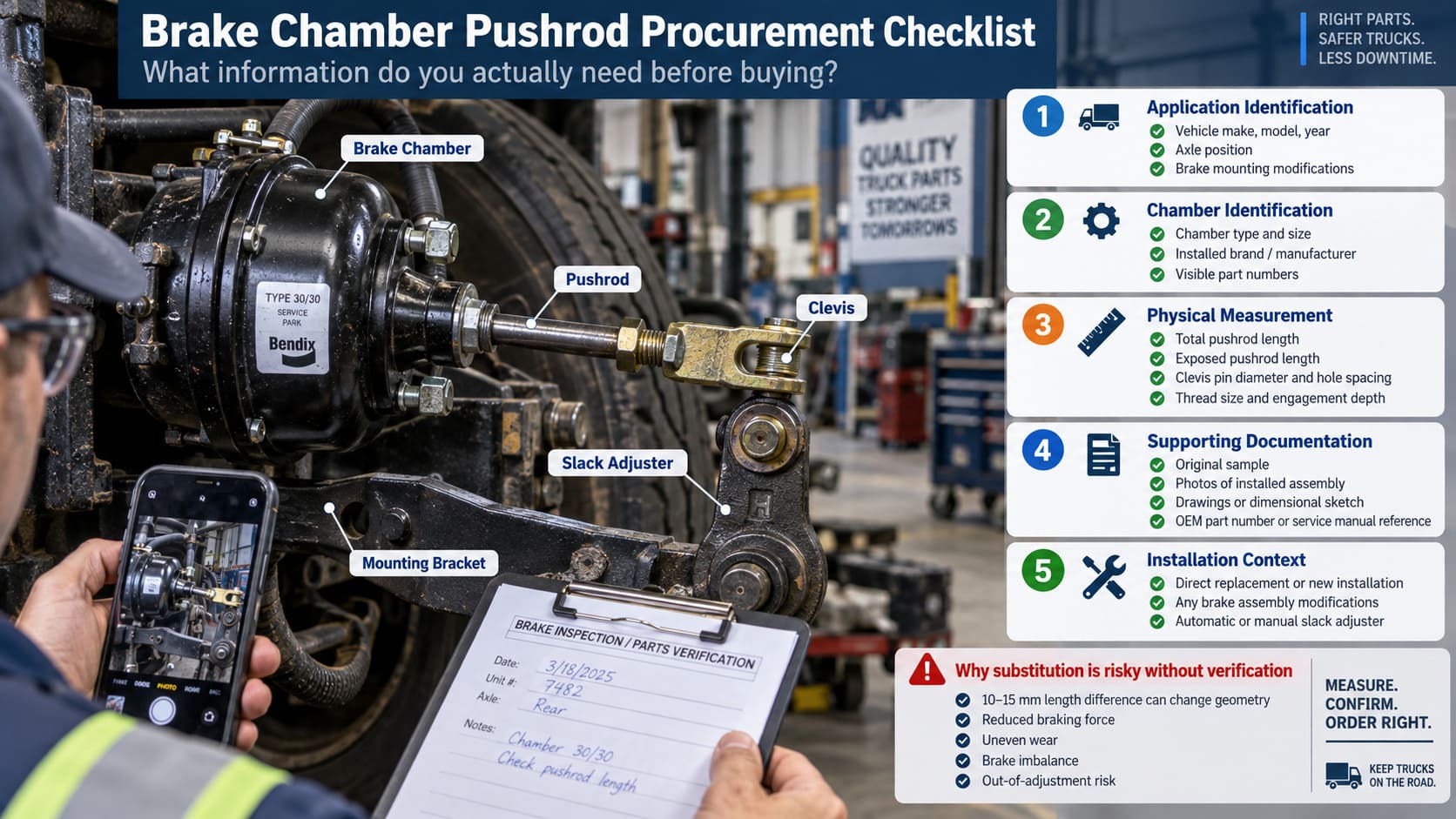
Pre-purchase confirmation checklist
Work through these points before placing an order or confirming a substitution:
Application identification
- Vehicle make, model, and year
- Axle position (steer, drive axle 1, drive axle 2, trailer)
- Any known modifications to the brake mounting configuration
Chamber identification
- Chamber type and size (e.g., Type 30, Type 24/30 piggyback)
- Manufacturer or brand currently installed
- Any visible part numbers on the chamber body
Physical measurement (from original part or installation)
- Total pushrod length, measured consistently end to end
- Exposed pushrod length at rest position
- Clevis pin diameter and hole spacing
- Thread size and engagement depth on clevis
Supporting documentation
- Original sample, if available
- Photographs of the installed assembly, including the bracket and slack adjuster position
- Drawings or dimensional sketches, if the customer has them
- Vehicle service manual reference or OEM part number
Installation context
- Is this a direct replacement of a failed part, or a new installation?
- Has anything in the brake assembly been modified since the truck was built?
- Is the slack adjuster automatic or manual?
I can't overstate how much faster and cleaner the sourcing process is when a buyer comes with this list completed. When customers send me a photo of the assembly alongside the worn pushrod and the chamber model number, we can confirm the match the same day. When the only information is "I need a pushrod for a Freightliner," we're starting from scratch — and there are hundreds of possible configurations on Freightliner trucks alone.
Why substitution is risky without verification
Parts substitution — using a different brand or a close-but-not-identical part — is common in the aftermarket. It's often fine when done carefully. It becomes a problem when the substitution is based only on visual similarity or a close length measurement.
A pushrod that is even 10–15mm longer or shorter than the correct specification can change the geometry enough to:
- Reduce braking force at full stroke
- Cause the pushrod to contact the chamber housing during full application
- Put the clevis at an angle that creates uneven wear on the slack adjuster pin
- Prevent the slack adjuster from reaching its designed mechanical advantage position
None of these failure modes are immediately obvious at installation. They show up as premature wear, brake imbalance, or an out-of-adjustment condition on the next inspection. By that point, the link back to the wrong pushrod length may not be obvious.
Frequently Asked Questions
Can I measure the old pushrod and order the same length?
You can use the old pushrod as a reference, but measure total length end-to-end rather than the exposed length, which varies by assembly. Also confirm the clevis pin diameter, thread specification, and chamber type match. A worn or bent pushrod may not reflect the original factory specification — use the measurement as a starting point, then verify against the chamber model.
Does pushrod length vary between Type 24 and Type 30 chambers?
Yes. Different chamber types have different internal dimensions and are used in different bracket configurations, which affects the required pushrod length. Always confirm the chamber type as part of your sourcing process, not just the pushrod length. A pushrod that fits a Type 24 will not necessarily be correct for a Type 30 application, even if the measured lengths appear similar.
How do I know if the pushrod is too long or too short after installation?
Verifying correct pushrod length is part of the brake adjustment and inspection process performed by a qualified technician. Signs that something is wrong include binding, uneven brake force, or a stroke measurement that falls outside the acceptable range at inspection. Any concerns about pushrod fit or brake adjustment should be referred to a qualified brake technician and verified against the vehicle service manual.
Do spring brake (piggyback) chambers use the same pushrods as service chambers?
No. Spring brake combination chambers have a different configuration from single-diaphragm service chambers. The pushrod and chamber dimensions are specific to the unit. Always identify whether the chamber is a service-only chamber or a spring brake combination unit before ordering.
What if the customer only has a photo of the old pushrod?
A clear photo is a useful starting point, especially if it includes a reference object for scale. But it's not sufficient on its own for a confident match. Ask for total measured length, clevis pin diameter, thread spec, and the chamber model number. If those aren't available, request the vehicle details and axle position so we can work from application data instead.
Conclusion
Brake chamber pushrod length is not a number you can look up on a generic chart. It's a matched specification that depends on chamber type, bracket geometry, clevis configuration, slack adjuster position, and the specific truck application. Ordering by a single measured number without the supporting application details is one of the most reliable ways to end up with a wrong part — and in brake system components, a wrong part is a safety issue, not just a stocking inconvenience.
Before you order, confirm the chamber type, axle position, vehicle details, physical measurements, and clevis specification. If you have the original part or a drawing, even better. That information is what makes a confident match possible.
If you're sourcing brake chamber pushrods or complete air brake chamber assemblies for North American or South American heavy-duty trucks, contact us with your application details. We'll work through the matching checklist with you and confirm the right specification before anything ships.
"Adjustment Procedures for Drum Brakes on Meritor Trailer ...", https://static.nhtsa.gov/odi/tsbs/2015/SB-10057918-4717.pdf. Manufacturer or industry service documentation describes brake chamber pushrod length as part of an installation-specific chamber, clevis, bracket, and slack-adjuster assembly, supporting the statement that no single pushrod length applies to all brake chambers. Evidence role: general_support; source type: institution. Supports: Authoritative brake service documentation should indicate that pushrod length is selected according to the chamber and vehicle installation, not from a universal length.. Scope note: Such documentation may support the principle generally while not listing every truck-specific pushrod dimension. ↩
"Recommended Procedure for Cutting Brake Chamber ...", https://cbsparts.ca/admin/bulletins/PUSH%20ROD%20CUTTING%20PROCEDURE.pdf. Technical training material on heavy-vehicle air brakes explains that chamber placement, clevis adjustment, and slack-adjuster geometry determine the operating position of the pushrod, providing mechanical context for these variables as determinants of pushrod fit. Evidence role: mechanism; source type: education. Supports: A technical source should explain how brake chamber placement, clevis adjustment, slack adjuster geometry, and axle configuration affect pushrod selection and operation.. Scope note: The source may explain the mechanism without giving a complete procurement checklist. ↩
"Parts and Accessories Necessary for Safe Operation: Brakes", https://www.federalregister.gov/documents/2012/08/06/2012-18899/parts-and-accessories-necessary-for-safe-operation-brakes-adjustment-limits. Government air-brake inspection guidance defines pushrod stroke as the travel of the actuator during brake application and treats brake adjustment as an inspection condition, supporting the distinction between operating stroke and physical pushrod length. Evidence role: definition; source type: government. Supports: A regulatory or training source should define pushrod stroke and brake adjustment separately from physical pushrod dimensions.. Scope note: The source may not use the phrase “exposed pushrod length” in the same terminology as the article. ↩
"Adjusting Air Brake Rod on Truck", https://www.facebook.com/groups/483964356970950/posts/938018304898884/. Service guidance for air-brake actuators describes the clevis as threaded onto the pushrod and adjusted during installation, supporting the point that the exposed pushrod length can vary with clevis position rather than reflecting only the rod’s manufactured length. Evidence role: mechanism; source type: institution. Supports: A brake service source should show that clevis threading changes the effective external length of the pushrod assembly.. Scope note: This support is mechanical and procedural; it does not quantify the amount of exposed-length variation for all chamber models. ↩
"49 CFR 393.47 -- Brake actuators, slack adjusters, linings/pads and ...", https://www.ecfr.gov/current/title-49/subtitle-B/chapter-III/subchapter-B/part-393/subpart-C/section-393.47. FMCSA brake-system regulations and inspection guidance address brake adjustment and actuator stroke limits for commercial motor vehicles, supporting the article’s statement that stroke and inspection criteria are governed by regulatory and inspection standards. Evidence role: general_support; source type: government. Supports: FMCSA regulations and CVSA materials should support that brake adjustment and stroke inspection are regulated compliance issues.. Scope note: FMCSA materials do not replace model-specific vehicle service manuals for repair dimensions. ↩
"Interpretation ID: nht74-2.26", https://www.nhtsa.gov/interpretations/nht74-226. Industry technical documentation distinguishes service chambers, spring-brake combination chambers, and long-stroke chambers by construction and stroke characteristics, supporting the statement that these chamber types are dimensionally and functionally different. Evidence role: definition; source type: institution. Supports: An industry or standards source should document that service, spring brake, and long-stroke chambers are distinct actuator configurations with different dimensions or operating characteristics.. Scope note: Catalog dimensions vary by manufacturer, so the citation provides category-level support rather than a universal dimension table. ↩
"Brake Chamber 24 30: Complete Analysis of Standards, Types ...", https://commercialtoolry.com/automotive/brake-chamber-24-30. Brake actuator specifications identify Type 24 and Type 30 chambers as different chamber sizes with different rated characteristics, supporting the conclusion that they should not be treated as interchangeable assemblies. Evidence role: general_support; source type: institution. Supports: A specification source should show that Type 24 and Type 30 chambers differ in size or rated characteristics, making direct substitution inappropriate without verification.. Scope note: The source may establish non-equivalence of chamber types without separately testing every possible pushrod substitution. ↩
"Adjustable mc pushrod - how much thread for safety", https://www.vintage-mustang.com/threads/adjustable-mc-pushrod-how-much-thread-for-safety.1186215/. Air-brake service instructions specify that the clevis must be threaded onto the pushrod with adequate engagement, supporting the article’s statement that insufficient thread engagement can compromise the mechanical connection. Evidence role: mechanism; source type: institution. Supports: A service source should state minimum clevis thread engagement requirements or explain why insufficient engagement weakens the connection.. Scope note: Minimum engagement values may differ by actuator or clevis design. ↩
"National Transportation Safety Board", https://www.ntsb.gov/safety/safety-recs/recletters/H01_04.pdf. Air-brake training materials describe the slack adjuster as the lever that transfers brake chamber pushrod movement to rotation of the S-cam shaft, supporting the article’s mechanical description. Evidence role: mechanism; source type: education. Supports: A technical education source should explain the function of the slack adjuster in transmitting brake chamber pushrod force to the S-cam.. Scope note: The explanation applies primarily to S-cam drum brake systems, not to every possible heavy-vehicle brake design. ↩
"WAC 204 - 76", https://lawfilesext.leg.wa.gov/Law/WAC/WAC%20204%20%20TITLE/WAC%20204%20-%2076%20%20CHAPTER/WAC%20204%20-%2076%20-99004.htm. Air-brake training references explain that the pushrod and slack adjuster should operate within the designed angular relationship to preserve mechanical advantage, supporting the claim that incorrect pushrod geometry can reduce brake efficiency. Evidence role: mechanism; source type: education. Supports: A technical source should explain that pushrod-to-slack-adjuster angle affects mechanical advantage and brake force transfer.. Scope note: The source may support the mechanical principle without proving that every incorrect pushrod length produces measurable brake imbalance. ↩
"How to Identify Brake Chamber Size: A Complete Step-by- ...", https://www.chinafuao.net/news/how-to-identify-brake-chamber-size-a-complete-stepbystep-guide.html. Commercial-vehicle brake-system documentation shows that actuator sizes and mounting arrangements are specified by vehicle and axle application, supporting the article’s statement that steer, drive, and trailer axle installations may differ. Evidence role: general_support; source type: institution. Supports: An industry or training source should show that air brake chamber selection and mounting vary by axle position and vehicle application.. Scope note: The source may describe typical configurations rather than an exhaustive rule for every truck or trailer. ↩
"How to change a brake chamber/ How to change a brake ...",
. OEM parts and service documentation organizes brake chamber components by vehicle model, axle, and configuration, supporting the contextual claim that chassis geometry and brake-chamber placement vary across truck platforms. Evidence role: general_support; source type: institution. Supports: OEM or parts documentation should show that brake chamber placement or part numbers vary by truck make, model, axle, and configuration.. Scope note: A single source is unlikely to compare all named brands directly; support may need to be contextual across multiple OEM references. ↩