Choosing the wrong DOT air fitting sizes to stock is a costly mistake. A mismatch between tube O.D. and NPT thread leaves trucks sidelined and customers calling competitors. Yet most suppliers hand you a generic size chart and call it guidance. The real question is: which sizes actually move in the North American heavy-duty truck aftermarket?
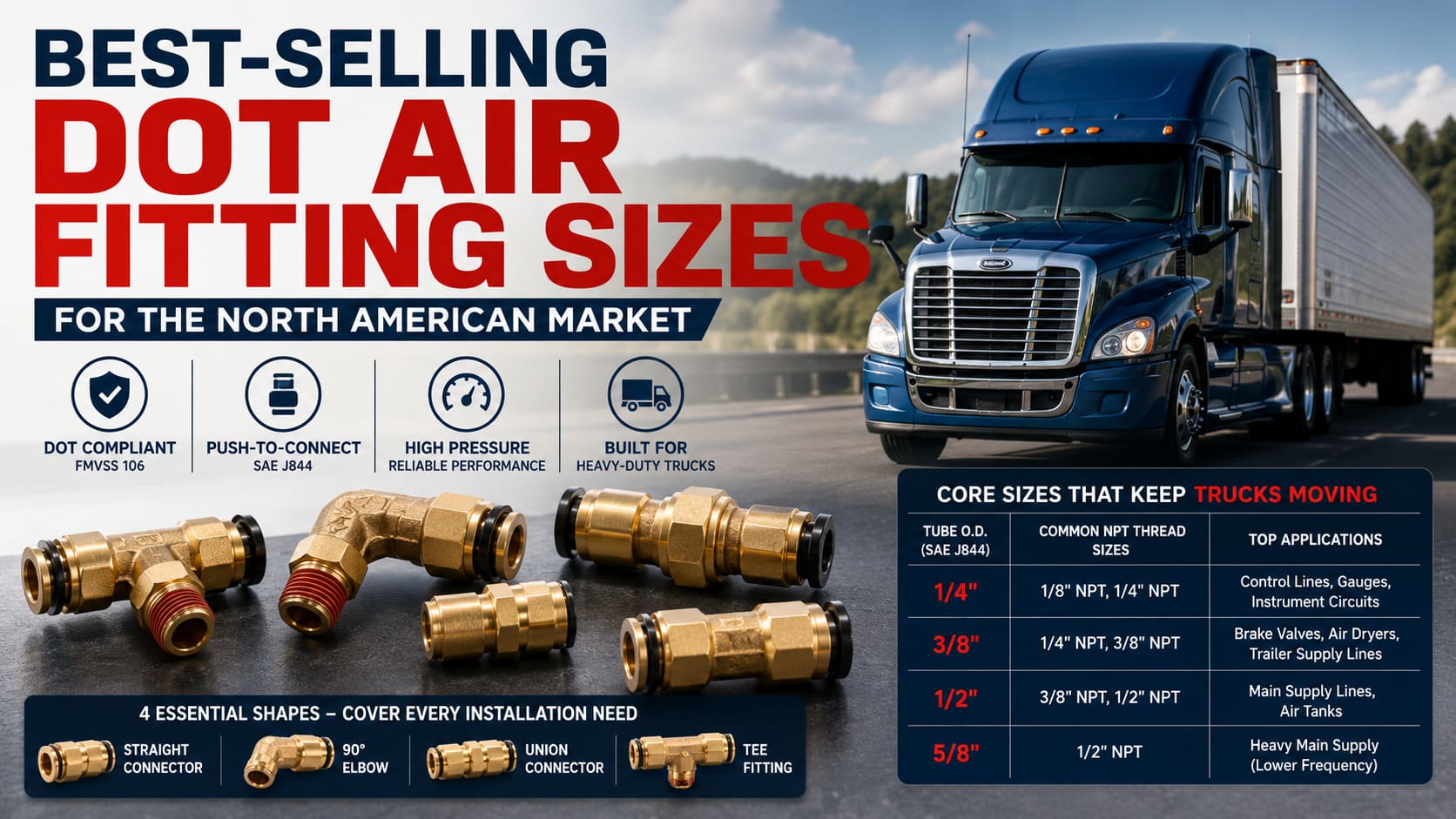
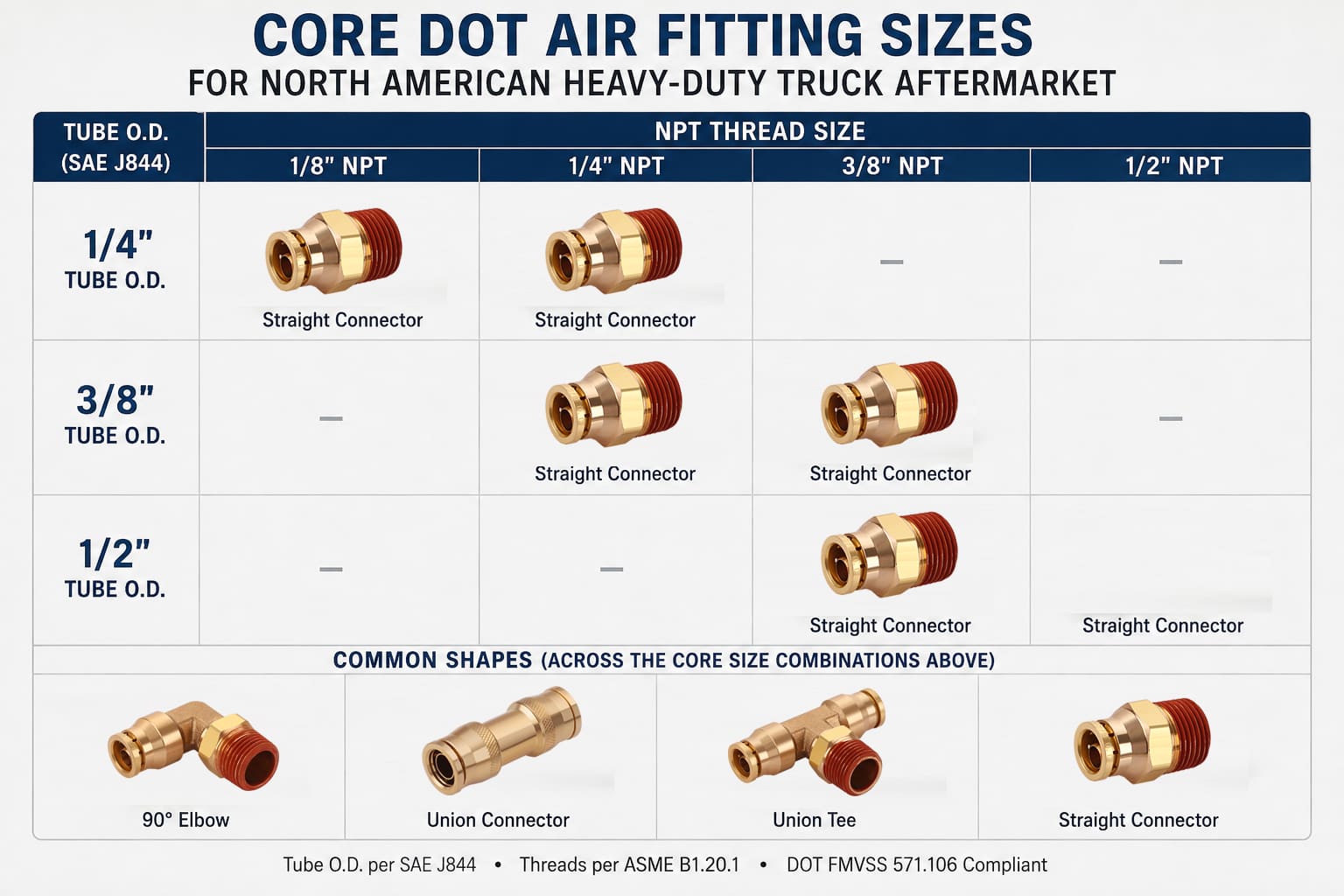
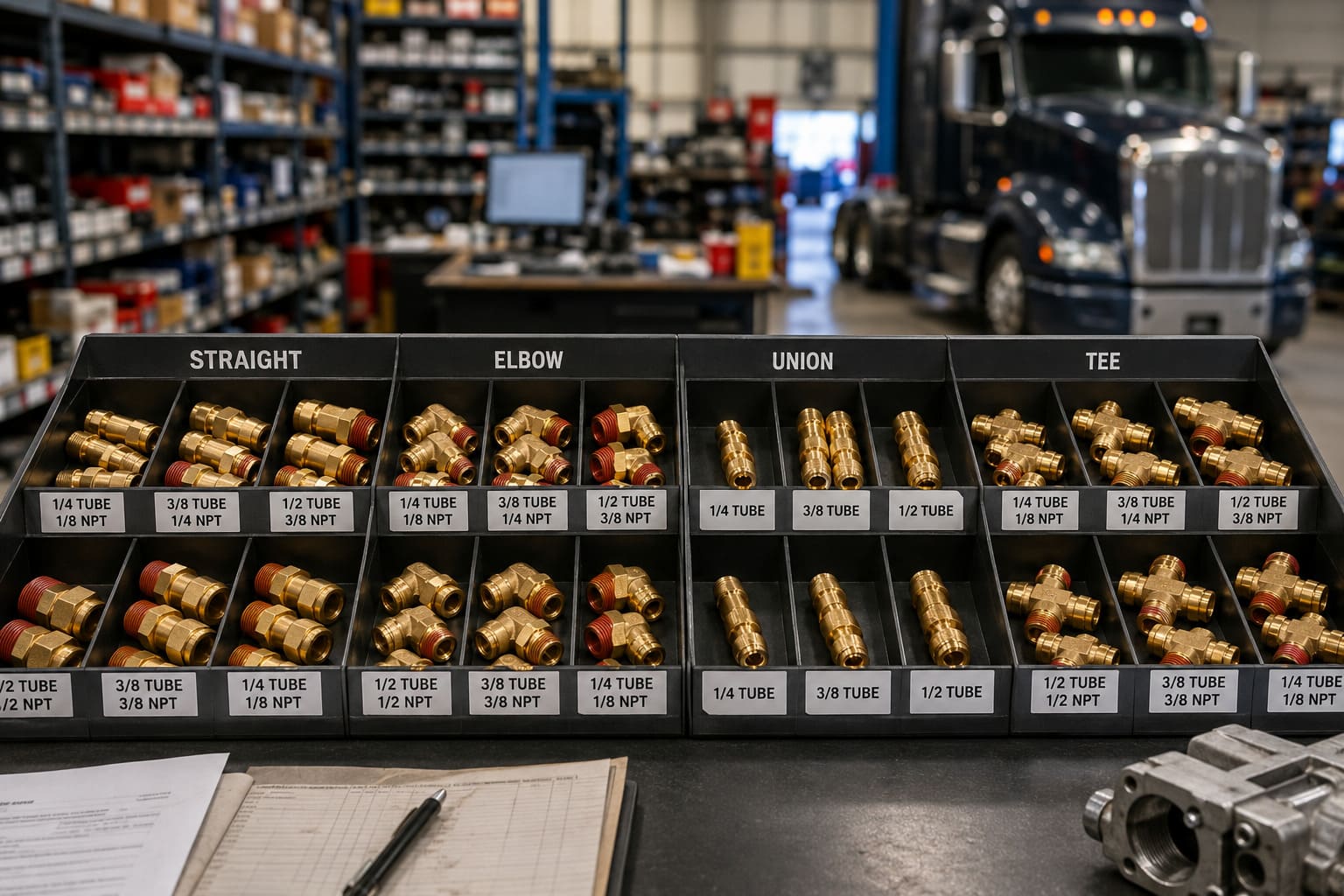
Based on inquiry frequency and repeat order patterns from North American distributors and repair shops, the most commonly stocked DOT air fitting sizes are 1/4" tube O.D. with 1/8" or 1/4" NPT, 3/8" tube O.D. with 1/4" or 3/8" NPT, and 1/2" tube O.D. with 3/8" or 1/2" NPT1. These combinations — across straight connectors, 90-degree elbows, union connectors, and tees — form the core stocking foundation for most North American heavy-duty truck applications.2
Knowing the sizes, though, is only half the answer. The other half is understanding why those combinations appear so frequently — and how tube O.D., NPT thread, and fitting shape are three separate decisions that compound your SKU count fast. The sections below break this down into practical stocking tiers.
What Makes a DOT Air Fitting "Best-Selling" in the North American Market?
Most buyers assume "best-selling" means one universal size dominates everything. That assumption leads to understocked repairs and overstocked shelves of sizes that rarely move.
In practice, no single DOT air fitting size fits every truck or every repair job. "Core stocking sizes" are better defined as the combinations that appear most consistently across repeat orders, emergency sourcing calls, and distributor replenishment cycles in the North American heavy-duty truck aftermarket.
The North American Heavy-Duty Truck Context
The North American heavy-duty truck market runs on a wide range of platforms — Freightliner, Kenworth, Peterbilt, International, Volvo, and Mack. Each OEM uses slightly different pneumatic system configurations.3 However, the aftermarket replacement cycle creates consistent demand patterns across a relatively limited set of fitting sizes.
From our experience handling orders from North American distributors and repair shops, a few factors consistently define which sizes move:
- Air brake and suspension system demands: Brake lines, trailer supply lines, and air suspension connections each create recurring replacement needs at predictable size points.4
- Emergency repair frequency: Repair shops and fleets tend to stock what breaks most often on the road. Fast-turn fittings reflect real failure patterns, not theoretical inventories.
- Distributor replenishment cycles: When a regional distributor reorders the same SKUs every 60–90 days, those sizes earn "core stocking" status regardless of what any single truck model specifies.
Why "Best-Selling" Is Not a Simple Top-Five List
A fitting's sales frequency depends on three overlapping variables:
| Variable | Why It Matters |
|---|---|
| Tube O.D. | Determines which airline the fitting connects to |
| NPT thread size | Must match the port on the component (valve, tank, etc.) |
| Fitting shape | Straight, elbow, union, or tee creates different installation needs |
A 3/8" tube fitting with 1/4" NPT is a different SKU than a 3/8" tube fitting with 3/8" NPT — even though both look nearly identical on a parts shelf. Treating them as interchangeable is a common and expensive mistake.
How Do Tube O.D., NPT Thread, and Fitting Shape Work Together?
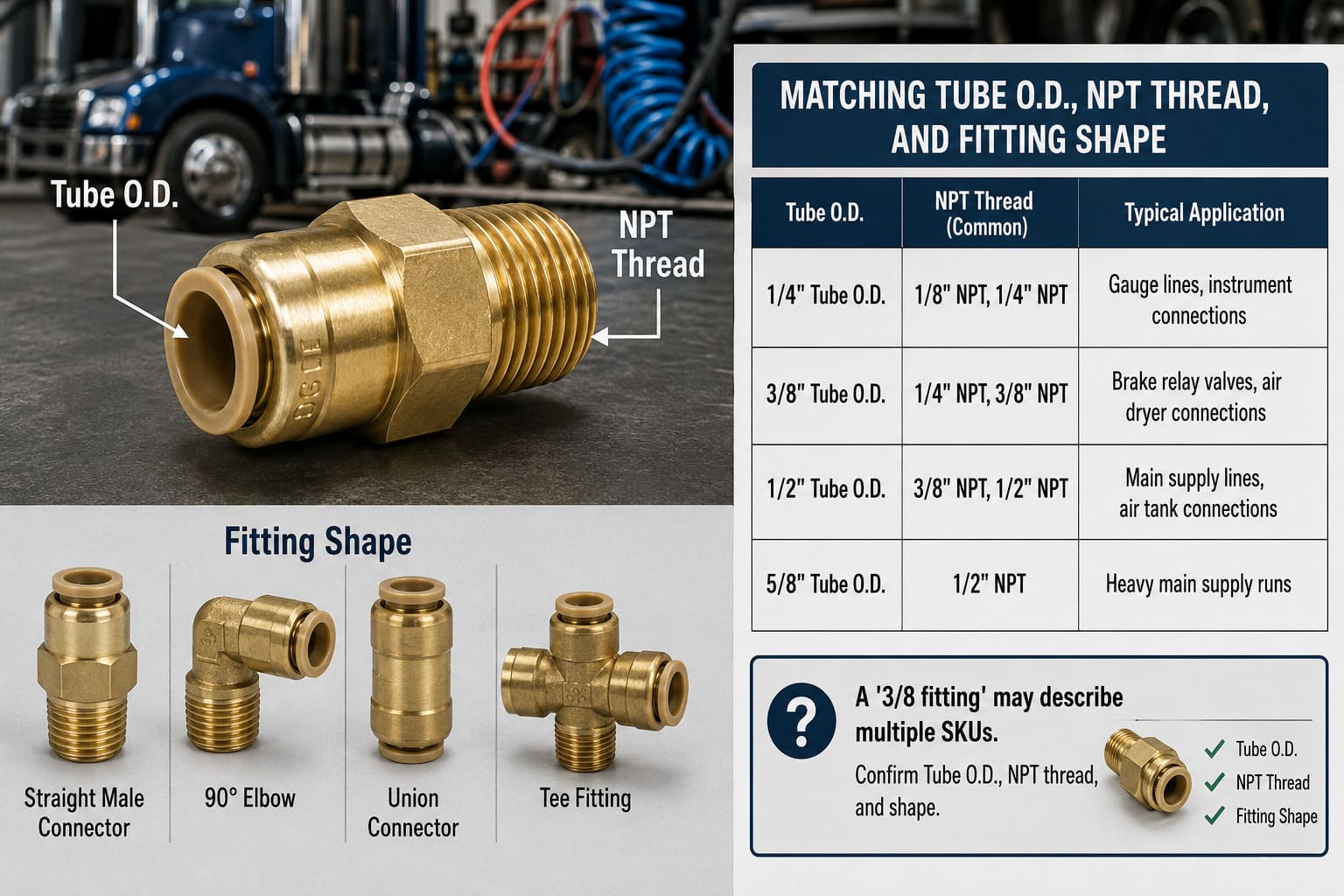
Many buyers contact us asking for "a 3/8 fitting" without specifying thread size or shape. That request could describe six or more distinct SKUs — and the wrong one delays the repair.
Tube O.D., NPT thread, and fitting shape are separate dimensions that must all align for a correct installation.5 Selecting any one without confirming the others creates mismatches that fail pressure testing or simply won't thread into the component port.
Tube O.D. vs. NPT Thread: Not the Same Measurement
This is the most common source of confusion we hear from new buyers.
- Tube O.D. refers to the outside diameter of the air line or tubing that inserts into the push-to-connect collet. Common sizes in the North American heavy-duty truck market: 1/4", 3/8", 1/2", and 5/8".6
- NPT thread refers to the National Pipe Taper thread on the male end that screws into valves, tanks, or manifolds.7 Common sizes: 1/8" NPT, 1/4" NPT, 3/8" NPT, and 1/2" NPT.
These measurements do not correlate directly. A 3/8" tube O.D. fitting can pair with 1/4" NPT or 3/8" NPT, depending on the port it connects to.8 Both combinations are frequently ordered. Neither is "wrong" — they serve different connection points on the same truck.
Fitting Shape Creates Additional SKUs
Once tube O.D. and NPT thread are confirmed, fitting shape determines the final SKU. The four most commonly stocked shapes in the North American aftermarket are:9
- Straight male connector — the single highest-volume shape across all tube sizes; used in direct inline connections
- 90-degree elbow — critical for tight-clearance installations; frequently requested in brake chamber and valve connections
- Union connector (straight union) — joins two air lines of the same diameter; essential for mid-line repairs
- Tee fitting — splits one air line into two; commonly used in trailer brake and suspension circuits
Each shape multiplies your SKU count. For example, if you stock two NPT thread options across four shapes for a single tube O.D., you are already managing eight SKUs for that one tube size.
Practical Matching Logic
| Tube O.D. | Common NPT Thread Pairings | Typical Use Location |
|---|---|---|
| 1/4" | 1/8" NPT, 1/4" NPT | Gauge lines, instrument connections, small control circuits |
| 3/8" | 1/4" NPT, 3/8" NPT | Brake relay valves, air dryer connections, trailer supply lines |
| 1/2" | 3/8" NPT, 1/2" NPT | Main supply lines, air tank connections, high-flow circuits |
| 5/8" | 1/2" NPT | Heavy main supply runs; lower aftermarket frequency than the above |
Understanding this matrix helps distributors and repair shops build stock that actually matches what comes through the door — rather than over-investing in one tube size and running short on thread variations.
Which DOT Air Fitting Sizes Should You Prioritize for Initial Stock?
Starting an air fitting inventory without a tiered approach wastes capital on slow movers while leaving gaps in the fast-turn sizes that customers expect you to have.
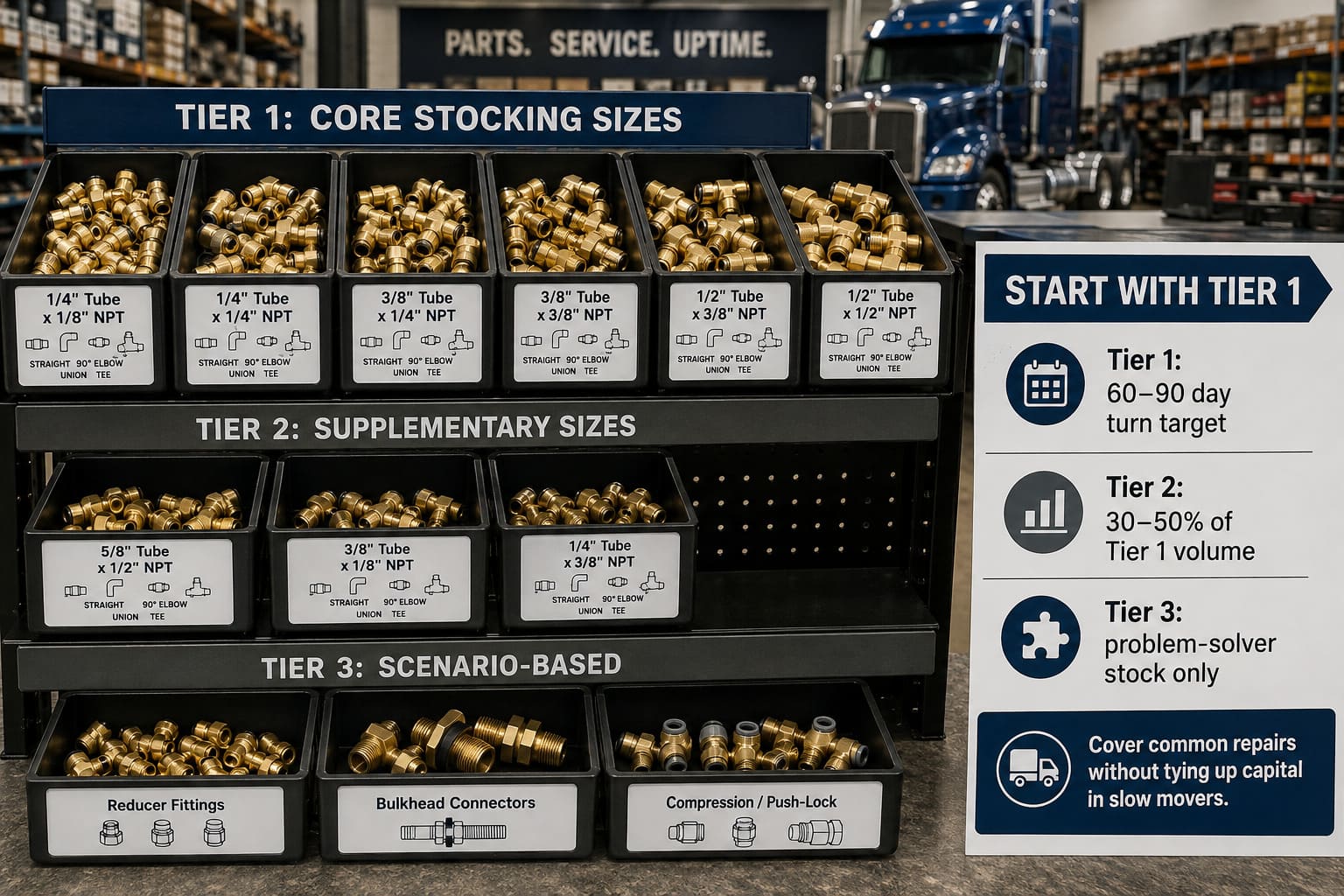
A three-tier stocking model — core, supplementary, and scenario-based — gives distributors, repair shops, and fleets a structured way to build inventory without guessing which sizes will move.
Tier 1: Core Stocking Sizes (High Frequency)
These combinations appear most consistently in repeat orders and emergency sourcing inquiries from North American customers. Stock these in all four primary shapes — straight connector, 90-degree elbow, union, and tee.
| Tube O.D. | NPT Thread | Priority Shape(s) |
|---|---|---|
| 1/4" | 1/8" NPT | Straight connector, 90-degree elbow |
| 1/4" | 1/4" NPT | Straight connector, 90-degree elbow, union |
| 3/8" | 1/4" NPT | Straight connector, 90-degree elbow, tee |
| 3/8" | 3/8" NPT | Straight connector, 90-degree elbow, union, tee |
| 1/2" | 3/8" NPT | Straight connector, 90-degree elbow |
| 1/2" | 1/2" NPT | Straight connector, union |
Why these move: The 3/8" tube with 1/4" and 3/8" NPT combinations are the most frequently cited in our North American distributor inquiries. They cover the majority of brake relay valve and trailer supply line connections across the major truck platforms. The 1/4" tube combinations serve control circuit and gauge connections that appear in almost every repair scenario.
Tier 2: Supplementary Sizes (Medium Frequency)
These sizes appear in regular but less urgent order cycles. Stock at lower quantities, replenish based on actual sell-through.
- 5/8" tube O.D. with 1/2" NPT — primarily main supply runs; lower frequency than smaller tube sizes but critical when needed
- 3/8" tube O.D. with 1/8" NPT — appears in some gauge and instrument connections; less common than 1/4" NPT pairing
- 1/4" tube O.D. with 3/8" NPT — occasionally specified for specific valve ports; not a core size but worth carrying in small quantities
Tier 3: Scenario-Based Fittings (Application-Specific)
These are not high-volume stocking items, but their absence creates significant repair delays when needed.
- Reducer fittings (e.g., 1/2" tube to 3/8" tube, or reducing NPT adapters) — useful for connecting mismatched legacy components
- Bulkhead connectors — for panel or wall-mounted installations on trailers and tanks
- Push-lock or compression fittings — for specific fleet specifications that do not use standard push-to-connect
For Tier 3, experienced distributors often carry a limited quantity as "problem-solver stock" rather than maintaining regular replenishment cycles.
Inventory Risk Considerations
Stocking too narrow leaves you unable to fill common repairs. Stocking too broad ties up capital in sizes that sit for 18+ months. The goal is to cover the core combinations thoroughly and let sales data guide expansion into Tier 2 and Tier 3.
A practical starting approach: build Tier 1 SKUs to a 60–90 day turn target, stock Tier 2 at 30–50% of Tier 1 volume, and carry Tier 3 only in response to demonstrated customer demand or fleet contract requirements.
What DOT Compliance Means When Sourcing Air Fittings?
Buyers sometimes assume any brass push-to-connect fitting is acceptable for air brake applications. That assumption can create liability exposure and failed inspections.
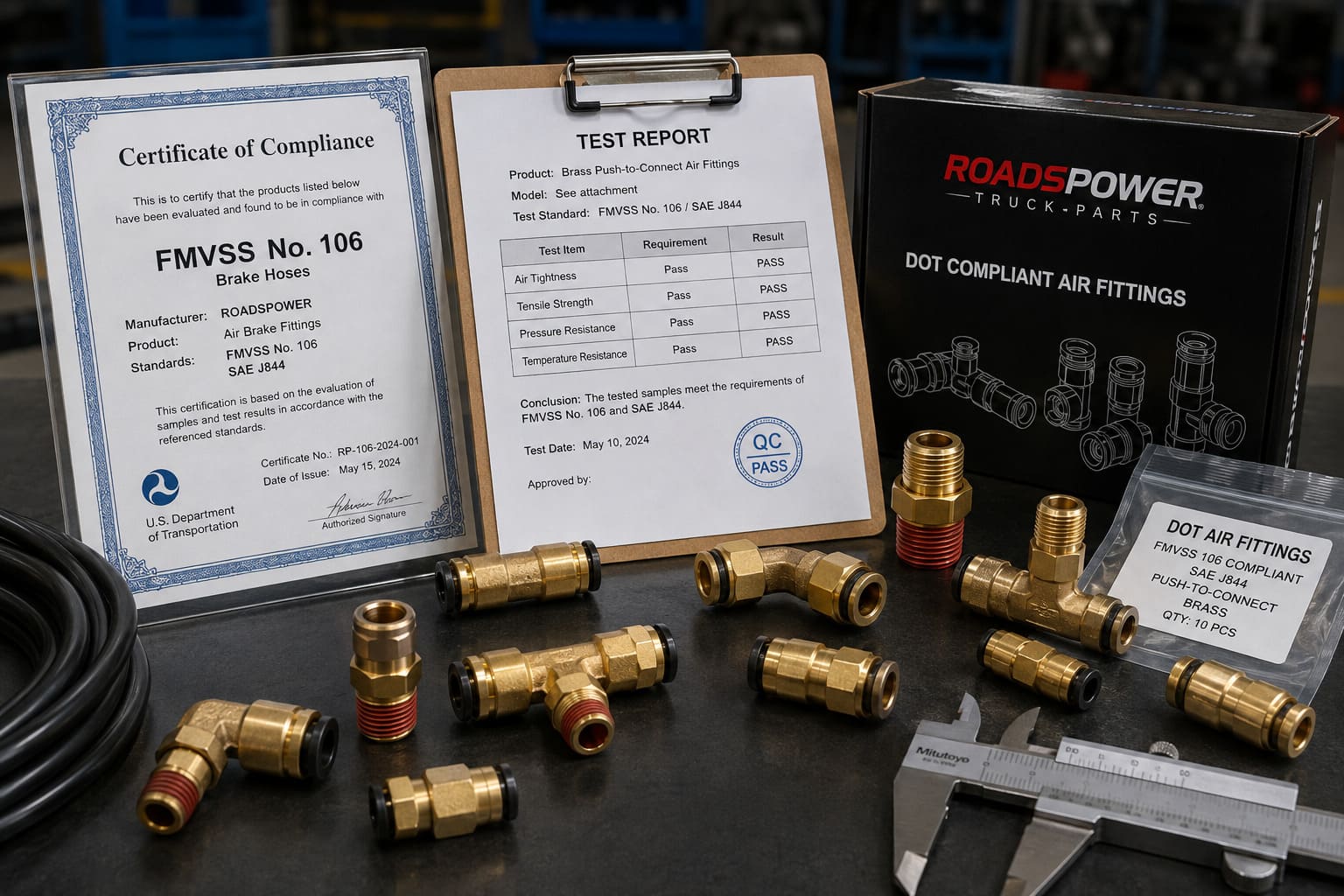
DOT compliance in air fittings for heavy-duty trucks means the fitting meets the performance and material requirements established under FMVSS No. 106 and related DOT/SAE standards for air brake tubing and fittings.10 Buyers should request and verify compliance documentation from suppliers rather than assuming compliance based on visual inspection alone.
What to Ask Suppliers About DOT Compliance
When evaluating a DOT air fitting supplier, the following documentation and process questions are reasonable to raise:
- DOT certification documentation: Can the supplier provide DOT compliance certificates for specific fitting series? Treat these as documents to verify independently, not self-reported claims.
- Material traceability: Are raw material batch records available? Brass composition and tubing material directly affect pressure and temperature performance.
- Performance test results: Has the supplier conducted air tightness, tensile strength, pressure resistance, and temperature resistance testing? Ask for actual test records.
- SAE and FMVSS awareness: Does the supplier design and test fittings with awareness of SAE J844 (air brake tubing) and FMVSS 106 requirements11? This does not guarantee regulatory compliance but signals supplier awareness.
- Quality management system: ISO 9001 certification indicates documented quality processes12, though buyers should confirm it through the certifying body.
At ROADSPOWER, our DOT fittings go through multi-node inspection covering incoming material verification, in-process sampling, and pre-shipment performance testing. We hold ISO 9001 and DOT certifications, and we make test records available for customer review. We recommend buyers verify all certifications independently and consult qualified professionals for specific application decisions.
Frequently Asked Questions
What is the most commonly ordered DOT air fitting size in the North American truck aftermarket?
Based on repeat order and inquiry patterns, 3/8" tube O.D. with 1/4" NPT and 3/8" tube O.D. with 3/8" NPT are among the most frequently requested combinations. However, "most common" depends on your specific customer base — repair shops, fleets, and distributors each have different mix profiles.
Can I use the same fitting for both air brake lines and air suspension lines?
Not necessarily. Air brake and suspension circuits may operate at different pressure ratings and use different tubing specifications. Always confirm the fitting's rated pressure and the application's requirements before substituting across systems. Consult a qualified technician for application-specific decisions.
How do I know which NPT thread size matches a valve or tank port?
The most reliable method is to measure the port directly with a thread gauge. Port markings are sometimes stamped near the opening but are not always legible after use. When in doubt, test with a known NPT fitting before ordering in volume.
Should repair shops stock all four fitting shapes for every size?
For Tier 1 core sizes, stocking all four primary shapes — straight connector, 90-degree elbow, union, and tee — reduces the risk of turning away repairs. For Tier 2 and Tier 3 sizes, shape selection can be narrowed based on actual demand patterns at your location.
What is the difference between a push-to-connect fitting and a compression fitting in truck air systems?
Push-to-connect (push-lock or DOT quick-connect) fittings use a collet and O-ring mechanism that grips the tubing when inserted. Compression fittings use a ferrule and nut tightened over the tubing. Both appear in North American truck applications, but DOT push-to-connect fittings dominate the aftermarket replacement segment because of their faster installation in roadside and shop repair conditions.
Conclusion
Choosing the right DOT air fitting sizes to stock is not about memorizing a top-five list. It is about understanding how tube O.D., NPT thread, and fitting shape combine into distinct SKUs — and then tiering your inventory around the combinations that genuinely move in the North American heavy-duty truck aftermarket. The core sizes covered here — particularly the 3/8" tube family and the 1/4" tube pairings — form a reliable stocking foundation for most distributors, repair shops, and fleets. From there, supplementary and scenario-based sizes can be added as your sales data develops.
If you are building or expanding an air fitting inventory for the North American or South American truck market, ROADSPOWER is ready to support your SKU planning with product specifications, compliance documentation, and flexible order quantities. Contact us to discuss your stocking requirements.
"5.1.1 Brake Systems (Part 393 Subpart C) - CSA", https://csa.fmcsa.dot.gov/safetyplanner/MyFiles/SubSections.aspx?ch=22&sec=64&sub=130. Industry standards for air-brake tubing identify nominal tube outside diameters used in heavy-vehicle pneumatic systems, providing context for why 1/4 in., 3/8 in., and 1/2 in. fitting families are common in stocking discussions. Evidence role: general_support; source type: institution. Supports: A neutral source should support that these tubing diameters and pipe-thread sizes are standard or commonly specified in heavy-vehicle air-brake systems.. Scope note: Such a source would support technical commonality, not directly prove aftermarket sales ranking or distributor stocking frequency. ↩
"Brass Push-To-Connect - DOT Air Brake - Fittings For SAE ...", https://www.wurthusa.com/Fluid-Power/Brass-Fittings/PTC-DOT-Air-Brk-Ftg-SAE-J844D-Nylon-Tbng/Union-Tee-Tube-Each-End/Brass-Push-To-Connect---DOT-Air-Brake---Fittings-For-SAE-J844D---Nylon-Tubing-Union-Tee---3-8-Inch-Tube-Outer-Diameter/p/188502002?srsltid=AfmBOopc7DW-8sLSbcqCuAh-3tSPWb1MLspOpKX8nemRyBYzHZ3JRDVu. Technical standards and fitting classifications for vehicle pneumatic tube connections describe connector, elbow, union, and tee configurations, supporting the article’s use of these shapes as a practical fitting taxonomy. Evidence role: general_support; source type: institution. Supports: A standards or technical reference should show that connector, elbow, union, and tee fitting configurations are recognized configurations in vehicle pneumatic or air-brake tube systems.. Scope note: The evidence would support the relevance of these shapes, not independently verify that they are the highest-selling shapes in the aftermarket. ↩
"NPRM Heavy Vehicle Automatic Emergency Braking ...", https://www.nhtsa.gov/document/nprm-heavy-vehicles-automatic-emergency-braking-systems. Government air-brake training and inspection materials describe heavy-vehicle pneumatic systems as assemblies of compressors, reservoirs, valves, chambers, tubing, and trailer connections, supporting the claim that system configuration depends on vehicle design. Evidence role: general_support; source type: government. Supports: A government or technical source should show that heavy vehicles use multi-component pneumatic brake systems whose layouts vary by vehicle design and application.. Scope note: This would provide contextual support for design variation rather than a model-by-model comparison of Freightliner, Kenworth, Peterbilt, International, Volvo, and Mack configurations. ↩
"5.1.1 Brake Systems (Part 393 Subpart C) - CSA", https://csa.fmcsa.dot.gov/safetyplanner/MyFiles/SubSections.aspx?ch=22&sec=64&sub=130. Roadside inspection and commercial-vehicle maintenance materials identify air-brake lines, hoses, tubing, and related pneumatic components as recurring inspection items and sources of out-of-service defects. Evidence role: statistic; source type: government. Supports: A government or inspection source should document that air-brake lines, hoses, tubing, or pneumatic components are regular inspection and maintenance concerns in commercial vehicles.. Scope note: Inspection or maintenance data would support recurring service need, but may not specify the exact fitting sizes that fail or are replaced. ↩
"Types of Tube Fittings: Learn the Key Differences | Swagelok", https://www.swagelok.com/en/blog/small-bore-tube-fittings-key-differences. Engineering references on tube and pipe fittings distinguish tube outside diameter, threaded-port specification, and fitting geometry as separate parameters that must be matched for a mechanically compatible connection. Evidence role: mechanism; source type: education. Supports: An engineering reference should explain that tube size, pipe-thread specification, and fitting geometry are distinct parameters that determine connection compatibility.. Scope note: The source would support the mechanical principle, not the article’s specific SKU-planning conclusions. ↩
"Federal Motor Vehicle Safety Standards; Brake Hoses", https://www.federalregister.gov/documents/2004/12/20/04-27088/federal-motor-vehicle-safety-standards-brake-hoses. SAE air-brake tubing standards specify nominal tubing sizes used in vehicle pneumatic brake systems, including the tube outside diameters discussed here. Evidence role: definition; source type: institution. Supports: A standards source should identify these nominal outside diameters as recognized air-brake tubing sizes.. Scope note: The standard would confirm recognized technical sizes, not measure how often each size is stocked or sold. ↩
"National pipe thread - Wikipedia", https://en.wikipedia.org/wiki/National_pipe_thread. National Pipe Thread references define NPT as a tapered pipe-thread standard used for threaded pipe and fitting connections, supporting the article’s distinction between NPT thread size and tube outside diameter. Evidence role: definition; source type: encyclopedia. Supports: A reference source should define NPT as National Pipe Taper thread and explain its tapered pipe-thread function.. ↩
"3/8" Tube O.D. x 1/4" NPT Male Connector Tube Fitting", https://www.alabamaindustrialproducts.com/products/3-8-tube-o-d-x-1-4-npt-male-connector-tube-fitting. Vehicle tube-fitting specifications identify tube-end size and threaded-end size as separate attributes, supporting the statement that a 3/8 in. tube fitting may be manufactured with different NPT thread ends. Evidence role: mechanism; source type: institution. Supports: A technical standard or specification should show that a fitting is specified by both tube O.D. and pipe-thread end size, allowing multiple thread pairings for one tube size.. Scope note: The source would support dimensional feasibility, not establish which pairings are most frequently ordered. ↩
"DOT approved Air Brake Fittings for Trucks & Trailers - Mytee Products", https://www.myteeproducts.com/trailer-parts/air-brake-hose-coils/air-brake-fittings.html?srsltid=AfmBOopNy5o5iwLTvNgT7X3NtT0Bmwg8bMMRHWRmV3m81AG8Z7PqZuyf. Technical classifications of air-brake tube fittings include straight connectors, elbows, unions, and tees, supporting their treatment as standard fitting configurations in vehicle pneumatic systems. Evidence role: general_support; source type: institution. Supports: A neutral technical source should show that these fitting shapes are recognized and commonly used configurations in air-brake tubing systems.. Scope note: This would not directly verify that these are the four most commonly stocked aftermarket shapes. ↩
"49 CFR 571.106 -- Standard No. 106; Brake hoses.", https://www.ecfr.gov/current/title-49/subtitle-B/chapter-V/part-571/subpart-B/section-571.106. FMVSS No. 106, codified at 49 C.F.R. § 571.106, establishes federal performance requirements for brake hoses, brake hose assemblies, and related end fittings, providing the regulatory basis for DOT compliance discussions in vehicle brake systems. Evidence role: definition; source type: government. Supports: The source should confirm the scope and requirements of FMVSS No. 106 for brake hoses, brake hose assemblies, end fittings, and air-brake tubing.. ↩
"Federal Motor Vehicle Safety Standards; Brake Hoses", https://www.federalregister.gov/documents/2004/12/20/04-27088/federal-motor-vehicle-safety-standards-brake-hoses. SAE J844 specifies requirements for nonmetallic tubing used in automotive air-brake systems, making it a relevant technical standard when evaluating tubing and fitting compatibility in DOT-regulated brake applications. Evidence role: definition; source type: institution. Supports: A standards source should identify SAE J844 as the standard for nonmetallic air-brake system tubing and explain its relevance to vehicle air-brake applications.. ↩
"[DOC] EQA_Exh5.docx - DOE Office of Science", https://science.osti.gov/-/media/SCMS/Management-Systems/QUAL/EQA/EQA_Exh5.docx. ISO describes ISO 9001 as a quality-management-system standard that sets requirements for organizational processes, documentation, customer focus, and continual improvement. Evidence role: definition; source type: institution. Supports: An ISO source should state that ISO 9001 specifies requirements for a quality management system, including documented processes and continual improvement.. Scope note: ISO 9001 certification supports the existence of a quality-management system, but it does not by itself prove that any particular fitting meets DOT performance requirements. ↩