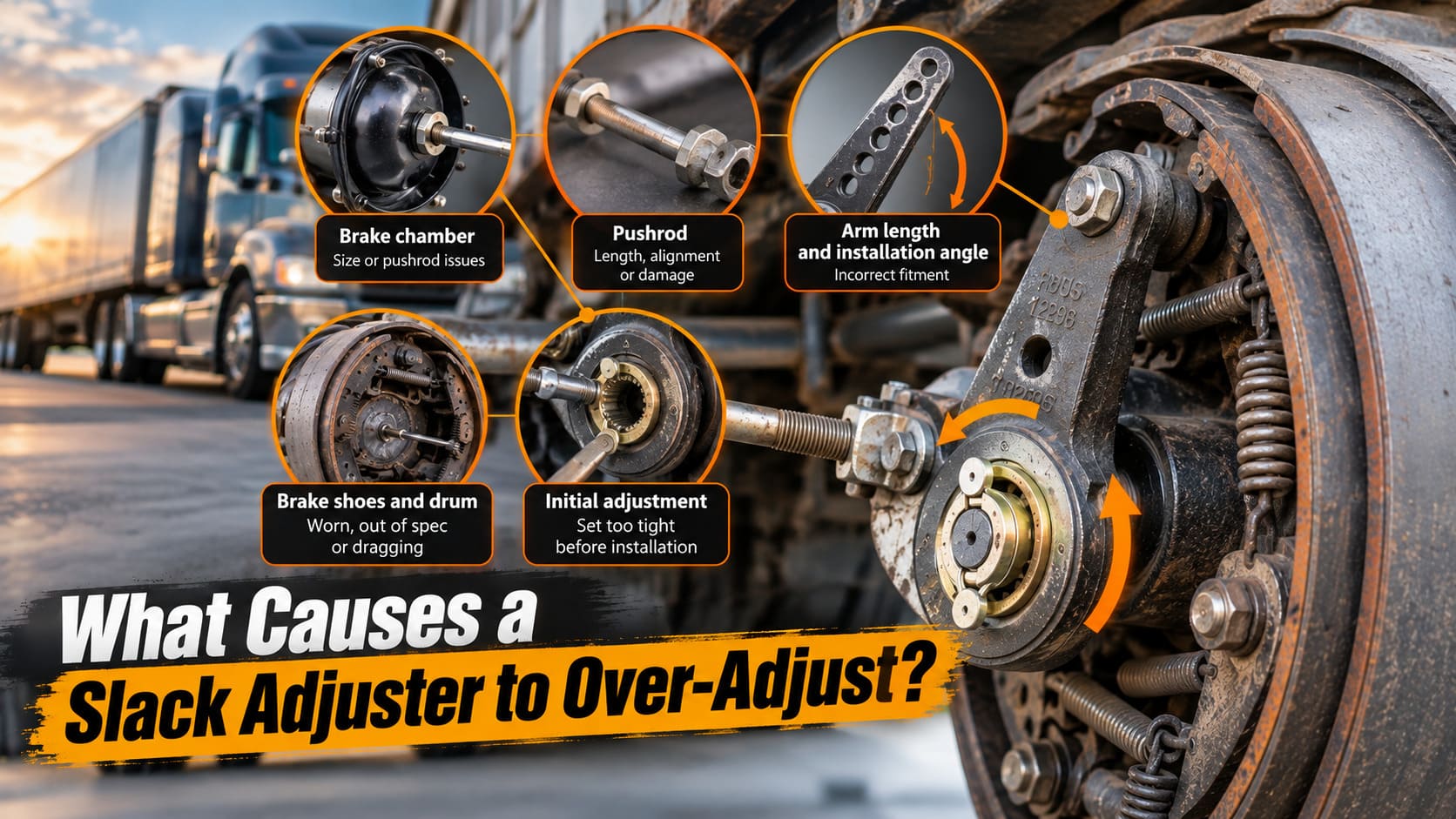
When a slack adjuster over-adjusts, the first instinct is to blame the part — but that assumption can be expensive. Misdiagnosis leads to unnecessary replacements, unresolved brake problems, and supplier disputes that could have been avoided with a more systematic inspection. Understanding the real causes starts with the brake system as a whole.
A slack adjuster over-adjusts when it shortens brake lash beyond the design specification, pulling the brake shoes too close to the drum or rotor and causing drag, excessive heat, or premature lining wear1. The most common contributing factors include incorrect initial setup, mismatched arm length or installation angle, brake chamber pushrod issues, and in some cases, a defective adjuster mechanism itself.2 No single cause should be assumed without inspection.
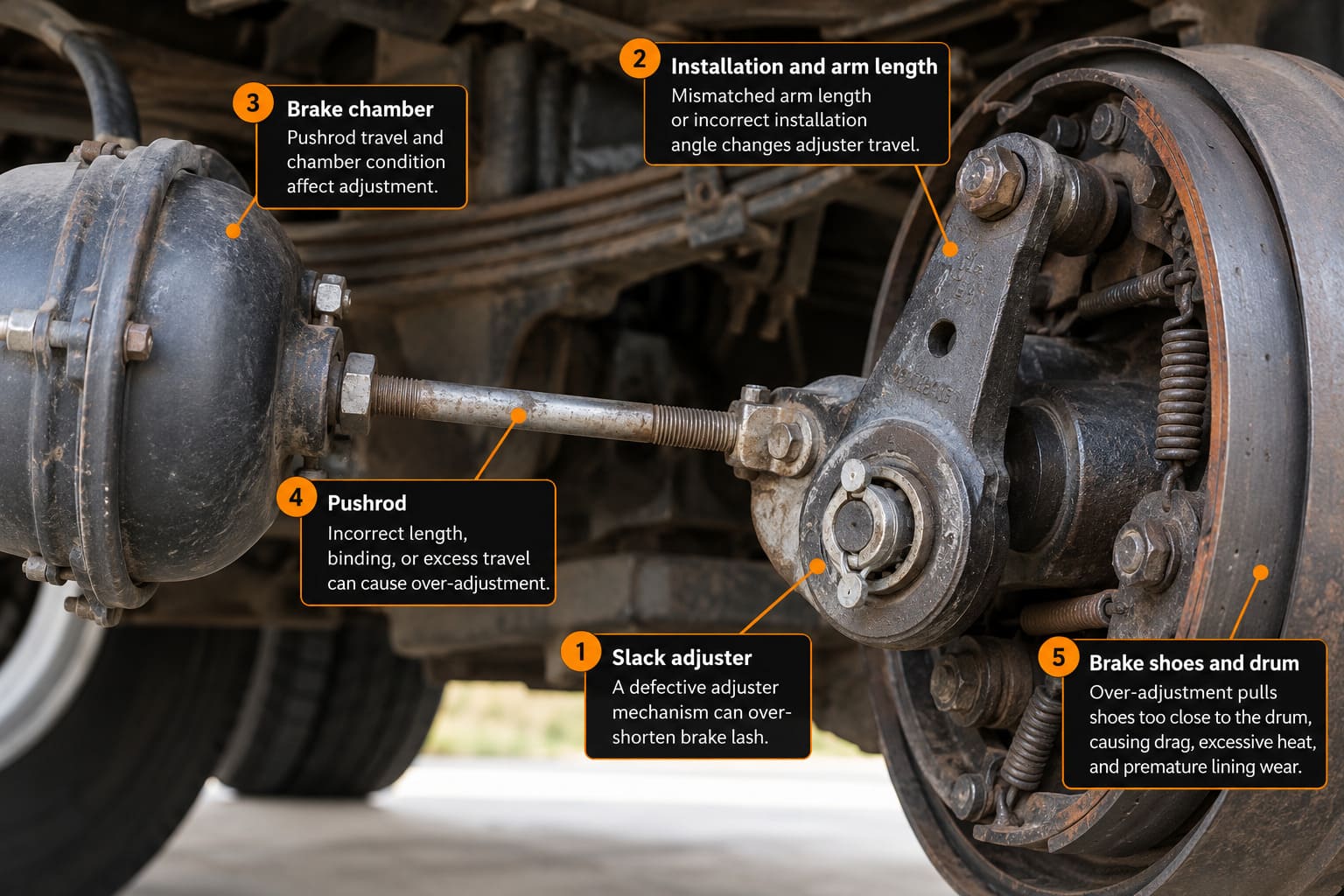
Over-adjustment complaints reach suppliers and distributors regularly — and the commercial cost runs deeper than a single returned part. Repeated replacements, incorrect warranty claims, and customer downtime all trace back to the same root problem: an incomplete diagnosis. The sections below walk through each contributing area in the order a qualified technician should evaluate them.
Is the Slack Adjuster Actually Over-Adjusting — or Is Something Else Happening?
Misreading the symptom is surprisingly common. A wheel dragging after brake release, a hot drum, or a stiff pushrod return may all look like over-adjustment — but the cause may be elsewhere in the brake system entirely.
Before any slack adjuster is removed or replaced, the brake system condition should be confirmed by a qualified technician. Brake drag, for example, can result from a seized chamber, a weak return spring, or a bent spider3 — none of which involve the adjuster at all. Replacing the slack adjuster without eliminating these possibilities solves nothing.
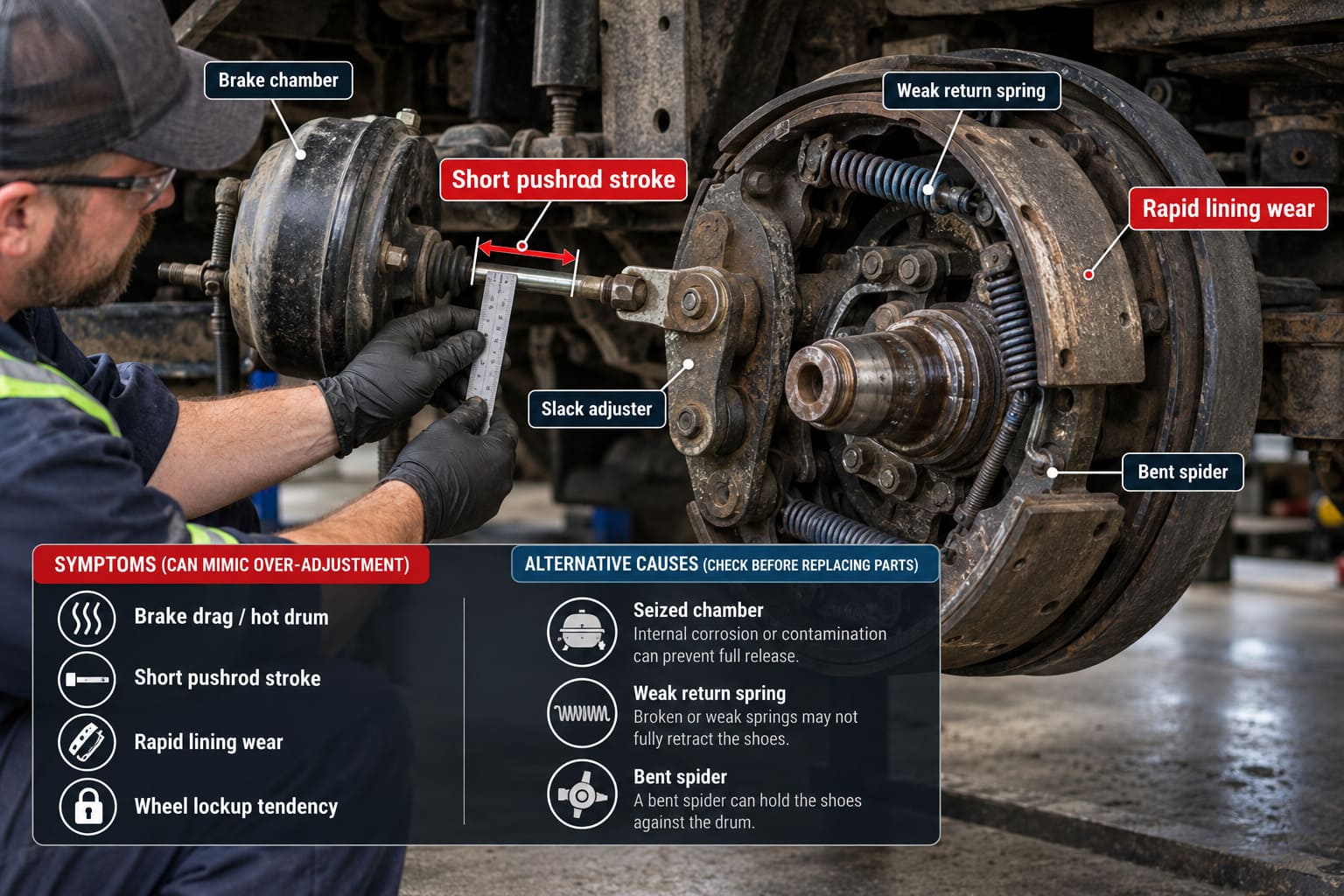
Symptoms That May Indicate Over-Adjustment
The following signs are commonly associated with over-adjustment, but each requires confirmation:
- Brake drag or wheel heat after normal driving without hard braking
- Short pushrod stroke measured at the brake chamber — below the minimum free stroke specification
- Rapid lining wear disproportionate to brake usage
- Wheel lockup tendency during light brake application
What Confirmation Looks Like
A qualified technician should measure pushrod travel against the manufacturer's specification for the chamber size installed. The CVSA (Commercial Vehicle Safety Alliance) out-of-service criteria and FMCSA brake adjustment guidelines both provide reference stroke limits by chamber type. Free stroke and applied stroke should both fall within specification. If they do not, the system — not just the adjuster — requires inspection.
Buyer and distributor note: When a customer reports over-adjustment, ask whether free stroke has been measured. If it has not, the complaint is premature for a parts-quality claim.
Was the Initial Brake Adjustment Set Correctly Before Installation?
Improper initial manual adjustment is one of the most frequently overlooked contributors to automatic slack adjuster problems. Many over-adjustment complaints, in our experience handling distributor and fleet inquiries, trace back to a setup step that was skipped or done incorrectly at installation.
Automatic slack adjusters are designed to maintain a pre-set running clearance — they do not establish it.4 If the initial clearance is set too tight before the adjuster is installed, the adjuster may respond as if the brakes are already worn and continue shortening the slack from an already-incorrect baseline.
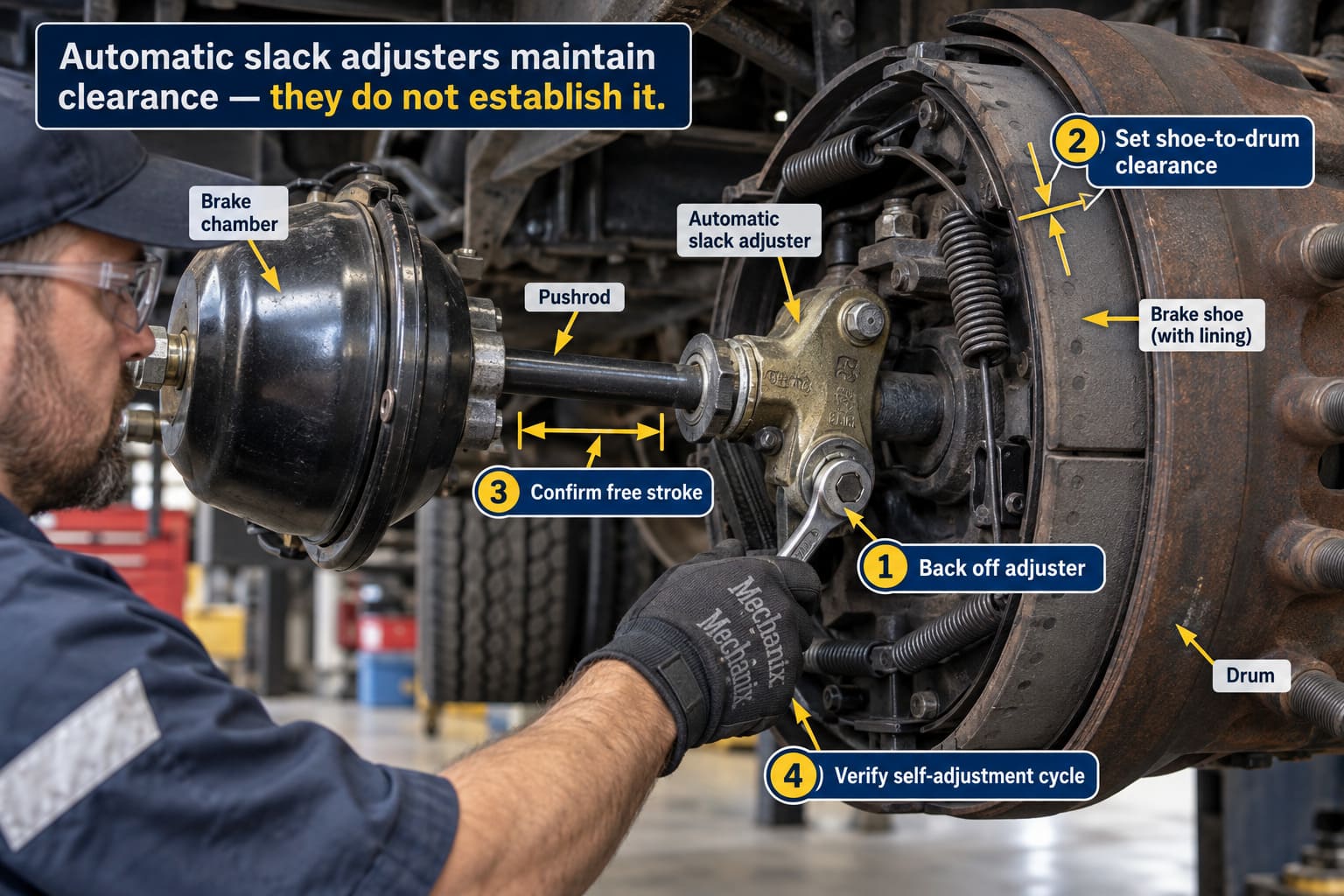
The Role of Initial Manual Adjustment
Most automatic slack adjuster service manuals — including those from major OE suppliers — specify a manual initial adjustment procedure before putting the vehicle into service.5 This typically involves:
- Backing off the adjuster to create a known clearance
- Manually rotating the worm gear to set the correct shoe-to-drum clearance
- Confirming free stroke at the brake chamber before the first brake application
- Verifying the adjuster clicks through its self-adjustment cycle correctly during an initial test application
Skipping step 2 or starting from an unknown clearance is a common field error. The adjuster has no way to distinguish between "brakes are worn and need adjustment" and "brakes were set too tight at installation." It responds to stroke length — not intent.6
Why This Matters for Distributors
If a distributor supplies a slack adjuster and the installer skips the initial setup, the adjuster may appear defective within the first few service cycles. The part itself may be entirely within specification. Without documentation of the installation procedure, resolving the subsequent claim becomes difficult for all parties. Providing installation instructions with each unit — and asking customers to confirm the initial setup was performed — is a practical step that reduces downstream disputes.
Could Arm Length or Installation Angle Be Contributing to the Problem?
Slack adjuster geometry is not universal. Arm length and clocking angle both affect how the adjuster translates pushrod force into rotational movement7 — and a mismatch in either dimension can cause the adjuster to behave incorrectly even if the part itself is functioning as designed.
This is an area where specification confirmation before procurement matters more than many buyers realize. Fitment errors in slack adjusters are a known cause of abnormal brake behavior, including over-adjustment.
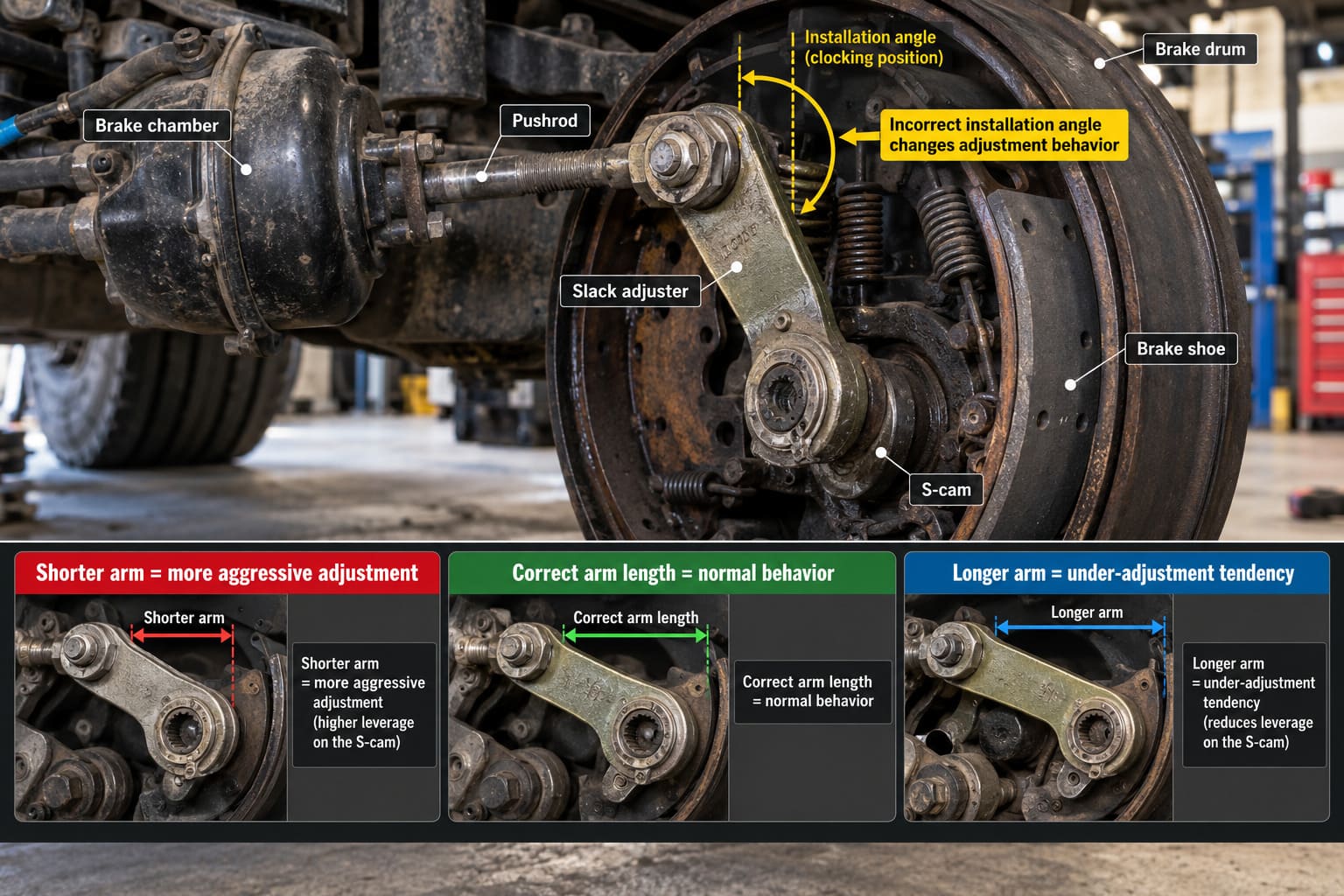
How Arm Length Affects Adjustment Behavior
The arm length of a slack adjuster determines its mechanical advantage — the leverage ratio between pushrod travel and camshaft rotation. A shorter arm produces more camshaft rotation per inch of pushrod travel. A longer arm produces less.8
| Arm Length | Camshaft Rotation per Unit Pushrod Travel | Practical Effect |
|---|---|---|
| Shorter than specified | Higher | More aggressive adjustment per cycle |
| Matched to specification | Correct | Normal operating behavior |
| Longer than specified | Lower | Under-adjustment tendency |
If an adjuster with a shorter arm than specified is installed in an application designed for a longer arm, each brake application may trigger more aggressive self-adjustment than the system expects. Over time, this can result in over-adjustment — not because the adjuster is defective, but because the geometry is wrong.
Installation Angle Considerations
The clocking position — where the adjuster arm sits relative to the S-cam when the brakes are released — must fall within the manufacturer's specified range. Most specifications call for the arm to sit close to perpendicular to the pushrod at the point of brake application for maximum efficiency and correct adjustment behavior.9 If the arm is clocked too far out of range, the effective stroke geometry changes, which may affect when and how much the adjuster self-adjusts.
Installation angle errors may also affect the adjuster's ability to fully return the brakes to the released position, compounding any over-adjustment tendency.
Practical action: Before ordering replacement slack adjusters, confirm arm length, spline count, spline size, and cam tube diameter against the vehicle's service manual or axle manufacturer's fitment guide. Do not substitute a visually similar unit without verifying these dimensions.
Can Brake Chamber or Pushrod Condition Cause a Slack Adjuster to Over-Adjust?
The slack adjuster does not act in isolation. Its self-adjustment mechanism responds to pushrod travel — specifically, to the difference between free stroke and applied stroke.10 If the chamber or pushrod is not behaving correctly, the adjuster receives incorrect signals and may respond with excessive adjustment.
This is a system-inspection question, not a parts-quality question. A qualified technician should evaluate the chamber and pushrod condition before concluding the adjuster is at fault.
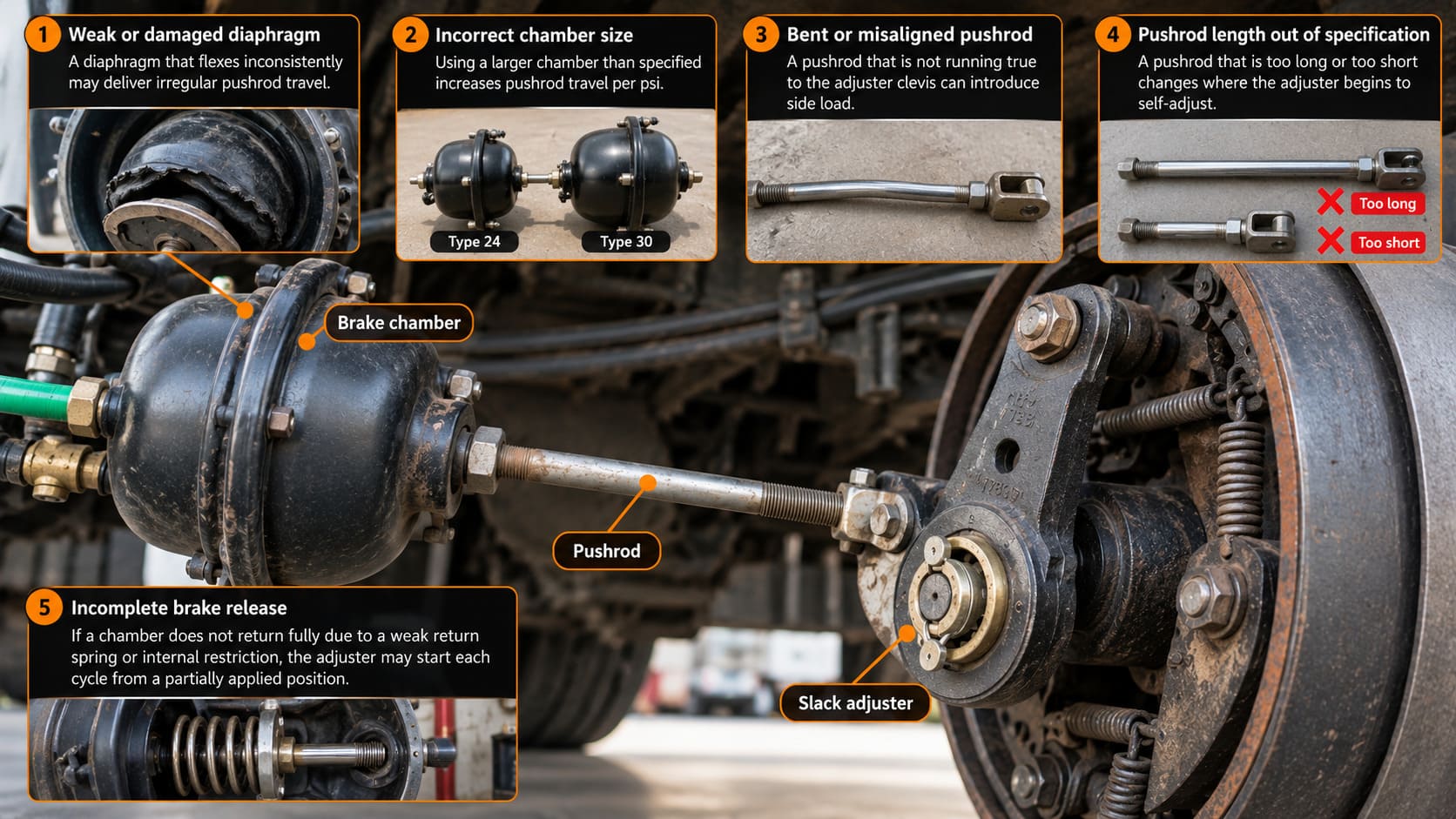
Chamber and Pushrod Conditions to Inspect
The following conditions may affect how the slack adjuster behaves, and should be inspected by a qualified technician if over-adjustment is suspected:
- Weak or damaged diaphragm — A diaphragm that flexes inconsistently may deliver irregular pushrod travel, confusing the adjuster's sensing mechanism
- Incorrect chamber size for the axle — Using a larger chamber than specified increases pushrod travel per psi, which the adjuster may interpret as excessive clearance requiring correction
- Bent or misaligned pushrod — A pushrod that is not running true to the adjuster clevis can introduce side load and affect stroke measurement
- Pushrod length out of specification — A pushrod that is too long or too short changes where in the stroke the adjuster begins to self-adjust
- Incomplete brake release — If a chamber does not return fully to the released position due to a weak return spring or internal restriction, the adjuster may start each cycle from a partially applied position
What This Means for Replacement Decisions
Replacing a slack adjuster without inspecting the chamber and pushrod is a common — and costly — error in fleet and repair shop environments. If the chamber is delivering inconsistent or excessive stroke, the replacement adjuster will exhibit the same over-adjustment behavior as the original. The shop replaces the part a second time, the distributor receives a second claim, and the root cause remains unaddressed.
Asking a customer to confirm chamber condition and pushrod travel measurement before processing a replacement is a reasonable and defensible standard for distributors managing claims.
When Is the Slack Adjuster Itself Actually Defective?
Product defects are possible and should not be dismissed. A slack adjuster with a worn or incorrectly calibrated internal pawl mechanism, a damaged worm gear, or an incorrectly assembled one-way clutch can over-adjust independent of the installation conditions. However, a defect diagnosis requires evidence — not just the presence of the symptom.
From a supplier-side perspective, the pattern of claims matters. A single unit complaint after installation on a single axle warrants inspection of the installation conditions first. A pattern of the same part number generating over-adjustment complaints across multiple customers and vehicles is a signal that warrants escalation to the manufacturer with documented evidence.
Evidence That Supports a Product-Quality Claim
| Evidence Type | Why It Matters |
|---|---|
| Pushrod stroke measurements (before and after) | Confirms over-adjustment is occurring — not just brake drag |
| Confirmation of correct initial setup | Eliminates installation error as a cause |
| Arm length and application fitment verification | Eliminates geometry mismatch |
| Chamber size and pushrod condition inspection | Eliminates system-level causes |
| Multiple affected units on the same vehicle spec | Suggests a part-level issue, not an installation issue |
Without this documentation, a product-quality claim is difficult to evaluate and difficult to resolve fairly for any party involved.
Frequently Asked Questions
Can an automatic slack adjuster over-adjust on a new installation?
Yes, and it is more common than many buyers expect. New installations are particularly vulnerable to over-adjustment if the initial brake clearance was not manually set before the first brake application. Automatic slack adjusters maintain clearance — they do not establish it. Skipping the initial setup procedure may result in over-adjustment within the first few brake cycles.
How do I know if my slack adjuster is the right arm length for my application?
Arm length should be confirmed against the vehicle's service manual or the axle manufacturer's fitment specifications. Visual similarity between two slack adjusters is not sufficient for fitment confirmation. Key dimensions to verify include arm length, spline count, spline diameter, and cam tube diameter. When in doubt, contact your parts supplier with the vehicle make, model year, and axle specification.
Will replacing the slack adjuster fix brake drag caused by a bad chamber?
Not necessarily. If the brake drag is caused by a chamber that is not fully releasing — due to a weak return spring, damaged diaphragm, or internal restriction — replacing the slack adjuster will not resolve the symptom. The replacement unit may exhibit the same behavior. A qualified technician should inspect the chamber and confirm full pushrod return before replacing the adjuster.
How should distributors handle over-adjustment complaints before filing a supplier claim?
Before filing a claim, distributors should ask their customer to confirm: pushrod travel measurements, whether initial setup was performed, chamber size and condition, and arm length fitment. Claims submitted with this documentation are easier to evaluate and resolve. Claims submitted without it may result in delays, disputes, or cost-sharing disagreements that damage the supplier relationship.
Are all slack adjusters certified to the same standard?
No. In the North American market, relevant certifications include DOT compliance and conformance with FMCSA brake adjustment regulations. SAE specifications such as SAE J1462 provide dimensional and performance guidelines.11 Buyers should verify that the specific part number they are procuring carries the appropriate documentation for their market. Do not assume that visual or dimensional similarity implies certification equivalency.
Conclusion
A slack adjuster that over-adjusts is a brake system problem before it is a parts-quality problem. In most cases, the root cause can be traced to incorrect initial setup, arm length or angle mismatch, or abnormal brake chamber behavior — all of which require qualified inspection before any part is replaced or any claim is filed. Product defects are possible, but they require documented evidence to evaluate fairly. For distributors and procurement managers, the real cost of misdiagnosis is not a single returned part — it is the compounding expense of repeated replacements, incorrect claims, and damaged supplier relationships. At ROADSPOWER, we support customers with model confirmation, fitment verification, and technical communication to reduce that risk at the point of procurement. If you are evaluating a slack adjuster complaint or reviewing a parts specification, contact our team to discuss fitment requirements and available documentation.
"5.1.1 Brake Systems (Part 393 Subpart C) - CSA", https://csa.fmcsa.dot.gov/safetyplanner/MyFiles/SubSections.aspx?ch=22&sec=64&sub=130. Government air-brake inspection guidance describes brake adjustment and shoe-to-drum clearance as factors affecting brake drag, heat generation, and lining wear. Evidence role: mechanism; source type: government. Supports: A neutral source should explain that incorrect brake adjustment or insufficient shoe-to-drum clearance can cause dragging brakes, heat, and abnormal lining wear.. Scope note: Such guidance supports the mechanism generally and may not use the specific term “over-adjustment” for every failure mode. ↩
"Gunite Automatic Slack Adjuster", https://www.accuridecorp.com/sites/default/files/resources/2020-08/WE3.001%20Rev.%202%20ASA%20Manual_low%20res.pdf. Technical air-brake service literature identifies installation setup, adjuster geometry, pushrod travel, and internal adjuster condition as relevant diagnostic factors in automatic slack adjuster performance. Evidence role: general_support; source type: institution. Supports: A technical training or standards source should identify installation setup, geometry, chamber/pushrod condition, and adjuster mechanism faults as recognized factors in automatic slack adjuster problems.. Scope note: The source may support the listed categories without proving their relative frequency in all fleets or markets. ↩
"FAW Front Axle Brake Logic Assembly: A Critical Analysis of 30+ ...", https://chinafawtruk.com/faw-front-axle-brake-logic-assembly.html. Commercial-vehicle brake inspection guidance recognizes chamber malfunction, release problems, and foundation-brake defects as possible causes of brake drag. Evidence role: general_support; source type: government. Supports: A vehicle inspection or maintenance source should support that brake drag can arise from brake chamber or foundation-brake defects rather than the slack adjuster alone.. Scope note: The evidence would be diagnostic context and may not specifically discuss slack adjuster over-adjustment complaints. ↩
"49 CFR § 393.53 - Automatic brake adjusters and brake ...", https://www.law.cornell.edu/cfr/text/49/393.53. Air-brake maintenance guidance describes automatic slack adjusters as devices that maintain brake adjustment during service after the brake has been correctly set up. Evidence role: mechanism; source type: government. Supports: A neutral air-brake source should explain that automatic slack adjusters compensate for lining wear and maintain adjustment after proper setup.. Scope note: The source may frame the point as maintenance guidance rather than an explicit statement that the adjuster cannot establish initial clearance. ↩
"Gunite Automatic Slack Adjuster", https://www.accuridecorp.com/sites/default/files/resources/2020-08/WE3.001%20Rev.%202%20ASA%20Manual_low%20res.pdf. Automatic slack adjuster installation literature commonly includes an initial adjustment and stroke-verification procedure before the vehicle is returned to service. Evidence role: general_support; source type: institution. Supports: A service or training source should document that automatic slack adjuster installation includes an initial adjustment and stroke verification procedure.. Scope note: The source may document procedures for one adjuster design or supplier rather than every automatic slack adjuster model. ↩
"How to test an automatic slack adjuster for proper operation if ...",
. Technical descriptions of automatic slack adjuster operation explain that adjustment is triggered by measured stroke or clearance-related motion rather than by diagnosis of the cause of the movement. Evidence role: mechanism; source type: research. Supports: A technical description should explain that automatic slack adjusters actuate adjustment based on stroke, clearance, or control-arm movement.. Scope note: Different adjuster designs use different sensing mechanisms, so the support is general rather than model-specific. ↩"Brake adjustment", https://sgi.sk.ca/air-brake/-/knowledge_base/air-brake/brake-adjustment. Mechanical and air-brake training materials describe the slack adjuster as a lever that converts brake chamber pushrod motion into S-cam rotation, making arm length and operating angle relevant to brake actuation geometry. Evidence role: mechanism; source type: education. Supports: An educational or engineering source should support the lever-arm relationship between pushrod motion, slack adjuster arm length, angle, and camshaft rotation.. Scope note: This supports the mechanical relationship but does not by itself quantify over-adjustment risk for a specific application. ↩
"Angular Displacement Interactive Calculator", https://www.firgelliauto.com/blogs/engineering-calculators/angular-displacement-calculator?srsltid=AU7gw4XnuAquvg0D759NFmcXnrZAO1CqZ5k-M8Rz-ryal5P68L8xpzgh. Basic lever kinematics show that, for a fixed linear displacement at the lever end, a shorter lever radius produces greater angular rotation than a longer lever radius. Evidence role: mechanism; source type: education. Supports: A mechanics or vehicle-brake source should support that angular displacement is inversely related to lever radius for a fixed linear pushrod movement.. Scope note: This is a general mechanics principle; actual brake behavior also depends on clevis position, chamber stroke, cam profile, and adjuster design. ↩
"Gunite Automatic Slack Adjuster", https://www.accuridecorp.com/sites/default/files/resources/2020-08/WE3.001%20Rev.%202%20ASA%20Manual_low%20res.pdf. Air-brake service guidance commonly specifies the slack adjuster and pushrod geometry so that the adjuster approaches a right angle to the pushrod during brake application, supporting efficient force transfer and proper adjustment operation. Evidence role: mechanism; source type: institution. Supports: A brake service reference should support the importance of slack adjuster-to-pushrod angle, especially the near-90-degree relationship for efficient force transfer.. Scope note: The exact allowable angle range varies by axle, chamber, and adjuster manufacturer. ↩
"Brakes; Adjustment Limits", https://downloads.regulations.gov/FMCSA-2010-0257-0009/attachment_1.pdf. Commercial-vehicle brake inspection guidance uses pushrod stroke measurements, including free and applied stroke concepts, to evaluate brake adjustment and automatic slack adjuster performance. Evidence role: mechanism; source type: government. Supports: A brake inspection or maintenance source should explain the role of pushrod stroke measurements in assessing automatic slack adjuster and brake adjustment condition.. Scope note: Regulatory inspection sources may describe measurement and compliance more directly than the internal mechanism of every adjuster model. ↩
"J1513_201607 : External Automatic Slack Adjuster ...", https://www.sae.org/standards/j1513_201607-external-automatic-slack-adjuster-performance-requirements/?src=j1461_201404. SAE J1462 is identified by SAE as a standard addressing slack adjuster characteristics and requirements relevant to dimensional and performance evaluation. Evidence role: definition; source type: institution. Supports: An SAE standard listing or abstract should confirm that SAE J1462 concerns slack adjuster dimensions, performance, or related requirements.. Scope note: SAE standards are often paywalled, so public abstracts may confirm scope without providing full test procedures or acceptance criteria. ↩