
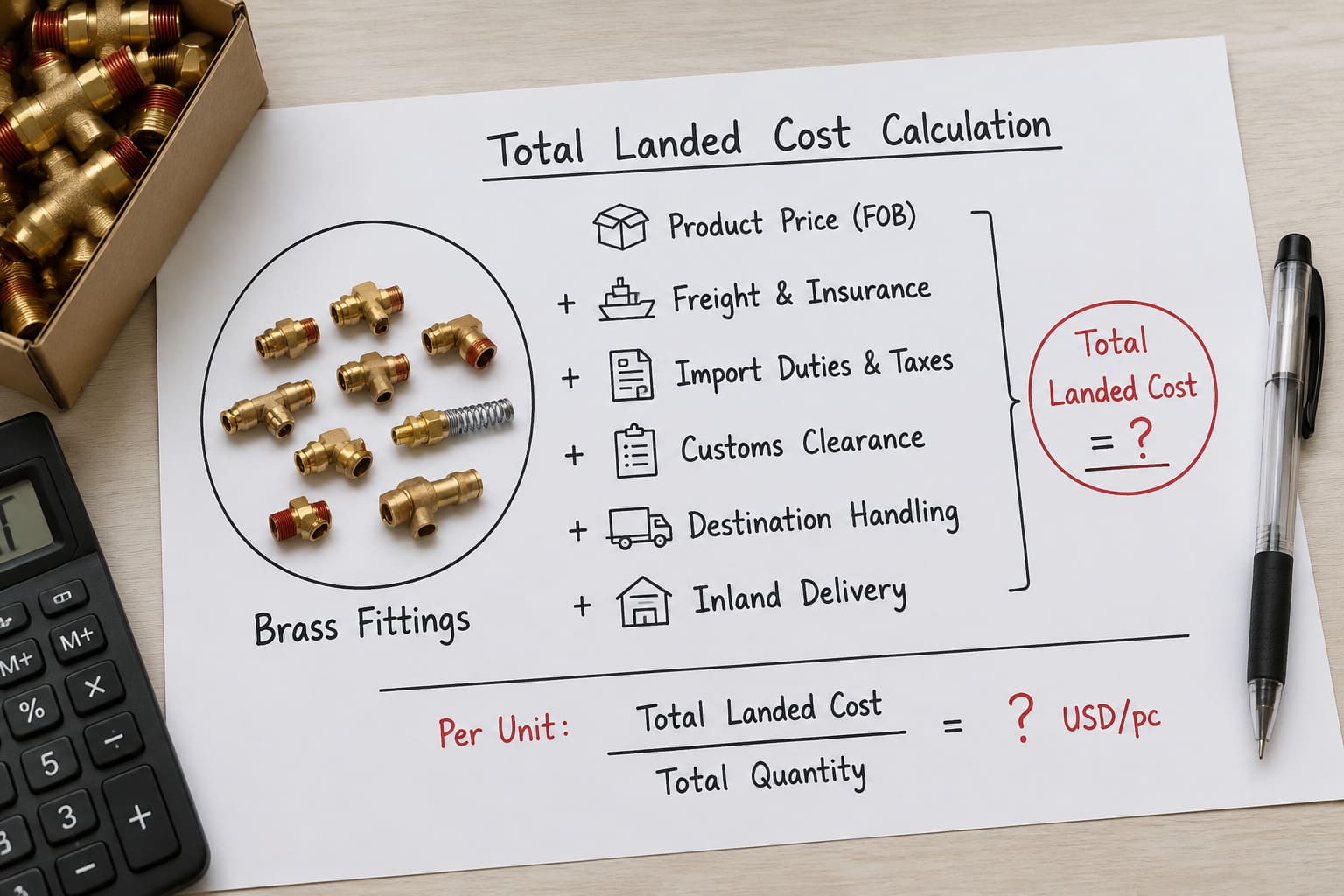
Buyers of brass fittings from China often make decisions based on FOB unit price alone — and that approach regularly leads to cost surprises at the destination. Freight, duties, destination charges, and trade-term gaps can turn a "cheap" quotation into an expensive one. Understanding total landed cost is how you avoid that problem.
Total landed cost for brass fittings imported from China is the sum of the product price, all freight and insurance charges, import duties and taxes, customs clearance fees, and any destination handling costs.1 It gives buyers a single, comparable number per unit or per order — regardless of which trade term the supplier quoted. Calculating it correctly requires aligning your supplier's trade term (FOB, CIF, or DDP), shipment mode, packaging details, HS code, and destination-specific charges before comparing quotations.
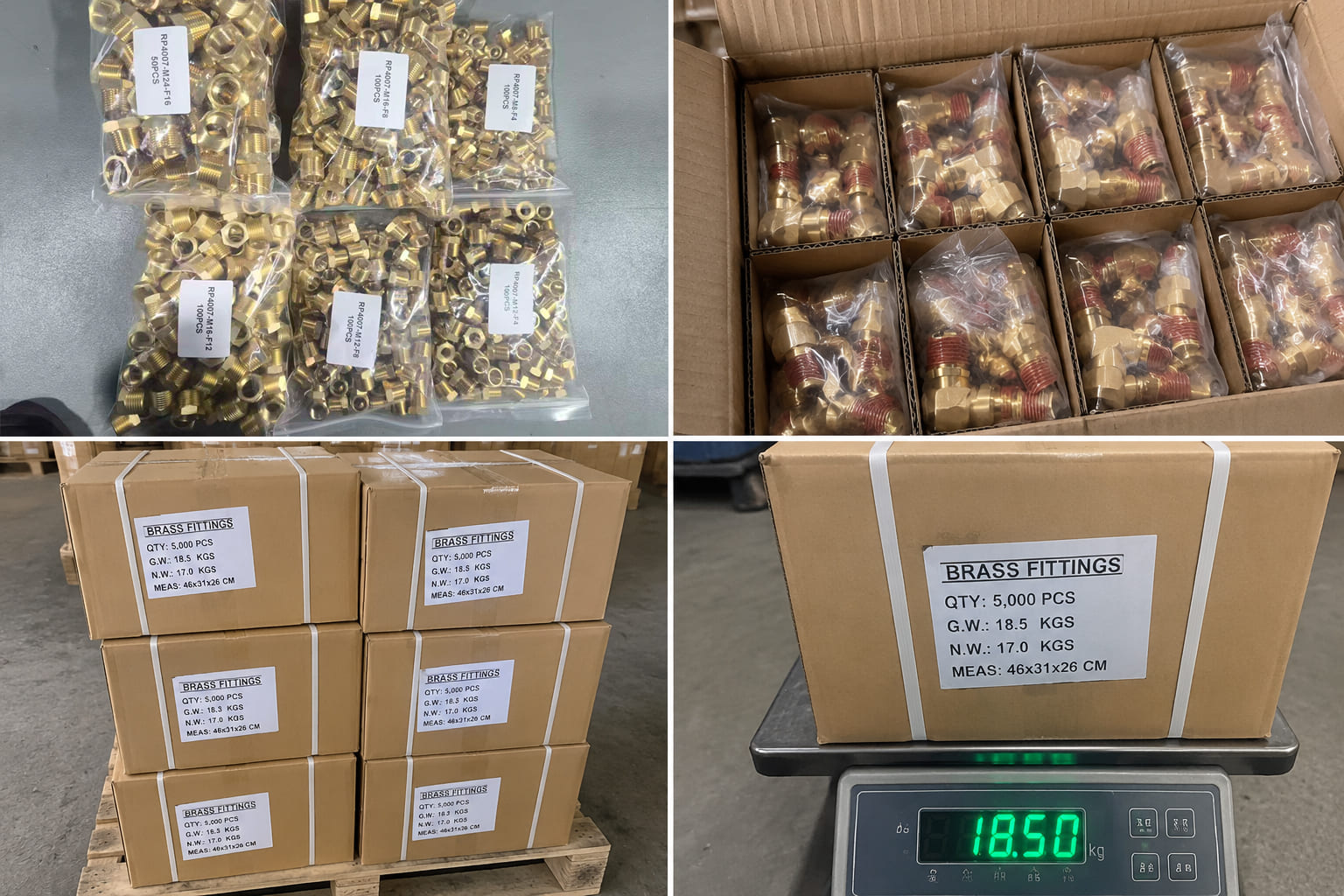
Knowing the definition is the easy part. The harder part is building the actual number from the variables that matter for brass fittings orders specifically — weight, MOQ, mixed SKUs, packaging dimensions, and trade-term inclusions. The sections below walk through each one.
Why Is FOB Price Alone a Misleading Comparison?
Buyers frequently send us a competitor's FOB price and ask whether we can match it. The problem is that FOB unit price is not total landed cost — it is only the starting point.
FOB price tells you what you pay until the goods cross the ship's rail at the origin port.2 Everything after that — ocean or air freight, insurance, destination port handling, customs clearance, inland delivery, duties, and taxes — sits outside the FOB quotation. Two suppliers with the same FOB price can produce very different landed costs depending on packaging efficiency, carton weight, and order volume.
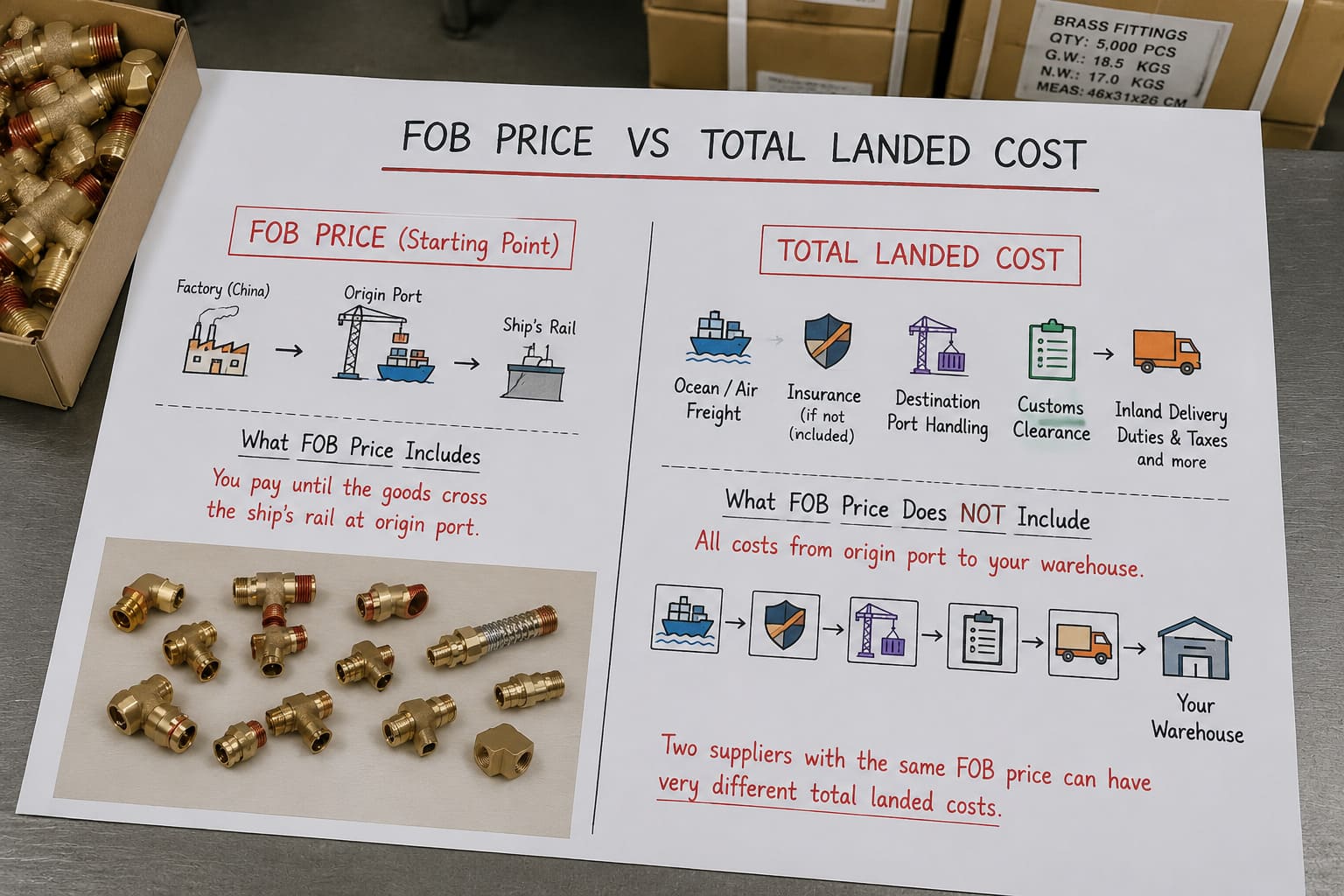
When you standardize your comparison to landed cost per unit, you are comparing what you actually pay to get the product into your warehouse — not just what you pay to get it onto a ship.
The Real Quotation-Comparison Problem
When distributors or repair shop owners ask me to compare our quotation against another supplier's, I always ask the same first question: what trade term is each quotation under? If one quote is FOB Shanghai and another is CIF Los Angeles, they are not comparable without adjustment.3 You need to bring both to the same cost boundary before drawing any conclusion.
Here is a practical reframe: treat every supplier quotation as a partial number, and your job is to complete it.
The cost components you need to complete any FOB quotation:
- Ocean or air freight (origin port to destination port or airport)
- Origin charges: documentation, export customs clearance, container loading, and local transport to port
- Insurance (if not included)
- Destination port handling: arrival charges, terminal handling, port fees
- Customs clearance brokerage fee
- Import duties and taxes (varies by HS code, destination country, and trade agreements — verify with your broker)
- Inland freight from port to your warehouse
- Any inspection or compliance fees specific to your market
For brass fittings — small, dense, metal parts — freight cost per kilogram can look low, but carton quantities and gross weight per shipment can still add up fast, especially for mixed SKU orders at MOQ levels.
Why Brass Fittings Specifically Require Weight-Volume Attention
Brass fittings are volumetrically compact but relatively heavy. That combination affects freight pricing in specific ways:
| Shipment Mode | Pricing Basis | Implication for Brass Fittings |
|---|---|---|
| Ocean FCL (full container) | Fixed container rate | Best for large volume; weight rarely limits a 20' or 40' container for brass parts |
| Ocean LCL (less than container) | CBM (cubic meters) or gross weight, whichever is higher4 | Brass fittings are usually weight-rated; packaging efficiency matters |
| Air freight | Chargeable weight (actual vs. volumetric)5 | Actual weight typically governs; air is expensive for heavy fittings |
| Courier / Express | Dimensional or actual weight | Usually only viable for samples or very small trial orders |
If you are ordering mixed SKUs at MOQ quantities — say, a small batch of brass push-in fittings, elbow connectors, and nipple adapters for truck air lines — the shipment is likely LCL. In that scenario, your freight cost depends on the combined gross weight and carton dimensions, not just unit price.
How Do FOB, CIF, and DDP Affect Your Total Landed Cost Calculation?
From our experience responding to quotation requests, buyers often ask us to quote all three terms so they can compare. That is a smart move — but only if you understand what each term includes and excludes.
FOB, CIF, and DDP represent different points at which cost responsibility transfers from seller to buyer. They are not quality tiers — they are different levels of cost visibility and buyer control. FOB gives the buyer full freight control and market access. CIF bundles freight and insurance but can obscure the actual shipping cost. DDP offers convenience and predictability but transfers freight decisions to the seller.
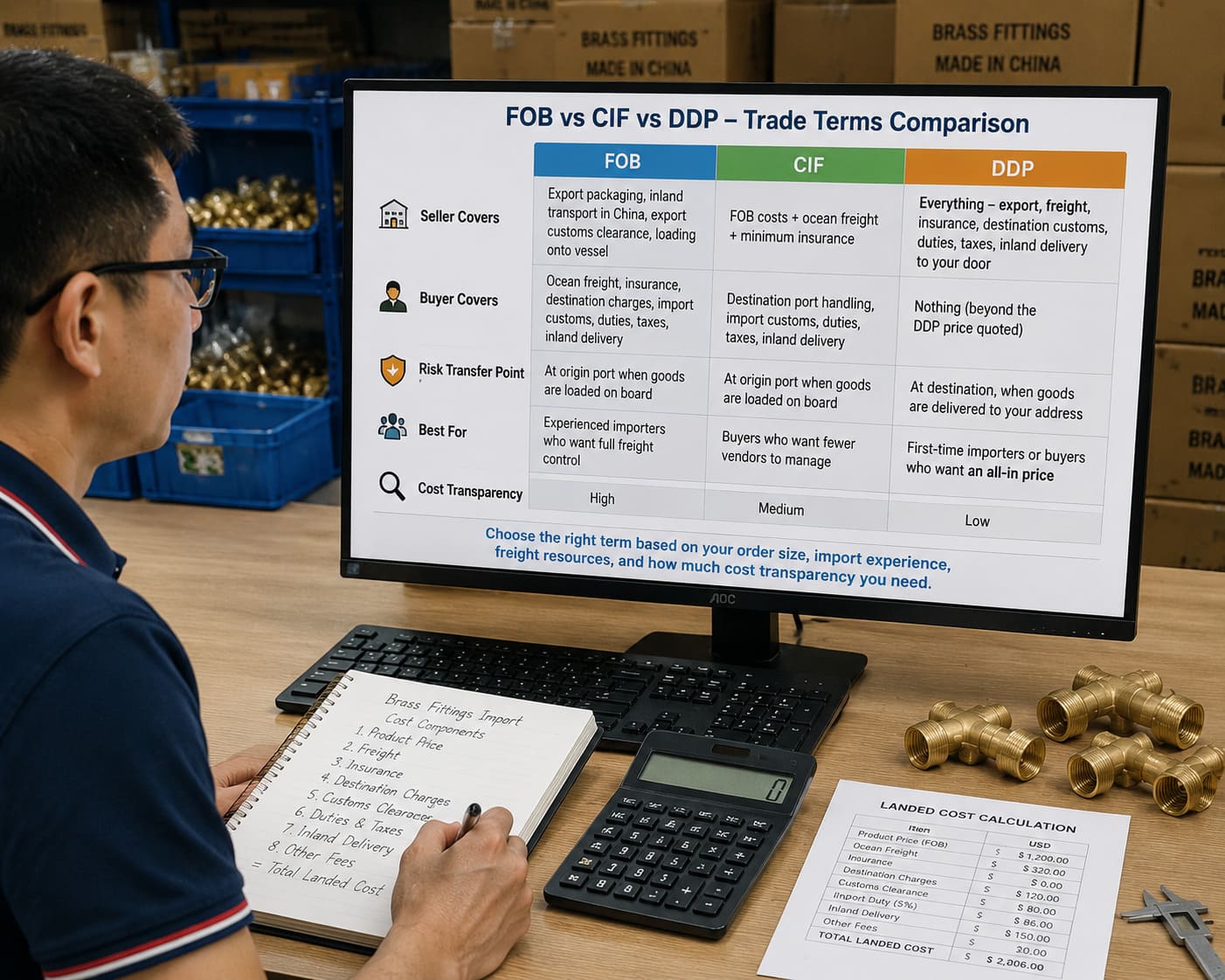
The right term depends on your order size, import experience, relationships with freight forwarders, and how much cost transparency you want.
Breaking Down Each Trade Term for Brass Fittings Buyers
FOB (Free On Board — Origin Port)
- Seller covers: export packaging, inland transport in China, export customs clearance, and loading onto the vessel
- Buyer covers: everything from the ship's rail forward — ocean freight, insurance, destination port charges, import customs, duties, taxes, and inland delivery
- Best for: experienced importers with established freight forwarder relationships who want to control freight costs and select their own carriers
- Landed cost transparency: high — you know every cost component
CIF (Cost, Insurance, and Freight — Destination Port)
- Seller covers: FOB costs plus ocean freight and a minimum insurance premium
- Buyer covers: destination port handling, import customs clearance, duties, taxes, and inland delivery
- Risk transfers to buyer at origin port despite the seller paying freight
- Best for: buyers who want to reduce the number of vendors to manage, or who are unfamiliar with China freight rates
- Landed cost transparency: medium — the freight line is bundled and may not reflect market rates
One thing we always clarify with buyers: under CIF, the seller buys the insurance and freight, but the goods travel at the buyer's risk from the port of origin onward.6 If something goes wrong at sea, the buyer files the insurance claim — not the seller. Many first-time importers do not realize this.
DDP (Delivered Duty Paid — Buyer's Named Address)
- Seller covers: everything — export, freight, insurance, destination customs clearance, import duties and taxes, and inland delivery to your door7
- Buyer covers: essentially nothing beyond the DDP price quoted
- Best for: buyers who want a single all-in price, first-time China importers, or situations where the order is small and managing logistics separately is not worth the effort
- Landed cost transparency: low from a learning standpoint — you see one number but do not see the breakdown
Choosing the Right Trade Term for Your Situation
| Your Situation | Recommended Approach |
|---|---|
| Large annual volume, established freight forwarder | FOB — maximize cost control and freight market access |
| Mid-size orders, some import experience | FOB or CIF — ask for both and compare |
| First import from China, small order | DDP — simplicity outweighs cost optimization |
| Mixed SKU, small batch, multiple suppliers | FOB and consolidate with your forwarder |
| South America, complex customs environment | Consider DDP or CIF with a trusted local broker |
None of these is universally correct. The best term is the one that matches your order reality, your import infrastructure, and how much cost transparency you need.
What Variables Drive Freight Cost for Brass Fittings Orders?
Freight cost is the component most buyers underestimate when they first import brass fittings from China. It is also the component most directly connected to how your order is packaged and shipped.
For brass fittings, freight cost is driven by gross weight, carton dimensions, shipment mode, origin port, destination port, and total order volume. Because fittings are small and dense, LCL ocean freight is typically the relevant scenario for orders below full-container quantities. Packaging decisions — inner boxes, master cartons, pallet configuration — directly affect the chargeable weight and therefore the freight rate.
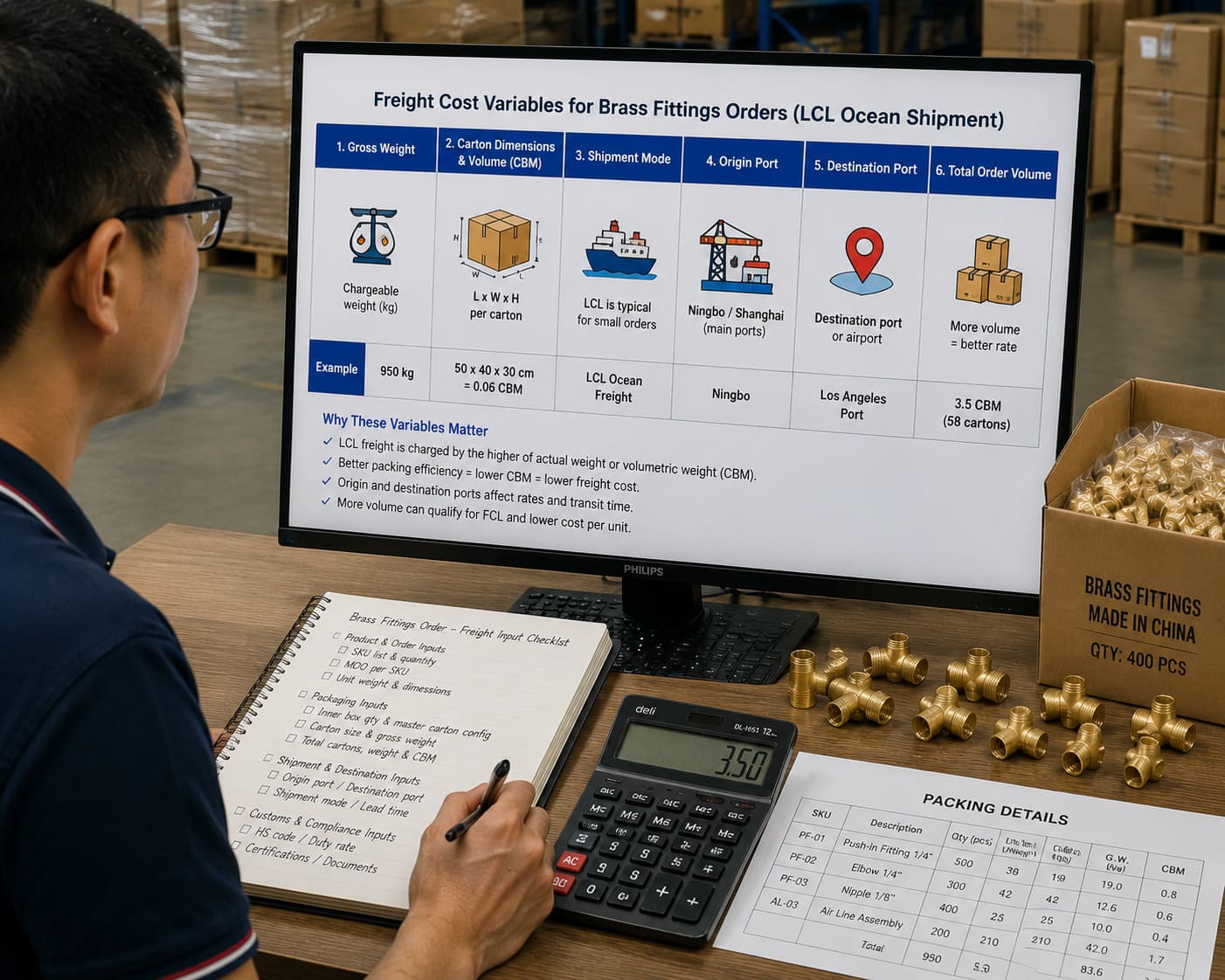
When buyers ask us for a freight estimate before placing an order, we ask for the following before we can provide any number.
The Packing and Freight Input Checklist
Before you can estimate freight for a brass fittings order, you need to know or confirm:
Product and order inputs:
- [ ] Product type and SKU list (push-in fittings, nipples, elbows, adapters, etc.)
- [ ] Quantity per SKU
- [ ] MOQ per SKU and whether it triggers mixed-carton packing
- [ ] Unit weight and dimensions (usually provided on the product datasheet)
Packaging inputs:
- [ ] Inner packaging quantity (units per inner box or bag)
- [ ] Master carton configuration (inner boxes per master carton)
- [ ] Master carton gross weight and dimensions (L × W × H in cm)
- [ ] Total number of cartons
- [ ] Total gross weight and total volume (CBM)
Shipment and destination inputs:
- [ ] Origin port (typically Ningbo or Shanghai for ROADSPOWER orders)
- [ ] Destination port or airport
- [ ] Final delivery address (if inland freight is included)
- [ ] Preferred shipment mode (LCL, FCL, air, or courier for samples)
- [ ] Required lead time
Customs and compliance inputs:
- [ ] HS code for the product (verify with your broker)
- [ ] Applicable import duty rate (verify with your broker by destination country)
- [ ] Any required certifications, test reports, or customs documents
- [ ] Whether your country has any trade agreements with China that affect duty rates
Important: We can help buyers understand our product packing specifications and origin-side costs. However, import duty rates, tax classifications, and customs compliance in the destination country must be verified with a licensed customs broker or freight forwarder in your country. Rates and requirements vary by HS code, country, and can change.
Why Mixed SKU Orders Complicate Freight Estimation
Many of our buyers order across product lines — brass fittings alongside air line kits or other truck accessories. Mixed SKU orders introduce complexity:
- Different unit weights and dimensions per SKU mean you cannot use a single carton spec to estimate total shipment weight and volume
- MOQ per SKU may result in partial cartons, which affects carton count and packing efficiency
- HS code differences between product types mean different duty rates may apply to different line items in the same shipment
For a distributor ordering 500 pieces of brass push-in fittings and 200 air line assemblies in the same shipment, the freight calculation requires packaging detail for each product line before a reliable landed cost can be built.
What Destination Charges Are Easy to Overlook?
Most buyers account for ocean freight and import duties. Fewer account for the full list of destination charges that accumulate between the vessel arriving and the product reaching their warehouse.
Destination charges are the fees assessed at or after the port of arrival, including terminal handling, port congestion surcharges, customs examination fees, brokerage fees, and inland delivery costs.8 For brass fittings importers in North and South America, these charges are real, variable, and can represent a meaningful portion of total landed cost on small and mid-size orders.
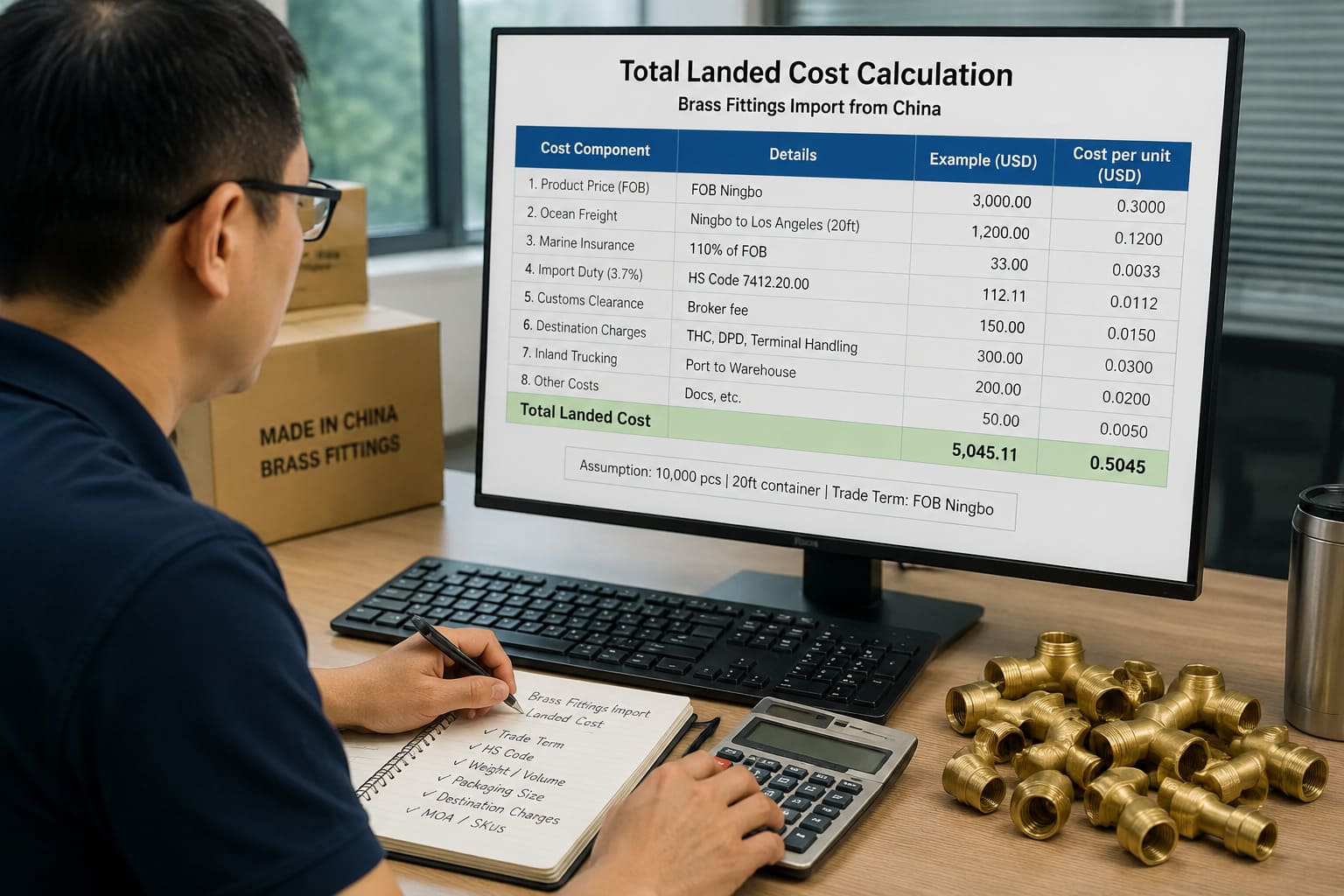
Common Destination Charges to Account For
At the destination port:
- Destination terminal handling charge (DTHC)
- Port congestion surcharge (seasonal and variable)
- Customs examination or X-ray fee (if selected for inspection)
- Harbor maintenance fee (U.S.-specific; applies to most ocean shipments)9
Customs clearance:
- Customs broker fee (charged per entry or per shipment)
- ISF filing fee (U.S.-specific; Importer Security Filing, required before vessel departure)10
- Customs bond cost (annual continuous bond or single-entry bond; U.S.-specific)
- Duties calculated on customs value — rate varies by HS code and destination country; verify with your broker
Inland delivery:
- Drayage from port to local warehouse or distribution point
- Delivery appointment fees (if applicable at your warehouse)
- Liftgate or inside delivery charges
For buyers in South America, additional considerations include:
- Import licensing requirements in some countries
- Value-added tax (VAT or equivalent) applied at import
- Country-specific documentation requirements (commercial invoice format, packing list requirements, certificate of origin)
These items are not optional and they are not always predictable. Building a conservative buffer into your landed cost estimate — and confirming actual rates with a licensed broker in your country — is the only reliable approach.
Frequently Asked Questions
What is a good target ratio between product cost and total landed cost for brass fittings?
There is no universal ratio, because it depends heavily on shipment mode, order volume, destination country, and applicable duty rates. For small LCL ocean shipments, total landed cost can easily be 30–60% above FOB value once freight, duties, and destination charges are included.11 Larger FCL orders tend to have better freight economics per unit.
Should I ask my China supplier to quote DDP so I can avoid dealing with customs?
DDP simplifies the process, but it reduces your visibility into cost components. For recurring orders, it is usually worth learning the FOB landed cost breakdown so you can benchmark your supplier's bundled DDP pricing and negotiate more effectively over time. For a first order, DDP can be a reasonable starting point.
How does MOQ affect my freight cost per unit for brass fittings?
Lower MOQ means fewer units spreading the fixed freight and destination charges. For small orders shipped LCL, freight and destination fees per unit can be disproportionately high. If your order volume allows it, consolidating SKUs into a single larger shipment — or coordinating with other buyers through a freight forwarder — typically improves the landed cost per unit.
What HS code do brass fittings typically fall under?
Brass fittings for pneumatic systems often fall under HS Chapter 74 (copper and articles thereof) or Chapter 84 (machinery and mechanical appliances), depending on product function and construction. The correct HS code affects your duty rate significantly. Always confirm the applicable HS code and duty rate with a licensed customs broker in your destination country before finalizing landed cost estimates.
Can ROADSPOWER help me estimate landed cost before I place an order?
We can provide full FOB pricing, packing specifications (carton weight, dimensions, units per carton), and origin-side cost detail. We can also quote CIF or DDP for your destination if that is helpful for comparison. Destination duties, taxes, and customs compliance decisions should be confirmed with your broker, but we are glad to support the product and logistics side of the calculation.
Conclusion
Total landed cost for brass fittings imports from China is not a single number on a quotation — it is the sum of product price, trade-term-specific inclusions, freight, destination charges, duties, and taxes. Calculating it accurately requires knowing your supplier's trade term, your shipment mode, your packaging specs, and your destination-specific cost environment. Comparing suppliers on FOB unit price alone will consistently produce misleading conclusions.
The right trade term — FOB, CIF, or DDP — depends on your import experience, order size, and how much cost control and transparency you want. Freight cost for brass fittings is weight-driven and sensitive to packaging efficiency and mixed SKU configuration. Destination charges and import duties are real and must be verified with a licensed broker for your specific HS code and country.
If you are sourcing brass fittings or related truck aftermarket parts and want help building a realistic landed cost estimate, send us your order details — product list, quantities, destination port or address, and preferred trade term. We will break down the FOB price, packing specifications, and available shipping options so you have the inputs you need to complete the calculation.
"Duty, Taxes and other Fees required to import goods into the United States", https://www.help.cbp.gov/s/article/Article-1225?language=en_US. A trade or customs reference defining landed cost supports the article's treatment of landed cost as the full import cost beyond the supplier's product price, including freight, insurance, duties, taxes, and customs-related charges. Evidence role: definition; source type: institution. Supports: A neutral trade or customs source should define landed cost as an aggregate of product value, transportation, insurance, duties, taxes, and import-related charges.. Scope note: The source may define landed cost generally rather than specifically for brass fittings imported from China. ↩
"Know Your Incoterms", https://www.trade.gov/know-your-incoterms. The International Chamber of Commerce's Incoterms explanation of FOB supports the article's point that FOB covers seller obligations up to loading on board at the origin port, after which main carriage and import-side costs are normally borne by the buyer. Evidence role: definition; source type: institution. Supports: An Incoterms source should explain that FOB requires the seller to deliver goods on board the vessel at the named port of shipment and that costs and risks are allocated from that delivery point.. Scope note: The current Incoterms formulation uses delivery 'on board the vessel' rather than the older 'ship's rail' terminology. ↩
"Know Your Incoterms", https://www.trade.gov/know-your-incoterms. Incoterms guidance comparing FOB and CIF supports the need to normalize quotations because CIF includes main carriage and minimum insurance while FOB does not. Evidence role: general_support; source type: institution. Supports: An Incoterms comparison should show that FOB and CIF assign freight, insurance, and post-shipment costs differently, making unadjusted quotations non-equivalent.. Scope note: The source establishes the trade-term cost boundaries; it does not calculate the brass-fitting-specific price difference between the two quotations. ↩
"Shivam Karale's Post", https://www.linkedin.com/posts/shivam-karale-_why-1-cbm-1000-kg-isnt-what-you-activity-7392102168490647553-Xq-L. A freight-pricing reference explaining LCL weight-or-measure charges supports the article's statement that LCL ocean freight can be rated by cubic volume or gross weight, whichever produces the chargeable basis. Evidence role: mechanism; source type: institution. Supports: A freight or logistics reference should explain weight-or-measure pricing for less-than-container-load ocean cargo.. Scope note: The source would describe standard rating practice; actual carrier tariffs and forwarder quotes can vary by lane and contract. ↩
"Air cargo chargeable weight calculation explained", https://www.maersk.com/logistics-explained/transportation-and-freight/2025/03/10/air-cargo-chargeable-weight. An air-cargo reference defining chargeable weight supports the article's description of air freight pricing as a comparison between actual weight and volumetric weight. Evidence role: definition; source type: institution. Supports: An air-cargo source should define chargeable weight as the greater of actual and volumetric weight for freight rating purposes.. Scope note: The source explains the pricing concept generally and does not establish the specific air-freight rate for brass fittings. ↩
"Know Your Incoterms", https://www.trade.gov/know-your-incoterms. Incoterms guidance on CIF supports the article's statement that the seller pays for freight and insurance but risk transfers to the buyer when the goods are delivered on board the vessel at the port of shipment. Evidence role: definition; source type: institution. Supports: An Incoterms source should confirm that CIF obliges the seller to arrange carriage and insurance while risk transfers to the buyer at shipment.. Scope note: The source defines default Incoterms allocation and does not address any modified contractual terms agreed by specific parties. ↩
"Know Your Incoterms", https://www.trade.gov/know-your-incoterms. Incoterms guidance on Delivered Duty Paid supports the article's description of DDP as assigning the seller responsibility for delivery to the named destination, including import clearance and payment of duties and taxes. Evidence role: definition; source type: institution. Supports: An Incoterms source should confirm that DDP places export, carriage, import clearance, and duty/tax responsibility primarily on the seller up to the named place of destination.. Scope note: The source states the default Incoterms allocation; local legal restrictions or contract modifications may affect whether a seller can practically act as importer of record. ↩
"Shipped a container and I have questions about ...", https://www.reddit.com/r/shipping/comments/7x32e4/shipped_a_container_and_i_have_questions_about/. A neutral import-logistics reference describing destination charges supports the article's classification of terminal handling, customs examination, brokerage, and inland delivery as post-arrival import costs. Evidence role: general_support; source type: institution. Supports: A port, customs, or freight reference should identify common post-arrival charges such as terminal handling, examination, brokerage, and inland transport.. Scope note: The source would support the categories of charges but not their amount or frequency for a particular shipment lane. ↩
"What is The Harbor Maintenance Fee (HMF)? - help.CBP.gov", https://cbpcomplaints.cbp.gov/s/article/Article-1105?language=en_US. U.S. Customs and Border Protection guidance on the Harbor Maintenance Fee supports the article's statement that this is a U.S.-specific charge associated with most commercial ocean import entries. Evidence role: definition; source type: government. Supports: A U.S. government source should explain the Harbor Maintenance Fee and its application to imported commercial cargo arriving by vessel.. Scope note: The source addresses U.S. imports only and does not apply to destination charges in other countries. ↩
"Import Security Filing (ISF) - When to submit to CBP", https://www.help.cbp.gov/s/article/Article-1868. U.S. Customs and Border Protection's Importer Security Filing guidance supports the article's statement that ISF is a U.S.-specific pre-arrival filing requirement for vessel shipments. Evidence role: definition; source type: government. Supports: A U.S. Customs and Border Protection source should confirm that ISF applies to U.S.-bound vessel cargo and must generally be submitted before cargo is laden aboard the vessel.. Scope note: The source establishes the regulatory filing requirement but does not prove the amount of any broker or forwarder filing fee. ↩
"Duty - Cost Insurance and Freight (CIF) - help.CBP.gov", https://www.help.cbp.gov/s/article/Article1126. Research on international transport costs and import charges can contextualize the article's estimate that small shipments may have landed costs substantially above FOB value once freight, duties, and destination fees are included. Evidence role: statistic; source type: research. Supports: A research or institutional source should provide data on how freight, duties, and import charges can raise landed costs relative to product value, especially for smaller shipments.. Scope note: The support is likely contextual rather than direct proof of the specific 30–60% range for brass fittings; the percentage will vary by route, order size, duty rate, and carrier charges. ↩