When a fleet manager or repair shop owner first considers switching from OEM to aftermarket semi-truck air power lines, the fear of a roadside failure is real. One bad hose can cascade into brake system trouble, unscheduled downtime, and angry customers.1 The market is flooded with options, and it’s easy to pick the wrong one.
Aftermarket semi-truck air power lines can deliver equal or better performance and service life2 when manufactured under strict quality control, material traceability, and performance testing — often at a lower total cost of ownership than OEM lines.
But the real difference isn’t the label; it’s the supplier’s production discipline. Let’s break down the factors that matter.
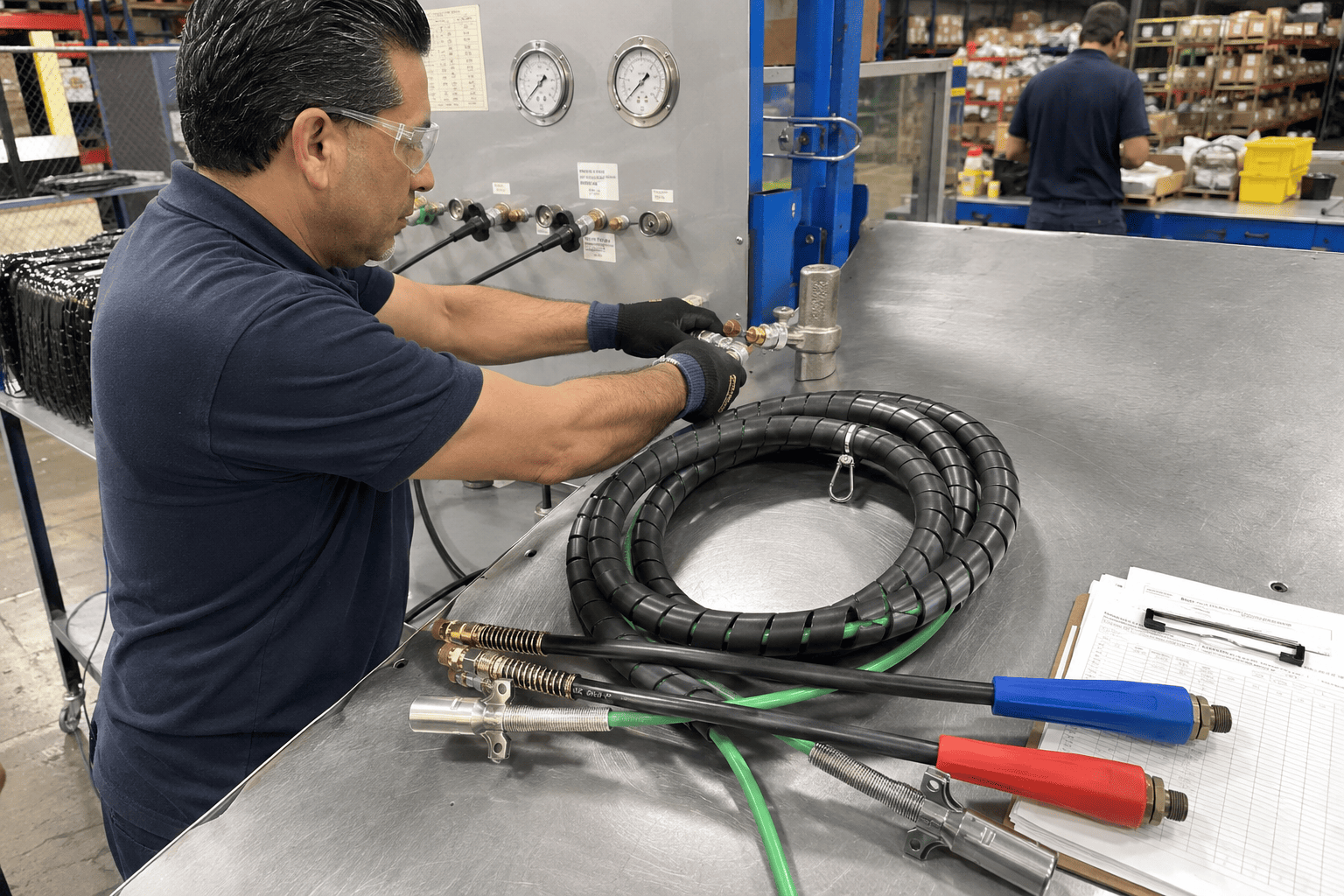
Seen from the parts counter or the shop floor, the “OEM vs. aftermarket” debate often sounds like a choice between safety and savings. That framing misses the point. The question isn’t whether to buy aftermarket — it’s how to buy aftermarket without bringing in hidden quality risks. I’ve walked through enough production lines and testing labs to know that the answer lies in a handful of verifiable supplier practices.
What Really Separates OEM and Aftermarket Semi-Truck Air Power Lines?
The assumption that OEM always means better is a shortcut that can cost you money. But the opposite belief — that all aftermarket lines are the same — is even more dangerous. The real gap sits between suppliers who control every production step and those who cut corners on materials or testing.
The key separators are material quality, fitting precision, and consistency of performance testing3, not the brand name on the box.
Material Composition and Brass Fittings
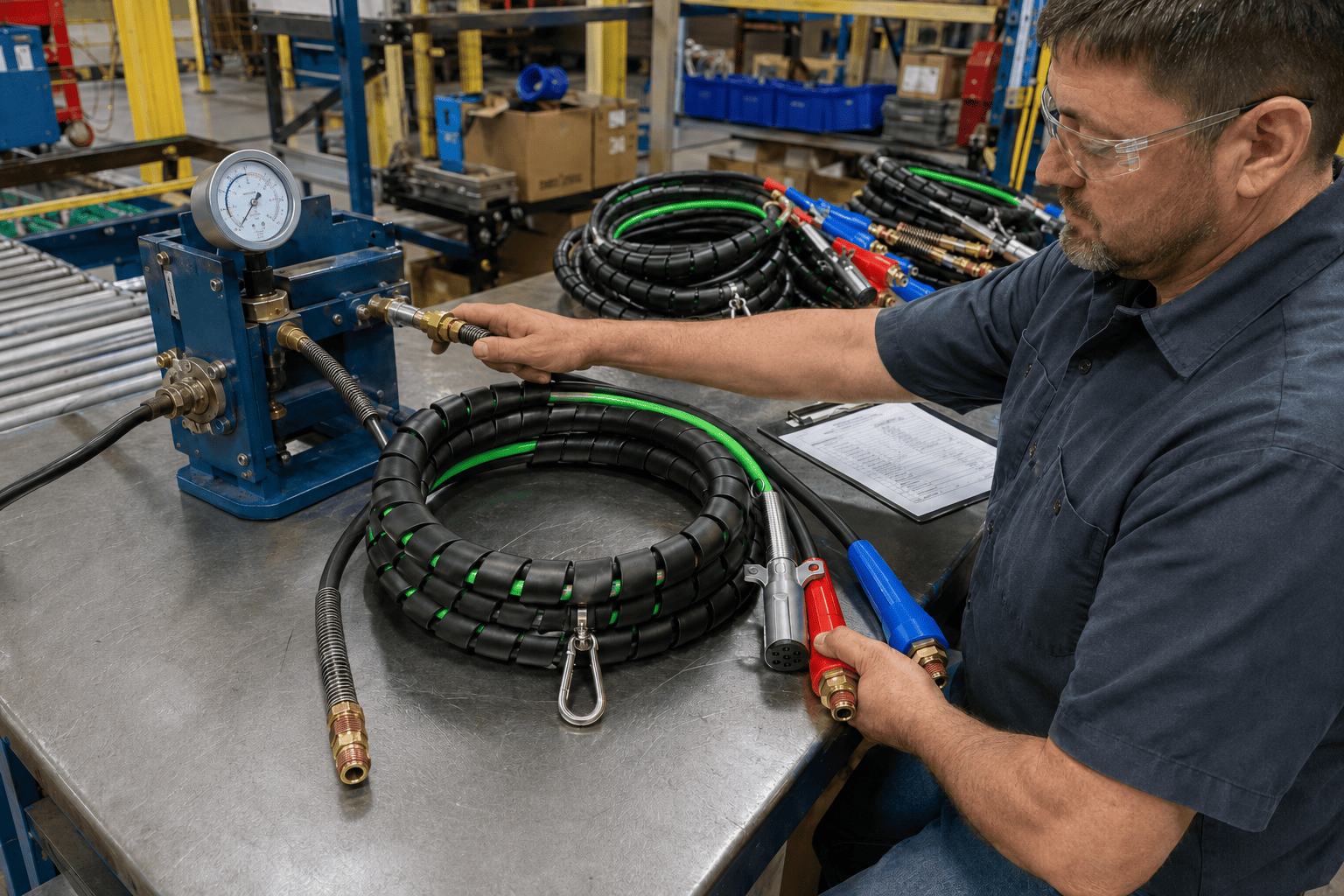
OEM specifications usually call for specific rubber compounds, reinforcement layers, and brass alloy grades4. A disciplined aftermarket manufacturer can match or exceed those material requirements. The challenge is that many small aftermarket suppliers use generic materials that degrade faster. At ROADSPOWER, we inspect every incoming batch of copper, rubber, and metal with compliance certificates before it ever touches a production line. That’s not optional — it’s a business defense. I’ve seen a distributor’s entire shipment returned because the brass fittings developed stress cracks after just a few months on the road. The root cause wasn’t a design flaw; it was substandard raw material that nobody checked.
When you compare air power lines, look for:
- Rubber compounds rated for high-temperature and low-temperature cycles without cracking.
- Reinforcement layers that prevent kinking and bursting under pressure.
- Brass fittings that meet ASTM or similar standards for corrosion resistance and thread integrity.
A simple table can help you visualize what separates a well-built aftermarket line from a generic one:
| Feature | Quality Aftermarket Line | Low-Cost Generic Line |
|---|---|---|
| Rubber compound | Formulated per SAE J1402 and temperature profiles | Basic EPDM or unknown blend |
| Reinforcement | Multiple textile or synthetic plies | Single or minimal reinforcement |
| Brass fitting alloy | ASTM B16 or equivalent, corrosion-resistant | Unknown alloy, may contain excessive zinc |
| Air tightness test | 100% tested at final assembly | Sample or no test |
| Batch traceability | Raw material lots mapped to finished goods | No traceability |
Performance Testing and Batch Consistency
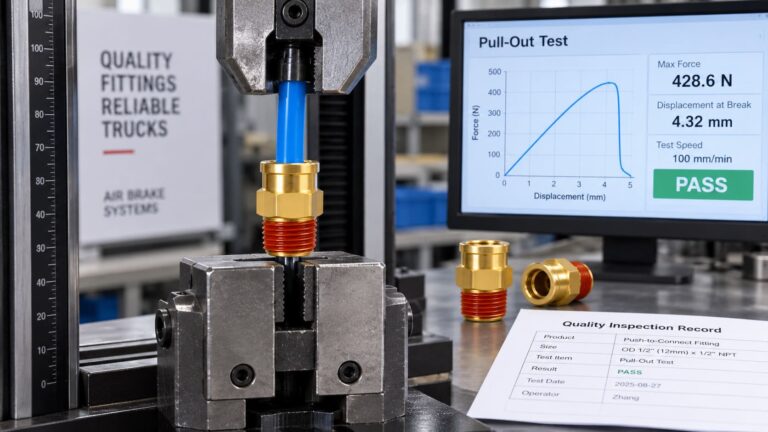
OEMs invest heavily in validation testing. A credible aftermarket supplier must replicate that discipline. The tests that matter most for air power lines are air tightness, tensile strength, temperature resistance, and pressure cycling.5 At ROADSPOWER, we perform multi-node in-process sampling and document every result. The final inspection includes 100% air tightness testing on key products, and we use AQL sampling before warehousing. These aren’t just paperwork exercises — they directly reduce the risk of a line failing under a truck on a hot highway or a freezing mountain pass.
I recall a fleet manager who told me he stopped buying aftermarket lines because every third hose seemed to leak within a year. After walking him through our inspection records and showing him the test setups, he realized the problem wasn’t “aftermarket” — it was the supplier he’d been using. Consistent batch testing is the only way to ensure that the line you ship today performs the same as the one you shipped six months ago.
How Does Material Quality Affect Service Life of Semi-Truck Air Power Lines?
A common failure mode I see in warranty returns is a hose that looks fine on the outside but has developed micro-cracks near the fittings or along the bend radius. Those cracks are rarely caused by a single event — they’re the slow accumulation of heat, pressure cycles, and abrasion.
Material quality determines resistance to heat, abrasion, and pressure cycles6, directly impacting how long an air power line lasts before it needs replacement.
What Shortens Service Life in the Real World?
Service life is never a fixed number. A line that runs 300,000 miles on a line-haul truck in moderate climates might fail at 150,000 miles on a dump truck that sees constant heat and vibration. But the materials you choose can shift that curve dramatically. Here’s what accelerates wear:
- High-temperature exposure — rubber compounds not rated for sustained 200°F+ environments harden and crack7.
- Pressure cycling — repeated inflation and deflation of the air system fatigues the hose wall8.
- Abrasion — routing that rubs against frame rails or other components wears through the outer cover.
- Corrosion — brass fittings with low dezincification resistance can become brittle and leak9.
A quality aftermarket air power line uses materials engineered to handle these stresses. At ROADSPOWER, we test for temperature resistance and pressure cycling on every product line before full-scale production. We also document the rubber compound specifications so that replacement orders remain consistent over time. That consistency is what keeps a fleet’s maintenance schedule predictable.
The Role of Assembly and Curing
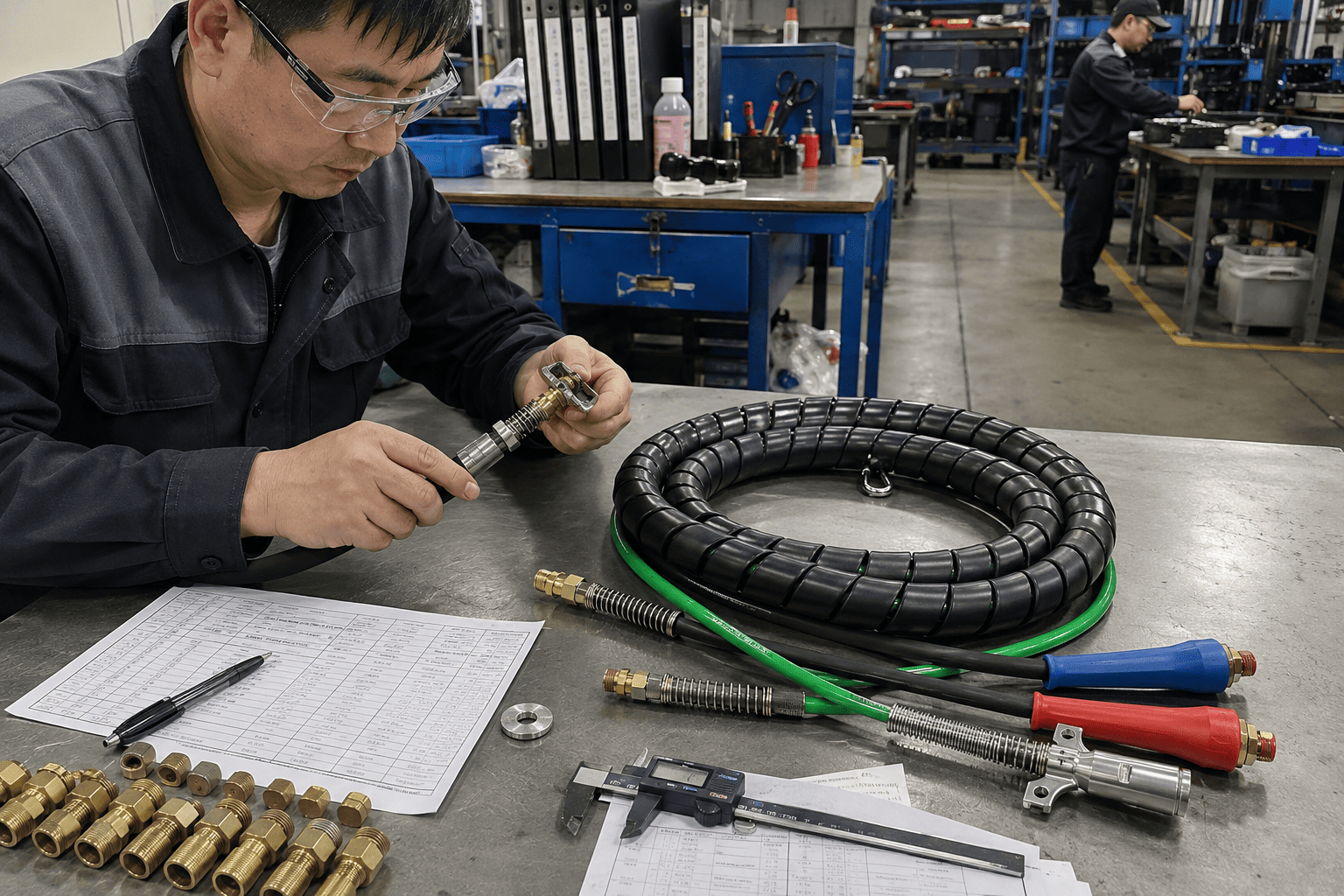
Even the best materials can fail if the assembly process is sloppy. The bond between the hose and the fitting must be uniform and strong. I’ve inspected lines where the crimp was uneven, creating a stress point that eventually leaked. The difference between a line that lasts and one that gets returned is often in the details of how the brass fitting is inserted and secured. Our in-house assembly lines use standardized torque and crimp settings, and we sample-test tensile strength at the connection point. That’s not a universal practice in the aftermarket, but it’s essential for service life.
-
What Is the True Cost of Failure for Low-Quality Semi-Truck Air Power Lines?
When a distributor tells me they’re buying the cheapest air line they can find, I don’t argue about price. I ask them to add up the costs of a single returned part. The math usually changes their mind.
A single air line failure can cost a fleet hundreds in towing and labor, plus lost revenue, while a distributor faces returns, shipping, and reputation damage.
Breaking Down the Hidden Costs
The unit price of a low-cost air line is seductive. But the total ownership cost often tells a different story. Consider these real-world expenses:
- Fleet downtime: A roadside air leak can mean a tow bill of $500–$1,500 and a few hours of lost revenue.10 For a refrigerated load, the cost multiplies.
- Labor for rework: A repair shop that installs a defective line has to do the job twice. The second time, the customer isn’t paying.
- Returns and shipping: A distributor that ships a bad line to a shop pays for return freight, restocking, and possibly a credit. Margins evaporate.
- Inventory write-offs: A batch of lines that all fail prematurely may sit unsold or get scrapped, turning a “good deal” into a loss.
- Reputation damage: A fleet that experiences repeated failures will stop calling that parts supplier. In the heavy-duty aftermarket, trust is everything.
I’ve worked with distributors who switched to a higher-quality aftermarket line and saw their return rate drop from 5% to under 0.5%. The savings from fewer returns and happier customers far outweighed the small increase in unit cost. That’s the difference between a price mentality and a cost mentality.
How a Quality Supplier Changes the Equation
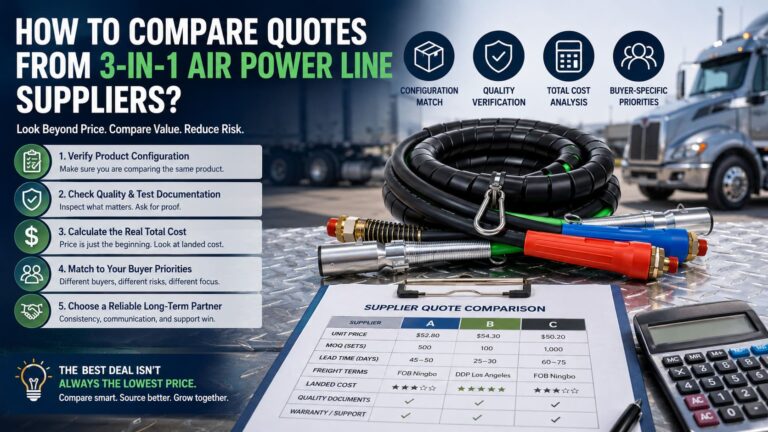
A supplier that invests in testing and process control absorbs some of the failure risk before the product ever ships. That means you, as the buyer, carry less risk. When we at ROADSPOWER pre-position safety stock for large-volume orders and maintain flexible MOQ for urgent needs, we’re not just offering convenience — we’re reducing the cost of stockouts and last-minute scrambles. That’s part of the total cost picture too. A reliable supply chain with consistent quality means you can plan inventory, reduce expedited shipping, and keep your own customers’ trucks on the road.
Frequently Asked Questions
Can aftermarket semi-truck air power lines meet DOT and SAE standards?
Yes, a properly manufactured aftermarket air power line can fully comply with DOT FMVSS regulations and SAE J1402 or J844 standards. The key is that the supplier actually performs the required testing and maintains material traceability. Certifications alone don’t ensure compliance; consistent process control does.
How do I identify a reliable aftermarket air line supplier without visiting the factory?
Ask for documented test reports, material certifications, and batch traceability records. A supplier that hesitates or can’t provide these likely doesn’t have a robust quality system. You can also request a small trial order and inspect the product’s fit, finish, and packaging before committing to volume.
What is the typical service life of a quality aftermarket air power line?
There is no single number because service life depends on application, climate, maintenance, and routing. However, a well-built line using high-grade materials and proper fittings can last as long as the OEM equivalent under comparable conditions. Avoid suppliers that promise a fixed mileage guarantee; instead, look for material and test data that supports durability.
Are aftermarket air lines compatible with all major truck makes like Freightliner, Kenworth, and Peterbilt?
Many aftermarket air power lines are designed to match OEM specifications for common North American truck models. A capable supplier can provide fitment cross-references or custom configurations based on your sample or drawing. Always confirm the exact part number and fitting dimensions before ordering, especially for specialty applications.
What tests should a supplier perform on air power lines before shipment?
At a minimum, the supplier should conduct air tightness testing, tensile strength testing at the hose-to-fitting connection, temperature resistance verification, and pressure cycling tests. In-process sampling and final inspection according to an AQL plan are also critical to catch defects before products leave the factory.
Conclusion
The choice between OEM and aftermarket semi-truck air power lines isn’t about brand loyalty — it’s about verifying that the product you buy meets the same performance, material, and safety standards. A disciplined aftermarket supplier can deliver cost savings without increasing failure risk, but only if the buyer looks beyond the label and asks the right questions about material quality, testing, and process control. Total cost of ownership, not unit price, should drive the decision. And when you find a supplier that combines consistent quality with flexible supply and responsive support, you strengthen your own business — whether you’re stocking shelves, running a fleet, or turning wrenches in a repair bay.
If you’re sourcing air power lines for your distribution business, repair shop, or fleet, reach out to ROADSPOWER. We can discuss your specific requirements, provide samples and test data, and help you build a reliable supply chain with consistent quality and competitive pricing.
"Air Brake Systems", https://www.fmcsa.dot.gov/sites/fmcsa.dot.gov/files/docs/brake_safety_systems_02-14.pdf. Federal commercial-vehicle inspection and brake-system guidance identifies air leaks and defective brake components as safety-relevant conditions that can remove a vehicle from service, supporting the article’s link between hose failure, brake trouble, and downtime. Evidence role: mechanism; source type: government. Supports: A government or safety source should explain that air leaks or defective brake hoses can impair commercial vehicle brake performance and may lead to service removal or roadside repair.. Scope note: This supports the mechanism and regulatory consequence of air-line failure, but it does not quantify how often such failures occur for the products discussed. ↩
"Federal Motor Vehicle Safety Standards; Brake Hoses", https://www.federalregister.gov/documents/2004/12/20/04-27088/federal-motor-vehicle-safety-standards-brake-hoses. Regulatory and standards-based sources treat replacement brake-hose performance in terms of compliance with specified safety tests rather than OEM branding, providing contextual support for the claim that non-OEM parts can perform adequately when they meet the same requirements. Evidence role: general_support; source type: government. Supports: A neutral source should support that replacement brake hoses or air-brake components can be legally and technically acceptable if they meet applicable safety-performance standards.. Scope note: This would not prove that any specific aftermarket supplier outperforms OEM parts; it only supports the standards-based basis for comparability. ↩
"Federal Motor Vehicle Safety Standards; Brake Hoses", https://www.federalregister.gov/documents/2004/12/20/04-27088/federal-motor-vehicle-safety-standards-brake-hoses. Brake-hose standards such as FMVSS 106 and SAE hose specifications evaluate materials, end fittings, pressure resistance, tensile strength, and environmental durability, supporting the article’s emphasis on material quality, fitting precision, and performance testing. Evidence role: expert_consensus; source type: institution. Supports: A standards or technical source should show that brake-hose requirements cover construction materials, end fittings, pressure resistance, tensile strength, and testing consistency.. Scope note: Standards identify required performance attributes but do not rank these factors as the only or universally most important quality separators. ↩
"Federal Motor Vehicle Safety Standards; Brake Hoses", https://www.federalregister.gov/documents/2004/12/20/04-27088/federal-motor-vehicle-safety-standards-brake-hoses. Technical standards for brake hoses define construction and performance requirements involving hose materials, reinforcement, and end-fitting characteristics, supporting the article’s statement that specifications commonly address these elements. Evidence role: definition; source type: institution. Supports: A standards source should document that brake hoses are specified by construction, reinforcement, end fittings, and performance properties.. Scope note: Such standards support the type of requirements used in compliant hose design, but they may not disclose proprietary OEM material specifications. ↩
"Federal Motor Vehicle Safety Standards; Brake Hoses", https://www.federalregister.gov/documents/2004/12/20/04-27088/federal-motor-vehicle-safety-standards-brake-hoses. SAE and federal brake-hose requirements include pressure integrity, tensile or pull-off strength, and environmental conditioning tests, supporting the article’s identification of leakage, strength, temperature, and pressure cycling as core validation areas. Evidence role: expert_consensus; source type: institution. Supports: A standards source should identify the relevant performance tests for air-brake hoses or tubing.. Scope note: The exact test names and procedures vary by component type, such as rubber brake hose versus nonmetallic air-brake tubing. ↩
"Federal Motor Vehicle Safety Standards; Brake Hoses", https://www.federalregister.gov/documents/2004/12/20/04-27088/federal-motor-vehicle-safety-standards-brake-hoses. Materials-engineering studies of reinforced elastomer hoses show that polymer formulation, reinforcement structure, heat exposure, abrasion, and cyclic loading affect crack growth and service durability, supporting the article’s mechanism-based claim. Evidence role: mechanism; source type: paper. Supports: A peer-reviewed or technical paper should explain how elastomer formulation, reinforcement, and environmental exposure affect hose durability.. Scope note: A general hose-material study may not test the exact semi-truck air power line designs discussed in the article. ↩
"Study on the Mechanical Behavior of Nitrile Rubber Materials Under ...", https://pmc.ncbi.nlm.nih.gov/articles/PMC12941664/. Studies of thermal aging in elastomers report that sustained high-temperature exposure can increase hardness, reduce elongation, and promote cracking, supporting the article’s explanation of heat-related hose degradation. Evidence role: mechanism; source type: paper. Supports: A materials-science paper should show that elevated-temperature aging changes rubber hardness, elasticity, and crack resistance.. Scope note: The cited literature may support the degradation mechanism without validating the article’s specific 200°F threshold for every rubber formulation. ↩
"Hitachi Cable America Consulting Technical Report in ...", https://downloads.regulations.gov/NHTSA-2022-0094-0004/attachment_6.pdf. Research on reinforced elastomer hoses under cyclic internal pressure describes fatigue damage and crack propagation in hose walls, supporting the article’s statement that repeated inflation and deflation can degrade hose structure. Evidence role: mechanism; source type: paper. Supports: A technical paper should explain fatigue of reinforced rubber or polymer hoses under repeated internal pressure cycles.. Scope note: This supports the physical mechanism, but service-life outcomes depend on hose design, reinforcement, operating pressure, and environmental conditions. ↩
"Effects of Alloy, Physical Conditions and Water Chemistry", https://vtechworks.lib.vt.edu/bitstream/handle/10919/36280/Zhang_Y_T_2009.pdf. Corrosion-engineering literature describes dezincification as selective zinc removal from brass that can leave a porous, weakened copper-rich structure, supporting the article’s claim that susceptible brass fittings may become brittle and leak. Evidence role: mechanism; source type: research. Supports: A corrosion research or engineering source should explain dezincification and its effect on brass fitting integrity.. Scope note: The mechanism is well established, but whether it occurs in a given fitting depends on alloy composition, environment, and exposure time. ↩
"An Analysis of the Operational Costs of Trucking: 2023 Update", https://www.ams.usda.gov/sites/default/files/media/FMMO_NMPF_53A.pdf. Fleet operating-cost research and roadside service cost data show that heavy-truck breakdowns can impose towing charges and lost operating time, providing contextual support for the article’s estimate of hundreds to more than one thousand dollars in direct disruption costs. Evidence role: statistic; source type: research. Supports: A neutral fleet-cost source should provide typical heavy-truck towing, roadside repair, or hourly operating-cost figures.. Scope note: The exact cost of a single air-line leak varies by location, vehicle, load, contract terms, and whether towing is required. ↩