Distributors sourcing push-to-connect air fittings often focus on leak performance — and miss the other half of the risk picture. A fitting that holds air pressure at rest can still fail when the tube is pulled under vibration, thermal expansion, or routing stress1. That gap creates returns, warranty claims, and brand exposure that no distributor wants to absorb.
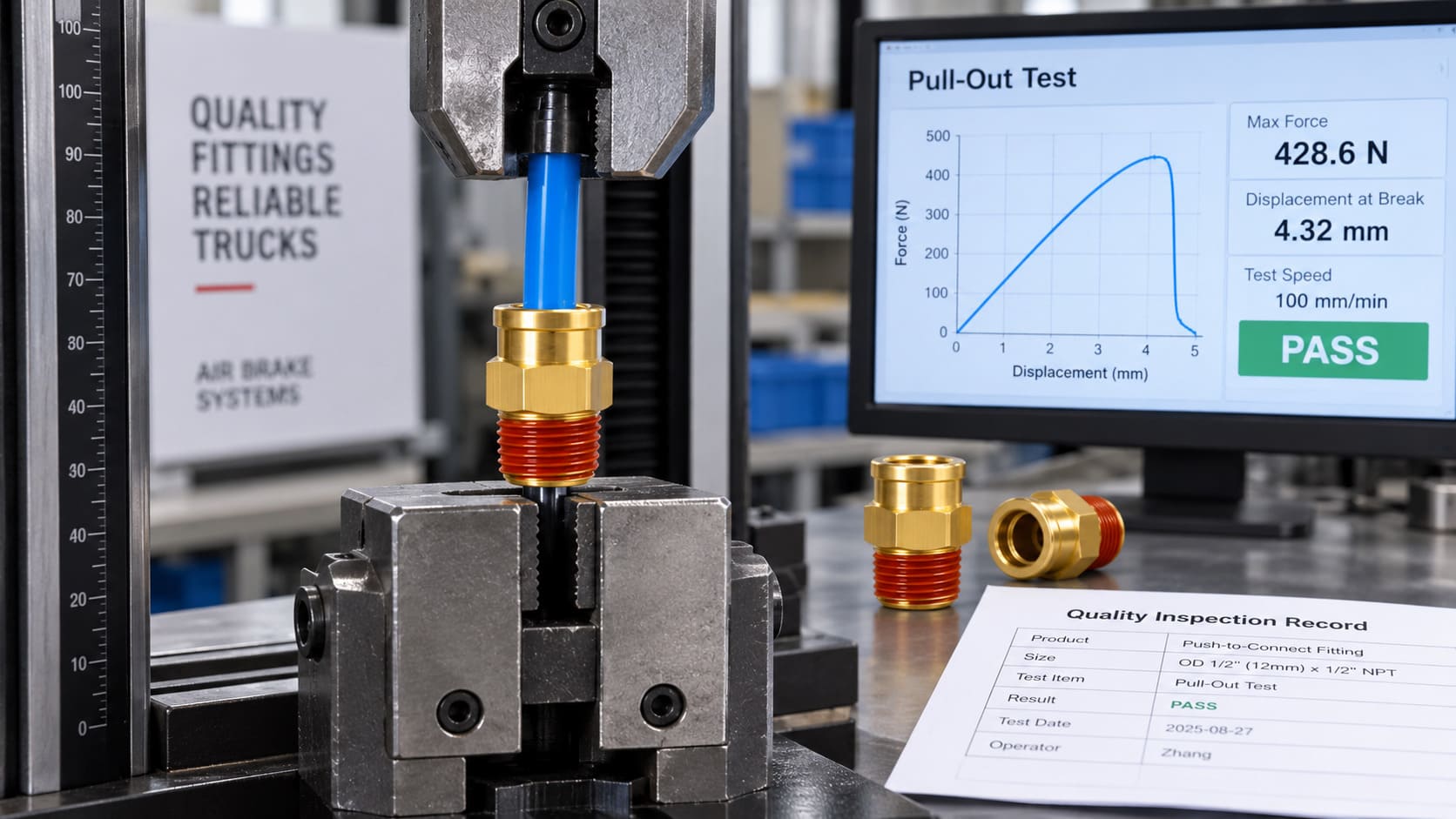
Pull-out testing for push-to-connect air fittings measures the axial force required to separate a tube from a connected fitting2. It is one of the most direct ways to evaluate whether a fitting's tube retention system — collet, sealing ring, and body — will hold together under the mechanical stress of real-world truck operations. A fitting that passes a leak test but fails a pull-out check is not a finished quality story.
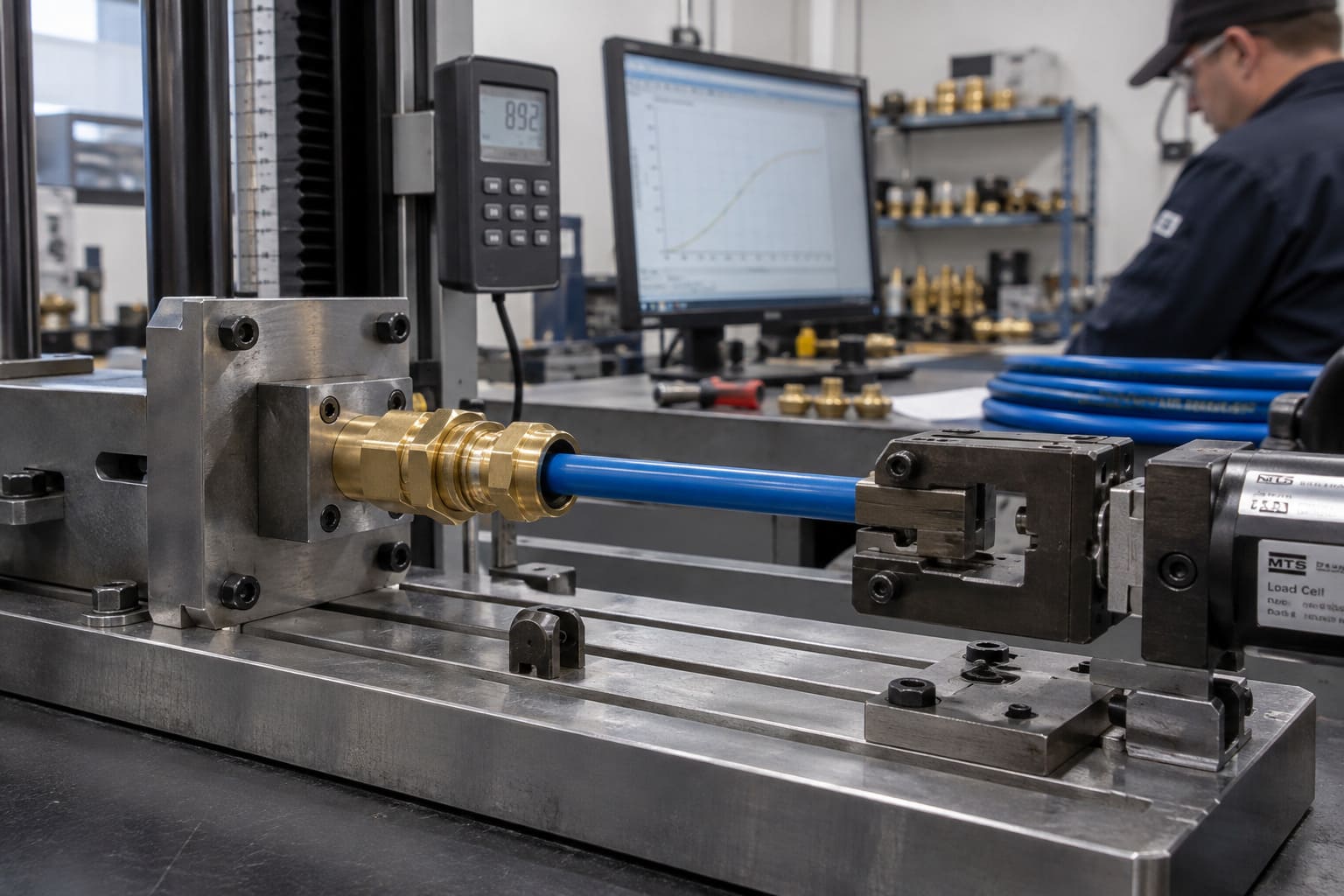
Understanding how pull-out testing works — and what it reveals about fitting design and production consistency — changes how you evaluate suppliers. The sections below break down the mechanics, the misunderstandings, and the procurement questions that separate reliable suppliers from risky ones.
What Does Pull-Out Testing Actually Measure?
Most buyers assume pull-out testing is simply about how strong a fitting is. That framing is too narrow — and it leads to the wrong supplier conversations.
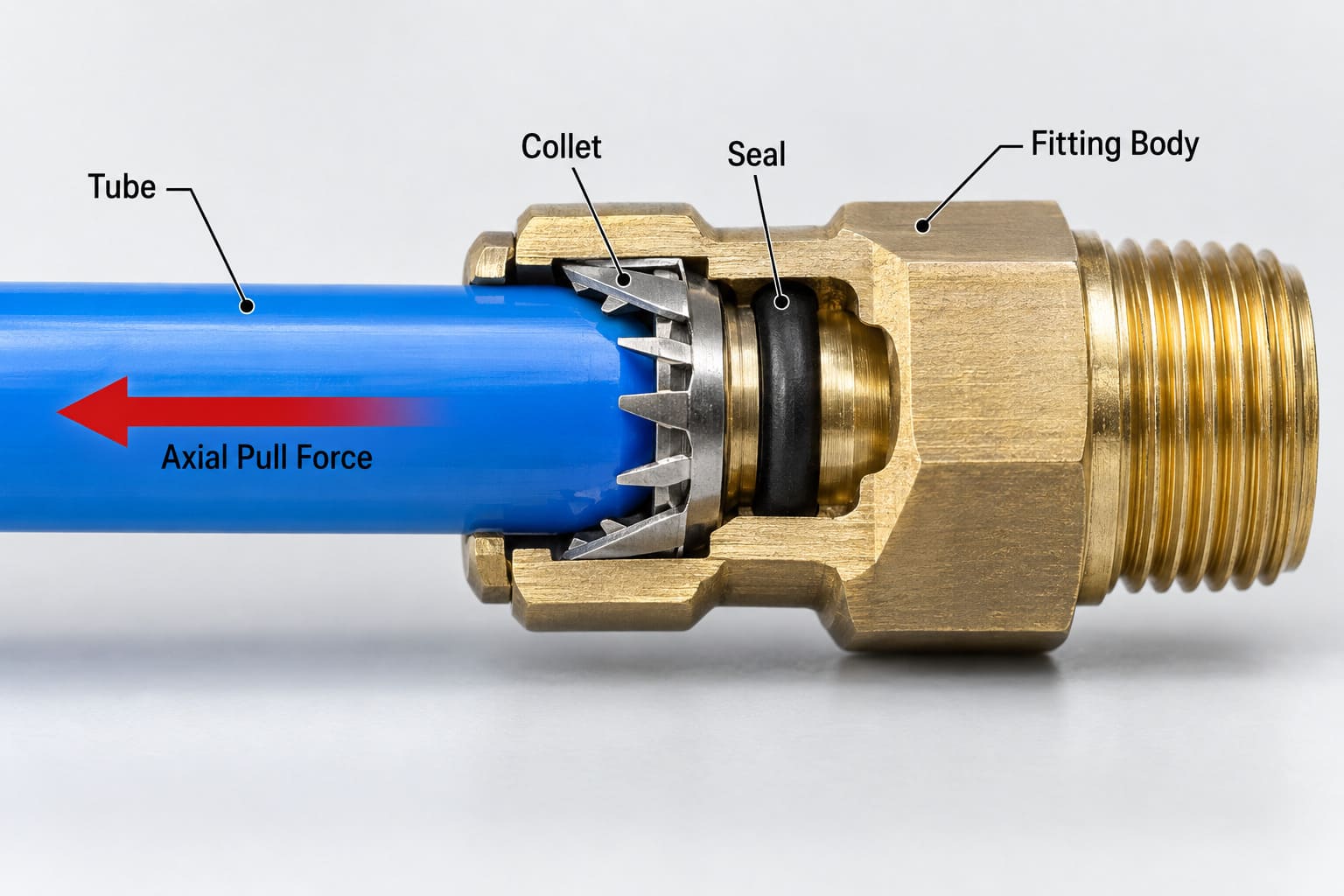
Pull-out testing measures the system integrity of a push-to-connect fitting under axial load. It tells you whether the tube, gripping mechanism, sealing structure, and fitting body can work together to resist separation — not just how hard you have to pull to break something.
The Four-Component System Being Tested
When you apply axial force to a connected tube, you are not testing one component in isolation. You are loading the entire retention system simultaneously:
- The tube itself — its outer diameter, wall thickness, material hardness, and cut quality all affect how well the collet can grip it.
- The collet (grab ring) — the toothed or claw-style insert that bites into the tube outer wall. Its geometry, tooth count, spring tension, and material determine grip consistency.
- The sealing ring (O-ring or lip seal) — which sits behind the collet and provides both the pressure seal and a secondary backstop against tube movement.3
- The fitting body — its bore diameter, depth, and thread or panel-mount engagement determine how much support the internal components actually receive.
A pull-out test result is only meaningful when you understand which part of this system is the limiting factor. A high pull-out force recorded on one batch tells you that batch performed well. It does not guarantee that next month's batch — made with slightly different tube stock, a different collet supplier, or a different line operator — will behave the same way.
Why "How Much Force?" Is the Wrong First Question
When I talk to procurement managers who are new to evaluating push-to-connect fittings, the first question is usually: "What's the pull-out force?" That question is worth asking — but it should not be the first one.
The better first question is: "How do you test, and how consistently do you test across batches?"
A supplier who can cite a single impressive number but cannot describe their sampling method, batch frequency, or documentation process is giving you a marketing answer, not a quality answer.
How Is Pull-Out Testing Different from Leak Testing?
Many distributors treat leak testing and pull-out testing as interchangeable quality checks. They are not. Conflating them creates a blind spot that shows up later as field failures.
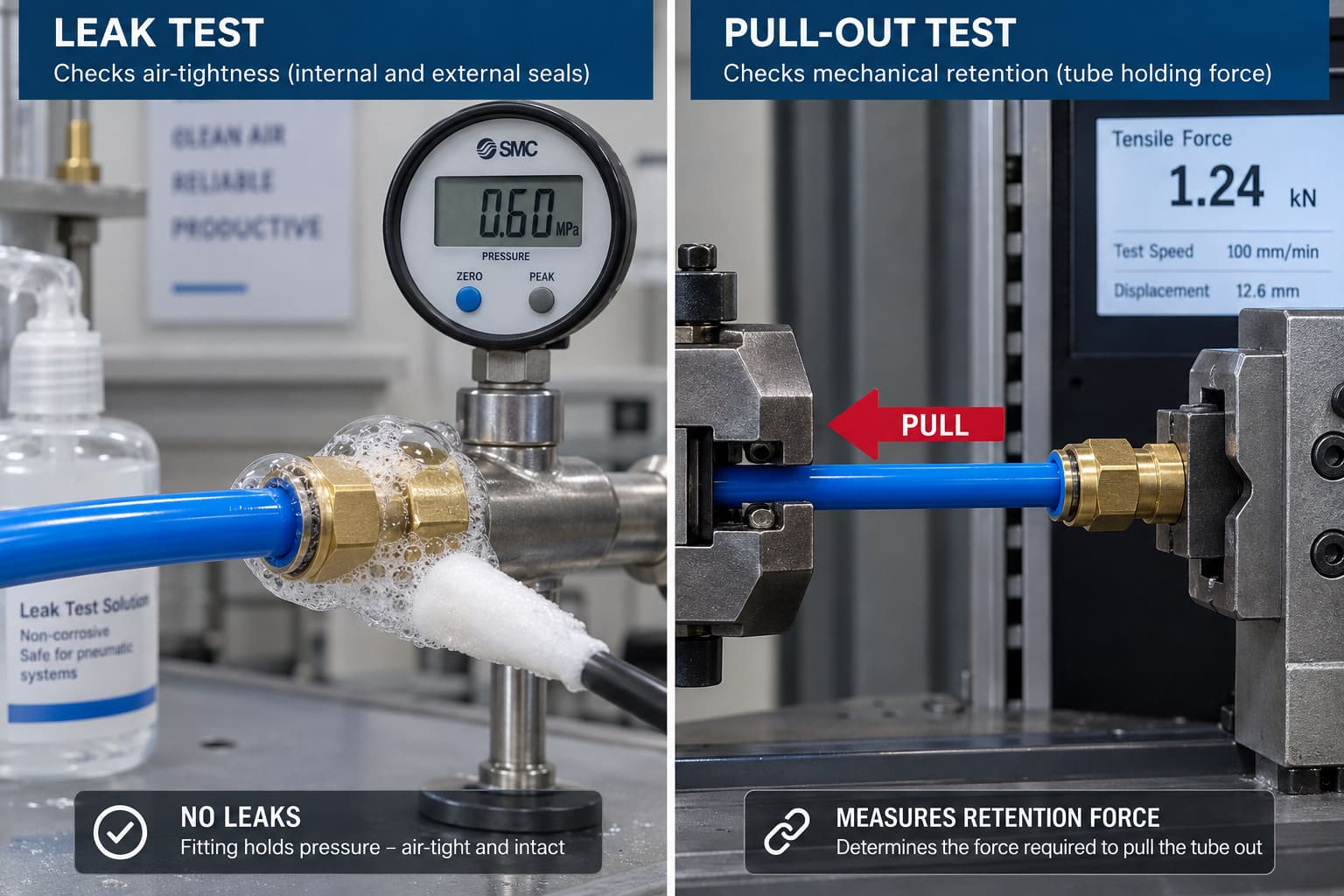
A fitting can be completely air-tight at operating pressure and still have a tube retention system that is marginal, inconsistent, or poorly matched to the tube being used. Leak testing and pull-out testing evaluate different failure modes.4
Different Failure Modes, Different Tests
| Test Type | What It Checks | What It Misses |
|---|---|---|
| Air tightness / leak test | Seal integrity under static or cyclic pressure | Tube retention strength under mechanical load |
| Pull-out test | Tube retention under axial force | Seal condition at working pressure |
| Combined pressure + pull | System integrity under simultaneous load | Not always performed in routine QC |
A static leak test pressurizes the fitting and checks for air escape. It is excellent at catching seal failures, poor O-ring seating, and body cracks. But it applies no mechanical load to the tube in the axial direction.
In a real truck environment, air lines do not just sit still under pressure. They route around chassis components, flex with suspension movement, and experience vibration at engine idle and road speed. They heat up and cool down, which causes thermal contraction and expansion along the tube length.5 That repeated movement puts axial and lateral stress on every connection point.
Where the Gap Creates Risk
Here is the failure sequence that concerns me from a quality control standpoint:
- A fitting passes leak testing at the factory — seal is intact, no pressure loss.
- The same fitting has a slightly undersized collet bore, or a collet tooth geometry that is nominally correct but manufactured to the loose end of tolerance.
- Under vibration and thermal cycling in the field, the tube works loose incrementally — not all at once.6
- Eventually the tube backs out enough to break the seal, and the fitting fails.
That failure was not random. It was predictable — if someone had tested pull-out resistance across enough samples and caught the collet variation. Leak testing alone would never have found it.
Why Do Similar-Looking Fittings Perform Differently?
This is a question I hear constantly from distributors who have switched suppliers and been surprised by the results — in both directions. Two fittings can look nearly identical on the outside and perform very differently under test and in the field.
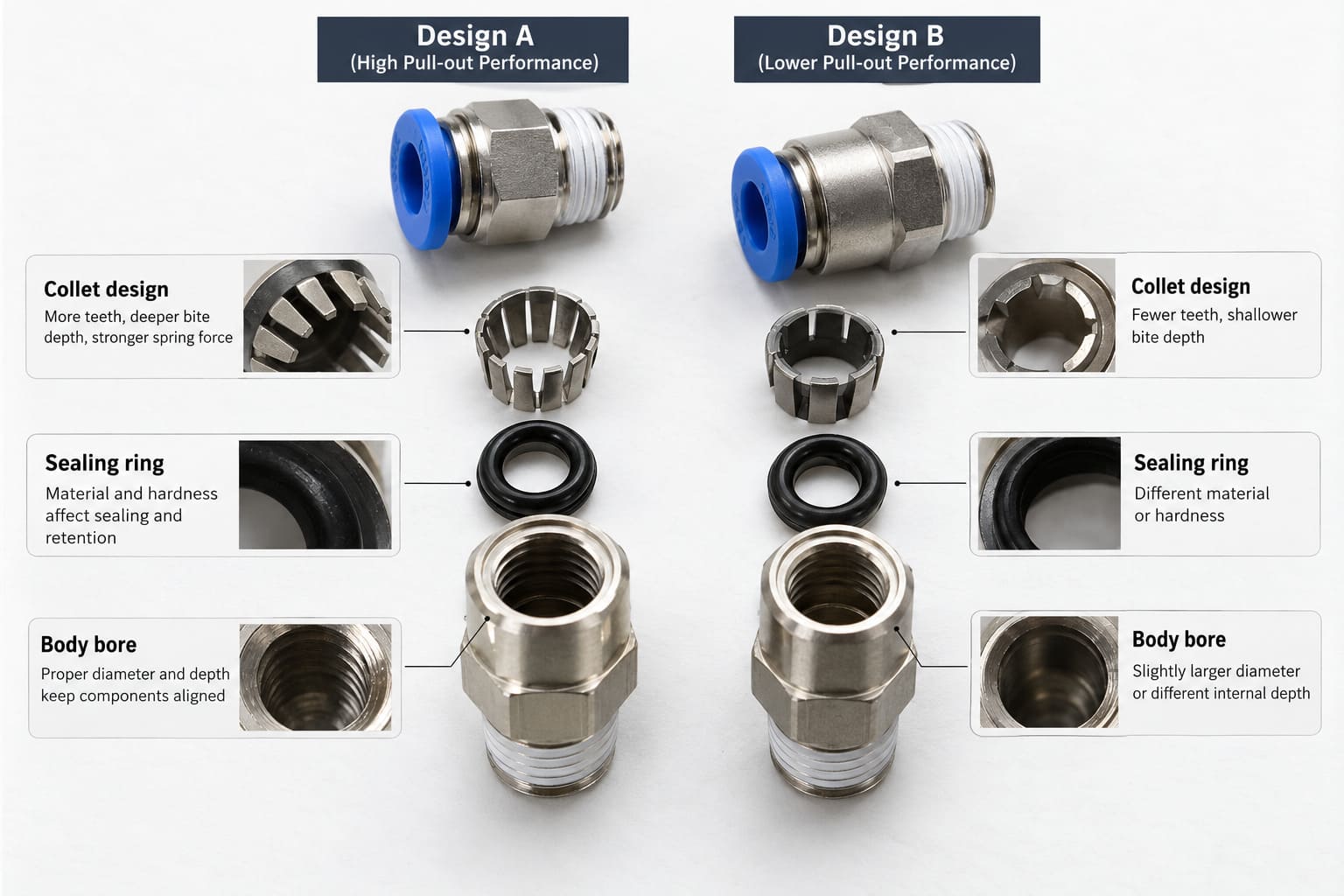
Push-to-connect air fittings are not simple stamped parts. There are multiple interacting variables that affect performance, and most of them are invisible in a photograph or a product listing.
Six Variables That Change Pull-Out Performance
1. Collet design and tooth geometry The number of teeth, tooth angle, bite depth, and spring return force all affect how aggressively and consistently the collet grips the tube. A collet that grips well at insertion but allows creep under sustained load is a design problem, not a batch problem.
2. Body bore diameter and internal depth If the bore is slightly oversized — even within a loose tolerance — the collet sits less concentrically, and grip force becomes uneven around the tube circumference. This rarely shows up in a leak test.
3. Sealing component material and hardness O-ring and lip seal materials affect both sealing and the secondary retention function. A seal that compresses correctly provides a backstop that supplements collet grip. A seal that is too soft or too hard changes the force distribution inside the fitting.
4. Tube outer diameter tolerance and material Push-to-connect fittings are designed around a specific tube OD tolerance range.7 When tube stock varies — especially if sourced from multiple suppliers across different batches — the same fitting body can produce very different pull-out results. We see this in incoming material inspection: tube OD variation is a more common quality issue than most buyers expect.
5. Tube cut quality A clean, square cut seats the tube fully and allows the collet to engage uniformly. A ragged or angled cut creates an uneven insertion depth and inconsistent grip engagement. This is partly a field installation issue — but it is also relevant to how pull-out testing should be standardized in QC.
6. Production consistency across batches A well-designed fitting produced inconsistently will underperform a simpler fitting produced under tight process control. Mold wear, material lot variation, and assembly line discipline all affect whether the 50,000th fitting off the line performs like the first.
What Should Procurement Buyers Ask Suppliers About Pull-Out Testing?
This is where pull-out testing becomes a practical procurement tool rather than a technical footnote. The questions you ask a supplier about their testing process reveal more about their quality culture than any single specification sheet.
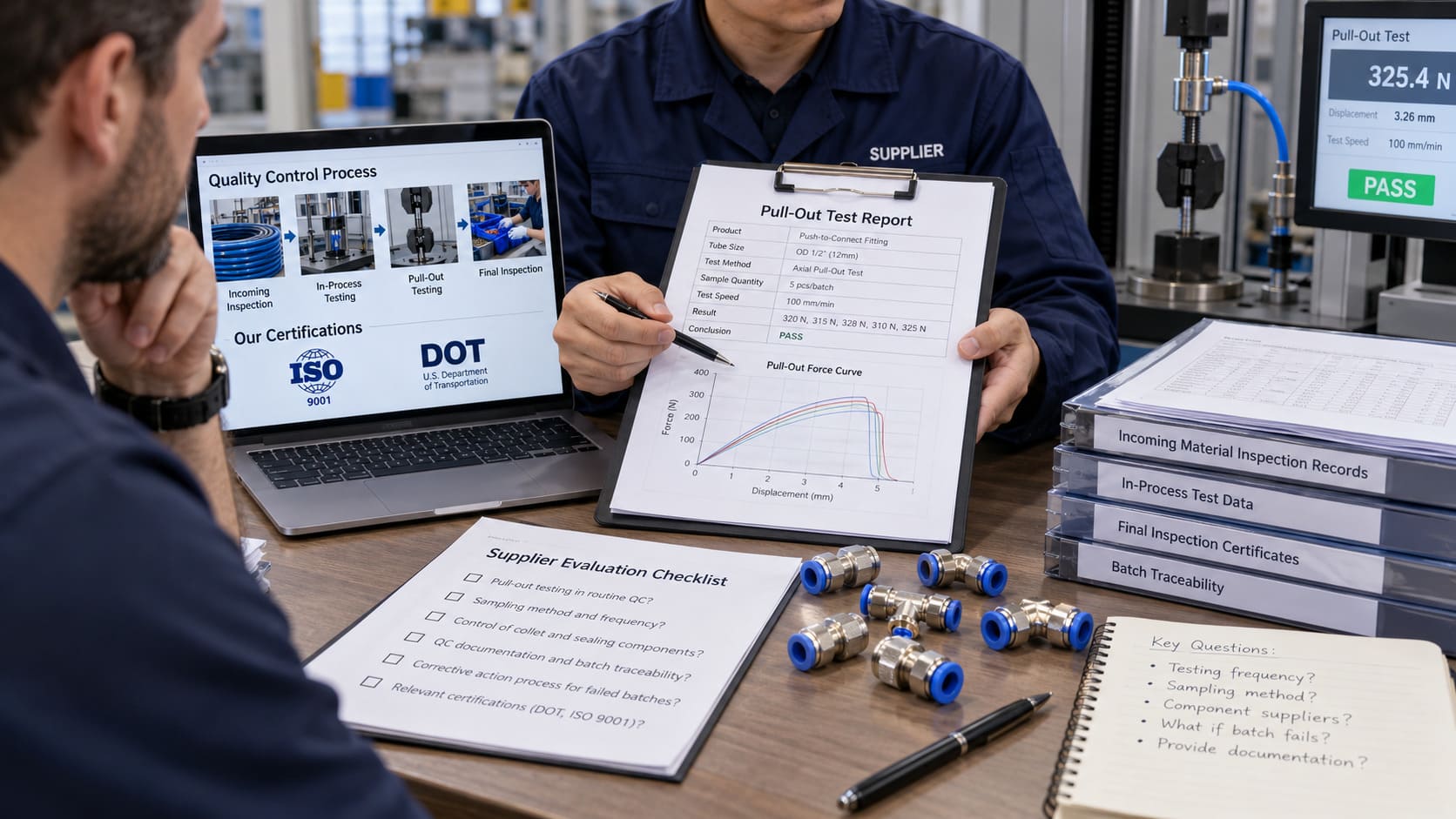
Buyers evaluating push-to-connect air fitting suppliers should treat pull-out testing questions as a supplier qualification filter — not as an afterthought.
The Core Supplier Questions
Here are the questions worth asking, and what the answers tell you:
"Is pull-out testing part of your routine QC — or only done during initial development?"
Development-only testing means the supplier validated the design once and assumed production consistency would follow. Routine QC testing means the supplier actively monitors whether their production is delivering what the design specified. These are very different quality postures.
"What is your sampling method and frequency?"
AQL sampling by lot, 100% inspection on critical dimensions, or periodic statistical sampling — each approach has a different risk profile. A supplier who cannot describe their sampling logic is likely not running a disciplined QC process.
"How do you control batch-to-batch consistency in the collet and sealing components?"
This question probes whether the supplier owns their supply chain for critical sub-components. Suppliers who source collets and seals from multiple spot-market vendors have limited ability to control the consistency that pull-out performance depends on.
"What documentation can you provide?"
At minimum, look for:
- Incoming material inspection records for tube stock and internal components
- In-process inspection records with pull-out sampling data
- Final inspection certificates with batch traceability
- Relevant certifications (DOT, ISO 9001) — and verify these independently, as certificates should be treated as documents to confirm, not marketing claims
"What happens when a batch fails pull-out testing?"
This answer reveals whether the supplier has a corrective action process. A supplier who has never had a batch fail, or who cannot describe what they would do, is either not testing thoroughly or not being transparent.
What Certifications Actually Tell You
DOT certification and ISO 9001 registration are meaningful baseline signals — but they are not substitutes for asking the questions above. DOT certification indicates the product has been evaluated against U.S. Department of Transportation requirements8 relevant to brake system components. ISO 9001 indicates the supplier operates a documented quality management system.9 Neither certification guarantees that pull-out testing is performed consistently at the batch level, or that the results meet your specific application requirements.
Treat certifications as the starting point for supplier evaluation, not the conclusion. Ask to see the actual QC documentation behind the certificate.
Frequently Asked Questions
Does a push-to-connect fitting that passes a pressure test automatically pass pull-out testing?
No. Pressure testing and pull-out testing evaluate different performance characteristics. A fitting can maintain an air-tight seal under static pressure while having a tube retention system that is marginal under axial mechanical load. Both tests are needed for a complete quality picture.
What tube types and sizes affect pull-out test results the most?
Tube outer diameter tolerance, wall hardness, and cut quality are the most significant variables. Nylon and polyurethane tubes behave differently under the same collet geometry.10 Tubes at the loose end of OD tolerance consistently produce lower pull-out resistance than tubes at the nominal dimension11, even with identical fittings.
How often should push-to-connect fittings be pull-out tested during production?
This depends on the supplier's QC process design, but routine AQL batch sampling12 — rather than development-only or first-article testing — is the standard that gives buyers meaningful protection. Ask suppliers specifically whether pull-out testing is part of ongoing production inspection.
Can installation quality affect pull-out resistance in the field?
Yes, significantly. Tube cut quality, insertion depth, and tube routing affect how well the collet engages and whether the fitting experiences additional stress beyond normal operating pressure. Supplier testing validates the product — proper installation practices validate the application.
Should I ask for pull-out test records before placing a large order?
Yes. For any order representing significant procurement volume or brand exposure, requesting batch inspection records, including pull-out sampling data, is a reasonable and professional supplier qualification step. Suppliers with mature QC processes should be able to provide this documentation.
Conclusion
Pull-out testing for push-to-connect air fittings is not a single number to collect and file away. It is a window into fitting design integrity, production consistency, and supplier quality culture. A fitting's ability to resist tube separation under axial load depends on the collet geometry, sealing components, body tolerances, tube stock quality, and the consistency of every production batch — factors that leak testing alone cannot reveal.
For distributors sourcing push-to-connect air fittings in the North or South American heavy-duty truck market, the practical takeaway is this: ask your supplier how they test, how often, and what documentation they can provide. Those answers separate suppliers who manage quality from suppliers who assume it.
At ROADSPOWER, pull-out testing is part of our in-process and final inspection workflow — not a development-only exercise. If you are evaluating push-to-connect air fitting suppliers and want to discuss our QC process or request product documentation, contact our team directly.
"Federal Motor Vehicle Safety Standards; Brake Hoses", https://www.federalregister.gov/documents/2004/12/20/04-27088/federal-motor-vehicle-safety-standards-brake-hoses. Standards for nonmetallic air brake tubing and push‑in connectors describe vibration and temperature cycling as service conditions and include tube retention performance requirements, supporting the risk of pull‑out under these stresses even when static leak performance is acceptable. Evidence role: general_support; source type: institution. Supports: That recognized standards for air brake tubing and push-in connectors identify vibration and temperature cycling as service conditions and require tube retention performance under such conditions.. Scope note: Standards specify test conditions and performance requirements rather than reporting statistical field failure rates. ↩
"Federal Motor Vehicle Safety Standards; Brake Hoses", https://www.federalregister.gov/documents/2004/12/20/04-27088/federal-motor-vehicle-safety-standards-brake-hoses. Technical standards for push‑in connectors specify a tensile (pull‑out) test in which the axial force required to separate the tube from the connector is measured, matching this definition. Evidence role: definition; source type: institution. Supports: That standards define a pull-out or tensile test for push-in connectors as measuring the axial force required to separate the tube from the connector.. ↩
"Pneumatic Quick Coupling Components Inside the Structure ...", https://www.fokcaflow.com/blog/pneumatic-quick-coupling-components-inside-the-structure-of-push-to-connect-fittings.html. Reference descriptions of push‑in pneumatic fittings distinguish a collet (for gripping) and an O‑ring (for sealing) located behind the collet; while primarily a seal, its placement can impede tube movement and provide a secondary restraint in some designs. Evidence role: mechanism; source type: encyclopedia. Supports: That push-in fittings employ a collet/grab ring for grip and an O‑ring for sealing, with the seal located behind the collet.. Scope note: Most references emphasize the O‑ring’s sealing role; its contribution to retention varies by design and is not universally specified. ↩
"Federal Motor Vehicle Safety Standards; Brake Hoses", https://www.federalregister.gov/documents/2004/12/20/04-27088/federal-motor-vehicle-safety-standards-brake-hoses. Standards for push‑in pneumatic connectors include separate procedures and criteria for leak tightness and for tube retention (axial pull‑out), indicating they address different failure modes. Evidence role: mechanism; source type: institution. Supports: That connector standards specify distinct procedures for leak tightness under pressure and tube retention under axial load.. ↩
"Federal Motor Vehicle Safety Standards; Brake Hoses", https://www.federalregister.gov/documents/2004/12/20/04-27088/federal-motor-vehicle-safety-standards-brake-hoses. The air‑brake tubing standard specifies environmental temperature ranges for service on heavy vehicles, which implies that tubes undergo thermal cycling and associated dimensional changes. Evidence role: mechanism; source type: institution. Supports: That air brake tubing standards specify environmental temperature ranges implying thermal cycling during service.. Scope note: The standard sets environmental and material requirements but does not quantify in‑field expansion magnitudes for specific tube materials. ↩
"Experimental Analysis of Thread Movement in Bolted ...", https://ntrs.nasa.gov/api/citations/19950018571/downloads/19950018571.pdf. Connector standards include endurance tests (e.g., vibration or impulse) that evaluate tube retention over time, reflecting the risk of progressive tube movement rather than only instantaneous failure. Evidence role: general_support; source type: institution. Supports: That standards include vibration or endurance tests for connectors to ensure tube retention over time, recognizing the possibility of gradual loosening.. Scope note: Standards require such tests but typically do not describe specific field loosening sequences. ↩
"Federal Motor Vehicle Safety Standards; Brake Hoses", https://www.federalregister.gov/documents/2004/12/20/04-27088/federal-motor-vehicle-safety-standards-brake-hoses. Standards specify tube outside‑diameter tolerances and compatible connector sizes, indicating that proper engagement of push‑in fittings presumes tubes within a defined OD range. Evidence role: mechanism; source type: institution. Supports: That standards define tube OD tolerances and matching connector dimensions for proper engagement.. ↩
"Interpretation ID: 23189ogm", https://www.nhtsa.gov/interpretations/23189ogm. NHTSA’s Federal Motor Vehicle Safety Standards, including FMVSS No. 121 for air brake systems, establish federal requirements that manufacturers must certify compliance with, providing the regulatory context often described as ‘DOT certification.’ Evidence role: historical_context; source type: government. Supports: That federal requirements for air brake systems exist under FMVSS, and manufacturers are responsible for certifying compliance.. Scope note: DOT/NHTSA does not issue individual product certificates; compliance is generally self‑certified and assessed at the vehicle or assembly level. ↩
"ISO 9000 family", https://en.wikipedia.org/wiki/ISO_9000_family. ISO 9001 defines requirements for a quality management system, including documented processes and continual improvement, supporting the statement about what ISO 9001 indicates. Evidence role: definition; source type: institution. Supports: That ISO 9001 specifies requirements for a documented quality management system.. ↩
"Federal Motor Vehicle Safety Standards; Brake Hoses", https://www.federalregister.gov/documents/2004/12/20/04-27088/federal-motor-vehicle-safety-standards-brake-hoses. Reference material data show that nylon and polyurethane have distinct hardness and creep characteristics, implying different retention behavior under identical collet designs. Evidence role: mechanism; source type: encyclopedia. Supports: That nylon (e.g., PA12) and polyurethane exhibit different hardness and creep behavior relevant to retention in push‑in fittings.. Scope note: General material properties support the trend, but actual pull‑out performance also depends on specific tube formulations and connector geometry. ↩
"Research on the anti-pull performance of a novel small-diameter steel ...", https://pmc.ncbi.nlm.nih.gov/articles/PMC13390846/. Experimental studies on push‑in connector retention report sensitivity of pull‑out force to tube outside diameter within tolerance, with reduced OD generally lowering grip strength. Evidence role: mechanism; source type: paper. Supports: That pull-out strength in push-in connectors is sensitive to tube outside diameter within tolerance, with smaller OD tending to reduce grip.. Scope note: Available studies may pertain to specific connector designs and materials; generalization across all fittings and tubes should be made cautiously. ↩
"ISO 2859-1:1999(en), Sampling procedures for inspection ...", https://www.iso.org/obp/ui/#iso:std:iso:2859:-1:ed-2:v1:en. The ISO 2859‑1 standard describes acceptance sampling by attributes using AQL for lot‑by‑lot quality control, supporting the reference to routine AQL batch sampling in production. Evidence role: expert_consensus; source type: institution. Supports: That acceptance sampling by attributes using AQL is an established method for lot-by-lot quality control.. ↩