When a heavy-duty truck part buyer asks, “What is an advantage of having a long stroke brake chamber over standard stroke?” they often assume the answer is about more stopping power. But that’s not exactly the case. The real advantage is far more practical — and it only applies in the right situation.
The primary advantage of a long stroke brake chamber is a greater usable pushrod stroke margin, allowing more tolerance before the brake reaches its stroke limit — but only when the vehicle’s brake system, axle, and manufacturer specifications are designed to use it.1
This distinction matters more than you might think, especially when you’re stocking parts or replacing a chamber. Let’s break down what that really means for your truck and your purchasing decisions.
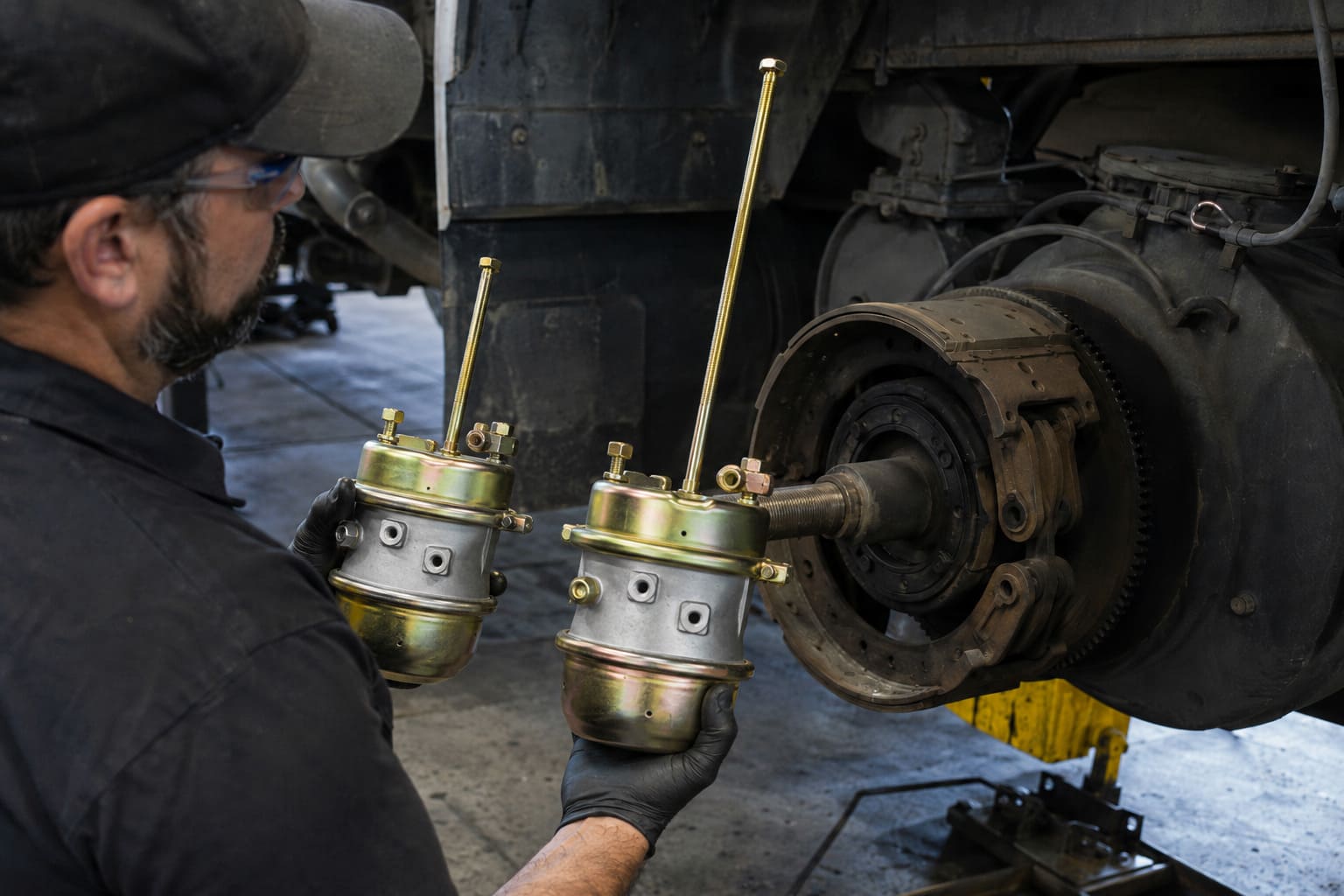
What exactly is a long stroke brake chamber?
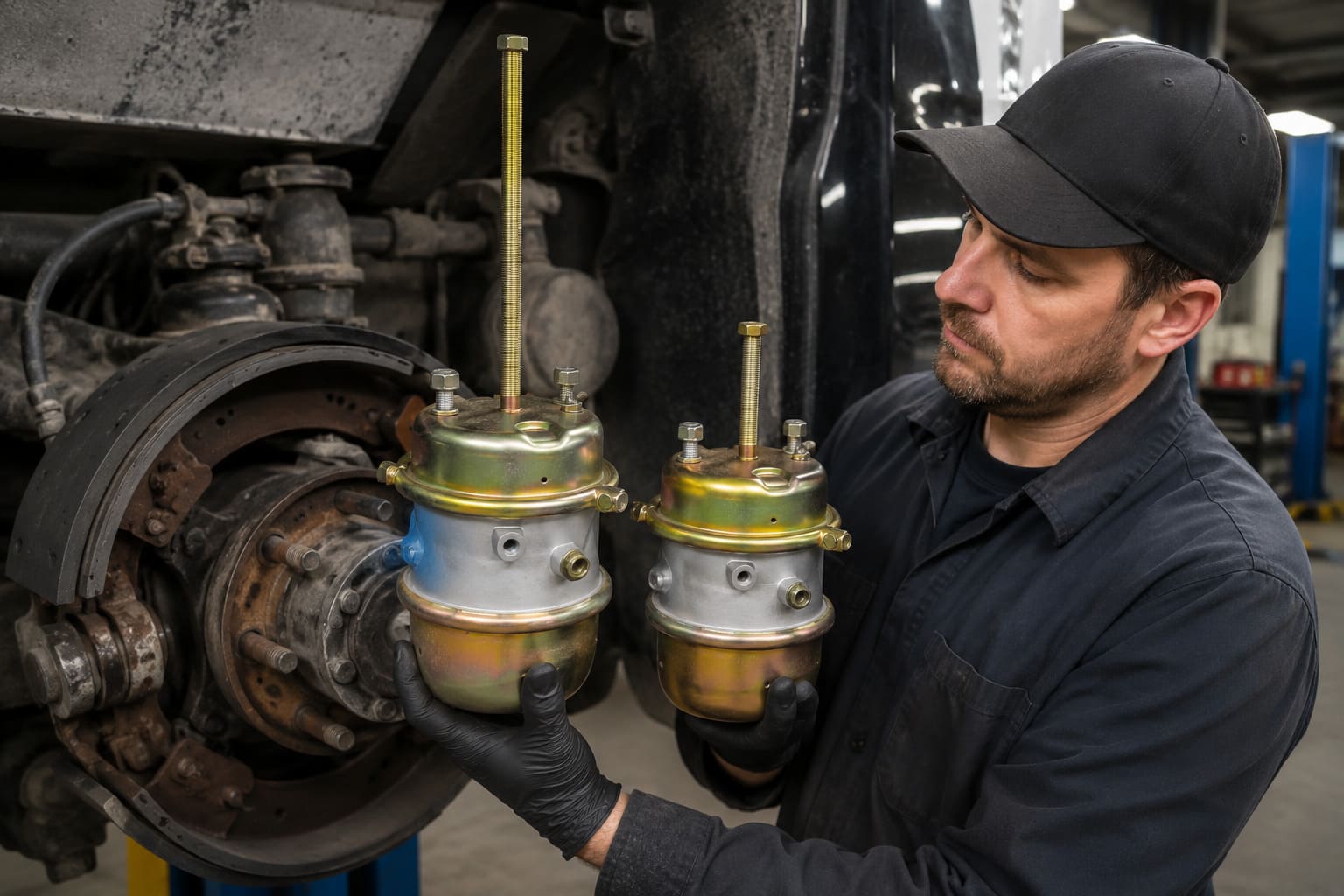
A long stroke brake chamber looks almost identical to a standard stroke unit from the outside, but the internal design is different. The key difference is the length of the pushrod stroke. A standard stroke chamber — for example, a Type 30 — typically has a maximum stroke length of around 2.5 inches.2 A long stroke version of the same size may allow 3.0 inches or more.3 That extra half-inch is the margin that changes everything.
The longer stroke does not automatically create more braking force. The force comes from air pressure and the size of the diaphragm.4 Instead, the longer stroke gives the pushrod more room to travel before it hits the internal stop. This becomes important when the brake is at the edge of its adjustment, or when the brake geometry is designed to need that extra travel.
| Chamber Type | Typical Max Stroke (approx.) | Common Use |
|---|---|---|
| Standard Type 30 | 2.5 in. | General service, many axles |
| Long Stroke Type 30 | 3.0 in. | Certain steer axles, trailers, specific OEM specs |
| Standard Type 24 | 2.5 in. | Lighter applications |
| Long Stroke Type 24 | 3.0 in. | Where extra stroke margin is specified |
I’ve seen many orders where a customer asks for a “stronger” chamber, thinking a long stroke chamber will solve a brake complaint. The real story is almost always about stroke reserve and adjustment tolerance — not about raw power.
How does the stroke length affect brake adjustment and safety?
A properly adjusted air brake system has a certain amount of pushrod travel before the brake shoes contact the drum. The stroke length is the total distance the pushrod can move. If the pushrod approaches or exceeds that limit, the brake can lose effectiveness, a condition commonly called “overstroke.”5 This is a safety and compliance issue.6
The extra margin in a long stroke chamber means the pushrod can travel farther before reaching the danger zone. That can give a fleet more time between brake adjustments, and it can reduce the risk of an overstroke condition during hard braking or when the slack adjuster has not yet compensated for wear.7 But this margin is only an advantage when the axle, brake hardware, and vehicle manufacturer’s design account for that longer stroke.
Imagine a freelance mechanic once told me he swapped a standard stroke chamber for a long stroke on a trailer because the brakes felt “slow.” The result was a dragging brake on that wheel and uneven stopping. He hadn’t checked the original spec. The longer travel allowed the pushrod to move past the point where the brake shoes could fully retract, causing drag and heat. The lesson: stroke length must match the system.
When is a long stroke brake chamber the right choice?
A long stroke brake chamber is the right choice when the original part, the vehicle manufacturer’s specification, or the axle design calls for one.8 It is not a universal upgrade. In many cases, the OEM installed a long stroke chamber on a specific axle position to manage stroke reserve under load, to accommodate a particular brake geometry, or to meet a specific performance requirement.
I handle customer inquiries like this frequently. The conversation usually goes:
- Check the label on the old chamber. Look for designations like “LS,” “long stroke,” or a specific stroke length stamped on the body.
- Verify the OEM part number. Cross-reference it with the vehicle application guide.
- Confirm the axle position and brake geometry. Sometimes a steer axle uses a long stroke while the drive axles use standard stroke.
- If the old chamber is missing or unreadable, consult the vehicle manufacturer’s maintenance manual or a trusted supplier who can help identify the correct replacement.
For a parts distributor or fleet buyer, stocking the correct chamber type is just as important as getting the size right. A long stroke chamber that looks similar to a standard stroke but carries the wrong stroke specification can lead to costly returns, safety issues, and confusion.
What happens if you install a long stroke chamber where a standard stroke is specified?
Installing a long stroke chamber on a system designed for a standard stroke can cause several problems. The pushrod may travel too far and not fully retract, leading to brake drag. The increased stroke could also cause the slack adjuster to operate outside its effective range, reducing the brake’s self-adjustment capability.9 In some cases, the pushrod may bottom out inside the chamber before the brake shoes are fully applied, which can damage the chamber or create a false sense of proper adjustment.
More critically, the brake balance across the axle or vehicle can be thrown off. If one wheel uses a long stroke and the others use standard stroke, the braking forces may not be evenly distributed.10 That can cause pulling during braking, uneven lining wear, and unpredictable stopping behavior. From a regulatory standpoint, mismatched components can affect compliance with FMVSS 121 or similar standards in other markets.
I recall a distributor who stocked long stroke chambers as a “one-size-fits-upgrade” for his fleet customers. He ended up with a batch of warranty claims because the chambers were installed on vehicles that were not designed for them. The stroke was long enough to cause pushrod retraction issues, and the brakes were dragging. That experience reinforced a simple rule: always match the chamber to the original spec.
How can I tell if my vehicle needs a long stroke or standard stroke chamber?
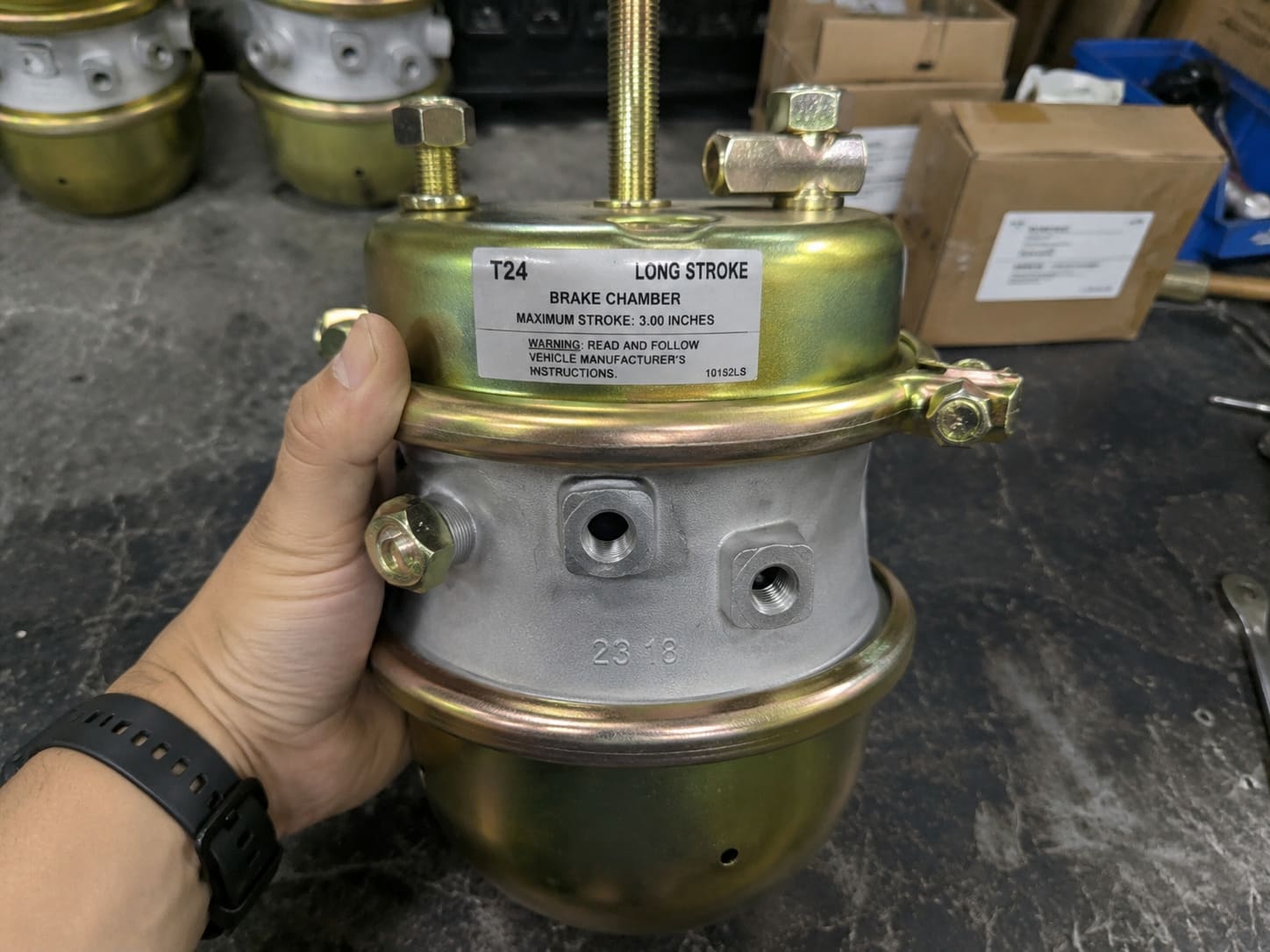
The most reliable way is to read the label on the existing chamber. Most brake chambers have a metal tag or stamped information that includes the type, size, and stroke designation.11 Look for:
- “LS” or “LONG STROKE” text
- A stroke length in inches (e.g., “3.0”)
- The OEM part number, which you can cross-reference
If the old chamber is too damaged or missing, you can measure the pushrod stroke at full brake application, but this requires knowing the specified stroke for that axle. The vehicle manufacturer’s documentation is the best source. I often ask customers to send a photo of the old chamber and the axle tag. With that information, our team can help confirm the correct replacement.
Another practical tip: don’t assume a chamber is long stroke just because it looks larger. Some standard stroke chambers have a longer body due to a different diaphragm design, but the stroke inside is still the standard length. Size alone is not a reliable indicator.
For a quick reference, here’s a simplified decision checklist:
- Step 1: Locate the old chamber and check for any readable label or stamp.
- Step 2: Note the type (e.g., 30/30), and look for stroke designation.
- Step 3: If no stroke info is found, check the vehicle’s maintenance manual or contact the OEM.
- Step 4: When in doubt, consult a supplier who can cross-reference the part number and application.
Frequently Asked Questions
Can I use a long stroke brake chamber on any truck?
No. A long stroke brake chamber must match the vehicle’s original design specification. Using one where a standard stroke is required can cause brake drag, uneven braking, and potential safety issues.
Does a long stroke chamber improve braking power?
No. Braking power comes from the chamber size and air pressure. A long stroke chamber provides more stroke margin, not more apply force. It does not generate higher braking force than a standard stroke chamber of the same size.
What is the difference between Type 30 standard and long stroke?
A Type 30 standard stroke chamber typically has a maximum stroke of about 2.5 inches. A Type 30 long stroke version allows approximately 3.0 inches of travel. The extra half-inch provides more stroke reserve for the brake system but only when the system is designed for that longer stroke.
Are long stroke chambers DOT approved?
Many long stroke chambers are DOT approved when used in the correct application. However, the approval applies to the specific chamber design and its intended use. Always verify that the chamber meets FMVSS 121 requirements for the vehicle it will be installed on. The DOT marking alone does not guarantee compatibility with every axle.12
How do I know if my brake chamber is out of stroke?
When the brake is fully applied, the pushrod should not travel beyond the chamber’s rated stroke limit. You can measure the pushrod travel with a ruler or a stroke indicator tool. If the pushrod extends past the specified maximum, the brake is overstroking and needs adjustment or the chamber may be incorrect for the application.
Conclusion
The advantage of a long stroke brake chamber over a standard stroke is a larger pushrod stroke margin, which translates into more adjustment tolerance and reduced risk of overstroke — but only when the vehicle was designed for it. It is not a shortcut to stronger braking or a universal upgrade. For parts buyers, repair shops, and fleet managers, the real skill lies in matching the chamber to the original specification. Check the label, verify the OEM part number, and never assume that physical fitment means correct stroke. If you’re unsure, reach out to a knowledgeable supplier who can help you confirm the right chamber for your application. At ROADSPOWER, we handle these specification questions daily and can assist you in finding the correct standard or long stroke brake chamber for your heavy-duty truck.
"Interpretation ID: nht74-2.26", https://www.nhtsa.gov/interpretations/nht74-226. FMCSA or NHTSA brake inspection materials define brake chamber stroke as a rated travel limit and show that long-stroke chambers permit greater pushrod travel than comparable standard-stroke chambers. Evidence role: general_support; source type: government. Supports: The source should document that brake chambers have rated stroke limits and that long-stroke chambers provide greater allowable pushrod travel than standard-stroke units.. Scope note: Such sources support the technical basis for added stroke margin, but they may not prove that every axle or OEM configuration benefits from a long-stroke chamber. ↩
"Commercial Vehicle Safety Alliance", https://downloads.regulations.gov/FMCSA-2010-0257-0001/attachment_1.pdf. Commercial vehicle brake inspection stroke-limit charts list a standard Type 30 clamp-type chamber with an allowable stroke of approximately 2.5 inches. Evidence role: definition; source type: institution. Supports: The source should list the rated or allowable stroke for a standard Type 30 clamp-type brake chamber.. ↩
"Parts and Accessories Necessary for Safe Operation: Brakes", https://www.regulations.gov/document/FMCSA-2010-0257-0005. Brake chamber stroke-limit references distinguish long-stroke Type 30 chambers from standard Type 30 chambers and commonly list the long-stroke allowable travel at about 3.0 inches. Evidence role: definition; source type: institution. Supports: The source should identify the rated stroke for long-stroke Type 30 brake chambers and distinguish it from standard Type 30 chambers.. ↩
"Section 5: Air Brakes", https://www.dmv.ca.gov/portal/handbook/commercial-driver-handbook/section-5-air-brakes/. Air-brake and pneumatic actuator references explain that actuator output force is calculated from applied air pressure and effective diaphragm area, providing the mechanical basis for brake chamber apply force. Evidence role: mechanism; source type: education. Supports: The source should explain that pneumatic actuator force is a function of applied pressure and effective diaphragm or piston area.. ↩
"Interpretation ID: nht74-2.26", https://www.nhtsa.gov/interpretations/nht74-226. FMCSA brake inspection guidance treats excessive pushrod travel as a brake adjustment defect because travel beyond the rated limit can reduce effective brake application. Evidence role: mechanism; source type: government. Supports: The source should connect excessive pushrod travel with reduced brake performance or out-of-adjustment conditions.. ↩
"49 CFR Part 393 Subpart C -- Brakes", https://www.ecfr.gov/current/title-49/subtitle-B/chapter-III/subchapter-B/part-393/subpart-C. Federal and North American commercial vehicle inspection criteria identify excessive pushrod stroke as a brake defect, supporting its treatment as both a safety and compliance matter. Evidence role: general_support; source type: government. Supports: The source should show that excessive pushrod stroke is addressed in commercial vehicle brake inspection or regulatory criteria.. ↩
"Federal Register / Vol. 60, No. 8 / Thursday, January 12, 1995 / Rules ...", https://www.govinfo.gov/content/pkg/FR-1995-01-12/pdf/95-752.pdf. Transportation safety research on air-brake adjustment indicates that greater stroke reserve can reduce the likelihood of a brake reaching its out-of-adjustment limit under specified wear and adjustment conditions. Evidence role: general_support; source type: research. Supports: The source should evaluate whether additional chamber stroke reserve affects out-of-adjustment frequency or overstroke risk.. Scope note: This support is contextual because maintenance interval effects depend on vehicle duty cycle, brake wear, slack adjuster condition, and inspection practices. ↩
"49 CFR Part 393 Subpart C -- Brakes", https://www.ecfr.gov/current/title-49/subtitle-B/chapter-III/subchapter-B/part-393/subpart-C. Federal motor carrier brake rules require service brakes and related components to be maintained in safe operating condition, which supports matching replacement brake chambers to the vehicle’s specified brake system design. Evidence role: general_support; source type: government. Supports: The source should support the principle that commercial vehicle brake components must be correctly installed and maintained for their intended brake system application.. Scope note: The regulation supports correct-component selection generally, but it may not name every long-stroke chamber application or axle-specific OEM specification. ↩
"November 1, 20111 Ms. Anne Ferro Administrator Federal Motor Carrier ...", https://downloads.regulations.gov/FMCSA-2010-0257-0009/attachment_1.pdf. NHTSA and FMCSA materials on automatic slack adjusters explain that proper adjustment depends on the relationship among chamber stroke, pushrod travel, and brake geometry. Evidence role: mechanism; source type: government. Supports: The source should explain how pushrod stroke and brake geometry affect automatic slack adjuster operation.. Scope note: This supports the mechanism generally; a source may not directly test every mismatch between standard-stroke and long-stroke chambers. ↩
"NPRM Heavy Vehicle Automatic Emergency Braking Systems", https://www.nhtsa.gov/document/nprm-heavy-vehicles-automatic-emergency-braking-systems. Heavy-vehicle braking studies show that differences in brake actuation or component condition can produce brake force imbalance, affecting vehicle stability and wheel-to-wheel braking distribution. Evidence role: mechanism; source type: paper. Supports: The source should explain that differences in brake component condition or actuation can produce brake force imbalance on heavy vehicles.. Scope note: This is contextual support for the imbalance mechanism and may not isolate long-stroke brake chambers as the sole causal variable. ↩
"2014-02 – Identification of Long Stroke Brake Chambers or ...", https://portal.ct.gov/-/media/DMV/CV_Bulletins/InspectionBulletin201402IDLongStrokeBrakeChamberspdf.pdf. Commercial vehicle inspection references describe brake chamber markings and tags as identifiers for chamber type and stroke rating, including markings used to distinguish long-stroke chambers. Evidence role: definition; source type: institution. Supports: The source should describe brake chamber identification markings used to distinguish standard and long-stroke chambers.. ↩
"49 CFR 571.121 -- Standard No. 121; Air brake systems.", https://www.ecfr.gov/current/title-49/subtitle-B/chapter-V/part-571/subpart-B/section-571.121. FMVSS 121 establishes performance requirements for air-braked vehicles and related systems, indicating that regulatory compliance is not equivalent to universal compatibility with every axle or brake configuration. Evidence role: general_support; source type: government. Supports: The source should show that FMVSS or DOT compliance addresses regulatory performance or certification requirements rather than universal fitment across all axle applications.. Scope note: The source supports the distinction between compliance and compatibility generally; axle-specific compatibility still requires OEM or application documentation. ↩