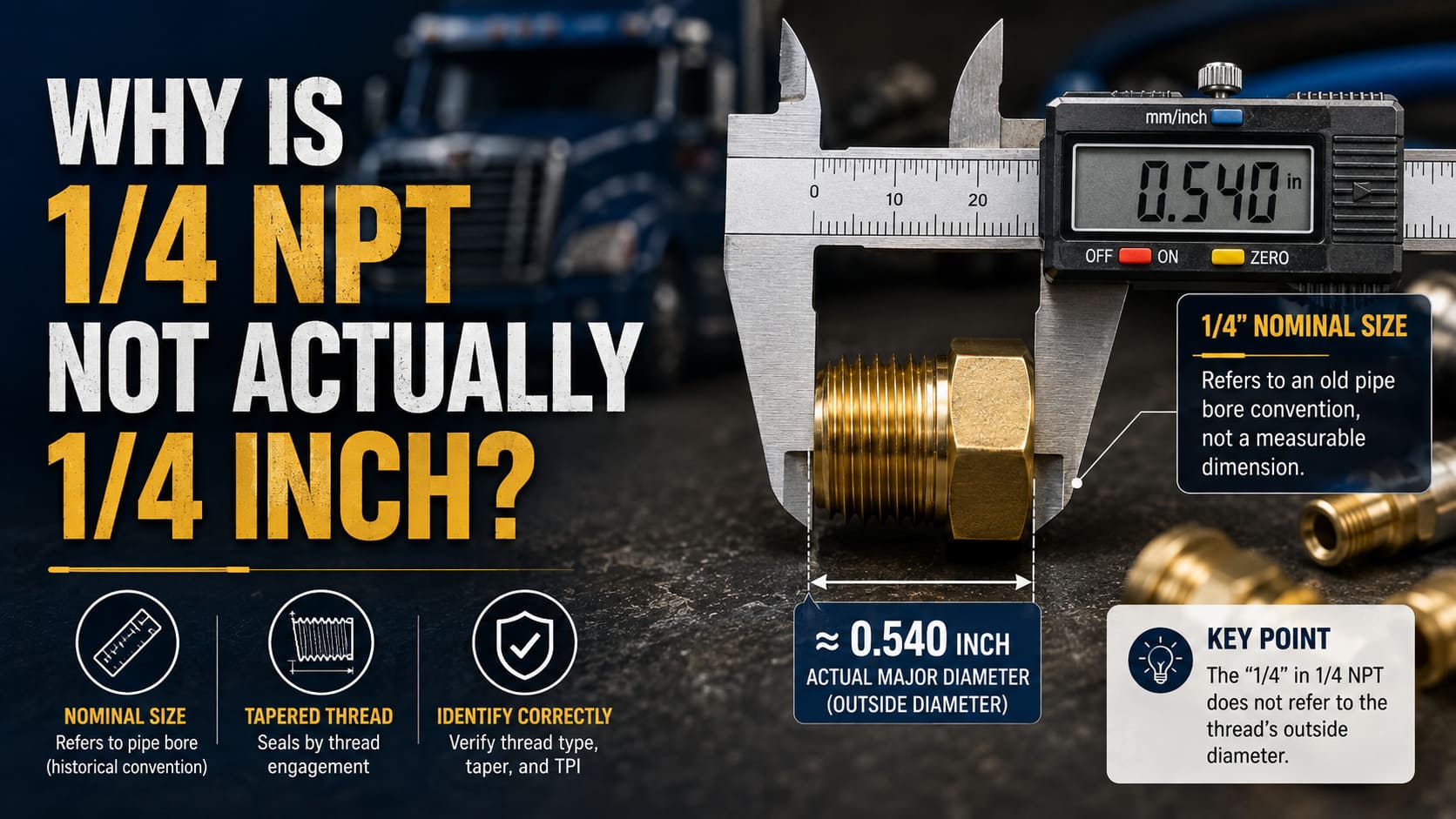
If you've ever measured a 1/4 NPT fitting with calipers and gotten a reading nowhere near 0.25 inch, you're not alone — and you're not wrong to be confused. The problem is that the "1/4" in 1/4 NPT has nothing to do with the thread's actual outside diameter1, and that disconnect causes real procurement headaches for truck parts distributors and repair shops every day.
The short answer: 1/4 NPT is a nominal pipe size designation, not a measurement of the thread's outside diameter. The actual major diameter of a 1/4 NPT male thread is significantly larger than 0.25 inch — closer to 0.540 inch, per ANSI/ASME B1.20.12 (verify against the current standard before specifying). The "1/4" refers to an old pipe bore convention, not any dimension you can read directly with a caliper.3
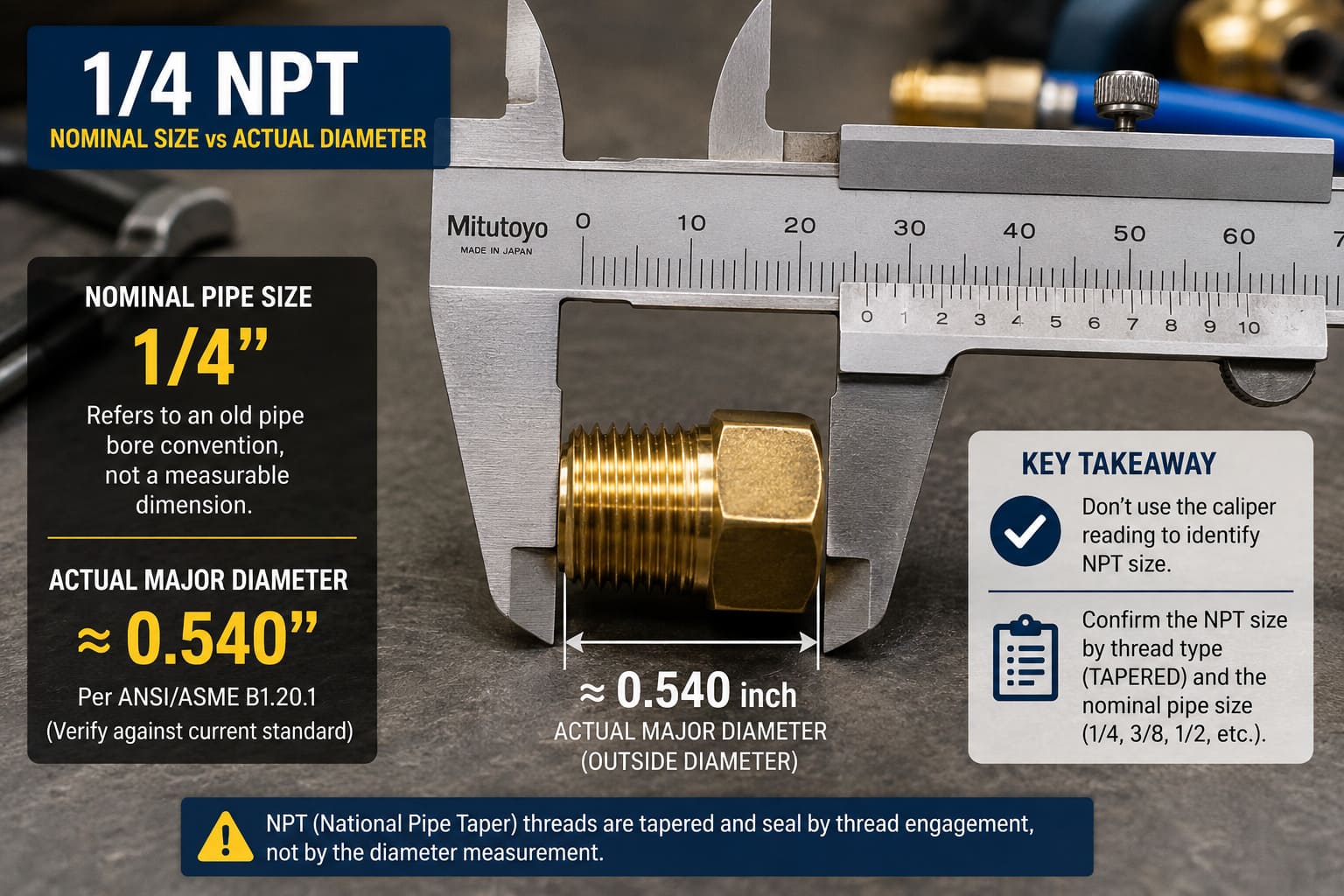
Understanding this distinction doesn't just clear up confusion — it changes how you evaluate, order, and install air line fittings on heavy-duty trucks. The sections below walk through exactly why the naming system works this way and what your team should be confirming instead of the caliper reading.
Where Does the Confusion Start for Truck Parts Buyers?
Most people working in truck parts sourcing or repair come from a world where numbers mean what they say. A 1/2-inch bolt is 1/2 inch. A 3/8-inch drive socket is 3/8 inch. So when someone picks up a 1/4 NPT brass fitting, puts calipers on the male thread, and reads something around 0.54 inch, the immediate reaction is reasonable: this part must be mislabeled.
We hear this regularly from customers sourcing truck air fittings. A distributor or repair shop owner will contact us questioning why a 1/4 NPT fitting they received doesn't measure 0.25 inch. They're not being difficult — they're applying a completely logical measurement framework that simply doesn't apply to pipe thread sizing.
The caliper reading is accurate. The fitting is also correct. The problem is that the "1/4" label doesn't promise a 0.25-inch measurement anywhere on the part.
Why the Measurement Makes Sense — Just Not in the Way You'd Expect
When a customer measures a 1/4 NPT male thread and sees roughly 0.54 inch, they're usually measuring one of the following:
- The major (outside) diameter of the thread — the largest diameter, measured across the thread crests
- The pitch diameter — a calculated value midway between the thread crest and root
- The minor diameter — the smallest diameter, at the thread root
None of these dimensions equals 0.25 inch on a 1/4 NPT thread. That's not a defect. That's exactly how NPT was designed.
Important: The approximate 0.540-inch figure cited here is consistent with widely published NPT dimension tables. Always verify against the current ANSI/ASME B1.20.1 standard before specifying dimensions in technical documents or purchase orders.
The confusion is completely understandable when you consider that in almost every other fastener and hardware category, the named size maps directly to a physical measurement. NPT breaks from that pattern — and it does so for historical reasons that go back well over a century.
What Does "Nominal Pipe Size" Actually Mean?
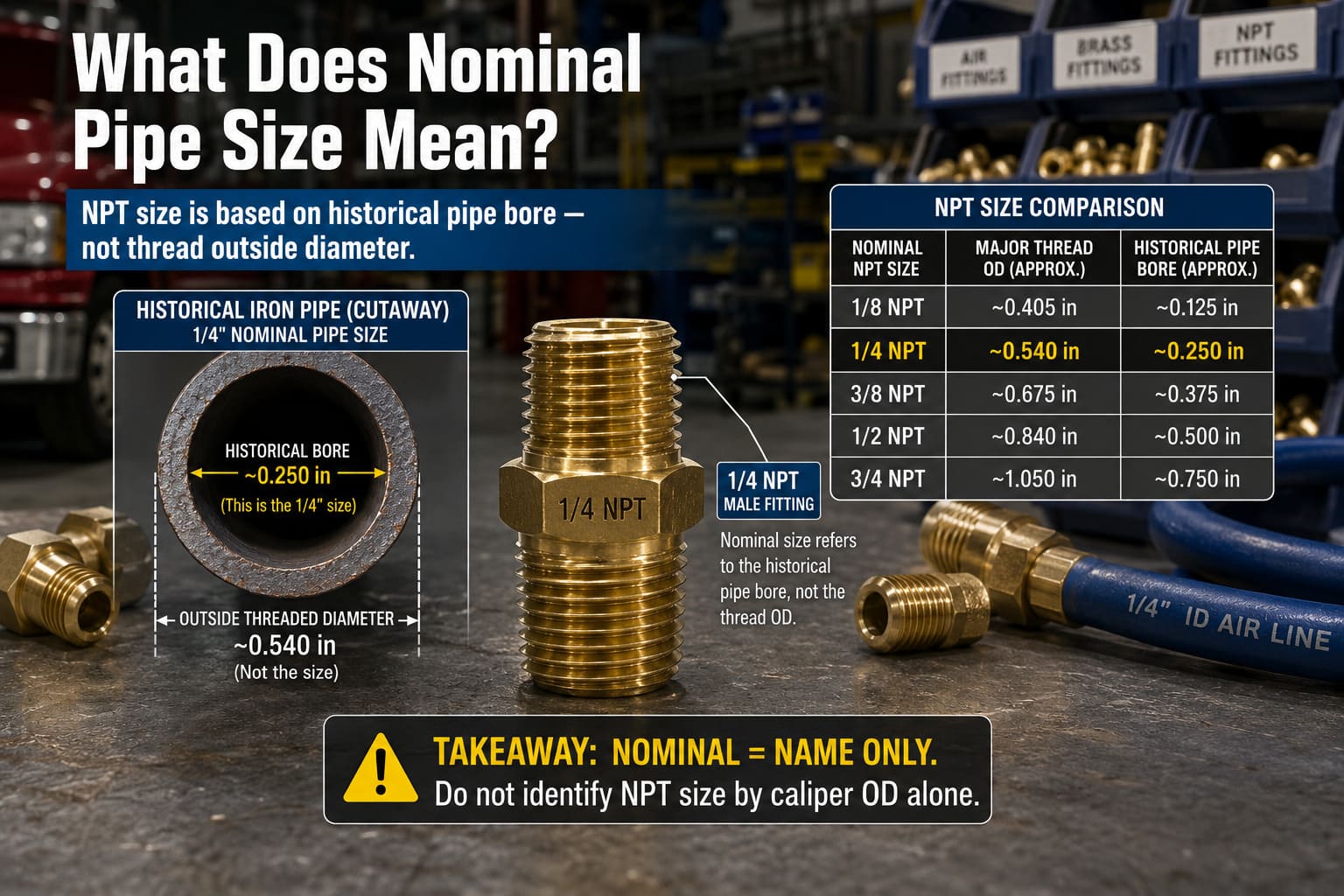
Nominal pipe size (NPS) is a North American designation system built around the internal bore of iron pipes, not the thread geometry.4 When iron plumbing became standardized in the 1800s, manufacturers named pipe sizes after the approximate inside diameter of the pipe the thread was cut onto. A pipe with roughly a 1/4-inch internal bore became "1/4-inch pipe," and the threads cut onto the outside of that pipe became 1/4 NPT.
The practical result: the NPT size number loosely references the pipe bore it was historically associated with — not the outside diameter of the thread, not the port opening of the fitting, and not the hose ID connected to it.
This matters enormously for anyone buying or specifying truck air system fittings. Here's why the mismatch between the name and the measurement grows larger at smaller sizes:
The Disconnect Gets Worse at Small Sizes
| NPT Size | Approx. Male Thread Major OD | Actual Pipe Bore (Historical Reference) |
|---|---|---|
| 1/8 NPT | ~0.405 in | ~0.125 in |
| 1/4 NPT | ~0.540 in | ~0.250 in |
| 3/8 NPT | ~0.675 in | ~0.375 in |
| 1/2 NPT | ~0.840 in | ~0.500 in |
| 3/4 NPT | ~1.050 in | ~0.750 in |
Source: Consistent with ANSI/ASME B1.20.1. Verify current standard before use in specifications.
Notice the pattern: the thread OD is always substantially larger than the nominal size, and the gap is proportionally biggest at small sizes. A 1/4 NPT thread is more than double its nominal size in actual outside diameter. This is why caliper-based identification fails completely for NPT threads5 — and why buyers who rely only on a diameter measurement risk rejecting good parts or ordering the wrong ones.
What "Nominal" Means for Procurement Decisions
The word "nominal" in this context means in name only. It's a label tied to a legacy sizing convention, not a specification you can verify with a single measurement tool.
For truck parts distributors and repair shop owners, this has direct consequences:
- You cannot confirm NPT size by measuring thread OD alone. A fitting reading 0.54 inch on calipers could, in principle, be mislabeled — but that determination requires checking thread count, taper, and engagement, not just diameter.
- You cannot interchange NPT size with hose ID, port diameter, or tube size without specific reference to application data for your fitting type.
- Catalog descriptions that list "1/4 inch" for a fitting require context. That could mean 1/4 NPT thread, 1/4-inch hose barb OD, 1/4-inch tube compression, or something else entirely.
Why Does NPT Have a Taper — and Why Does It Matter?
NPT stands for National Pipe Taper. The taper is not incidental — it's the core sealing mechanism of the thread system. Understanding this helps explain why a single diameter reading is an incomplete way to evaluate any NPT fitting.
An NPT thread is not cylindrical. It's cut at a taper of 1 inch per 16 inches (or 3/4 inch per foot) along the thread axis.6 As two NPT fittings engage, the taper causes the threads to wedge together, creating mechanical interference that forms the seal.7
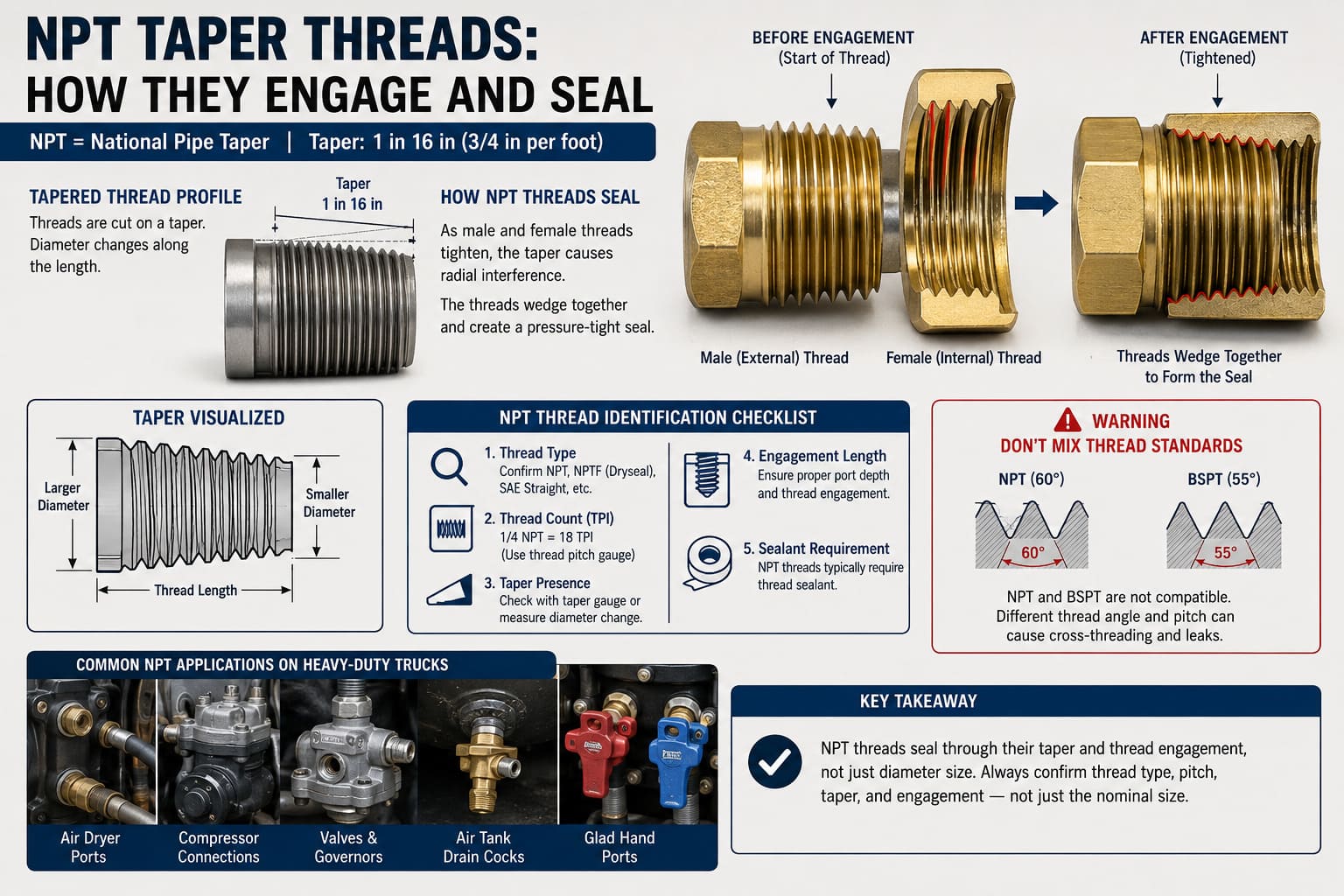
This is fundamentally different from straight (parallel) threads, which rely on a separate sealing element — like an O-ring or gasket — and don't seal through thread engagement alone.
What This Means When Replacing Truck Air Fittings
On heavy-duty trucks, NPT threads appear throughout the air system:
- Air dryer ports
- Governor and compressor connections
- Glad hand and airline bracket ports
- Valve body inlets and outlets
- Tank drain cocks and pressure protection valves
When a fitting needs replacement, the technician or procurement buyer needs to confirm several things — not just diameter:
- Thread type: Is it NPT, NPTF (Dryseal), SAE straight, or another standard? (NPTF threads also taper but have tighter tolerances for metal-to-metal sealing without sealant — they're not identical to NPT despite looking similar.8)
- Thread count (TPI): 1/4 NPT has 18 threads per inch.9 This is verifiable with a thread pitch gauge.
- Taper presence: Check with a taper gauge or by feel — a tapered thread will show measurable diameter change from one end of the threaded section to the other.
- Engagement length and port depth: A fitting must reach the right seating depth without bottoming out or leaving threads exposed and unsealed.
- Sealant requirement: NPT threads typically require thread sealant (PTFE tape or anaerobic compound). NPTF threads are designed for drysealing but often use sealant in practice for additional security.
A Brief Warning on Thread Standard Interchange
NPT is not universally compatible with other taper thread standards. BSPT (British Standard Pipe Taper) looks similar and also tapers, but uses a different thread angle (55° vs. NPT's 60°) and different pitch values. Mixing these in a truck air system can result in cross-threading, poor sealing, or slow leaks that are difficult to diagnose.
If you're sourcing fittings from multiple suppliers or importing parts, confirm the thread standard explicitly — not just the nominal size. At ROADSPOWER, we specify both thread type and NPT designation on product documentation precisely because "1/4 inch" is not enough information to confirm compatibility.
How Should Distributors and Repair Shops Actually Identify 1/4 NPT Fittings?
The right replacement fitting for a truck air system port isn't confirmed by one measurement. It's confirmed by a short checklist that any parts counter or shop floor can apply consistently.
Replace the "measure with calipers" habit with a systematic thread identification process. For NPT threads, correct identification requires verifying thread standard, taper, TPI, and application fit — not outside diameter alone.
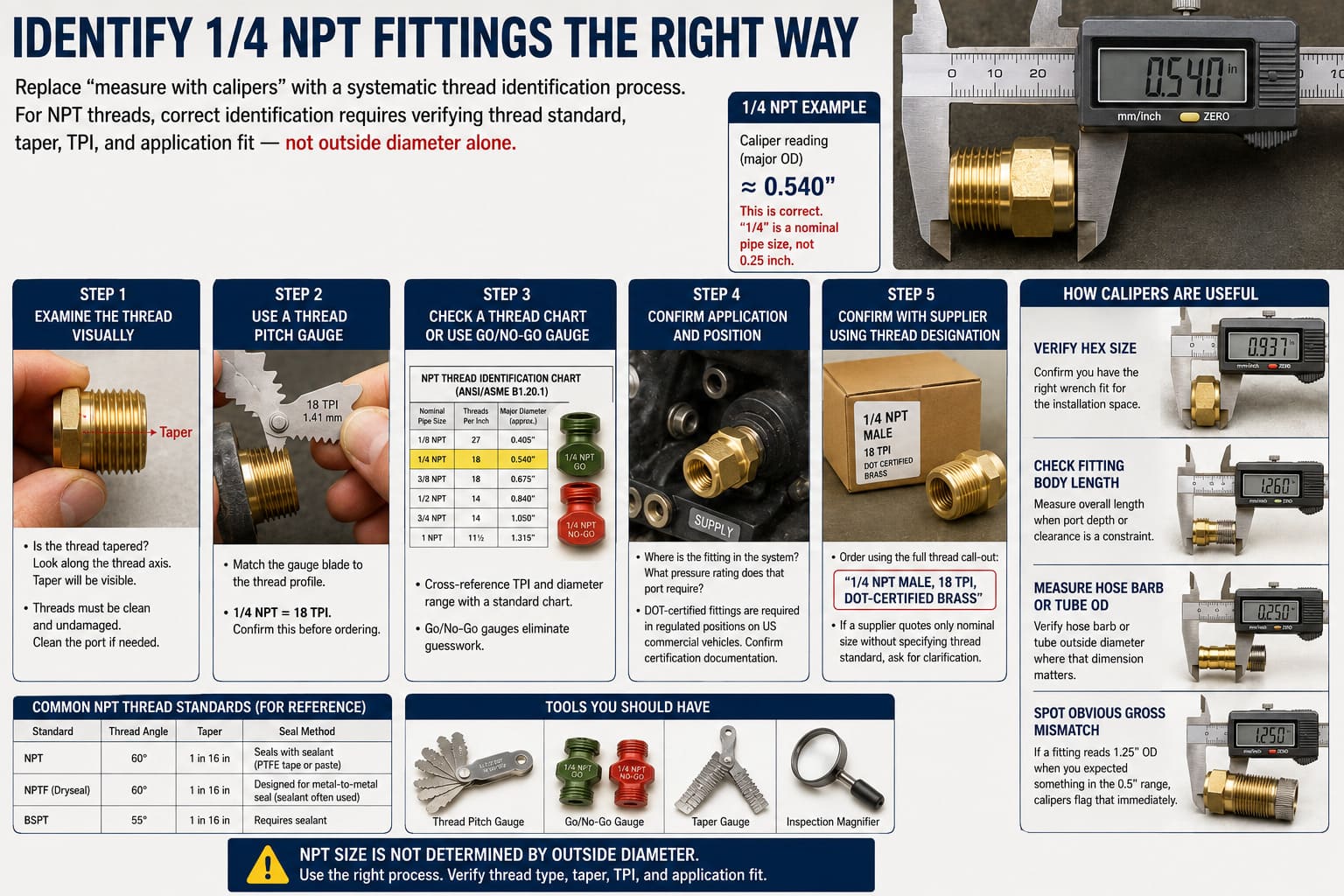
Practical Thread Identification Checklist
Here's the process we recommend to distributors and repair shops when they're replacing an NPT fitting in a truck air system:
Step 1 — Remove the fitting and examine the thread visually
- Is the thread tapered? Hold it to eye level and look along the thread axis. Taper will be visible.
- Are threads clean and undamaged? Damaged threads require port cleaning before replacement.
Step 2 — Use a thread pitch gauge
- Count threads per inch by matching the gauge blade to the thread profile.
- 1/4 NPT = 18 TPI. Confirm this before ordering.
Step 3 — Check a thread identification chart or use a go/no-go gauge
- Cross-reference TPI and approximate diameter range against a standard NPT identification chart.
- For high-volume operations, go/no-go gauges eliminate guesswork entirely.
Step 4 — Confirm application and position
- Where is the fitting in the system? What pressure rating does that port require?
- DOT-certified fittings are required in regulated positions on US commercial vehicles.10 Confirm certification documentation from your supplier.
Step 5 — Confirm with your supplier using thread designation, not just caliper readings
- Order using the full thread call-out: e.g., "1/4 NPT male, 18 TPI, DOT-certified brass."
- If a supplier quotes only nominal size without specifying thread standard, ask for clarification.
What Caliper Measurements Are Useful For
Calipers still have a role in fitting verification — just not for confirming NPT size directly. Use them to:
- Verify hex size to confirm you have the right wrench fit for the installation space
- Check fitting body length when port depth or clearance is a constraint
- Measure hose barb or tube OD on a hose-end fitting where that dimension matters
- Spot obvious gross mismatch — if a fitting reads 1.25 inch OD when you expected something in the 0.5-inch range, calipers flag that immediately
Frequently Asked Questions
If 1/4 NPT isn't 0.25 inch, what is the actual thread diameter?
The major (outside) diameter of a 1/4 NPT male thread is approximately 0.540 inch, per published NPT dimension tables consistent with ANSI/ASME B1.20.1. This is substantially larger than the nominal "1/4" designation. Always verify the current standard before using dimensions in technical specifications or purchase orders.
Can I use a 1/4 NPT fitting in a 1/4 BSPT port on a truck?
No — not safely. NPT and BSPT threads are not interchangeable. They use different thread angles (60° vs. 55°) and different pitch values, even when the nominal size matches. Forcing an NPT fitting into a BSPT port can result in poor thread engagement, air leaks, or port damage. Always confirm thread standard, not just nominal size.
How do I identify a 1/4 NPT thread in the field without a gauge?
Use a thread pitch gauge to confirm 18 TPI, which is the standard for 1/4 NPT. Visually check for taper by sighting along the thread axis. Cross-reference with a printed NPT identification chart. If you're uncertain, bring the removed fitting to your distributor for confirmation before ordering a replacement.
Does NPT size correspond to hose ID or tube OD?
No. NPT nominal size, hose inner diameter, and tube outer diameter are independent dimensions.11 A 1/4 NPT fitting on a hose end does not mean the hose ID is 0.25 inch. Always specify each dimension separately when ordering air line assemblies or fittings.
Are DOT-certified fittings required for truck air line applications?
In the United States, fittings used in regulated positions on commercial vehicle air brake systems must meet DOT requirements under FMVSS standards. Buyers should verify that their supplier provides documentation confirming DOT certification for the specific fitting and application. Consult a qualified engineer or compliance specialist for application-specific determinations.
Conclusion
1/4 NPT is not 0.25 inch — and understanding why is genuinely useful for anyone sourcing or replacing truck air line fittings. The "1/4" is a nominal pipe size label tied to a historical bore convention, not a thread measurement. The actual thread OD is substantially larger, and the sealing function depends on taper, thread engagement, and proper installation — none of which a caliper reading alone can confirm.
For distributors, wholesalers, and repair shop owners, the practical takeaway is simple: identify NPT fittings by thread standard, TPI, and taper — not by diameter. That process eliminates the most common ordering errors and prevents the rejection of correct parts.
At ROADSPOWER, we work with truck parts buyers across North and South America who need reliable, DOT-certified brass fittings and air line components. If your team is evaluating a fitting replacement or building a sourcing checklist for your air system inventory, we're glad to share our thread identification resources and product documentation. Contact our team to discuss your application.
"NPT - American National Standard Taper Pipe Threads", https://www.engineeringtoolbox.com/npt-national-pipe-taper-threads-d_750.html. Authoritative NPT dimension tables based on ASME B1.20.1 list 1/4 NPT as a nominal pipe thread size with a basic outside diameter of about 0.540 inch, supporting the distinction between the nominal designation and the measured thread diameter. Evidence role: general_support; source type: institution. Supports: A standard or engineering reference should show that 1/4 NPT has a major outside diameter much larger than 0.25 inch and is identified by nominal pipe size.. Scope note: Public summaries may reproduce standard dimensions but do not replace the paid current ASME standard for specification control. ↩
"FAQ-ASME B1.20.1 Pipe Threads", https://www.modulusmetal.com/faq-asme-b1-20-1-pipe-threads/. ASME-derived NPT dimension data identify 1/4-18 NPT with a basic outside thread diameter of approximately 0.540 inch, corroborating that the measured major diameter is not 0.25 inch. Evidence role: statistic; source type: institution. Supports: The source should confirm the 1/4-18 NPT basic major diameter or outside diameter value near 0.540 inch.. Scope note: The citation supports the nominal basic dimension; manufacturing tolerances and measurement location on a tapered thread can affect field readings. ↩
"Nominal Pipe Size", https://en.wikipedia.org/wiki/Nominal_Pipe_Size. Reference material on Nominal Pipe Size explains that NPS is a legacy North American pipe designation associated historically with approximate pipe inside diameter, providing context for why a nominal 1/4 pipe thread is not measured as 0.25 inch across the thread. Evidence role: historical_context; source type: encyclopedia. Supports: The source should explain that nominal pipe size is a historical designation related to pipe bore or inside diameter rather than a direct measured outside diameter.. Scope note: This supports the historical context of the naming convention, not the exact dimensions of every current NPT product. ↩
"Nominal Pipe Size", https://en.wikipedia.org/wiki/Nominal_Pipe_Size. Definitions of Nominal Pipe Size describe it as a North American nominal designation for pipes, historically associated with approximate inside diameter rather than the geometry of a pipe thread itself. Evidence role: definition; source type: encyclopedia. Supports: The source should define NPS and describe its relationship to nominal or historical pipe inside diameter rather than thread form geometry.. Scope note: Modern pipe schedules mean actual inside diameters vary, so the source provides definitional context rather than a direct sizing rule for every pipe or fitting. ↩
"How to identify NPT thread: a step-by-step field guide", https://www.fastercouplings.com/blog/how-to-identify-npt-thread-390. Technical thread-identification guides describe NPT recognition as involving nominal size, thread pitch, and taper, supporting the article’s point that caliper diameter alone is insufficient for reliable identification. Evidence role: general_support; source type: education. Supports: The source should support that NPT thread identification requires more than a single outside-diameter measurement, including pitch and taper checks.. Scope note: Such guides support general identification practice; they do not prove that every individual field error results from caliper-only measurement. ↩
"National Standard Taper Pipe Threads Size NPT Chart", https://www.engineersedge.com/hardware/taper-pipe-threads.htm. Standards-based descriptions of National Pipe Taper threads specify a taper of 1 in 16 on diameter, equivalent to 3/4 inch per foot, supporting the stated geometry of NPT threads. Evidence role: definition; source type: institution. Supports: The source should confirm that National Pipe Taper threads use a 1:16 taper, or 3/4 inch per foot.. Scope note: The citation addresses the standardized thread form; worn, damaged, or nonconforming parts may deviate from the ideal taper. ↩
"Basic Pipe Threads Explained - Swagelok Georgia", https://georgia.swagelok.com/en/blog/basic-pipe-threads-explained-11-19. Engineering references on tapered pipe threads explain that tightening mating NPT threads produces radial interference between the tapered male and female threads, which is the mechanical basis for sealing the joint. Evidence role: mechanism; source type: education. Supports: The source should explain that tapered pipe threads create increasing interference as they are tightened, forming the basis of the joint seal.. Scope note: Many references also note that NPT joints commonly require sealant, so the mechanism alone should not be read as proof of leak-tight sealing in all installations. ↩
"Getting to Leakproof with NPT & NPTF Threads: What Matters", https://www.industrialspec.com/about-us/blog/detail/npt-nptf-tapered-threads-and-leakproof-seals?srsltid=AfmBOoqowicV6HqRhXySILMUxooT3lyiXvX77pgkmblgPt7SVcv7xIZ_. Standards and engineering references for Dryseal pipe threads describe NPTF as a tapered thread form related to but dimensionally distinct from NPT, designed to achieve metal-to-metal sealing with controlled crest and root truncation. Evidence role: definition; source type: institution. Supports: The source should support that NPTF is a Dryseal tapered pipe thread standard with dimensional differences from NPT intended to improve metal-to-metal sealing.. Scope note: The citation supports the design intent and standard distinction; actual leak performance still depends on material, assembly condition, and workmanship. ↩
"National Standard Taper Pipe Threads Size NPT Chart", https://www.engineersedge.com/hardware/taper-pipe-threads.htm. NPT dimension tables derived from ASME B1.20.1 identify the 1/4 inch nominal pipe thread as 1/4-18 NPT, confirming the standard pitch of 18 threads per inch. Evidence role: statistic; source type: institution. Supports: The source should confirm that 1/4 NPT is specified as 1/4-18 NPT, meaning 18 threads per inch.. Scope note: The citation supports the standard pitch designation; it does not verify the condition or conformity of any particular fitting measured in the field. ↩
"Interpretation ID: 04-009159drn", https://www.nhtsa.gov/interpretations/04-009159drn. U.S. federal motor vehicle safety regulations, including NHTSA standards for brake systems and brake hoses, set performance and compliance requirements for regulated air-brake components, supporting the need to verify DOT-compliant fittings in applicable vehicle positions. Evidence role: general_support; source type: government. Supports: The source should establish that U.S. federal motor vehicle safety regulations govern air brake hose assemblies, fittings, or brake-system components used on commercial vehicles.. Scope note: The citation provides regulatory context; determining whether a specific fitting in a specific location requires certification may require application-specific legal or engineering review. ↩
"Is there any reason why the NPT standard is so illogical? ...", https://www.reddit.com/r/Machinists/comments/pfwotb/is_there_any_reason_why_the_npt_standard_is_so/. Fluid-connector sizing references distinguish pipe-thread designations from hose inside diameter and tube outside diameter, supporting the article’s statement that these dimensions must be specified independently when selecting fittings or assemblies. Evidence role: general_support; source type: education. Supports: The source should support that thread designation, hose inside diameter, and tubing outside diameter are separately specified dimensions in fluid-connector systems.. Scope note: The citation supports general sizing conventions; individual catalog part numbers may combine several dimensions in supplier-specific ways. ↩