Brake chambers are one of the most safety-critical components in a heavy-duty truck's air brake system — yet they are also one of the most commonly misidentified parts in the procurement process. When distributors, repair shops, or fleet buyers search for a replacement brake chamber, ordering the wrong type can mean delayed repairs, wasted freight costs, or a vehicle that fails its brake inspection.1
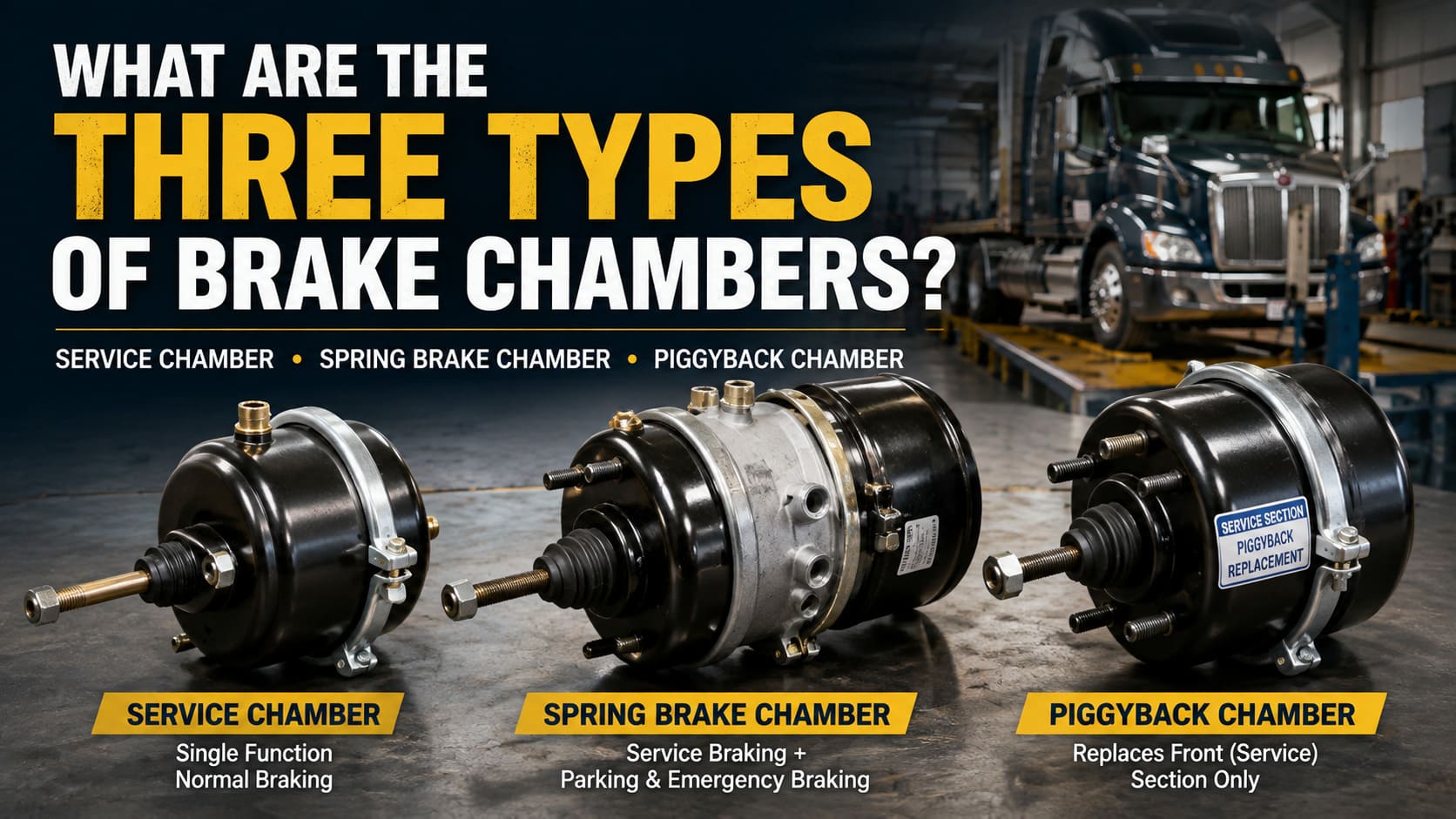
Brake chambers in heavy-duty air brake systems fall into three functional types: service brake chambers, spring brake chambers (also called spring brake actuators), and piggyback chambers.2 Service chambers handle normal stopping. Spring brake chambers add parking and emergency brake functions. Piggyback chambers are replacement rear sections of a spring brake assembly. Understanding which type you need — before you order — is the most important step in the replacement process.
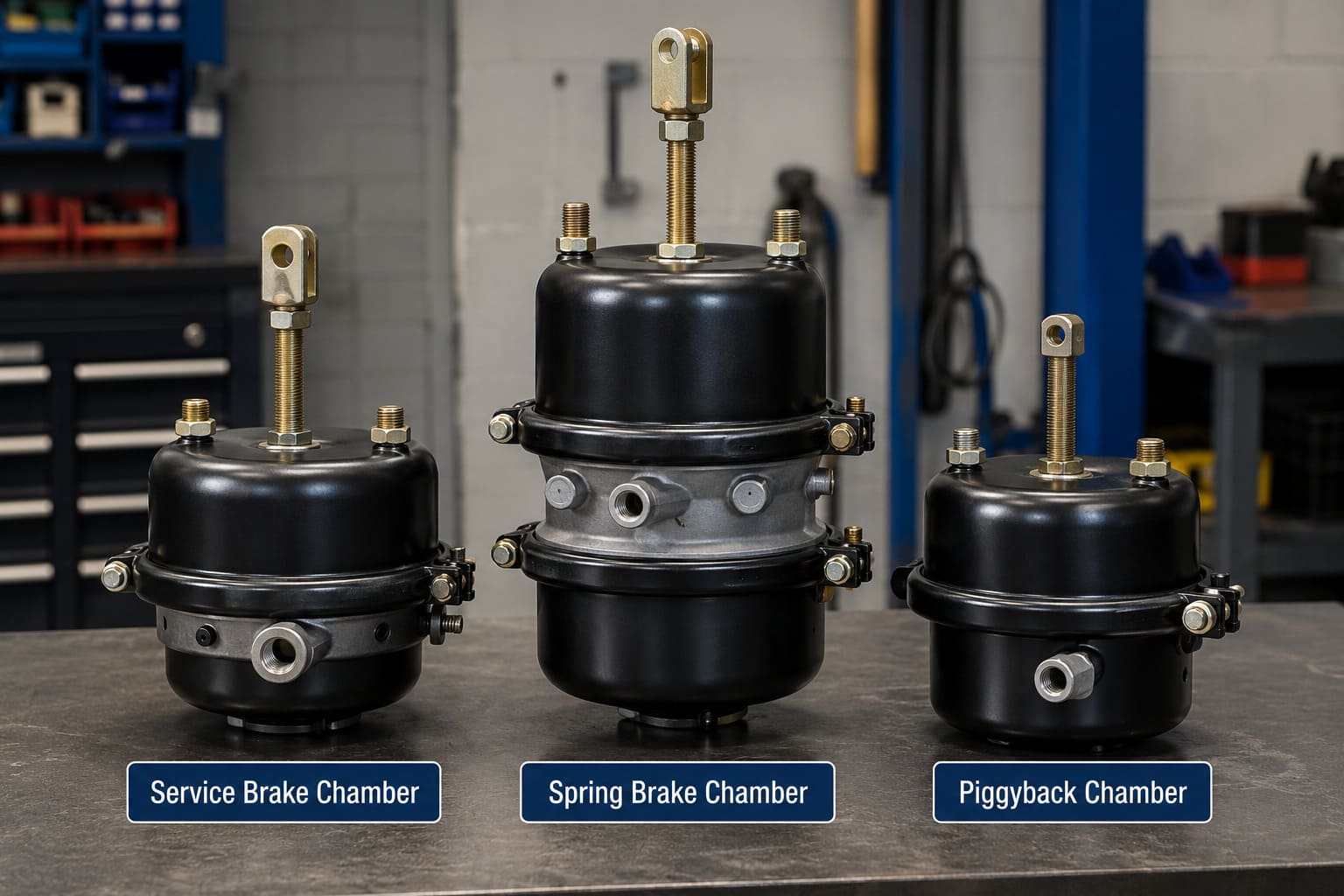
Knowing the names is only the beginning. The real purchasing risk comes from what buyers often get wrong: confusing chamber size numbers with chamber types, assuming that two chambers that look similar are interchangeable, or ordering a piggyback unit when the full spring brake assembly needs replacement. The sections below break down each type and explain what to verify before placing an order.
What Is a Service Brake Chamber?
When a truck stops on the highway, one component converts air pressure into mechanical force to push the brake shoes or pads against the drum or rotor. That component is the service brake chamber — and without it, the vehicle has no normal stopping power.
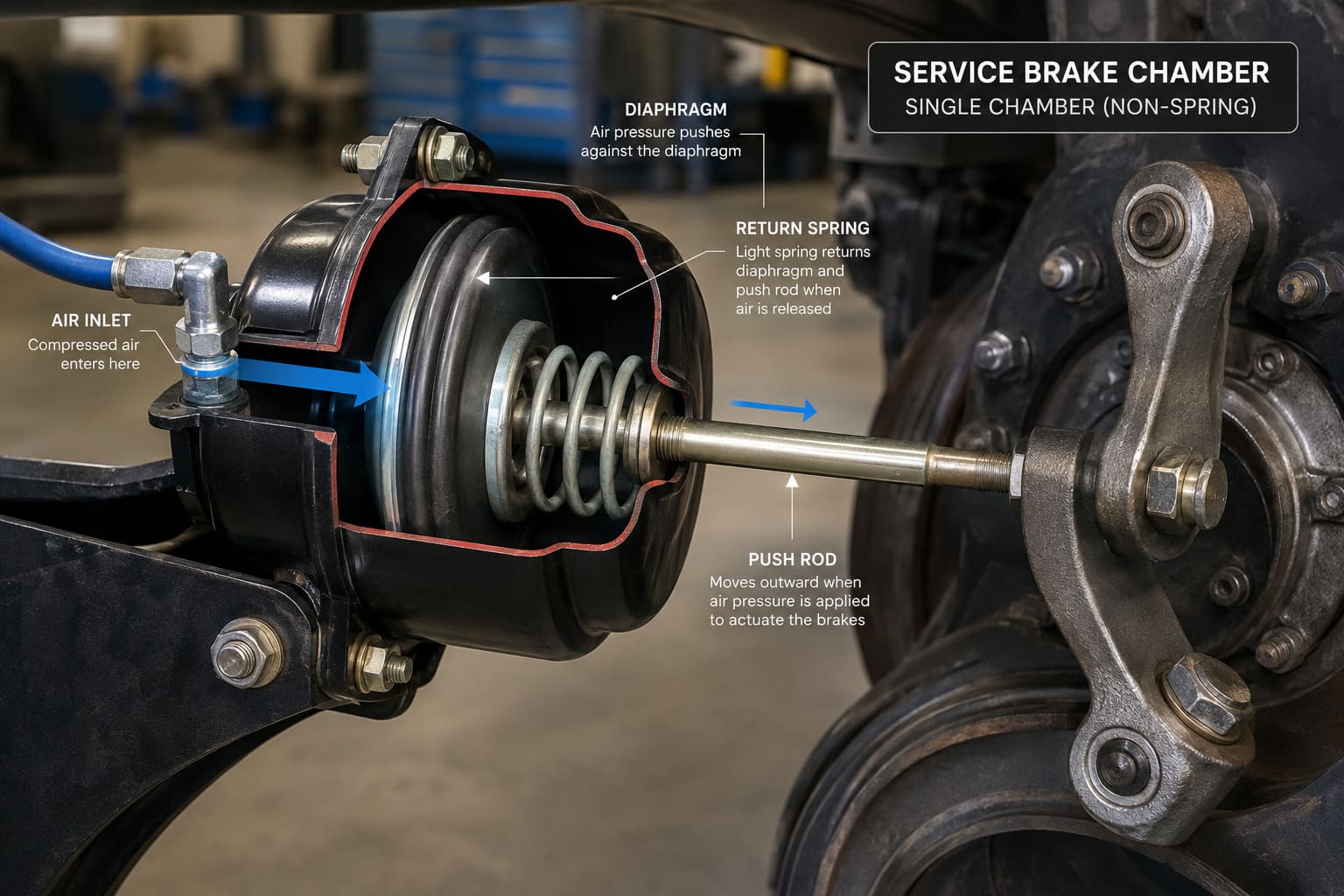
A service brake chamber is a single-function pneumatic actuator. When the driver presses the brake pedal, compressed air enters the chamber, pushes against a flexible diaphragm, and extends the push rod to apply the foundation brakes.3 When air pressure releases, an internal return spring retracts the push rod and the brakes release.
Where Are Service Chambers Used?
Service-only chambers are most commonly found on steer axles of trucks and on trailer axles where the brake system relies on spring-loaded slack adjusters and separate parking mechanisms.4 They are not designed to provide parking or emergency brake holding force on their own.
Key Identification Features
| Feature | Service Chamber |
|---|---|
| Housing sections | Single (one chamber) |
| Parking/emergency function | No |
| Spring inside | Return spring only (light) |
| Common axle position | Steer axle, trailer axle |
| Air ports | Typically one service port |
What Buyers Need to Know Before Ordering
A service brake chamber appears deceptively simple. It is a round canister with a push rod. However, several variables must be confirmed before purchasing:
- Chamber size (type number): Type 20, Type 24, Type 30, and others refer to the effective diaphragm area in square inches.5 This is not the chamber type — it is the size. Two service chambers can both be "Type 24" but have different stroke lengths or mounting configurations.
- Stroke rating: Standard stroke and long stroke versions exist.6 Using a standard-stroke chamber in an application that requires long stroke will result in insufficient push rod travel and incomplete brake application.7 This is a safety-critical mismatch.
- Port location and orientation: The air inlet port position affects how the air line connects. On some axle positions and chassis configurations, port direction matters for clean installation.
- Mounting style: Bolt-circle pattern and bracket compatibility must match the vehicle's existing mount.
A note from our experience: In pre-sales inquiries from repair shops and distributors, our team regularly encounters requests where the customer describes a service chamber by size alone — "I need a Type 24." But without knowing the stroke, port direction, and vehicle application, size alone is not enough to confirm the right part. We always ask for the old part label, a photo, and the vehicle's axle position before confirming a match.
What Is a Spring Brake Chamber?
A spring brake chamber does everything a service chamber does — and adds a critical second function that keeps a parked truck from rolling and provides emergency stopping force if air pressure is lost.
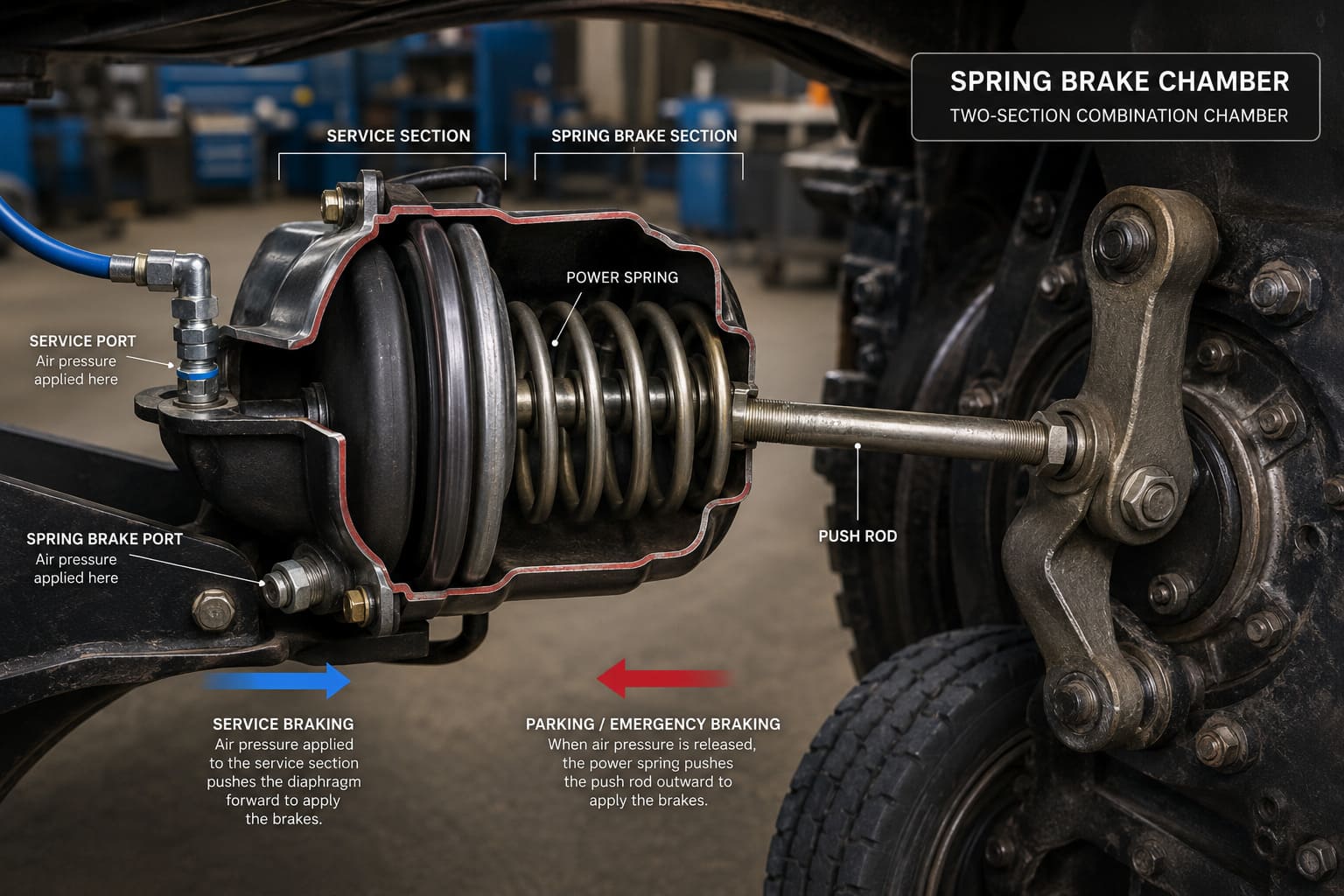
A spring brake chamber (also called a spring brake actuator or combination chamber) is a two-section unit. The front section is a service chamber that works exactly as described above. The rear section contains a heavy-duty power spring. When air pressure in the rear section drops — either because the driver sets the parking brake or because the system loses air — the power spring extends and applies the brakes mechanically.8
Why Spring Brake Chambers Are Different From Service Chambers
This is the most important distinction for buyers to internalize: a spring brake chamber and a service chamber are not interchangeable, even if they appear similar in outer diameter or overall size. The spring brake's rear section contains a compressed power spring under significant stored energy. This is why brake system disassembly must always be performed by qualified technicians following proper procedures — releasing a caged power spring incorrectly is a serious safety hazard.9
Where Are Spring Brake Chambers Used?
Spring brake chambers are standard on the drive axles of tractors and on the rear axles of heavier trailers. They provide the parking and emergency brake function required by FMVSS (Federal Motor Vehicle Safety Standards) regulations in North America.10
Key Identification Features
| Feature | Spring Brake Chamber |
|---|---|
| Housing sections | Two (service + spring brake) |
| Parking/emergency function | Yes |
| Spring inside | Heavy-duty power spring (rear) + return spring (front) |
| Common axle position | Drive axle (tractor rear) |
| Air ports | Service port + spring brake port |
What Buyers Need to Know Before Ordering
Spring brake chambers carry additional verification requirements beyond what a service chamber requires:
- Clamp ring vs. welded rear housing: Some spring brake chambers use a clamp ring construction on the rear (spring) section; others are welded. This affects whether the rear section can be serviced separately.
- Spring brake hold-off pressure: The air pressure required to compress the power spring and release the parking brake varies. Mismatches can affect brake system balance across axles.
- Piggyback compatibility: If only the service (front) section has failed, a piggyback replacement may be appropriate. If the entire assembly has failed, the full spring brake chamber needs replacement. These two scenarios require different parts.
- Stroke and size still apply: All the same size type numbers and stroke ratings apply here. A spring brake chamber is also described with a size designation — for example, a "Type 30/30" unit means a Type 30 service section paired with a Type 30 spring brake section.
What Is a Piggyback Brake Chamber?
The piggyback chamber is the type that most buyers encounter with the least context — and the one most likely to be ordered incorrectly.
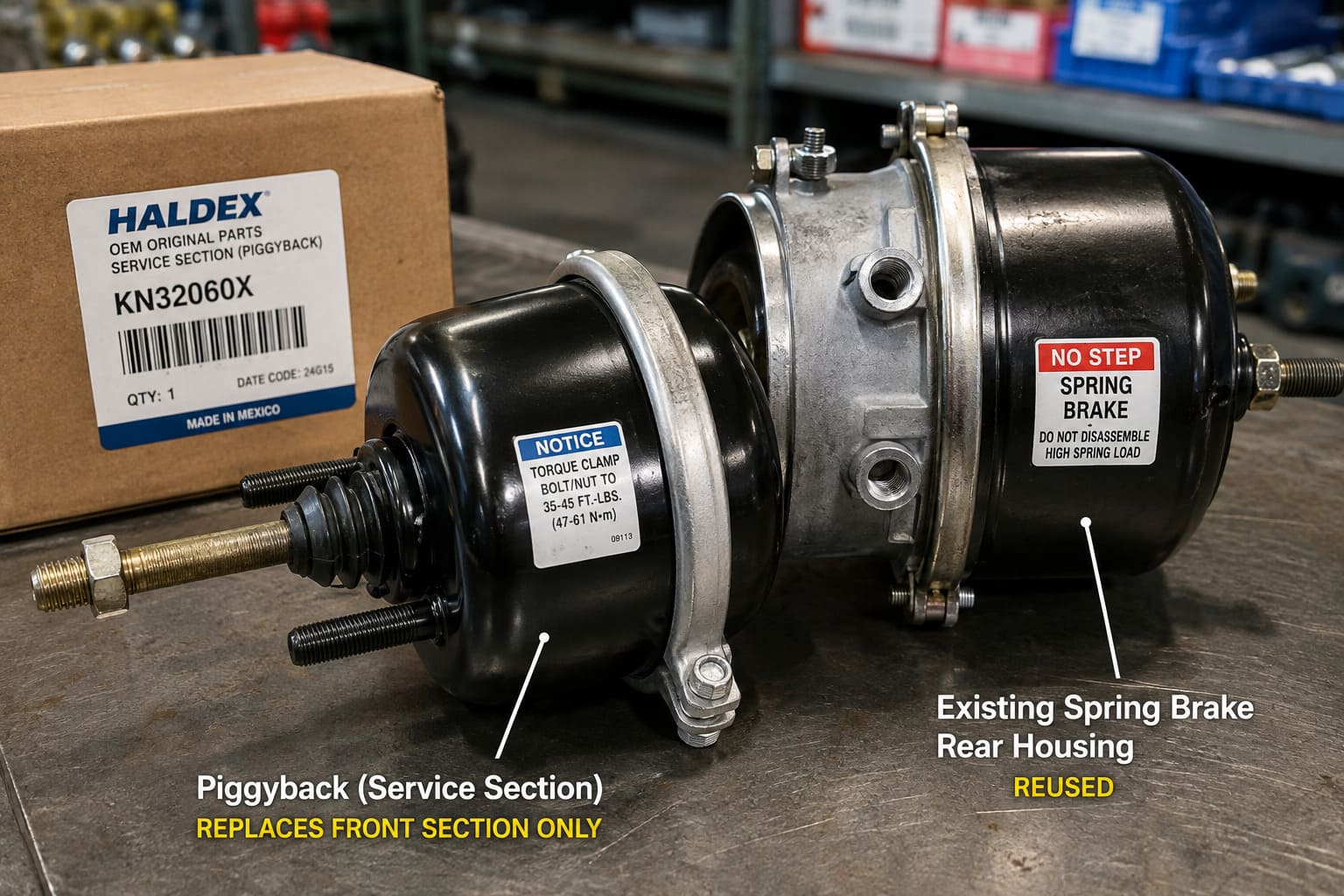
A piggyback chamber (sometimes called a service pot or front section replacement) is a replacement service section designed to be installed on an existing spring brake rear housing.11 It is not a standalone brake chamber. It does not include the power spring or the rear housing of the spring brake assembly.
When Is a Piggyback Chamber the Right Choice?
When a spring brake chamber's service (front) section fails — typically due to a torn diaphragm — but the rear spring brake section is still serviceable, a technician can remove the front section and replace it with a new piggyback unit. This approach avoids replacing the entire spring brake assembly.
However, this only works under the right conditions:
- The rear housing must be in good condition and meet the original specifications.
- The piggyback must match the clamp ring design and size of the existing rear housing.12
- A qualified technician must perform the inspection and replacement — the power spring in the rear housing remains under load during this process.
What Buyers Often Get Wrong With Piggyback Chambers
- Ordering a piggyback when the full assembly needs replacement. If the rear section (spring brake housing) is damaged, cracked, or corroded, a piggyback will not solve the problem.
- Assuming any piggyback fits any spring brake rear housing. Clamp ring diameter, bolt pattern, and size type must match the existing rear section exactly.
- Confusing a piggyback with a service chamber. Piggybacks are designed specifically to mate with a spring brake rear housing. A standard service chamber is built as a complete, standalone unit.
Key Identification Features
| Feature | Piggyback Chamber |
|---|---|
| Housing sections | One (service section only) |
| Parking/emergency function | No (relies on existing rear section) |
| Standalone use | No |
| Clamp ring interface | Required to match existing rear housing |
| Common scenario | Diaphragm failure in front section of spring brake assembly |
From our product communication experience: Distributors who stock brake chambers for repair shops often need both piggyback units and full spring brake assemblies in inventory. The repair shop's technician is the one who determines which is needed after inspecting the failed unit. When a distributor contacts us, we ask whether the customer has already confirmed whether the rear housing is reusable, because that single question changes the product entirely.
Why Chamber Type, Size, and Stroke Are Three Separate Questions
One of the most persistent sources of ordering errors in our pre-sales communication involves buyers conflating chamber type with chamber size. These are completely separate attributes, and both must be confirmed independently.
Type Numbers Refer to Diaphragm Area — Not Chamber Category
When a customer says "I need a Type 30 chamber," they have described the size — specifically, a chamber with approximately 30 square inches of effective diaphragm area. They have not specified whether they need:
- A service chamber
- A spring brake chamber
- A piggyback
A "Type 30" can be any of the three. A spring brake chamber with a Type 30 service section and a Type 30 spring brake section is described as a 30/30 combination. A smaller combination might be 30/24 — a Type 30 spring brake section with a Type 24 service section.
Stroke Rating Is a Third Independent Variable
Even after type and size are confirmed, stroke must be verified separately.
| Stroke Type | Typical Push Rod Travel | Common Application |
|---|---|---|
| Standard stroke | Up to 2.5 inches (Type 30) | Most standard drive axle applications |
| Long stroke | Up to 3.0 inches (Type 30LS) | Extended travel, some specific configurations |
Using a standard-stroke chamber in a long-stroke application results in incomplete brake application — the push rod does not travel far enough to fully engage the brakes at full air pressure. This is not visible to the naked eye during installation but will affect braking performance and may cause a brake inspection failure.
A Verification Checklist Before Ordering
Before ordering any brake chamber — service, spring brake, or piggyback — a buyer or procurement team should be prepared to confirm:
- [ ] Old part label or OEM part number (if still legible)
- [ ] Chamber type (service, spring brake, or piggyback)
- [ ] Chamber size (type number, e.g., Type 24, Type 30, 30/30)
- [ ] Stroke rating (standard or long stroke)
- [ ] Vehicle make, model, and year
- [ ] Axle position (steer, drive, trailer)
- [ ] Port quantity and orientation
- [ ] Mounting bracket compatibility
- [ ] Clamp ring design (for piggyback and spring brake units)
- [ ] Photos of the old unit (front, rear, label side)
This checklist is not bureaucratic caution — it reflects the real information our team needs to confirm a match before recommending a part.
Frequently Asked Questions
Can I replace a spring brake chamber with a service chamber?
No. A service chamber does not have a power spring and cannot provide parking or emergency brake function. Replacing a spring brake chamber with a service-only chamber would eliminate the parking and emergency brake capability on that axle. This is both a compliance issue under FMVSS regulations and a serious safety risk. Always replace like-for-like unless a qualified brake system engineer has evaluated the change.
What does "Type 30" mean on a brake chamber?
Type 30 refers to the effective diaphragm area of the chamber — approximately 30 square inches. It describes the size of the chamber, not its functional category. A Type 30 chamber can be a service chamber, a spring brake chamber, or a piggyback unit. Chamber type, size, and stroke must all be confirmed separately before ordering.
Is a piggyback chamber the same as a service chamber?
No. A piggyback chamber is a service section specifically designed to attach to an existing spring brake rear housing using a clamp ring interface. A service chamber is a complete, standalone unit. They may look similar in shape but are not interchangeable. Using a standard service chamber where a piggyback is needed — or vice versa — will result in a fitment failure.
How do I know if my spring brake chamber needs full replacement or just a piggyback?
A qualified technician must inspect the rear housing (spring brake section) to determine whether it is still serviceable. If the rear housing is structurally sound and dimensionally correct, a piggyback replacement of the front service section may be appropriate. If the rear housing is damaged, corroded, or out of specification, the entire spring brake assembly should be replaced. Do not make this determination based on appearance alone.
Do brake chambers need to match on both sides of the same axle?
Yes. Both brake chambers on the same axle should be of the same type, size, and stroke to ensure balanced braking force. Mismatched chambers on the same axle can cause uneven brake application, pulling, and accelerated lining wear. When replacing one chamber, verify that the replacement matches the unit on the opposite side.
Conclusion
Understanding the three types of brake chambers — service chambers, spring brake chambers, and piggyback chambers — is the foundation of accurate replacement and smart procurement. Each type serves a distinct function, and no two types are interchangeable, even when they appear similar in size or shape. Beyond type, buyers must independently confirm chamber size, stroke rating, mounting details, and application fit before placing an order.
At ROADSPOWER, our team works directly with heavy-duty truck parts distributors, repair shops, and fleet procurement teams across North and South America. In that daily communication, we see the same sourcing confusion repeat itself — and the most common cause is incomplete information at the point of inquiry. If you are sourcing brake chambers and want to confirm the right type, size, and specification for your application, contact us with your old part label, photos, and vehicle details. We will help you identify the right option before an order is placed.
"5.1.1 Brake Systems (Part 393 Subpart C) - CSA", https://csa.fmcsa.dot.gov/safetyplanner/MyFiles/SubSections.aspx?ch. Federal and roadside inspection materials treat brake defects, including brake actuator and adjustment problems, as safety-relevant violations that can affect inspection outcomes; this supports the inspection-risk aspect of incorrect brake chamber selection, although it does not quantify freight or repair-delay costs. Evidence role: general_support; source type: government. Supports: A regulatory inspection source should show that defective, mismatched, or noncompliant brake components can cause commercial vehicles to fail roadside or safety inspections.. Scope note: The source is likely to support inspection consequences directly but not the commercial cost consequences. ↩
"5.1.1 Brake Systems (Part 393 Subpart C) - CSA", https://csa.fmcsa.dot.gov/safetyplanner/MyFiles/SubSections.aspx?ch. A commercial-vehicle air-brake reference identifies service chambers and spring brake actuators as distinct pneumatic brake components, with service sections also used in replacement assemblies; this supports the article's functional classification, although terminology such as "piggyback" may vary by service manual. Evidence role: definition; source type: government. Supports: A neutral technical or regulatory source should define the main brake chamber/actuator categories used in commercial vehicle air brake systems.. Scope note: The source may describe piggyback units as service replacement sections rather than as a separate regulatory category. ↩
"Anti Derailment Sensor System Phase I Feasibility Study Apr ...", https://railroads.dot.gov/sites/fra.dot.gov/files/fra_net/14601/Anti%20Derailment%20Sensor%20System%20Phase%20I%20Feasibility%20Study%20Apr%201973.pdf. Air-brake training materials describe the service brake chamber as a diaphragm actuator in which compressed air moves the diaphragm and push rod to apply the foundation brake; this directly supports the described operating mechanism. Evidence role: mechanism; source type: education. Supports: A technical education source should explain how air pressure acts on a diaphragm in a brake chamber to move the push rod and apply the brakes.. ↩
"49 CFR Part 393 Subpart C -- Brakes - eCFR", https://www.ecfr.gov/current/title-49/subtitle-B/chapter-III/subchapter-B/part-393/subpart-C. Commercial vehicle brake-system references distinguish service chambers from spring brake actuators and commonly describe service chambers as providing service-brake actuation without an internal parking spring; this supports the application distinction, although exact axle placement can vary by vehicle design. Evidence role: general_support; source type: institution. Supports: A commercial vehicle brake-system reference should indicate typical axle applications for service chambers and distinguish them from spring brake actuators.. Scope note: The source may support the functional distinction more strongly than the word "most commonly" for axle placement. ↩
"5.1.1 Brake Systems (Part 393 Subpart C) - CSA", https://csa.fmcsa.dot.gov/safetyplanner/MyFiles/SubSections.aspx?ch. Technical brake references define chamber type designations such as Type 24 and Type 30 by the chamber's nominal effective diaphragm area in square inches; this supports the article's distinction between chamber size and chamber function. Evidence role: definition; source type: institution. Supports: A standards or technical reference should define brake chamber type numbers as nominal/effective diaphragm areas.. ↩
"49 CFR Part 393 Subpart C -- Brakes", https://www.ecfr.gov/current/title-49/subtitle-B/chapter-III/subchapter-B/part-393/subpart-C. Commercial vehicle inspection guidance distinguishes brake chambers by rated stroke and includes separate limits for standard-stroke and long-stroke chambers; this supports the statement that both versions are recognized specifications. Evidence role: definition; source type: government. Supports: A government inspection or compliance source should describe standard-stroke and long-stroke brake chamber classifications.. ↩
"49 CFR Part 393 Subpart C -- Brakes", https://www.ecfr.gov/current/title-49/subtitle-B/chapter-III/subchapter-B/part-393/subpart-C. Federal inspection criteria use brake chamber rated stroke and measured push-rod travel to determine whether brakes are within allowable adjustment, supporting the safety significance of using the correct stroke rating; the source establishes the stroke-performance relationship rather than testing this exact installation error. Evidence role: mechanism; source type: government. Supports: A regulatory or inspection source should connect rated brake chamber stroke, push-rod travel limits, and adequate brake application.. Scope note: The source may not specifically test a standard-stroke chamber substituted into a long-stroke application. ↩
"5.1.1 Brake Systems (Part 393 Subpart C) - CSA", https://csa.fmcsa.dot.gov/safetyplanner/MyFiles/SubSections.aspx?ch=22&sec=64&sub=130. Air-brake training and regulatory materials describe spring brake actuators as using air pressure to compress or hold off a power spring, with the spring applying the brakes when pressure is released; this directly supports the article's description of parking and emergency operation. Evidence role: mechanism; source type: government. Supports: A neutral air-brake reference should explain that spring brake actuators use air pressure to hold off a mechanical spring and apply brakes when pressure is released.. ↩
"1910.217 - Mechanical power presses. | Occupational Safety and ... - OSHA", https://www.osha.gov/laws-regs/regulations/standardnumber/1910/1910.217. Safety guidance for spring brake actuators warns that the power spring is under stored mechanical energy and must be handled only according to prescribed service procedures; this supports the article's warning about incorrect release, although the exact phrase "caged power spring" may differ across sources. Evidence role: expert_consensus; source type: government. Supports: A safety or technical source should warn that spring brake chambers contain stored spring energy and require proper service procedures.. Scope note: The source may address stored-energy hazards generally rather than the specific procedure named in the article. ↩
"49 CFR 571.121 -- Standard No. 121; Air brake systems. - eCFR", https://www.ecfr.gov/current/title-49/subtitle-B/chapter-V/part-571/subpart-B/section-571.121. FMVSS No. 121 specifies performance requirements for air brake systems, including parking-brake and emergency-brake functions for covered commercial vehicles; this supports the regulatory basis for those functions, while not prescribing one specific actuator design for every configuration. Evidence role: historical_context; source type: government. Supports: A federal regulation should show that vehicles covered by FMVSS 121 must meet parking and emergency brake requirements.. Scope note: The regulation establishes required functions but may not state that spring brake chambers are the only permissible means of compliance. ↩
"Air Brake Chambers (PiggyBacks) Change Out - The Easy Way",
. Technical brake-service references describe piggyback chambers as replacement service sections intended to mate with an existing spring brake housing; this supports the article's definition, although naming conventions may vary among manuals. Evidence role: definition; source type: institution. Supports: A technical parts or training source should define piggyback brake chambers as service-section replacements for spring brake assemblies.. Scope note: The source may use alternative terms such as replacement service chamber or service section. ↩"How to Identify Complete, Piggyback, and Service & Complete Brake ...",
. Brake service guidance requires replacement service sections to match the existing spring-brake housing interface and dimensions, including clamp-ring compatibility; this supports the article's fitment requirement, though exact dimensional checks may depend on the specific chamber family. Evidence role: general_support; source type: institution. Supports: A technical service source should state that replacement service sections must match the existing spring brake housing interface and dimensions.. Scope note: The source may discuss compatibility in general terms rather than listing every clamp-ring dimension. ↩