Most procurement conversations about truck air brake fittings start with size, thread type, and unit price. I hear it every week. A distributor sends me a list of part numbers, asks for a quote, and wants to know if my brass fittings can match their current cost. That is a reasonable starting point. But what happens when those fittings leave the warehouse shelf and spend 100,000 miles on a Freightliner running through Colorado mountain passes? That is the question vibration resistance forces us to answer — and it is the one that separates a supplier conversation from a real quality evaluation.
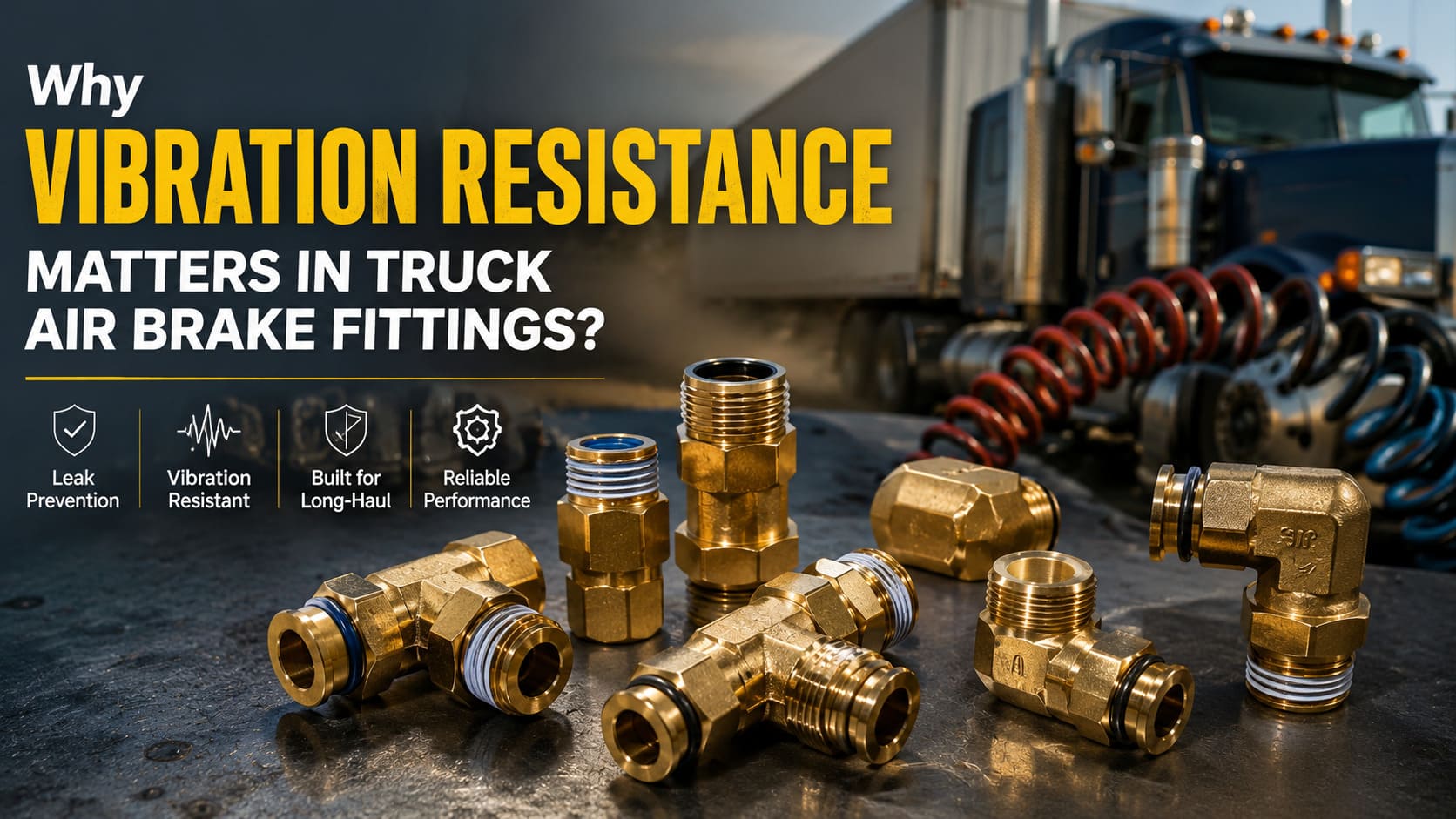
Vibration resistance matters in truck air brake fittings because a fitting that passes a static bench test can still fail on the road when constant engine vibration, road shock, and trailer movement gradually loosen the connection, compromise the seal, and create slow leaks1 that lead to brake system pressure loss2, increased warranty claims, and damaged distributor reputation over time.

Here is the problem I want to walk you through today. As a supplier, I do not get to choose where my fittings end up. They could go to a fleet running long-haul routes across the Midwest, or they could go to a distributor serving logging trucks in South America. The same fitting needs to hold air pressure in both conditions. And when it does not, nobody calls the factory first. They call the distributor who sold it to them.
What Happens When Air Brake Fittings Face Constant Vibration?
A truck is not a stationary air system. It is a moving platform with a diesel engine vibrating at idle, a suspension system absorbing road impacts, and air lines flexing with every turn and brake application3. When a brass fitting is threaded into an air valve or connected to a nylon tube, it does not just sit there. It moves.
Under constant vibration, air brake fittings experience micro-movement at the thread interface and the tube connection point4. This movement can gradually reduce clamping force5, create microscopic gaps in the seal, and allow compressed air to escape — often too slowly to notice during a quick visual inspection but enough to affect brake system performance over time.
I have handled enough incoming quality inspections to know that a fitting can hold 120 PSI on a test bench at room temperature and still not survive six months on a truck6. The difference is not material spec on paper. It is how the fitting geometry, thread engagement, and seal design behave under dynamic load.
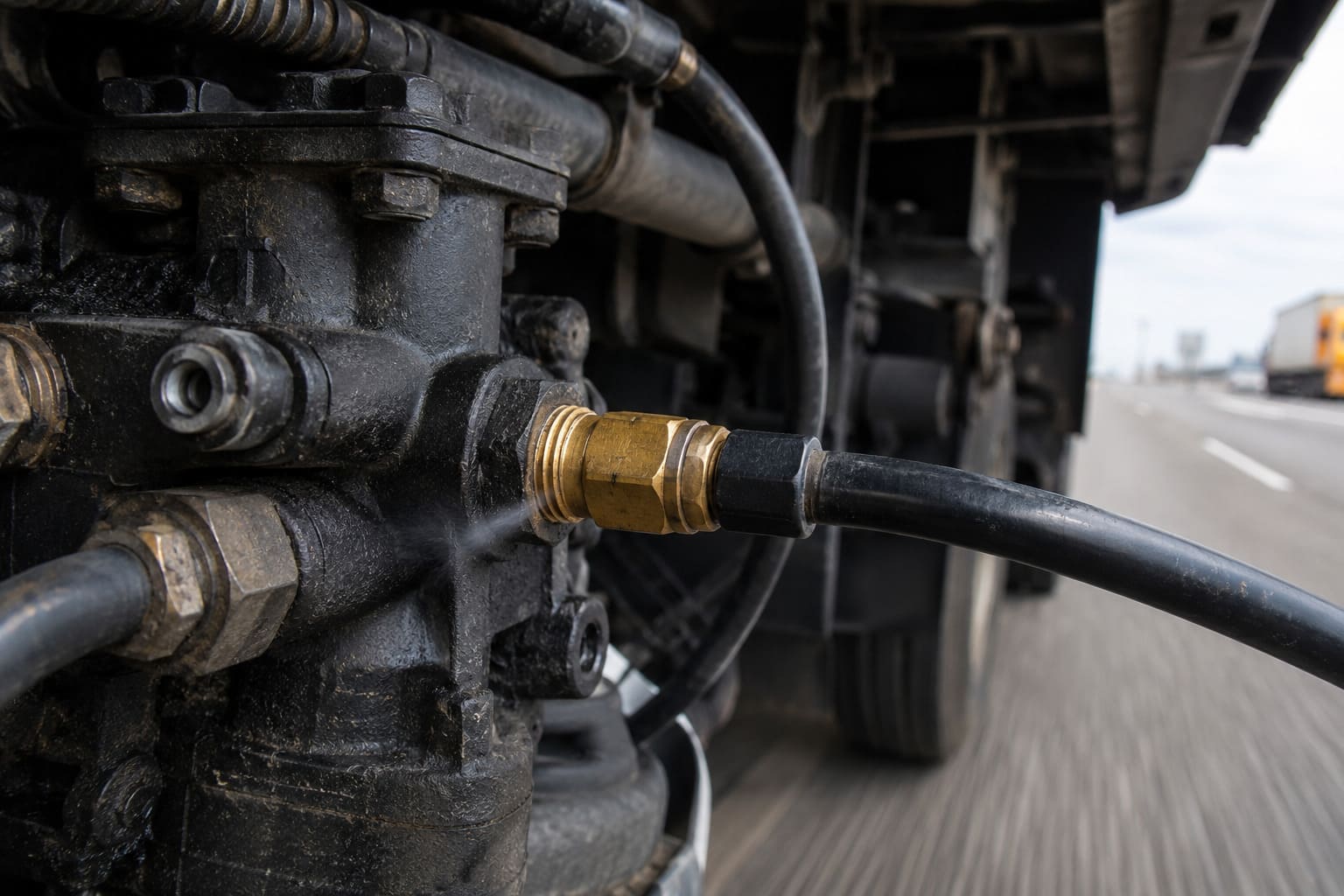
The Gap Between Bench Testing and Road Reality
When I talk to procurement managers about quality control, most of them understand the basics. They ask about air-tightness testing. They want to know the pressure rating. Those are valid starting points. But here is what I have learned from years of handling distributor feedback: a static pressure test tells you the fitting does not leak today. It does not tell you whether it will still seal after the truck has idled through a Chicago winter or run 80,000 miles of Brazilian highway.
The issue comes down to three factors:
- Thread relaxation — brass and the mating component material expand and contract at different rates under temperature cycling7. Add vibration, and the threaded connection can lose its initial torque over time.
- Seal compression set — O-rings and sealing surfaces that work perfectly on day one can take a permanent deformation after thousands of micro-movements8, especially if the material formulation is not optimized for dynamic conditions.
- Tube grip fatigue — Push-to-connect fittings rely on a gripping mechanism to hold the nylon tube9. Vibration-induced flexing at the fitting body can gradually loosen that grip, especially if the internal stainless steel grab ring or collet design lacks sufficient bite depth.
I am not saying every fitting will fail. I am saying that a buyer who only evaluates the first sample on a static bench has skipped the most important question: what happens later?
Why Do Distributors Need to Care About Vibration Resistance and Leakage?
If you are a parts distributor or wholesale procurement manager, your exposure to this problem is different from mine. I see it at the production level. You see it when a fleet customer calls and says they are seeing slow pressure drops on three trucks, and all three have your fittings installed.
Distributors need to care about vibration resistance because slow brake system leaks generate returns, warranty claims, and customer service costs that erode margin long after the initial sale. Even if the fitting was priced competitively at purchase, a single batch with inconsistent vibration durability can damage the trust a distributor has built with repair shops and fleets over years.
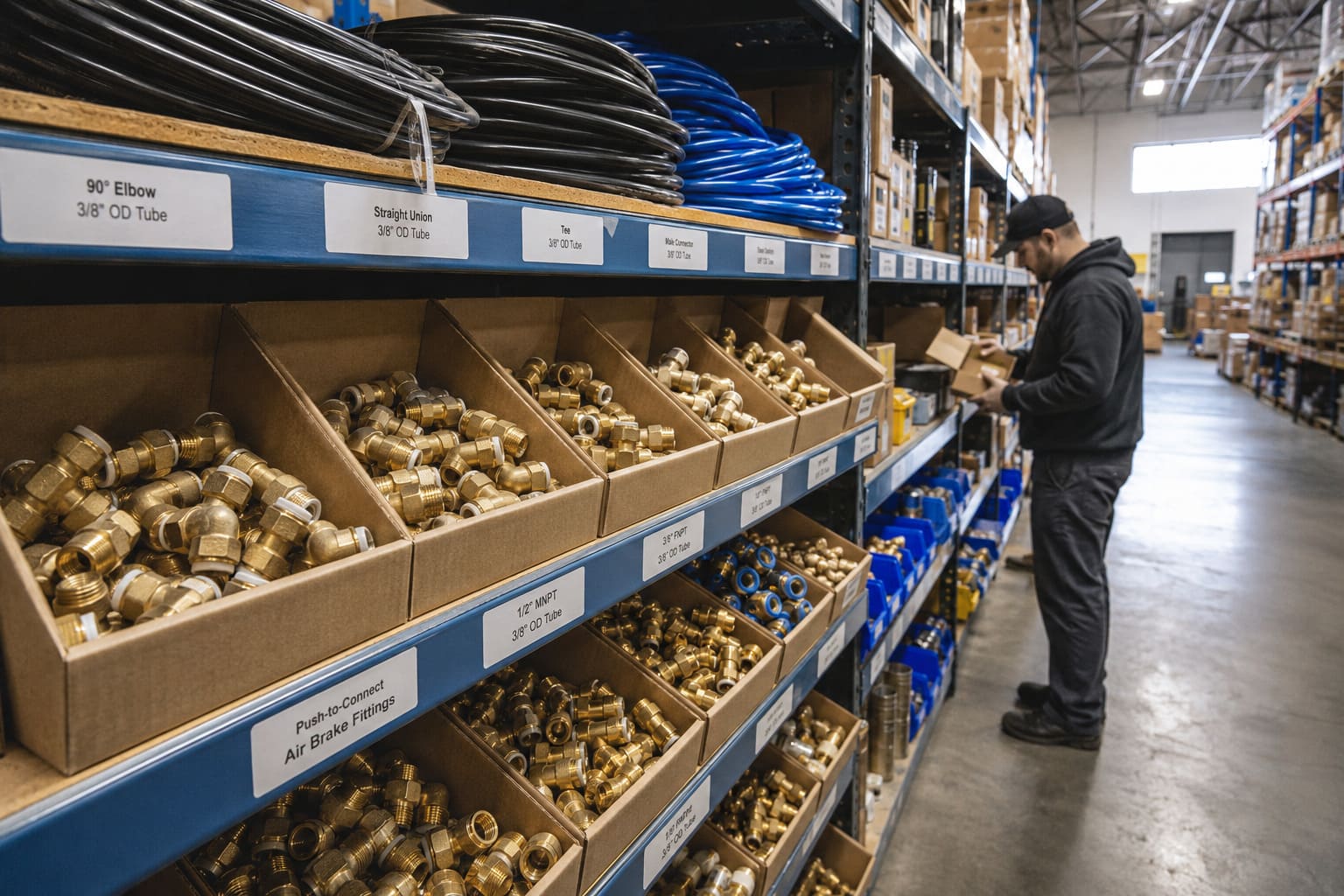
The Real Cost of a Leaking Fitting
I have talked to enough distribution managers to understand the math. Let me break down what actually happens when a fitting does not hold up:
| Cost Factor | Immediate Impact | Long-Term Consequence |
|---|---|---|
| Customer return | Processing time, shipping, credit | Administrative overhead |
| Technician troubleshooting | Fleet or shop spends hours finding the leak | Labor cost passed to distributor |
| Replacement fitting | Distributor provides new part at no charge | Margin erosion on the order |
| Brand reputation | Fleet tells other fleets about the problem | Lost repeat business |
| Warranty reserve | Higher reserve allocation for future claims | Cash flow pressure |
A brass fitting that costs two dollars at wholesale can easily generate fifty dollars in total downstream cost once you factor in diagnostics, returns processing, and customer goodwill.10 Multiply that across a container order, and the procurement decision that started with "let's save three cents per unit" becomes a liability.
Batch Consistency Is the Procurement Threshold
Here is something I want to be direct about, because it is where I have seen the most disappointment from distributors. You can test one sample. You can test ten. They can all pass. But what about the 5,000 pieces arriving in month six of your supply relationship?
Vibration resistance is not a property you can fully verify with a one-time incoming inspection on a handful of parts.11 It depends on:
- Consistent raw material quality across copper alloy batches
- Repeatable machining tolerances that maintain thread form accuracy
- Stable heat treatment or stress-relief processes if applicable
- Uniform O-ring or seal material from qualified sub-suppliers
- No process drift in assembly or crimping operations
When a supplier cannot demonstrate batch-to-batch traceability and in-process documentation, you are gambling.12 I am not saying that to scare anyone. I am saying it because I have seen procurement managers learn this lesson the hard way — typically after a container has already cleared customs and landed in their warehouse.
How Can Procurement Teams Evaluate Vibration Resistance Before Ordering?
So we agree that vibration resistance matters. The next logical question is: how do you check for it without being an engineer or owning a vibration test rig? This is where practical sourcing judgment comes in, and it is a skill I have developed from handling hundreds of distributor inquiries.
Procurement teams can evaluate vibration resistance before ordering by asking suppliers about their incoming material inspection practices, in-process dimensional sampling frequency, batch-level air-tightness testing protocols, and whether they can provide traceability documentation from raw material to finished fitting — not just a certificate for the first sample.
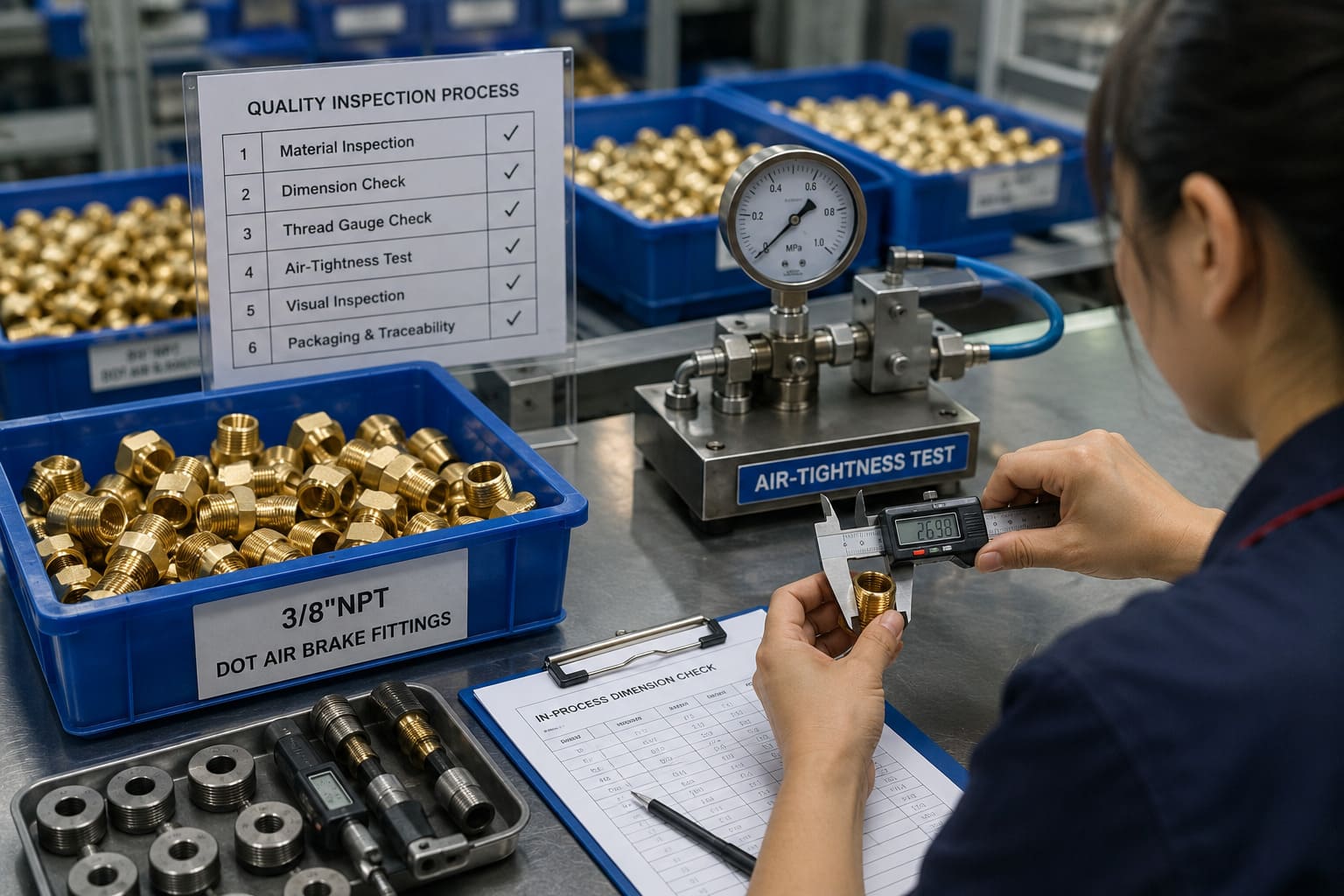
Questions to Ask Beyond Price and Delivery
When a distributor reaches out to me with a part number and a target price, I can answer that in one email. But the ones who ask better questions get better outcomes. Here is what a solid procurement evaluation looks like for vibration-critical fittings:
On materials and sourcing:
- Where does your brass material come from, and can you provide batch compliance certificates with each shipment?
- Do you verify the material composition of incoming copper alloy, or do you rely solely on supplier certificates?
- For fittings with O-rings, what is the seal material specification, and is it consistent across production runs?
On process control:
- How often do you perform in-process dimensional checks during a production run?
- Can you explain how you maintain thread form accuracy across high-volume batches?
- Do you document and archive process data so it is traceable back to a specific production date and line?
On performance testing:
- What air-tightness testing do you perform, and is it done on a sampling basis or 100% of parts?
- Have you tested your fittings under temperature cycling or with vibration exposure? If so, what method was used? (Be prepared for the supplier to describe a specific internal or external test; do not accept vague "yes" answers without details.)
I want to be careful here. I am not claiming that every supplier needs to have a full vibration test laboratory. That would be unrealistic for most aftermarket manufacturers. What matters is whether the supplier can show you they think about these factors and have built their process to control the variables that affect vibration performance: material consistency, dimensional accuracy, seal quality, and assembly repeatability.
Red Flags That Signal Vibration Risk
Over the years, I have also learned to recognize the warning signs. When you are evaluating a new source, pay attention to these:
- No material traceability — if the supplier cannot tell you which heat or batch of brass went into your specific order, you have no way to connect a field failure back to the root cause.
- 100% reliance on final inspection — if the only quality check happens after the fitting is finished, process variation upstream is not being controlled. Vibration durability is built into the part from the start, not inspected in at the end.
- Inconsistent seal performance — if you have sampled multiple batches and noticed differences in O-ring hardness, color, or fit, that suggests sub-supplier variation that will eventually surface in the field.
- Price that seems too good to be true — competition is healthy, but if a price is well below the market range for DOT-compliant brass fittings, someone is cutting corners somewhere. Usually that somewhere is material quality or process control.
Does DOT or SAE Certification Guarantee Vibration Durability?
This is a question I get regularly, and it is worth addressing head-on. Many procurement managers in North America use DOT certification as a baseline requirement. That is appropriate. But it is also where the conversation should begin, not end.
DOT and SAE certifications establish minimum performance and dimensional standards for air brake fittings, but they do not specifically test or guarantee long-term vibration durability under real-world operating conditions. Compliance confirms the fitting meets regulatory requirements; it does not replace batch-level quality consistency or application-specific evaluation.
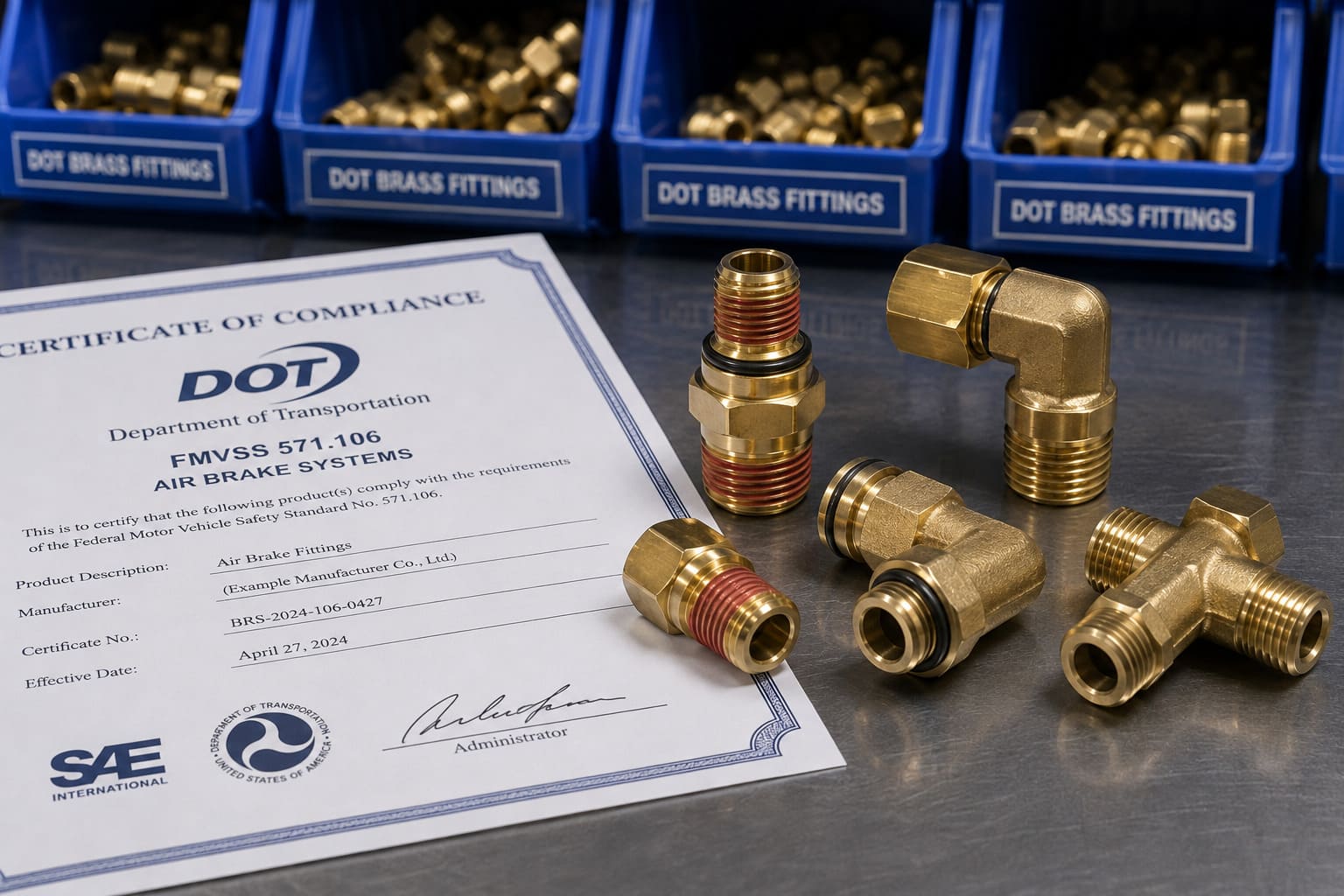
Certification Is a Floor, Not a Ceiling
Think of it this way. A driver's license proves someone passed a basic test of competence. It does not tell you whether they are a safe driver in heavy rain, at night, or after eight hours behind the wheel. DOT certification works similarly. It means the fitting design has been reviewed and tested to meet Federal Motor Vehicle Safety Standards. It does not mean every batch exiting the factory will survive ten years of vibration fatigue on a logging truck.
I have seen distributors assume that a DOT-marked fitting from any supplier will perform consistently. Then they are confused when field returns spike. The certification is real and meaningful. It is just not a substitute for what I described above: material traceability, process control, and batch-level performance verification.
What Buyers Should Verify Beyond the Certificate
When a supplier shows you a DOT registration or SAE compliance document, take it seriously, but also ask these follow-ups:
- Is the certification tied to this specific fitting design, or is it a general company-level registration?
- Has the design or material changed since the certification was obtained?
- Does the supplier maintain ongoing compliance through internal audits and testing, or was the certification a one-time event?
- Can they provide batch-specific test results that correlate to the certified design?
I keep my own certifications documented and available. But I also expect serious buyers to ask what happens between certification and shipment. That is the part that matters for vibration resistance.
Frequently Asked Questions
Can a brass air brake fitting loosen over time even if it was properly tightened during installation?
Yes, a properly tightened brass fitting can loosen over time due to thermal cycling, vibration, and mechanical stress. These factors cause micro-movement at the thread interface, which gradually reduces clamping force. This is why thread sealant selection, proper torque, and fitting design all contribute to long-term retention — not just the initial installation quality.
How do I know if my current supplier's fittings have vibration-related quality issues?
Look for patterns in your return data. Are you seeing increased leakage complaints from fleets operating in specific conditions, such as rough roads or extreme temperatures? Are failures occurring after a consistent number of miles or months in service rather than immediately? These patterns often point to vibration-related durability problems rather than one-off manufacturing defects.
What is the difference between a static air-tightness test and a test that accounts for vibration?
A static air-tightness test checks for leakage at a fixed pressure with no movement applied to the fitting or connected tube. A vibration-aware evaluation typically applies mechanical cycling, tube flexing, or temperature variation while monitoring pressure retention. The static test confirms initial seal quality. The dynamic approach reveals whether the seal holds under conditions that simulate actual vehicle operation.
Does a higher price always mean better vibration resistance?
Not necessarily, but extreme low pricing often correlates with reduced process control, lower-grade materials, or skipped inspection steps. Price alone is not a reliable quality indicator. Instead, evaluate whether the supplier can demonstrate the material traceability, in-process control, and batch testing that support consistent vibration performance. A moderately priced fitting from a supplier with strong documentation is often a better long-term value than the cheapest option.
Should I test every batch of fittings for vibration performance before stocking them?
Full vibration testing on every incoming batch is typically impractical for distributors. What is practical is requesting batch-specific air-tightness test data, verifying dimensional consistency on a sample basis, and tracking field performance closely. If you start seeing unusual return patterns, you can then request more detailed investigation from the supplier, including any design or process changes that may have occurred.
Conclusion
Vibration resistance is not an extra feature you pay more for on a premium air brake fitting. It is the difference between a fitting that works on a test bench and one that holds air pressure through years of actual truck operation. For procurement managers and parts distributors, the question is not just whether the sample passes inspection. It is whether every batch that follows will perform consistently enough to protect your inventory reputation and keep your customers coming back without leakage headaches.
I have seen too many sourcing decisions made on unit price and delivery time alone. The fittings that seem cheapest on the purchase order often become the most expensive when returns, warranty claims, and lost trust are added to the total cost. Next time you evaluate a brass fitting supplier, ask about material traceability, in-process control, and batch-level testing. Pay attention to how they answer. If they cannot speak to these points with clarity, the risk is probably higher than the quote makes it look. If you are sourcing heavy-duty air brake fittings for the North or South American market and want to discuss quality expectations before your next order, reach out. I would rather have that conversation now than after a container has already shipped.
"Federal Motor Vehicle Safety Standards; Brake Hoses", https://www.federalregister.gov/documents/2004/12/20/04-27088/federal-motor-vehicle-safety-standards-brake-hoses. Engineering literature on vibration loosening describes how cyclic movement can reduce clamping force in threaded joints, providing contextual support for the claim that a fitting may pass an initial static pressure check yet later leak under road-induced vibration; this evidence supports the mechanism generally rather than proving failure rates for a specific fitting model. Evidence role: mechanism; source type: research. Supports: Mechanical vibration and repeated movement can reduce joint preload or sealing integrity even when an assembly initially passes a static leak or pressure test.. Scope note: The source would support the general mechanical mechanism, not the performance of the article's specific fittings. ↩
"Motorcoach Brake Systems and Safety Technologies | FMCSA", https://www.fmcsa.dot.gov/carrier-safety/carrier-safety-resources/motorcoach-brake-systems-and-safety-technologies. Government commercial-vehicle inspection guidance treats air leaks as defects because air brake systems require retained compressed-air pressure for proper operation, supporting the statement that leaking fittings can contribute to brake-system pressure loss. Evidence role: general_support; source type: government. Supports: Air brake systems depend on maintaining compressed-air pressure, and leaks are recognized in inspection and safety guidance as conditions that can reduce available brake-system pressure.. ↩
"A Laboratory Evaluation of Seat-suspension Designs", https://pubmed.ncbi.nlm.nih.gov/25625530/. Studies of heavy-vehicle vibration identify engine and road-surface inputs as significant sources of dynamic loading on vehicle components, providing contextual support for describing air-brake fittings as operating in a vibrating, flexing environment. Evidence role: general_support; source type: paper. Supports: Heavy commercial vehicles experience vibration from engine operation and road inputs, creating dynamic mechanical conditions for mounted components and lines.. Scope note: The source would document the vehicle vibration environment generally, not measure vibration at every fitting location. ↩
"Reduced-order Modeling of Loosening in Bolted Joints and ...", https://digitalcommons.unl.edu/cgi/viewcontent.cgi?article=1184&context=mechengdiss. Research on vibrated mechanical joints reports microslip and fretting at contact interfaces under cyclic loading, supporting the mechanism that vibration can create micro-movement at thread and tube-connection interfaces. Evidence role: mechanism; source type: paper. Supports: Cyclic vibration can cause microslip or fretting at mechanical interfaces, including threaded joints, which may affect preload and sealing surfaces.. Scope note: The evidence is mechanistic and may not be specific to truck air-brake brass fittings. ↩
"Junker test", https://en.wikipedia.org/wiki/Junker_test. NASA fastener guidance and related vibration-loosening literature explain that cyclic loading can reduce preload in threaded joints, supporting the statement that vibration may gradually reduce clamping force. Evidence role: mechanism; source type: government. Supports: Vibration, especially transverse cyclic loading, can cause threaded fasteners to loosen and lose preload.. ↩
"Federal Motor Vehicle Safety Standards; Brake Hoses", https://www.federalregister.gov/documents/2004/12/20/04-27088/federal-motor-vehicle-safety-standards-brake-hoses. Engineering qualification standards commonly treat pressure/leak testing and environmental durability testing, including vibration and temperature cycling, as distinct evaluations, supporting the point that a room-temperature static pressure pass does not by itself demonstrate long-term vehicle durability. Evidence role: general_support; source type: institution. Supports: Component qualification commonly separates initial pressure/leak tests from environmental durability tests such as vibration and temperature cycling.. Scope note: The source would support the testing principle rather than verify the six-month service example. ↩
"Material Properties References", https://trc.nist.gov/cryogenics/materials/references.htm. Published materials-property data show that brass and common mating metals have different coefficients of thermal expansion, supporting the mechanism that temperature cycling can alter fit or preload in dissimilar-material threaded assemblies. Evidence role: mechanism; source type: research. Supports: Brass and common mating metals have different coefficients of thermal expansion, and temperature cycling can change stress or preload in assemblies made from dissimilar materials.. Scope note: The data support the physical mechanism but do not establish the magnitude of preload loss for a particular fitting design. ↩
"Best O-Rings for Compression Set Resistance Comparison", https://detroitsealing.com/feeds/blog/best-o-rings-compression-set-resistance. Elastomer-seal literature defines compression set as permanent deformation after sustained compression and notes its relevance to seal performance, supporting the claim that O-rings may lose sealing effectiveness over time. Evidence role: mechanism; source type: paper. Supports: Elastomer seals can develop compression set, meaning they fail to return fully to their original shape after prolonged compression, which can reduce sealing effectiveness.. Scope note: The source would explain the general elastomer behavior and may not address the exact operating cycle of truck air-brake fittings. ↩
"Push-to-pull compression fittings", https://en.wikipedia.org/wiki/Push-to-pull_compression_fittings. Industry standards for push-to-connect air-brake tube fittings describe performance requirements for tube retention, supporting the functional statement that these fittings depend on an internal gripping mechanism to hold nylon tubing. Evidence role: definition; source type: institution. Supports: Push-to-connect fittings for air-brake tubing use internal retention features such as collets or gripping elements to hold the tube.. Scope note: The standard may specify performance requirements rather than describe every manufacturer's internal design. ↩
"Guide: Cost of Poor Quality (COPQ) - Learn Lean Sigma", https://www.learnleansigma.com/guides/cost-of-poor-quality-copq/. Quality-management research on cost of poor quality classifies warranty claims, returns, troubleshooting, and customer dissatisfaction as external failure costs, supporting the general claim that a low-value component failure can impose downstream costs greater than its unit price. Evidence role: general_support; source type: research. Supports: External failure costs, including warranty, returns, troubleshooting, and customer dissatisfaction, can exceed the direct cost of the defective component.. Scope note: The source would support the cost structure generally, not the specific two-dollar-to-fifty-dollar estimate. ↩
"6.1.2. What are Process Control Techniques?", https://www.itl.nist.gov/div898/handbook/pmc/section1/pmc12.htm. Quality-engineering references on statistical process control explain that sampling inspection provides limited confidence about a lot and does not replace control of the production process, supporting the claim that one-time inspection of a few parts cannot fully verify vibration durability across batches. Evidence role: expert_consensus; source type: research. Supports: Sampling inspection has limitations for detecting all defects or durability variation, and ongoing process control is used to manage batch-to-batch consistency.. ↩
"Metrological Traceability: Frequently Asked Questions and NIST Policy", https://www.nist.gov/metrology/metrological-traceability. Quality-management standards such as ISO 9001 require control of documented information and, where applicable, identification and traceability, supporting the view that batch records and in-process documentation are central to managing manufacturing quality and investigating nonconformities. Evidence role: expert_consensus; source type: institution. Supports: Quality-management systems emphasize traceability, documented information, and process control to support conformity and corrective action.. Scope note: The standard supports quality-management practice generally and does not quantify the risk for any single supplier. ↩