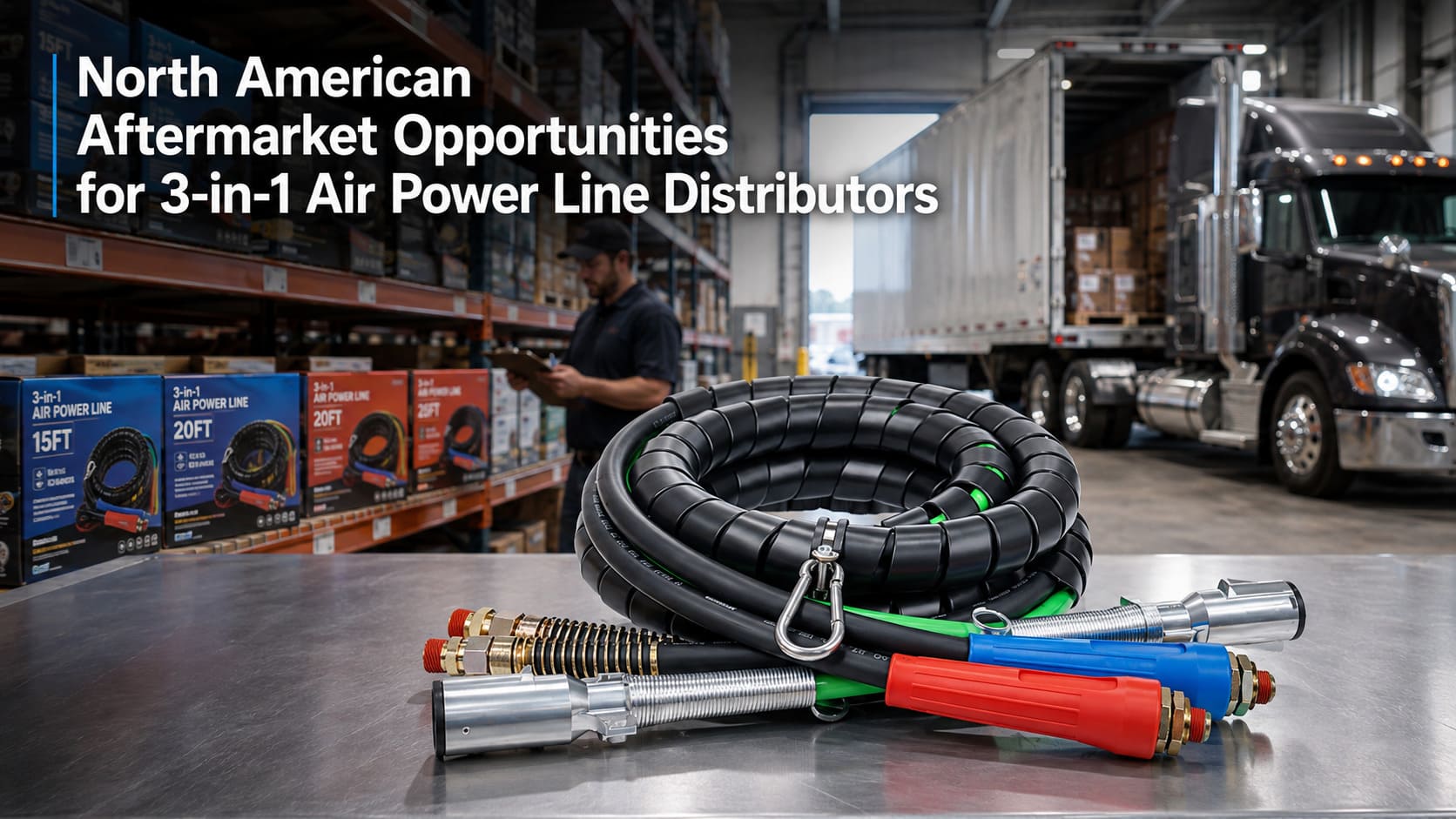
When I talk to distributors about expanding their heavy-duty truck parts catalog, the conversation often starts with one question: “What moves fast and doesn’t come back?” The 3-in-1 Air Power Line is one of those parts that checks both boxes, but only if you understand the real opportunity. Many buyers see it as just another replacement item. They miss the bigger picture — this is a channel-ready category where the right supplier choice determines whether you build recurring revenue or manage constant headaches.
The North American aftermarket opportunity for 3-in-1 Air Power Lines isn’t simply about more trucks needing replacement parts. It is a distributor selection problem centered on reliable SKUs, consistent quality, compliance awareness, and sustainable replenishment systems that keep your shelves stocked without creating dead inventory.
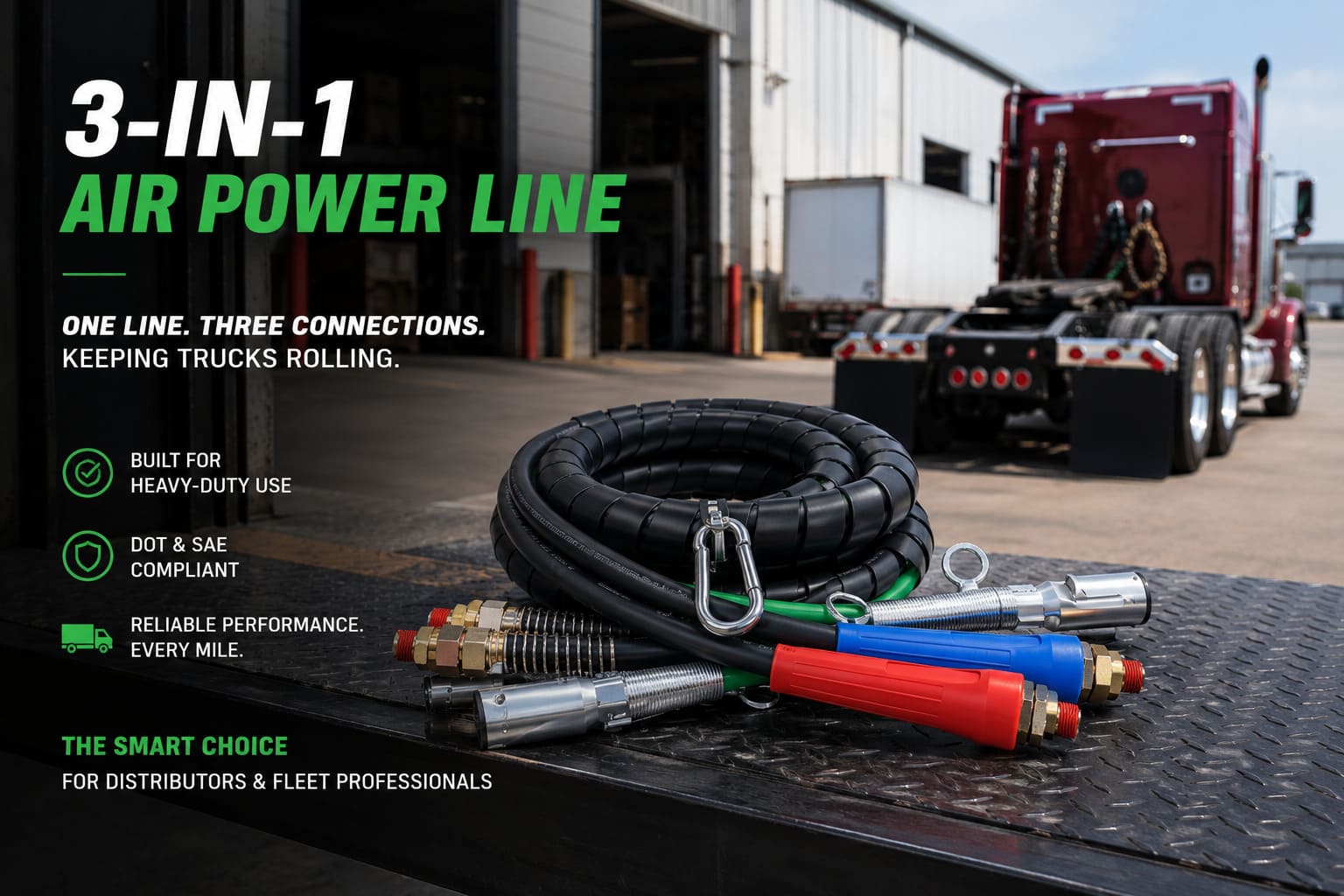
I remember a distributor in Texas telling me he had tried three different suppliers before finding one that understood what “mixed-batch support” actually means. He wasn’t looking for the cheapest price. He was looking for a partner who wouldn’t leave him with missing SKUs during peak repair season. That conversation shaped how I think about this market, and it frames everything I’ll share here.
Why Are 3-in-1 Air Power Lines a Channel-Ready Replacement Category?
Some distributors treat 3-in-1 Air Power Lines as simple bundled commodities — air lines and electrical cable wrapped together. But repair shops and fleets see them differently. They see installation time, line management, and whether the part holds up under the truck’s actual operating conditions.
What makes these lines valuable beyond the bundle?
The real value proposition for the aftermarket channel comes from five factors that matter during installation and service life. These are the points that experienced shop owners mention when they explain why they prefer certain SKUs.
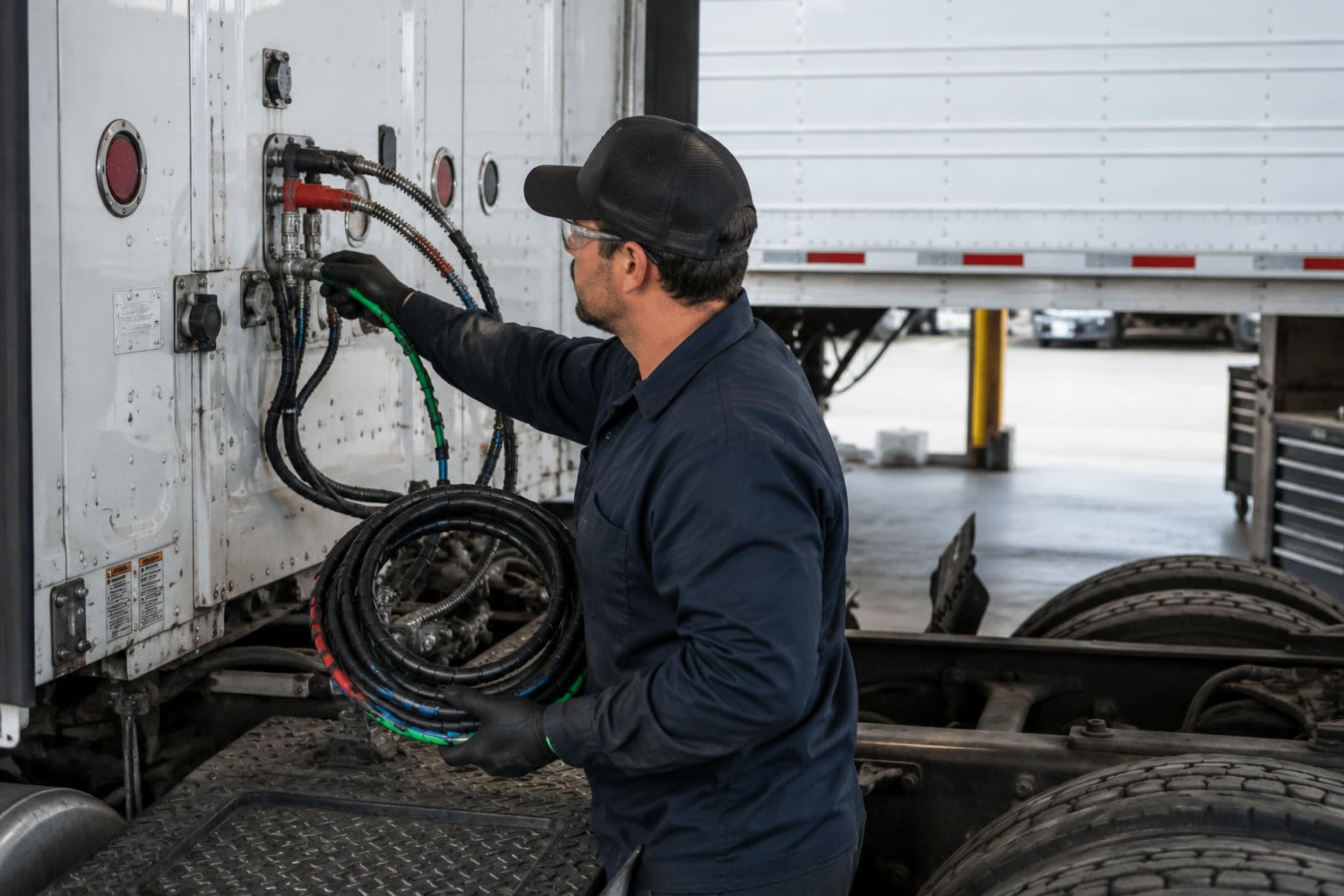
Installation efficiency is the first advantage. A technician connects one assembly instead of routing and securing separate air and electrical lines. That reduces labor time, which matters when a fleet manager sees the bill or a shop tries to turn bays faster. When I discuss specifications with distributors, I emphasize that the time saved per installation is part of the product’s value — not just the unit price.
Line management is the second factor. A well-designed 3-in-1 line keeps the air lines and cable organized along the trailer length. That prevents tangling, rubbing, and the kind of damage that comes from loose routing. A repair shop in Georgia once shared feedback through a distributor that their rework claims dropped noticeably after switching to a properly bonded assembly. I cannot verify that claim independently, but the logic holds — organized lines last longer.
Wear resistance becomes critical in real-world use. The outer jacket needs to survive road debris, weather exposure, and the constant flexing that happens between tractor and trailer1. If the jacket fails early, the internal components are vulnerable, and the replacement cycle accelerates. That leads directly to the next point.
Maintenance convenience matters for fleets doing preventive inspections. When lines are bundled cleanly, visual checks are faster. Technicians can spot early signs of jacket wear or connector corrosion without untangling a mess. This reduces the chance of roadside failures, which are far more expensive than scheduled maintenance2.
Reduced replacement friction is the outcome that distributors should care about most. When a 3-in-1 assembly fits correctly, performs reliably, and doesn’t generate complaints, the reorder cycle becomes predictable. The shop stocks what they trust. The distributor gets repeat business without the noise of returns or warranty claims.
Where Is the Real Distributor Opportunity in This Category?
The surface-level opportunity is obvious: trucks on the road need replacement parts. But the deeper opportunity — the one that builds sustainable distributor revenue — sits in how you manage demand recurrence and replenishment reliability.
Is this just about selling more parts, or is there a structural advantage?
The structural advantage comes from how professional repair channels actually buy. They don’t want one container of a single SKU. They want consistent availability across common specifications, the ability to mix orders, and a supplier who understands what “steady restocking” means in practice.
Common specifications drive most of the volume. In the North American heavy-duty aftermarket, certain lengths, connector types, and configurations repeat across Freightliner, Kenworth, Peterbilt, International, Volvo, and Mack applications. Distributors who identify which SKUs cover the broadest fleet base can concentrate inventory where it turns fastest. That reduces the working capital tied up in slow-moving stock.
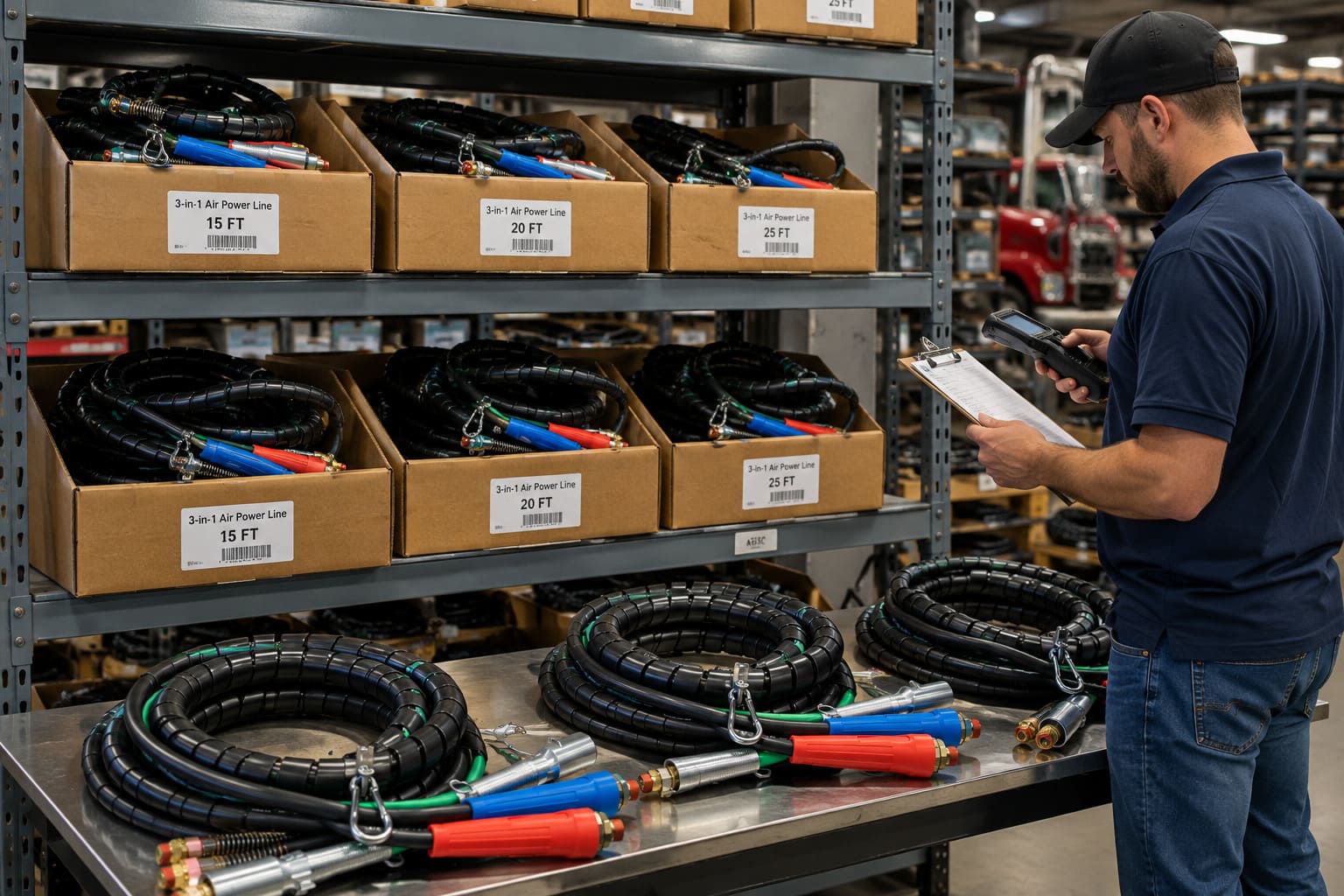
Mixed orders and flexible MOQ are not just nice-to-have supplier features. They are operational necessities for distributors serving regional repair shops and small fleets. A shop might need fifteen pieces of one length, eight of another, and five of a less common configuration. A supplier that forces large minimums on each SKU forces the distributor to overstock or leave gaps in their catalog. That gap becomes an opening for a competitor.
Steady restocking depends on supplier production planning. I have seen cases from our production side where pre-positioned safety stock for regular customers meant the difference between four-week and one-week lead times. When a distributor knows their supplier holds buffer inventory for their top-moving SKUs, they can offer shorter delivery promises to their own customers.
Avoiding slow-moving or missing SKUs is the flip side of inventory management. A missing connector or an out-of-stock common length during brake service season isn’t just a lost sale. It damages the distributor’s reputation with the repair shop. The shop remembers who had the part and who didn’t.
Here is a comparison of inventory scenarios distributors commonly face:
| Scenario | Inventory Risk | Customer Impact | Preferred Supplier Behavior |
|---|---|---|---|
| Single-SKU bulk order only | Overstock on one item, gaps elsewhere | Shop can’t get full set, goes elsewhere | Flexible mixed-batch support |
| Long lead time, no safety stock | Stockouts during peak demand | Missed sales, damaged trust | Pre-positioned buffer inventory |
| Fixed MOQ per SKU | Dead inventory on slow movers | Ties up cash, limits catalog breadth | Adjustable MOQ by SKU velocity |
| No demand history sharing | Reactive restocking | Delayed replenishment | Proactive communication on reorder points |
Why Does Total Aftermarket Cost Matter More Than Unit Price?
Price comparison is easy. Cost comparison requires discipline. I have seen distributors learn this the hard way — ordering based on the lowest unit price and then absorbing the downstream costs of returns, complaints, and lost customer confidence.
What hidden costs can erase a price advantage?
The total aftermarket cost includes everything that happens after the part leaves the distributor’s shelf. If the part fails, the cost multiplies quickly. A $15 savings on unit price disappears the first time a distributor processes a return, ships a replacement, and loses a shop’s trust.
Leakage failure is the most common and most damaging quality issue. A 3-in-1 Air Power Line that leaks air at the fitting or along the line body creates immediate problems. The trailer’s braking system relies on consistent air pressure.3 A leak triggers warning lights, service calls, and potentially roadside downtime.4 The repair shop that installed the part gets blamed first. The distributor that supplied it gets blamed second.
Wear-related failure shows up over time but leaves a lasting impression. If the outer jacket abrades faster than expected, the internal components are exposed.5 If the bonding between air lines and electrical cable separates, the assembly no longer manages lines properly. These are not dramatic failures — they are slow degradations that generate steady complaints.
Tensile failure at connection points can happen when the line is stressed during coupling and uncoupling. A properly manufactured line should withstand the repeated pulling and flexing that occurs in normal operation. If it doesn’t, the failure mode is sudden and inconvenient.
Temperature and pressure resistance varies significantly between material grades and manufacturing processes. Lines that perform adequately in moderate climates may fail prematurely in extreme heat or cold. A distributor in Minnesota faces different environmental demands than one in Arizona, but both need the part to hold up.
Returns and customer complaints carry administrative costs, freight costs, and relationship costs. Every return that a distributor processes represents time that could have been spent selling. Every complaint that reaches a shop owner’s ear represents a risk to future business.
Here is a quick breakdown of quality-related costs versus unit price savings:
| Quality Issue | Immediate Cost | Downstream Cost | Net Impact |
|---|---|---|---|
| Air leakage at fitting | Return shipping, replacement part | Shop distrust, lost future orders | Negative after 1-2 incidents |
| Premature jacket wear | Warranty claim processing | Brand erosion in local market | Cumulative and long-term |
| Tensile failure | Emergency replacement, potential downtime claim | Fleet relationship damage | Potentially large if fleet involved |
| Inconsistent specifications | Time spent verifying each batch | Operational friction, ordering delays | Steady drain on efficiency |
How Should Distributors Evaluate Supplier Capability as Risk Reduction?
When I talk to distributors about supplier evaluation, I frame the conversation around risk reduction rather than feature lists. Every supplier has a factory, production lines, and some form of quality control documentation. The question is whether those capabilities translate into lower risk for the distributor.
What supplier capabilities actually reduce aftermarket risk?
The capabilities that matter are the ones that prevent problems from reaching the distributor’s customer. This means looking upstream at how the supplier handles material, process, testing, and logistics.
Material inspection at incoming stage is the first defense. The copper, rubber, and metal that go into 3-in-1 Air Power Lines vary by source. A supplier that verifies batch compliance certificates and performs incoming checks catches material problems before they become product problems. I have seen cases where a rubber batch showed acceptable physical properties but slight formulation variations that affected long-term aging. Catching that early prevents field failures later.
In-process sampling with documented SOPs6 provides consistency across production runs. When operators follow standardized procedures and quality staff perform multi-node checks, the output variation narrows. This matters for distributors because it means the part they receive in month six performs like the part they received in month one.
Performance testing across relevant parameters goes beyond basic dimensional checks. Testing should cover:
- Air tightness at operating pressure and above
- Tensile strength at connection points
- Temperature resistance across the expected service range
- Pressure resistance with appropriate safety margins
These tests simulate what the part will experience on a truck. Passing them doesn’t guarantee perfect field performance, but failing them almost certainly predicts problems.
Final inspection methodology tells you how seriously the supplier treats outgoing quality. AQL sampling is standard practice.7 100% final inspection on key products indicates higher rigor.8 For critical assemblies like 3-in-1 lines, knowing that each unit gets a final check reduces the probability of a defective part reaching your shelf.
Standard awareness without overclaiming is an important distinction. A supplier should know which standards apply — DOT, SAE, FMVSS9, and relevant European norms — and should design and test accordingly. But the supplier should not present themselves as a certification authority or guarantee universal compliance across all applications. The distributor should still verify that the product meets the requirements of their specific market and application.
Mixed-batch support and logistics experience round out the risk-reduction picture. A supplier that can handle small-batch mixed orders reduces inventory risk. A supplier with experience in FOB and DDP shipping terms to North and South American ports reduces logistics risk. They know the documentation requirements, customs clearance processes, and shipping lanes that keep goods moving.
Frequently Asked Questions
What are the most common 3-in-1 Air Power Line lengths for the North American aftermarket?
The most frequently requested lengths typically range from 12 feet to 20 feet, with specific lengths like 15 feet being particularly common for standard tractor-trailer configurations. However, actual demand varies by fleet type, trailer configuration, and regional preference. Distributors should analyze their own customer base to identify top-moving lengths rather than assuming a universal standard.
How do I verify that a supplier’s quality claims are legitimate?
Request documented evidence of their quality management system — ISO 9001 certification is a baseline indicator. Ask about specific testing procedures for air tightness, tensile strength, and temperature resistance. Review their incoming material inspection process. Legitimate suppliers can describe their quality control nodes in detail and provide batch traceability information for production runs.
What is a reasonable MOQ for 3-in-1 Air Power Line orders?
Reasonable MOQ depends on the supplier’s production setup and your volume. Some suppliers offer flexible MOQ with the ability to mix SKUs within a total order quantity. Others require large minimums per individual SKU. For distributors testing a new supplier relationship, look for the ability to start with moderate mixed orders before committing to full-container volumes.
How important is DOT compliance for 3-in-1 Air Power Lines?
DOT compliance is significant for products used on vehicles operating on U.S. highways.10 The relevant standards address performance requirements for air brake system components. Distributors should verify that the supplier understands applicable DOT requirements and designs products accordingly. However, final compliance verification and certification responsibility typically rests with the importer or distributor bringing products into the market11.
Can one 3-in-1 Air Power Line fit multiple truck makes and models?
Some configurations cover multiple makes and models, especially when the connection types and lengths align with common fleet specifications. However, universal fitment should not be assumed. Fitment depends on connector style, line length, and the specific tractor-trailer combination. Distributors should maintain clear application data and verify compatibility rather than making blanket fitment claims.
Conclusion
The North American aftermarket for 3-in-1 Air Power Lines offers real opportunity, but it rewards the distributors who approach it as a selection and replenishment challenge rather than a price-shopping exercise. The parts that move fastest and stay sold are the ones backed by consistent specifications, verified quality control, and supplier processes designed to prevent problems before they reach your customer. Focusing on total aftermarket cost — not just unit price — protects margins and relationships. Evaluating supplier capabilities as risk reduction tools rather than checklist items helps you build a catalog that repair shops and fleets trust. If you are reviewing your 3-in-1 Air Power Line supply strategy or exploring new sourcing options, start by examining your current failure points and inventory gaps. The right partner is the one who understands how to keep your shelves stocked with parts you can stand behind.
"49 CFR 571.106 -- Standard No. 106; Brake hoses.", https://www.ecfr.gov/current/title-49/subtitle-B/chapter-V/part-571/subpart-B/section-571.106. Federal brake-hose performance requirements address durability under pressure, environmental exposure, and mechanical stresses, supporting the article’s identification of debris, weather, and flexing as relevant service conditions; the standard does not prove the durability of any individual aftermarket assembly. Evidence role: mechanism; source type: government. Supports: Brake-hose standards include tests or requirements related to environmental durability, pressure, and mechanical stress.. Scope note: The source supports the relevance of these stressors, not the performance of a specific supplier’s product. ↩
"Operational Costs of Trucking", https://truckingresearch.org/about-atri/atri-research/operational-costs-of-trucking/. Truck operating-cost studies identify repair, maintenance, roadside service, and downtime as significant fleet expenses, supporting the article’s comparison between roadside failures and scheduled maintenance; the evidence is contextual unless the source directly separates roadside failures from planned maintenance for air-line components. Evidence role: statistic; source type: research. Supports: Fleet operating-cost research shows that repair and maintenance, roadside service, towing, and downtime impose material costs beyond planned maintenance.. Scope note: The support is for fleet maintenance economics generally, not for a quantified cost ratio specific to 3-in-1 air power lines. ↩
"5.1.1 Brake Systems (Part 393 Subpart C) - CSA", https://csa.fmcsa.dot.gov/safetyplanner/MyFiles/SubSections.aspx?ch=22&sec=64&sub=130. Federal air-brake standards and inspection guidance describe heavy-vehicle service brakes as pneumatic systems that require adequate reservoir and line pressure to function, supporting the statement that trailer braking depends on consistent air pressure; these sources do not evaluate any specific aftermarket 3-in-1 line. Evidence role: mechanism; source type: government. Supports: Federal air-brake rules and inspection materials describe heavy-vehicle braking as a pneumatic system dependent on adequate air pressure.. Scope note: The support is for the braking-system mechanism generally, not for the performance of a particular product. ↩
"5.2.4 Common Violations - CSA - Department of Transportation", https://csa.fmcsa.dot.gov/safetyplanner/myfiles/SubSections.aspx?ch=22&sec=65&sub=150. Commercial-vehicle inspection guidance treats significant air-brake leakage as a safety defect that may require repair or removal from service, supporting the article’s point that leaks can lead to warning events, service calls, and roadside downtime; it does not quantify the likelihood for this specific component category. Evidence role: general_support; source type: government. Supports: Commercial vehicle inspection rules treat air-brake leaks as defects that can require repair or place a vehicle out of service.. Scope note: The source supports the general consequence of air-brake leakage, not the failure rate of 3-in-1 air power lines. ↩
"5.1.1 Brake Systems (Part 393 Subpart C) - CSA", https://csa.fmcsa.dot.gov/safetyplanner/MyFiles/SubSections.aspx?ch=22&sec=64&sub=130. Commercial-vehicle inspection criteria identify chafed, worn, or damaged brake hoses as defects when protective material is compromised, supporting the article’s mechanism that abrasion can expose internal components; this is general inspection evidence rather than product-specific testing. Evidence role: mechanism; source type: government. Supports: Inspection criteria identify chafed, damaged, or exposed brake hoses as defects because protective layers can wear through.. Scope note: The source addresses brake hose damage generally, not bonded 3-in-1 assemblies specifically. ↩
"6.1.2. What are Process Control Techniques?", https://www.itl.nist.gov/div898/handbook/pmc/section1/pmc12.htm. Quality-management standards and statistical process-control guidance link documented procedures, process monitoring, and in-process inspection with improved consistency of manufacturing outputs, supporting the article’s reliance on SOPs and sampling as risk controls; these sources do not verify any particular factory’s controls. Evidence role: expert_consensus; source type: institution. Supports: Quality-management standards and process-control guidance associate documented procedures, monitoring, and inspection with consistent production outputs.. Scope note: The evidence supports the quality-management principle, not the implementation quality of a specific supplier. ↩
"6.2.3.1. Choosing a Sampling Plan: MIL Standard 105D", https://www.itl.nist.gov/div898/handbook/pmc/section2/pmc231.htm. ISO acceptance-sampling standards define AQL-based inspection plans for evaluating production lots, supporting the article’s statement that AQL sampling is a standard inspection practice; AQL sampling controls lot acceptance risk and is not equivalent to testing every unit. Evidence role: definition; source type: institution. Supports: ISO 2859 and related quality-control references define AQL-based acceptance sampling for lot inspection.. Scope note: The source defines the practice and its role, but does not show that any supplier uses it correctly. ↩
"6.2.1. What is Acceptance Sampling? - Information Technology Laboratory", https://www.itl.nist.gov/div898/handbook/pmc/section2/pmc21.htm. Quality-control literature distinguishes acceptance sampling from full inspection and notes that 100% inspection may be used for critical characteristics, supporting the article’s view that final checks on every key unit can indicate greater inspection rigor; full inspection still depends on test validity and inspector effectiveness. Evidence role: expert_consensus; source type: research. Supports: Quality-control literature distinguishes sample inspection from full inspection and explains why full inspection may be used for critical characteristics.. Scope note: The evidence supports the inspection concept, not the defect-prevention performance of a particular inspection program. ↩
"Interpretation ID: 04-009159drn - NHTSA", https://www.nhtsa.gov/interpretations/04-009159drn. Federal motor vehicle safety regulations for brake hoses, together with referenced technical standards such as SAE air-brake tubing specifications, support the article’s identification of DOT, SAE, and FMVSS as relevant compliance frameworks; applicability depends on the exact component design and vehicle use. Evidence role: general_support; source type: government. Supports: Federal motor vehicle safety standards and incorporated technical standards govern brake hose and air-brake tubing performance requirements.. Scope note: The citation supports standards relevance, not universal applicability to every 3-in-1 assembly. ↩
"49 CFR Part 571 -- Federal Motor Vehicle Safety Standards - eCFR", https://www.ecfr.gov/current/title-49/subtitle-B/chapter-V/part-571. NHTSA guidance and federal regulations state that covered motor vehicles and motor-vehicle equipment must comply with applicable Federal Motor Vehicle Safety Standards, supporting the article’s statement that DOT compliance is significant for highway-use products; the exact obligation depends on whether the component is covered equipment under a specific standard. Evidence role: general_support; source type: government. Supports: U.S. vehicle-safety law applies Federal Motor Vehicle Safety Standards to covered motor vehicles and motor vehicle equipment.. Scope note: The support is regulatory context and does not determine compliance for a particular SKU. ↩
"Importation and Certification FAQs", https://www.nhtsa.gov/importing-vehicle/importation-and-certification-faqs. NHTSA’s self-certification and importation guidance explains that manufacturers and importers of covered motor vehicles or motor-vehicle equipment are responsible for compliance with applicable safety standards, supporting the article’s statement about importer or distributor responsibility; the precise legal duty depends on the party’s role and the regulated status of the product. Evidence role: general_support; source type: government. Supports: NHTSA’s self-certification framework places compliance responsibilities on manufacturers and importers of regulated motor vehicles and equipment.. Scope note: The evidence provides regulatory context and is not legal advice for a specific transaction. ↩