Heater hose clamps are a small line item that creates large problems when chosen wrong. In heavy-duty truck applications, a failed clamp means coolant loss, roadside downtime, and a repair job that comes back too soon. Yet many buyers — distributors, shop owners, and fleet buyers alike — still select clamps almost entirely on size and price, without considering what the application actually demands.
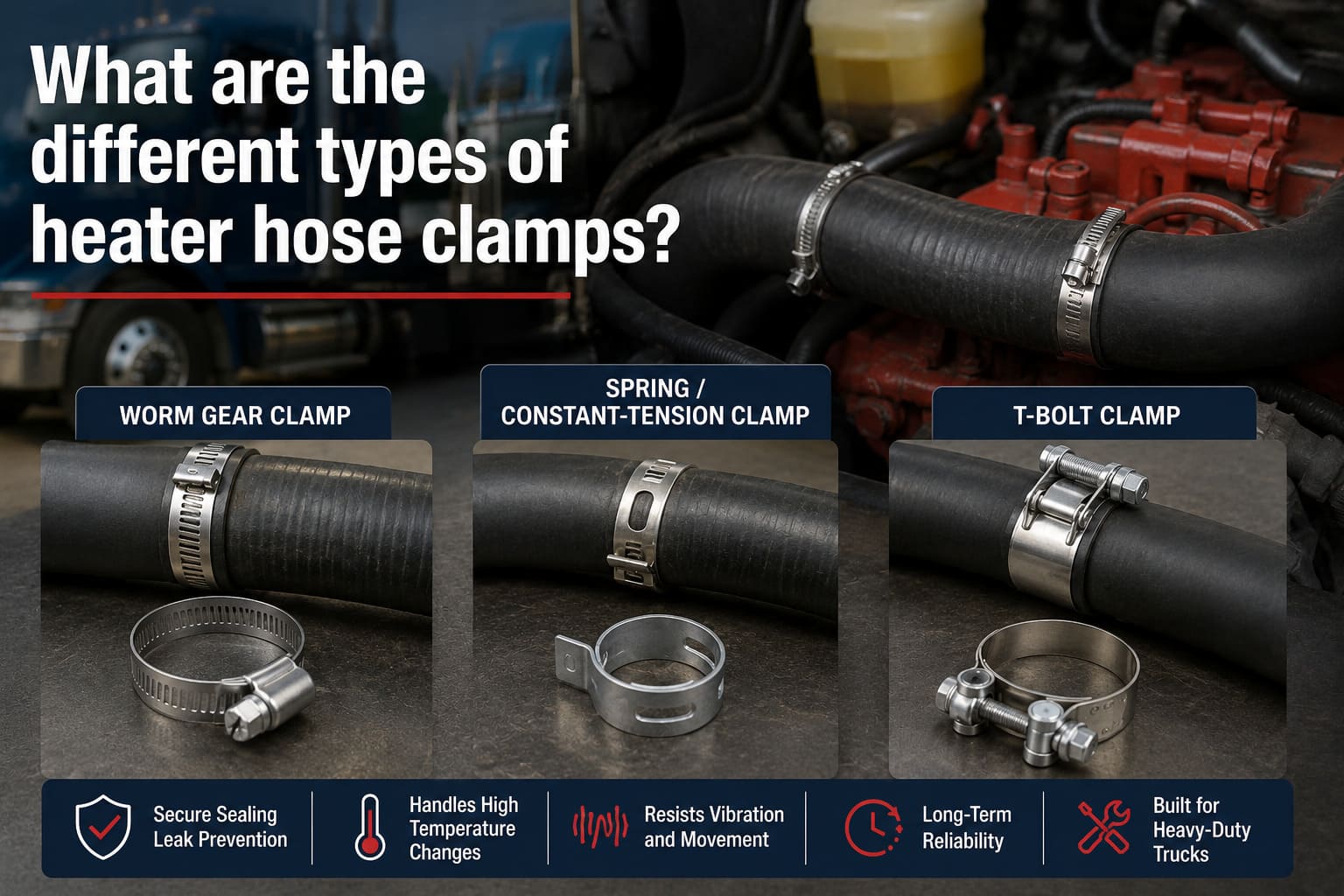
Heater hose clamps for heavy-duty trucks fall into three main types: worm gear clamps, spring (constant-tension) clamps, and T-bolt clamps.1 Each works differently, holds tension differently, and suits different conditions. The right choice depends on hose size, operating temperature range, vibration exposure, and how often the connection needs to be serviced2 — not just on which clamp fits over the hose.
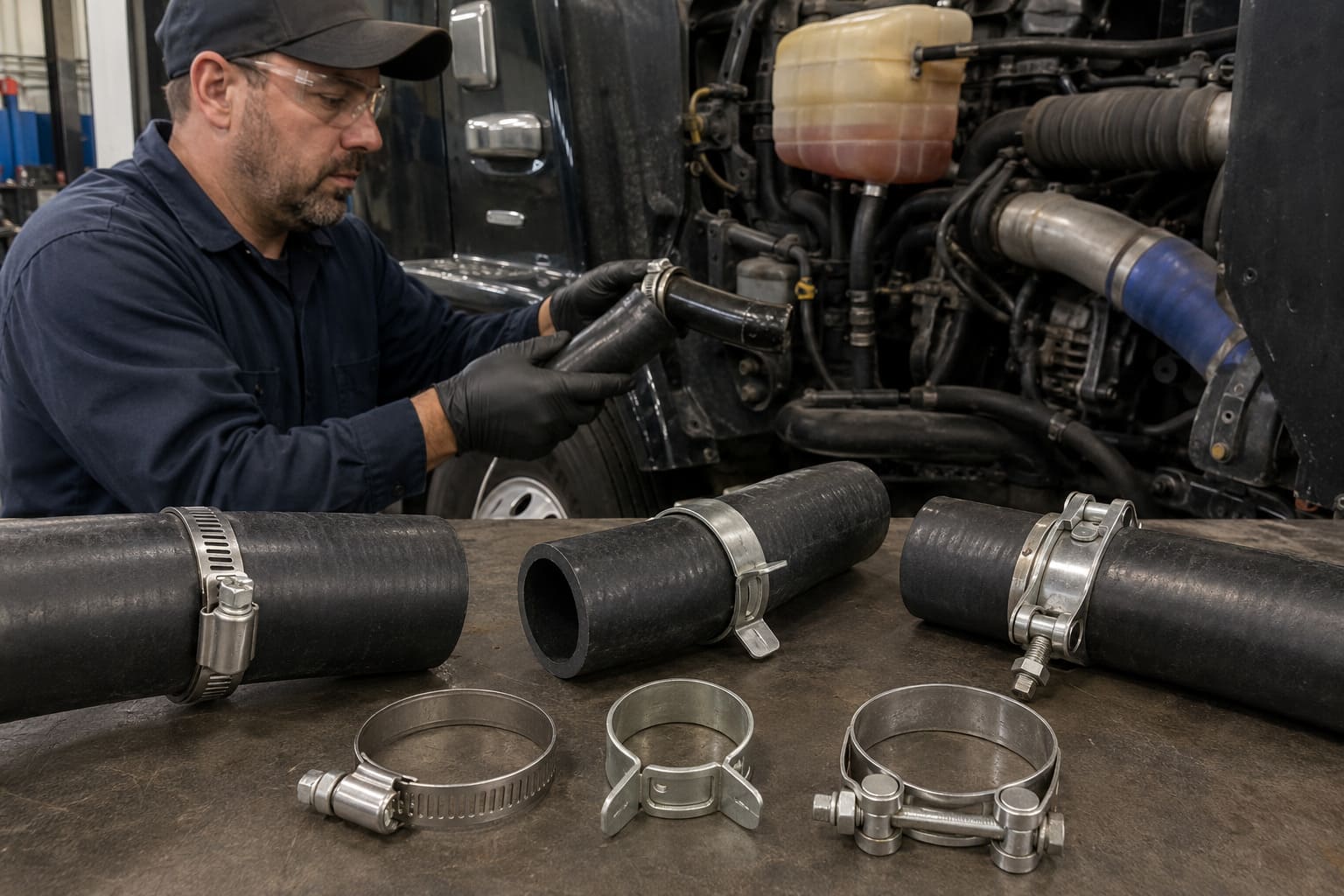
Understanding the structural and mechanical differences between these three types helps you stock smarter, reduce comebacks, and give better guidance to your customers. The sections below break each type down in practical terms — what they are, where they work well, and where they fall short.
What Is a Worm Gear Hose Clamp and When Does It Work?
Worm gear clamps are the most recognized fastener in any cooling system parts bin. They are easy to find, easy to install, and available in a wide range of sizes. But familiarity does not mean they are always the right tool.
A worm gear clamp uses a slotted stainless or carbon steel band tightened by a screw-driven worm mechanism.3 As the screw turns, it draws the band tighter around the hose. Clamping force is applied manually and stays where the installer sets it — unless something causes it to change.
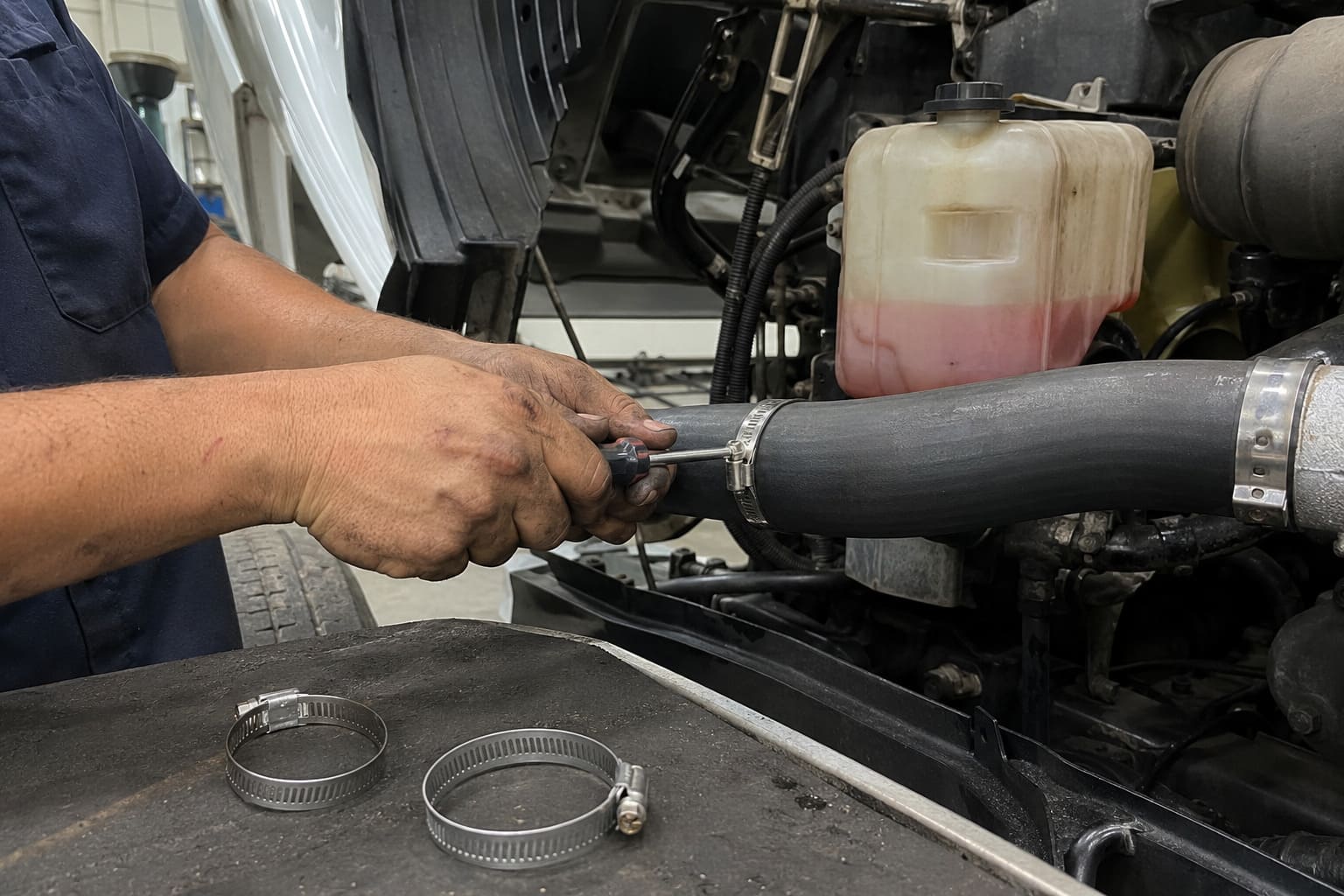
The key limitation in heavy-duty truck applications is tension stability over time. Worm gear clamps set a fixed tension at installation. They do not compensate for what happens afterward.4
How Temperature Cycling Affects Worm Gear Clamps
Every time a truck engine heats up and cools down, the heater hose expands and contracts. Over many thermal cycles, this movement gradually relaxes the clamp's grip.5 The band does not spring back. The screw does not self-adjust. The result is a clamp that was tight on day one and is noticeably looser six months later.
In a passenger car that sees moderate temperatures and limited vibration, this may not matter much. In a Class 8 truck running long-haul cycles with consistent thermal stress and road vibration, it matters a great deal.
Where Worm Gear Clamps Still Make Sense
Despite this limitation, worm gear clamps are not the wrong choice across the board. They work well in:
- Low-vibration, short-run heater hose connections where temperature cycling is moderate
- Service environments where re-torquing is a standard maintenance step and technicians check clamp tension at regular intervals
- Applications requiring precise, adjustable fit across a wide band range — particularly useful when hose OD varies between truck models or repair jobs involve non-standard hose
The practical advantage of worm gear clamps is their adjustability and availability. A distributor stocking a limited SKU range can cover many hose sizes with a small number of clamp sizes. For repair shops handling mixed truck brands — Freightliner, Kenworth, Peterbilt, International, Volvo, Mack — that flexibility has real value.
Material and Surface Treatment Considerations
Not all worm gear clamps are built equally. Key differences include:
| Feature | Standard Carbon Steel | 304 Stainless Steel | 316 Stainless Steel |
|---|---|---|---|
| Corrosion resistance | Low | Moderate–High | High |
| Typical use | Dry, mild environments | General truck applications | High-moisture or chemical exposure |
| Band width options | Narrow (12–14 mm common) | Narrow to wide | Narrow to wide |
| Cost | Lowest | Mid | Higher |
Band width also matters. A wider band (14 mm or 16 mm) distributes clamping force more evenly and reduces the chance of cutting into softer hose materials.6 In our experience supplying heater hose clamp kits for the North American market, buyers often overlook band width when specifying clamps — then encounter hose biting issues in the field.
What Is a Spring or Constant-Tension Hose Clamp and When Does It Help?
Spring clamps — also called constant-tension clamps — solve the core problem that worm gear clamps cannot: they automatically adjust clamping force as the hose expands and contracts with temperature7.
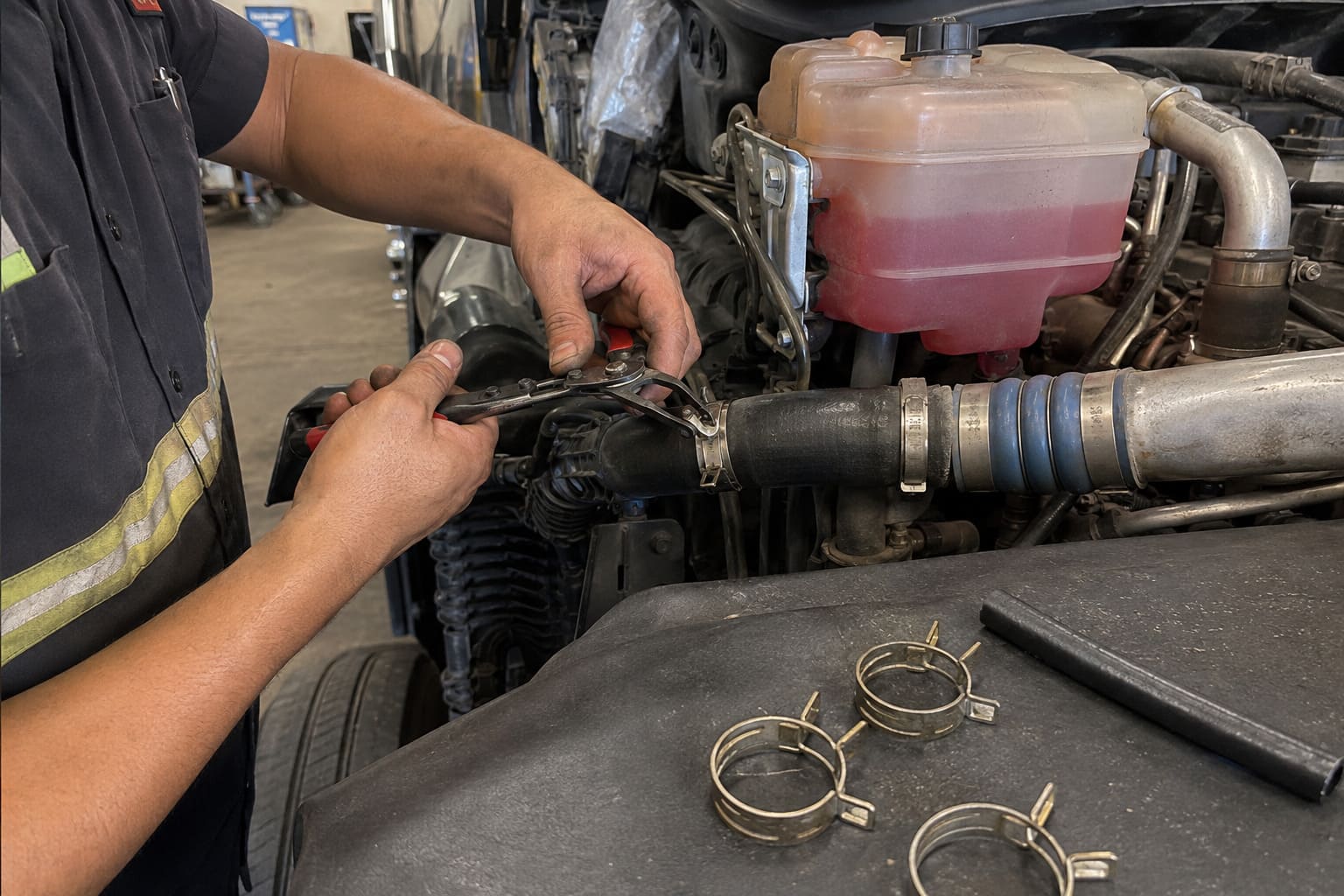
A spring clamp is stamped from spring-tempered steel and pre-tensioned during manufacture. When installed, it applies consistent radial pressure around the hose. As the hose swells with heat, the clamp opens slightly. As the hose cools and contracts, the clamp closes back. This self-adjusting behavior is what earns the name "constant-tension."
Why Constant Tension Matters in Heavy-Duty Truck Heater Hose Circuits
Heater hose in a Class 8 truck runs between the engine coolant circuit and the cab heater core.8 Operating temperatures in these circuits can swing significantly between cold startup and full operating temperature. The hose — whether EPDM, silicone, or reinforced rubber — expands with heat and contracts with cold.
A clamp that cannot follow this movement will either:
- Leak during contraction — the hose shrinks away from a fixed-tension clamp, and coolant finds the gap
- Damage the hose during expansion — if the clamp was over-tightened at installation, hose expansion has nowhere to go
Spring clamps eliminate both risks because the clamp force tracks the hose diameter in real time.
Practical Limitations of Spring Clamps
Spring clamps are not universally superior. They come with their own set of constraints:
- Fixed size range — unlike worm gear clamps, spring clamps are not adjustable. They must be matched closely to the hose OD. A clamp that is too large provides insufficient tension; too small, and it cannot install correctly.
- Installation requires the right tool — spring clamps typically require hose clamp pliers to open and position. This is not complicated, but it adds a tool requirement versus a simple screwdriver.
- Not ideal for oversized or non-standard hose OD — in repair situations where hose diameter does not match standard sizing, worm gear clamps offer more flexibility.
- Limited re-use — spring clamps can be reinstalled, but repeated opening and closing degrades spring tension over time9. Many experienced shop buyers treat them as single-use.
Where Spring Clamps Belong in a Distributor's Stock
For distributors and wholesalers supplying shops that work on production trucks — vehicles with consistent factory hose diameters — spring clamps are a strong choice for heater hose positions that see regular thermal cycling. Stocking the correct sizes matched to common truck OEM hose ODs is the key. This requires knowing which truck platforms your customers service most often.
Spring clamps are factory-installed on many North American heavy-duty trucks for exactly this reason. When a shop replaces a heater hose, replicating the OEM clamp type is often the lower-risk decision.
What Is a T-Bolt Hose Clamp and When Is It Worth the Cost?
T-bolt clamps represent the heaviest-duty option in the heater hose clamp category. They are built for higher clamping forces, more aggressive operating conditions, and applications where joint integrity cannot be compromised.
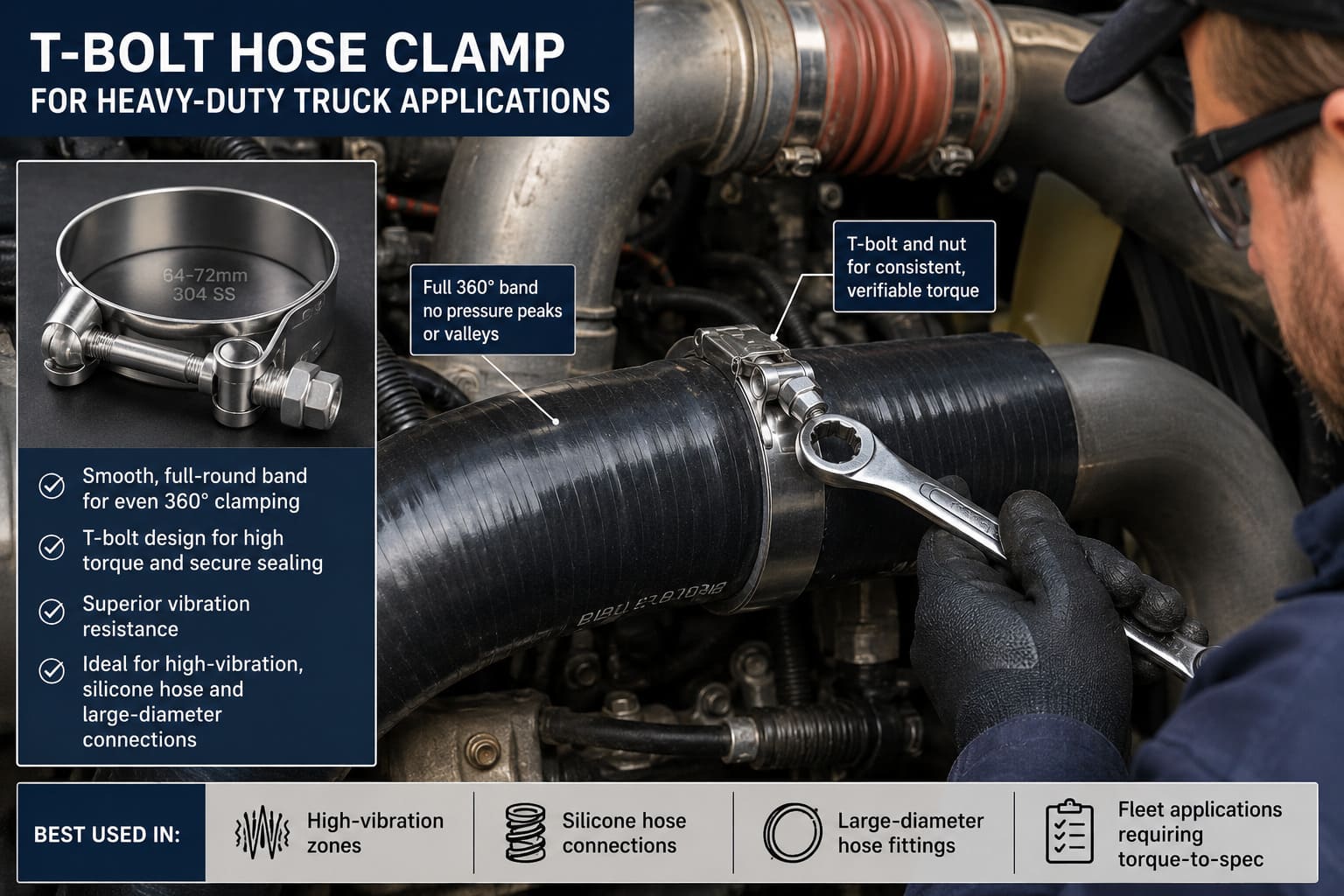
A T-bolt clamp uses a smooth, full-round stainless steel band with a T-headed bolt and nut assembly that draws the band ends together uniformly. Because the band is smooth and continuous — with no worm channel cutting across its surface — clamping force is distributed evenly across the entire hose circumference.10
Structural Advantages Over Worm Gear Clamps
The worm gear clamp's screw mechanism creates a point of uneven force — the area of the band where the worm engages applies different pressure than the rest of the band. On firm, thick hoses, this may not cause problems. On softer heater hoses, particularly silicone hoses, it can create deformation or leak paths.
T-bolt clamps avoid this entirely:
- Full 360° contact with no pressure peaks or valleys
- Higher torque capacity — T-bolt assemblies can be torqued to specification with a wrench or socket, making installation more consistent and verifiable
- Better vibration resistance — the bolt-and-nut design is more resistant to loosening under mechanical vibration than a worm screw11
Where T-Bolt Clamps Are and Are Not Necessary for Heater Hoses
T-bolt clamps are not automatically necessary for every heater hose connection. Their advantages are most relevant in:
- High-vibration zones — engine-side connections on turbocharged heavy-duty diesels where vibration amplitude is significant
- Silicone hose connections — silicone is softer and more deformable than EPDM; full-circle clamping reduces the risk of hose damage
- Large-diameter heater hose fittings — where standard worm gear clamps struggle to maintain consistent band pressure across a wide diameter
- Fleet applications requiring torque-to-spec installation — T-bolt clamps allow documented, repeatable installation torque, which supports maintenance recordkeeping
For smaller-diameter heater hose runs in moderate-vibration positions, the added cost of T-bolt clamps may not deliver proportional benefit. The choice should be driven by the application, not by a general preference for heavier hardware.
Cost and Stocking Considerations for Distributors
T-bolt clamps cost more per unit than worm gear or spring clamps. For distributors building a catalog, this creates a positioning question:
| Clamp Type | Relative Unit Cost | Adjustability | Best Application |
|---|---|---|---|
| Worm gear | Lowest | High — wide size range | Flexible service, moderate thermal/vibration conditions |
| Spring/constant-tension | Mid | Low — size-matched | Temperature-cycling heater hose on production trucks |
| T-bolt | Highest | Mid — limited range | High-vibration, silicone hose, large-diameter, spec torque required |
Stocking all three types in the sizes relevant to your market — and being able to explain to shop customers which type fits which situation — is a straightforward way to add value beyond price competition.
Frequently Asked Questions
Can I use a worm gear clamp to replace a spring clamp on a heater hose?
You can physically install a worm gear clamp in place of a spring clamp, but the performance behavior is different. A worm gear clamp holds fixed tension and does not self-adjust with temperature cycling. If the heater hose sees significant thermal expansion and contraction, a worm gear replacement may require periodic re-torquing to maintain a leak-free seal.
What size heater hose clamp do I need for a heavy-duty truck?
Heater hose diameters on Class 8 trucks commonly range from 3/4 inch to 1-1/2 inches depending on the circuit and truck model.12 Always measure the hose OD after installation on the fitting — not the hose ID or the nominal hose size — to select the correct clamp range. Spring clamps must be closely matched; worm gear clamps offer a wider adjustable range.
Are stainless steel heater hose clamps worth the extra cost?
For heavy-duty truck applications in North America and South America, stainless steel — at minimum 304 grade — is generally the right baseline for heater hose clamps. Carbon steel clamps corrode faster in environments with road salt, moisture, and coolant exposure. Corrosion weakens band integrity and makes future serviceability difficult. The cost difference is small relative to the labor cost of a repeat repair.
How do I know if a heater hose clamp is too tight or too loose?
A clamp that is too loose will allow coolant seepage, particularly after thermal cycling. A clamp that is too tight on a soft hose (especially silicone) can cut into the hose material, creating a stress point that fails over time. T-bolt clamps with torque specifications reduce guesswork. For worm gear clamps, follow manufacturer torque guidance and inspect visually for hose deformation at the clamp edges.
Do heavy-duty trucks use the same heater hose clamp types as passenger vehicles?
The same three clamp types appear in both markets, but the operating demands are different. Heavy-duty diesel engines run higher sustained temperatures, greater vibration, and heavier-duty cooling circuits than passenger cars. This shifts the selection criteria — particularly toward constant-tension and T-bolt clamps for applications where a passenger-car-grade worm gear clamp would be marginal or would require frequent re-torquing.
Conclusion
Heater hose clamps are a small part with real consequences when specified incorrectly. The three main types — worm gear clamps, spring constant-tension clamps, and T-bolt clamps — each have a logical place in heavy-duty truck cooling system maintenance. Worm gear clamps offer flexibility and availability. Spring clamps deliver the self-adjusting tension that temperature-cycling heater hose connections genuinely need. T-bolt clamps provide the uniform clamping force and vibration resistance that demanding, high-load positions require.
Selecting the right heater hose clamp type for the application — not just the right size — reduces coolant leaks, repeat repairs, and downtime risk for your customers.
At ROADSPOWER, we supply heater hose clamps and related cooling-system accessories built to common North American and South American heavy-duty truck specifications. Whether you are a distributor building a catalog, a repair shop looking for consistent supply, or a fleet buyer standardizing your parts list, we can support your volume requirements with stable supply and flexible order options. Contact us to discuss specifications or request samples.
"Hose clamp", https://en.wikipedia.org/wiki/Hose_clamp. A general technical reference on hose clamps identifies worm-drive, spring, and T-bolt clamps as distinct clamp designs used to secure flexible hoses. Evidence role: definition; source type: encyclopedia. Supports: A neutral reference should identify worm-drive, spring, and T-bolt clamps as recognized hose clamp designs.. Scope note: This supports the classification of clamp types generally, not their relative suitability for heavy-duty truck heater circuits. ↩
"How to Choose the Right Hose Clamp: A Complete Guide for Industrial ...", https://www.ydsevereon.com/en-US/newsc8-how-to-choose-the-right-hose-clamp-a-complete-guide-for-industrial-applications. Engineering guidance for hose and clamp assemblies treats clamp selection as an application-dependent decision involving hose dimensions, thermal conditions, mechanical loading, and service environment. Evidence role: expert_consensus; source type: institution. Supports: A standards or engineering-institution source should show that hose clamp selection is governed by application conditions such as diameter, temperature, vibration, and service environment.. Scope note: The source would provide general selection criteria rather than a truck-heater-specific decision matrix. ↩
"Achieving Optimal Tightness: Guide to Worm-Gear Clamps in Hose ...", https://www.smecoupling.com/wormgearclampsinhoseassemblies.html. Technical descriptions of worm-drive hose clamps define them as clamps in which a screw engages slots in a metal band to reduce the band diameter around a hose. Evidence role: definition; source type: encyclopedia. Supports: A reference source should define the worm gear hose clamp as a slotted band tightened by a screw or worm-drive mechanism.. ↩
"Constant Tension Worm Gear Clamps | Leak-Proof Seal", https://hcl-clamping.com/collections/constant-tension-worm-gear-clamps-2?srsltid=AfmBOop8d1eXey3GDUgpN2-5ojGgDGmSAVopR_ef4N99A1MGuD7FBxda. Studies of hose joints and clamp load behavior describe conventional screw-type clamps as fixed-setting devices whose sealing load can change when the hose material expands, contracts, or relaxes. Evidence role: mechanism; source type: paper. Supports: A mechanical or materials source should explain that conventional screw clamps maintain a set diameter or load and do not self-adjust as hose dimensions change.. Scope note: The evidence may address elastomeric hose joints generally rather than heater hose clamps on heavy-duty trucks specifically. ↩
"Study of Bolt Load Loss in Bolted Aluminum Joints - Rod Lakes", https://lakeslab.ep.wisc.edu/BoltJEMT07.pdf. Research on elastomeric hose joints shows that thermal cycling and viscoelastic relaxation can alter hose dimensions and reduce sealing load in clamped connections. Evidence role: mechanism; source type: paper. Supports: A research source should document stress relaxation, creep, or clamp-load loss in elastomeric hose joints under repeated temperature changes.. Scope note: Such findings support the underlying mechanism but may not quantify the exact six-month loosening pattern described in field use. ↩
"Band Width & Thickness: Key Specifications for Hose Clamp ...", https://hcl-clamping.com/blogs/glossary/band-width-thickness?srsltid=AfmBOoo0zeYrGJBzGaREFD5hXOy5lqJz3AkFRx6OEyMLan3-c5UBU3G5. Contact-mechanics principles and hose-assembly guidance indicate that increasing clamp band width spreads load over a larger hose surface area, reducing localized pressure at the clamp edge. Evidence role: mechanism; source type: research. Supports: A source should support the relationship between band width, contact pressure distribution, and reduced localized hose deformation.. Scope note: This is contextual mechanical support and may not compare 14 mm and 16 mm bands in a controlled heater-hose test. ↩
"Constant Tension Hose Clamps", https://www.murraycorp.com/constant-tension-clamps. Technical descriptions of constant-tension hose clamps state that their spring element allows the clamp to expand and contract with the hose, helping maintain sealing pressure during temperature changes. Evidence role: mechanism; source type: institution. Supports: A technical institution or standards source should explain that spring clamps maintain clamping force over diameter changes caused by thermal expansion and contraction.. ↩
"Does coolant run through a car's heater core even when the system is off?", https://www.quora.com/Does-coolant-run-through-a-car-s-heater-core-even-when-the-system-is-off. Automotive heating-system references describe the heater core as a heat exchanger supplied by engine coolant through heater hoses, which supports the described function of heater hose circuits. Evidence role: definition; source type: education. Supports: An automotive education or training source should explain that heater cores receive hot engine coolant through heater hoses.. Scope note: The source may describe automotive heater systems generally rather than Class 8 truck plumbing in particular. ↩
"Central and peripheral fatigue kinetics during exhaustive constant-load ...", https://pubmed.ncbi.nlm.nih.gov/20807390/. Materials engineering literature on spring fatigue reports that repeated deflection cycles can reduce spring force through fatigue, stress relaxation, or permanent set. Evidence role: mechanism; source type: paper. Supports: A materials or mechanical-engineering source should support that repeated deflection cycles can cause spring fatigue or load loss.. Scope note: This supports the plausibility of reduced tension from repeated reuse, but it may not establish a specific reuse limit for heater hose spring clamps. ↩
"Choosing the Right Hose Clamp: Worm Gear, T-Bolt & Quick Release", https://morelandhose.com/choosing-the-right-clamp-for-your-hose-assembly/. Engineering discussions of hose clamp design note that smooth-band clamps provide more continuous contact around the hose than slotted worm-drive bands, supporting more uniform circumferential pressure. Evidence role: mechanism; source type: research. Supports: A technical source should explain that smooth-band clamps reduce localized pressure discontinuities compared with slotted worm-drive bands.. Scope note: The source may describe design principles rather than directly measuring every T-bolt and worm gear clamp model. ↩
"Vibration Resistant T-Bolt Clamps | Secure Hose Fastening", https://hcl-clamping.com/collections/vibration-resistant-t-bolt-clamps-1?srsltid=AfmBOopR2LLoG63eDk8fZqw8Pmrlbg4sLbj7yLGlB-fUeT8uK0wM6n1e. Research on vibration-induced loosening of threaded and clamping assemblies shows that joint geometry, preload, and fastening method influence resistance to loosening under cyclic mechanical vibration. Evidence role: mechanism; source type: paper. Supports: A source should support that clamp fastener design affects resistance to vibration-induced loosening, ideally comparing T-bolt and worm-drive clamps.. Scope note: Unless the source directly compares hose clamp types, it provides contextual support for the mechanism rather than direct proof that every T-bolt clamp outperforms every worm gear clamp. ↩
"Untitled", https://www.mauicounty.gov/DocumentCenter/View/96201/IFB1415-P59-6x6-2800-Gallon-Tanker?bidId=. Heavy-duty vehicle service and parts documentation lists heater and coolant hose sizes in the approximate 3/4-inch to 1-1/2-inch range across different circuits and models. Evidence role: statistic; source type: institution. Supports: A source should document common heater hose size ranges used in heavy-duty truck coolant and cab-heater circuits.. Scope note: The cited documentation may demonstrate common examples rather than establish a comprehensive industry-wide statistical range. ↩