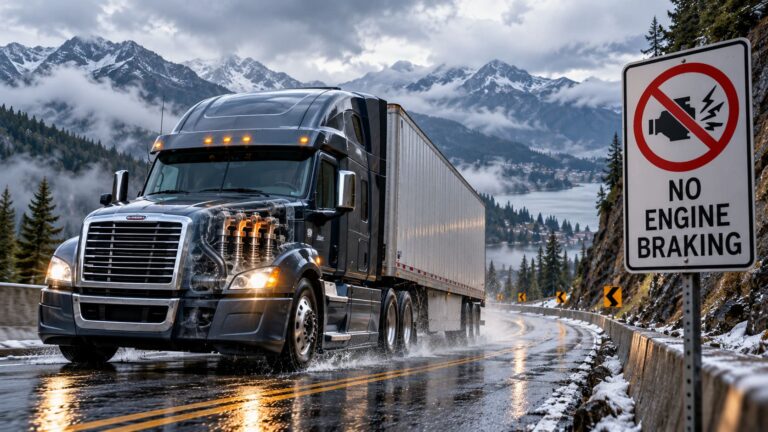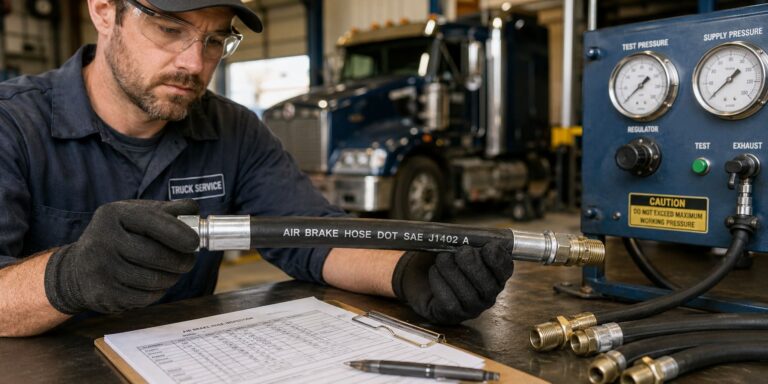
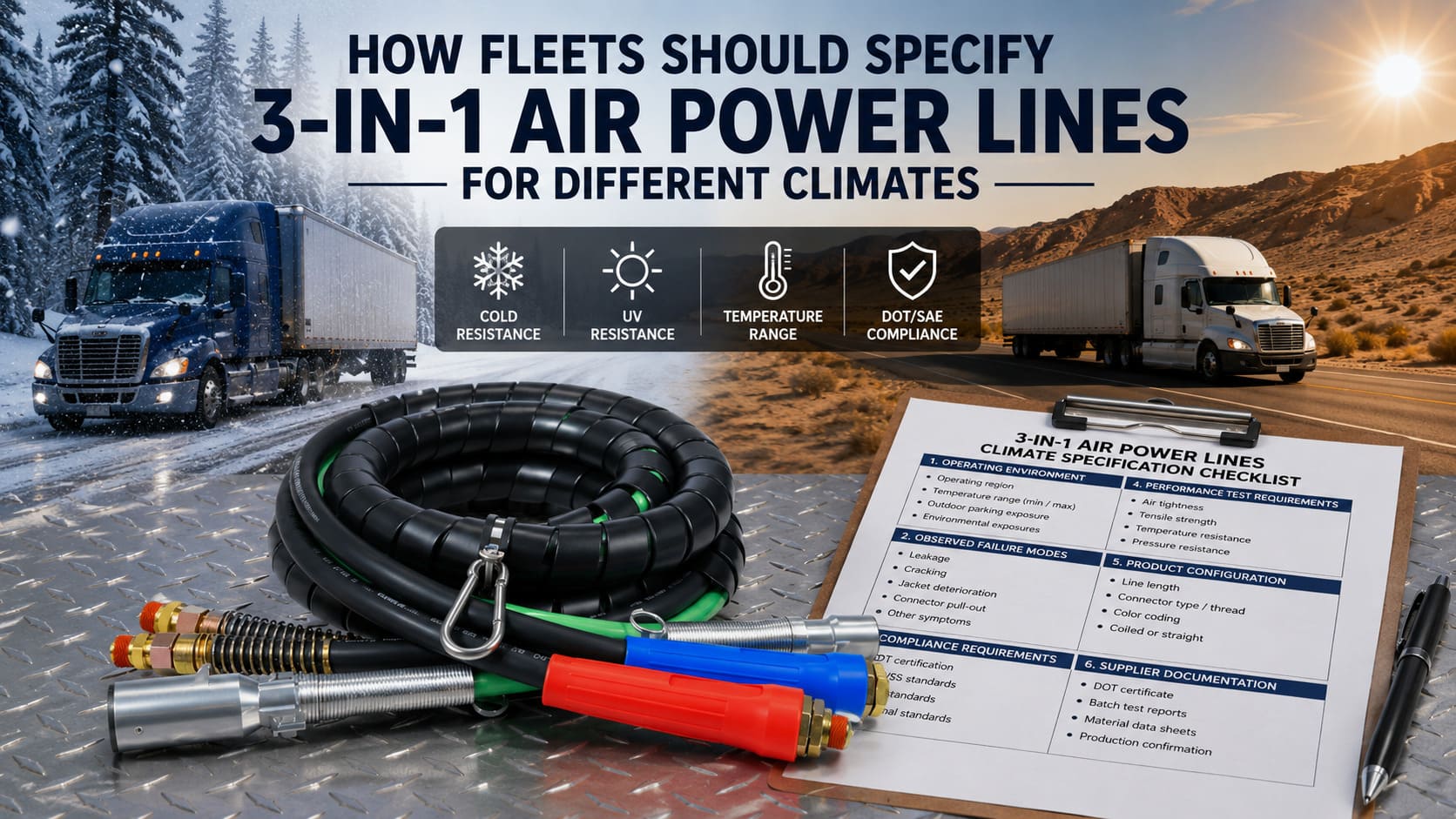
Choosing the wrong 3-in-1 air power lines for your operating climate is one of the quietest causes of preventable downtime. Fleets often default to a single SKU or ask only for "the coldest rating available" — and then wonder why lines crack in January or go brittle after two summers in the desert Southwest. Specifying correctly starts with understanding what your operating environment actually demands.
3-in-1 air power lines should be specified by translating your fleet's real operating conditions — including route climate, outdoor parking exposure, temperature range, and compliance requirements — into a structured RFQ. No single temperature rating or universal SKU covers every duty cycle. The right specification combines material selection, connector compatibility, verified test data, and regulatory compliance for your specific region.
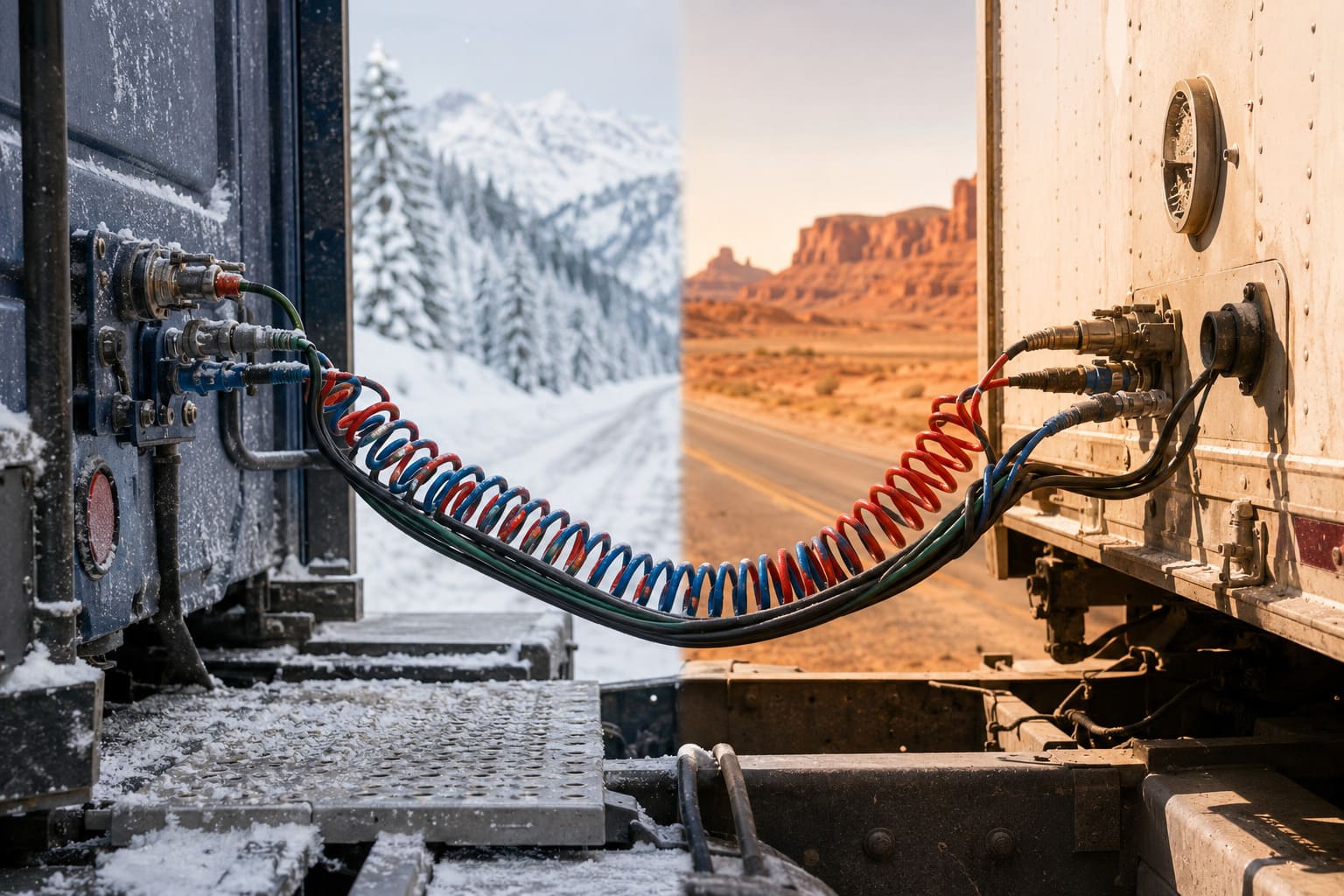
Most procurement managers I speak with have already experienced at least one climate-related misspecification — a batch of lines that stiffened up on a northern route, or a set of jackets that chalked out after a summer of UV exposure in the Southwest. The details below will help you avoid both mistakes by asking better questions before you write the purchase order.
Why Does Climate Matter So Much for 3-in-1 Air Power Lines?
A single wrong assumption about operating temperature can translate into cracked tubing, air leaks, and roadside failures before a line's expected service period is anywhere near complete. Procurement teams often underestimate how differently the same product performs across different climates — until returns start arriving.
3-in-1 air power lines are exposed to ambient temperature, UV radiation, ozone, road chemicals, and mechanical flexing simultaneously. Each climate stresses a different part of the assembly — the tubing compound, the jacket material, or the connector seal — which is why a specification built around one number rarely accounts for the full performance picture.
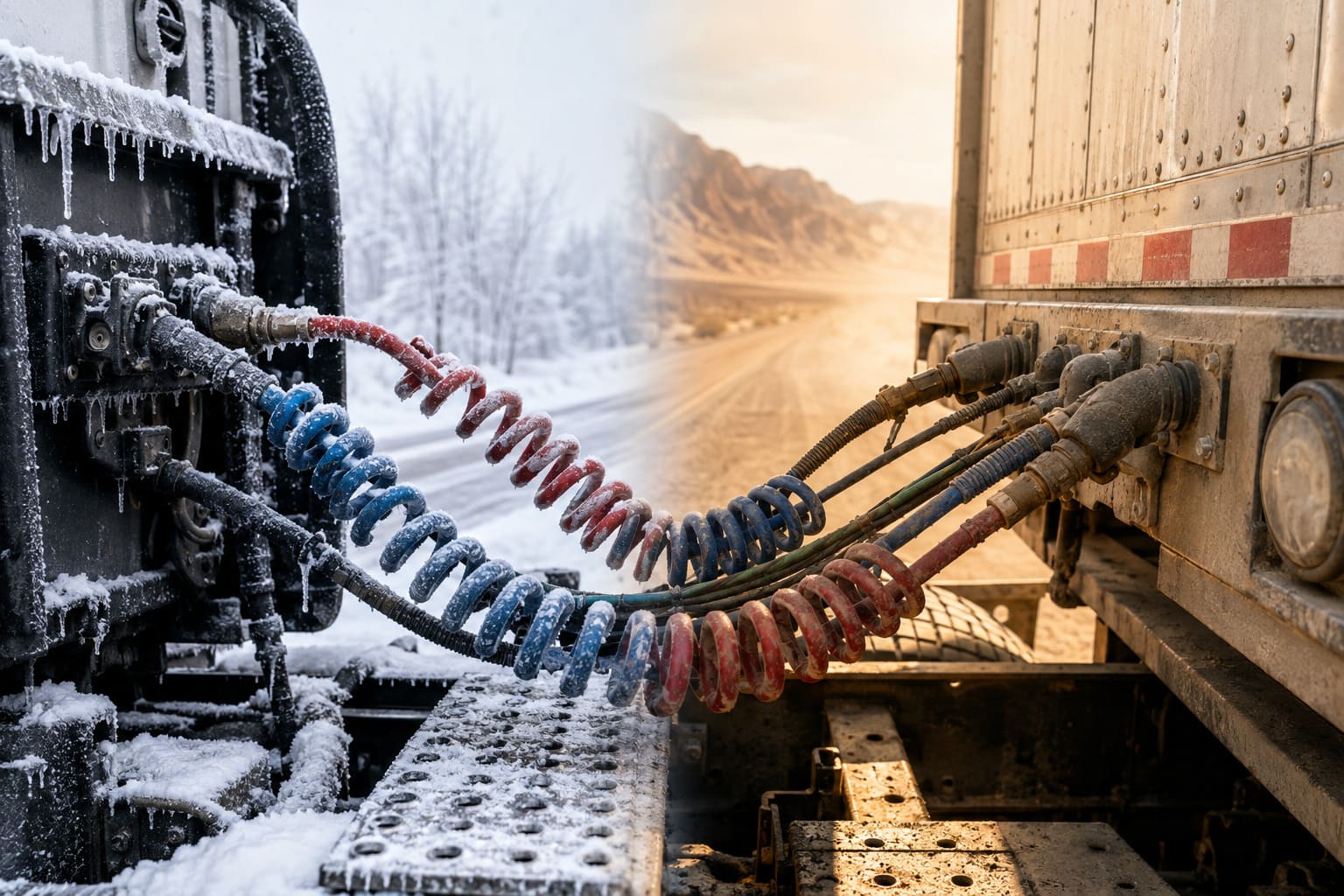
Understanding the failure modes specific to each climate helps you write a spec that targets the right properties — not just the lowest temperature rating on a product sheet.
Cold-Climate Failure Modes
In cold climates — think northern U.S. routes, Canadian provinces, or high-altitude corridors — the primary risks are:
- Tubing hardening: Rubber and thermoplastic compounds lose flexibility at low temperatures.1 A line that flexes normally at 70°F may become stiff and brittle at -40°F.2
- Cracking at bend points: When stiffened tubing is connected or repositioned in cold conditions, stress concentrates at bends and connector interfaces, leading to cracks.
- Air leakage at seals: Connector O-rings and gland seals also compress differently at low temperatures. If the connector spec doesn't match the tubing compound's cold-temperature behavior, micro-leaks develop.
- Overnight parking exposure: A truck parked outdoors in a northern winter for eight to twelve hours experiences sustained low temperatures without engine heat. This is a harder test than a brief cold snap during operation.
Hot-Climate and UV Failure Modes
In hot climates — the desert Southwest, Gulf Coast routes, or Central and South American lowland corridors — the primary risks shift:
- Jacket compound aging: Sustained heat accelerates oxidation in rubber jackets.3 Lines lose surface flexibility and begin to chalk, crack, or peel from the outside in.
- UV degradation: Direct sun exposure breaks down compound polymers over time, especially in jackets without adequate UV stabilizer content.4
- Ozone attack: Many southern and coastal routes carry higher ambient ozone levels.5 Ozone degrades certain rubber formulations at the surface, creating fine surface cracks that deepen under flex stress.6
- Heat-cycle fatigue: Repeated daily temperature swings — cold morning starts, hot afternoon operation — stress the interface between the tubing and connector more than sustained heat alone.
Mixed-Duty Routes
Many fleets don't run pure cold or pure hot routes. A regional carrier might run Denver to Phoenix, or Toronto to Atlanta. In these cases, neither the cold-only nor the hot-only failure modes fully describe the risk. The specification needs to account for the full temperature range the line will experience, not just the lowest or highest point.
| Climate Profile | Primary Risk | Key Property to Specify |
|---|---|---|
| Northern cold routes | Hardening, cracking, seal leakage | Low-temperature flexibility, cold-bend performance |
| Desert/UV-exposed routes | Jacket aging, UV degradation, ozone cracking | UV resistance, ozone resistance, jacket compound stability |
| Mixed or cross-regional routes | Both sets of risks across cycles | Broad operating range, cycle fatigue resistance |
| Coastal/humid routes | Corrosion at metal connectors, ozone | Connector plating, ozone-resistant jacket |
What Questions Should You Ask Before Writing a Specification?
Most specification errors I see don't come from lack of technical knowledge — they come from skipping a few key questions at the start of the procurement conversation. Before matching a product to a climate, you need to map the operating reality first.
Before specifying 3-in-1 air power lines, answer these questions: Where does the fleet operate? Are trucks parked outdoors for extended periods? What failure symptoms has the fleet actually experienced — leakage, cracking, stiff lines, or fitment problems? And what DOT, SAE, or FMVSS compliance documents does the application require?
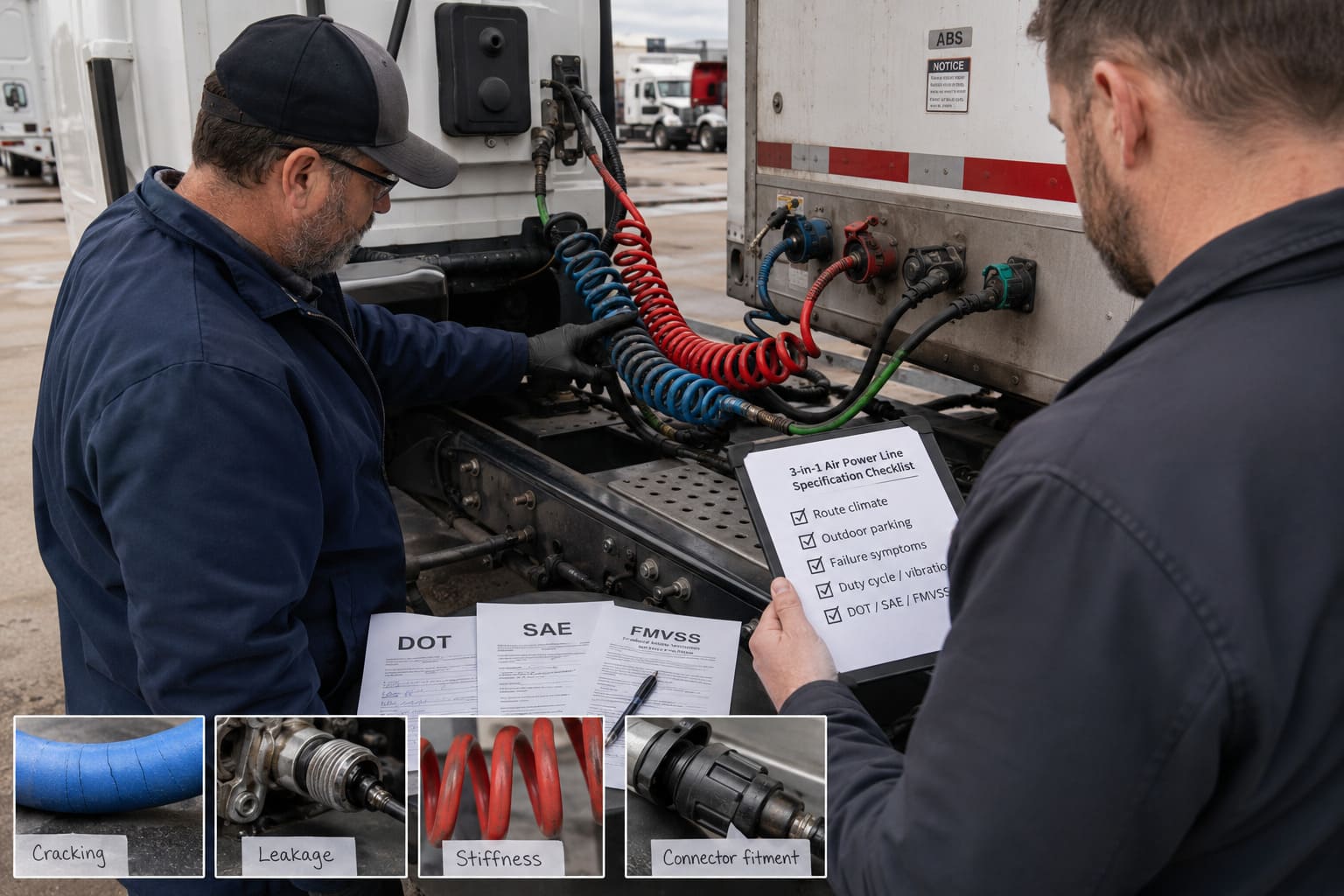
These questions don't require lab data to answer. They require honest input from drivers, maintenance leads, and whoever handles warranty returns. The answers directly shape the specification.
Question 1: Where Does the Fleet Operate?
This seems obvious, but "North America" is not an answer — it's a continent with wildly different climate profiles. I always ask customers to describe their routes specifically:
- Northern routes: Minnesota, Montana, Manitoba, Alberta — sustained cold, road salt, freeze-thaw cycles
- Southern/desert routes: Texas, Arizona, New Mexico, Nevada — sustained heat, UV, ozone
- Cross-regional routes: Routes that span multiple climate zones in a single run
- South American routes: Tropical lowland versus Andean high-altitude corridors — very different humidity and temperature profiles
The answer shapes both the compound selection and the test data you should request from the supplier.
Question 2: Is the Truck Parked Outdoors for Long Periods?
Overnight outdoor parking changes the severity calculation significantly. A truck that is garaged or stays connected to engine heat recovers from temperature extremes faster than one sitting in an open yard at -20°F for ten hours. If your fleet parks outdoors in cold climates, the specification for cold-temperature performance needs to reflect the static cold exposure case, not just the operating case.
Similarly, a truck parked under direct sun in a hot desert environment for days at a time experiences a more severe UV and heat load than one that runs daily and stays in motion.
Question 3: What Failure Symptoms Has the Fleet Actually Seen?
This is the most underused diagnostic question in aftermarket parts procurement. Before assuming a climate mismatch, separate the possible causes:
- Air leakage at connectors: Often a connector fit or installation issue, not a tubing material issue
- Cracking in the middle of a line: More likely a material or cold-temperature failure
- Cracking or splitting at the connector end: Could be over-bending, connector misalignment, or cold-climate stiffness
- Jacket surface chalking or peeling: Typically UV or heat aging of the outer compound
- Lines that feel stiff or won't flex during winter hookup: Cold-temperature hardening
Important note: Not every leak, crack, or failure is caused by the wrong climate specification. Installation errors, incorrect line lengths, connector incompatibility, and rough handling during coupling account for a significant share of field failures. Diagnosing the actual failure mode before changing the specification prevents solving the wrong problem.
Question 4: What Compliance Documents Does the Application Require?
For fleets operating in the U.S., this is not optional. The minimum compliance questions to answer:
- Is DOT certification required for the specific line and connector configuration?
- Does the application fall under FMVSS 106 or other Federal Motor Vehicle Safety Standards7?
- Are SAE J844 or other SAE pneumatic line standards8 relevant?
- For South American markets, are there applicable regional standards or import requirements?
Treat compliance documents as verification items, not assumptions. Ask the supplier for the actual certificates and verify the scope of certification against your application before finalizing the order.
How Should Test Requirements Be Written Into an RFQ?
Requesting a certificate is not the same as requesting verified performance. A well-written RFQ for 3-in-1 air power lines for climate-specific applications should call out specific tests and state the acceptance criteria you expect — not just ask for "DOT-compliant product."
A climate-aware RFQ for 3-in-1 air power lines should specify air tightness test parameters, tensile strength requirements, operating temperature range with cold-bend and heat-aging test references, and pressure resistance levels appropriate for the application. These four test categories address the primary failure modes in both cold and hot climates.
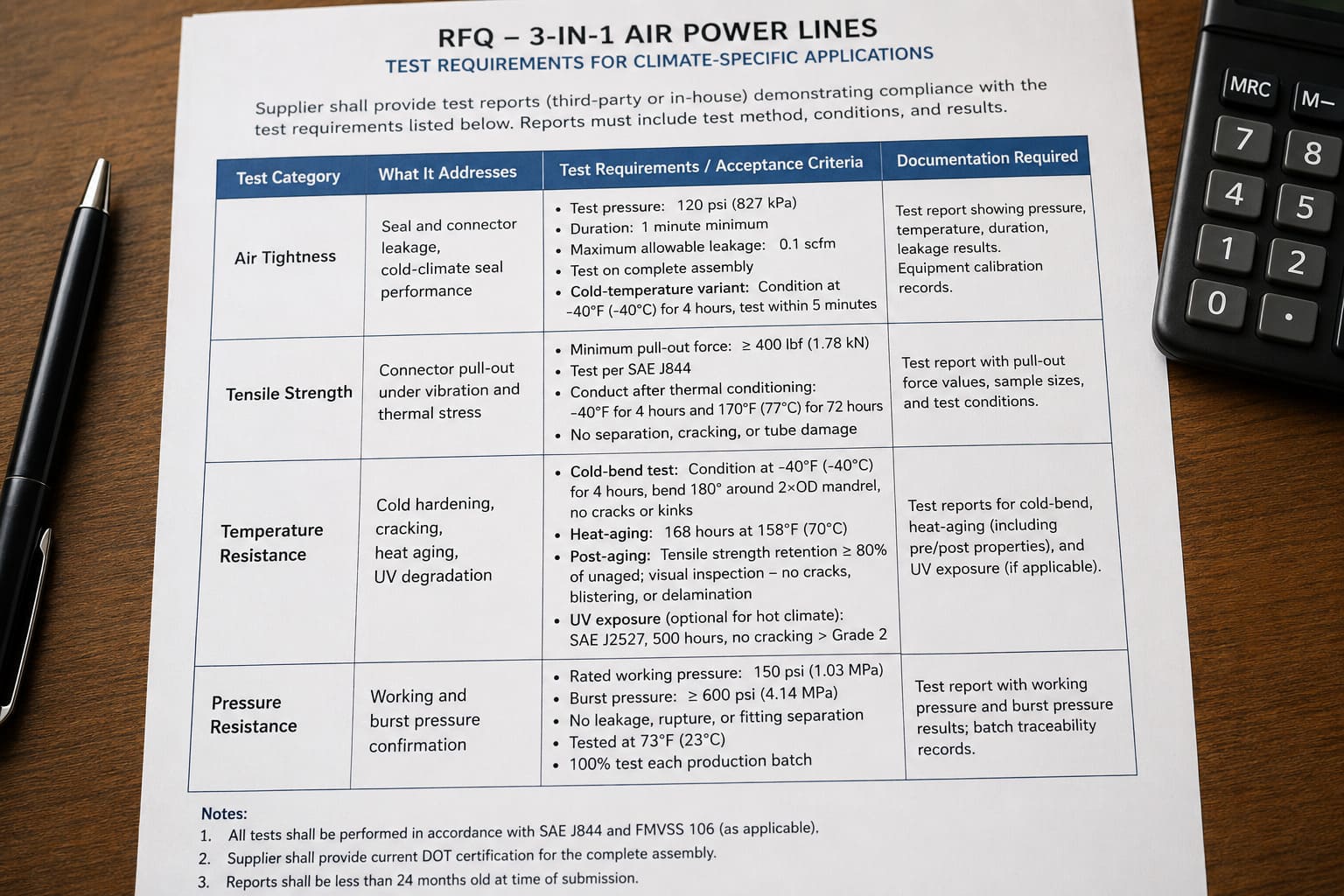
Here is how each test category maps to climate risk:
Air Tightness Testing
Air tightness testing confirms that the assembled line — tubing, connectors, and seals together — holds pressure without measurable leakage under defined conditions.9 This is the most direct test for the cold-climate connector seal failure mode.
When writing the RFQ, ask the supplier:
- At what pressure is air tightness tested?
- Is testing conducted on the full assembly or on the tubing alone?
- Is there a cold-temperature variant of the air tightness test?
A supplier who can only show a room-temperature air tightness result for a product going into a northern fleet is giving you incomplete information.
Tensile Strength Testing
Tensile strength testing measures the force required to pull a connector fitting out of the tubing end. This directly addresses the risk of connector pull-out under vibration, thermal cycling, or rough handling during coupling in cold conditions when the tubing is stiffer.
Ask for:
- Pull-out force values for the connector-tubing interface
- Whether tensile testing is conducted after thermal conditioning (cold soak or heat aging)
- Batch-level testing frequency versus type-approval testing only
Temperature Resistance Testing
This is the test category most directly linked to climate specification. Temperature resistance testing typically involves:
- Cold-bend testing: Conditioning the line at a specified low temperature and then bending it around a mandrel to check for cracking or kinking
- Heat aging testing: Exposing the line to elevated temperature for a defined period and measuring the change in mechanical properties
- Low-temperature impact or flexibility testing
When reviewing supplier test data, check:
- What temperature was the cold-bend test conducted at?
- How long was the heat-aging exposure, and at what temperature?
- Were post-aging mechanical properties measured, or only visual inspection?
Pressure Resistance Testing
Pressure resistance testing confirms that the line can sustain working pressure and burst pressure without failure.10 For pneumatic brake and supply lines on heavy trucks, this is a safety-critical parameter.
Ask the supplier:
- What is the rated working pressure?
- What is the tested burst pressure?
- Is pressure resistance verified on each production batch, or only at type approval?
A structured way to build these requirements into a RFQ:
| Test Category | What It Addresses | What to Request from Supplier |
|---|---|---|
| Air tightness | Seal and connector leakage, cold-climate seal performance | Pressure level, assembly-level test, cold-temperature variant |
| Tensile strength | Connector pull-out under vibration and thermal stress | Pull-out force, post-thermal-conditioning results |
| Temperature resistance | Cold hardening, cracking, heat aging, UV degradation | Cold-bend temperature, heat-aging duration and temperature, post-aging properties |
| Pressure resistance | Working and burst pressure confirmation | Rated working pressure, burst pressure, batch test frequency |
How Should Material Selection Be Evaluated for Climate Suitability?
Material selection is where climate specification gets most specific — and where the most marketing language tends to appear. "Premium compound," "heavy-duty jacket," and "all-weather formulation" are phrases that need to be followed up with actual material data before you rely on them.
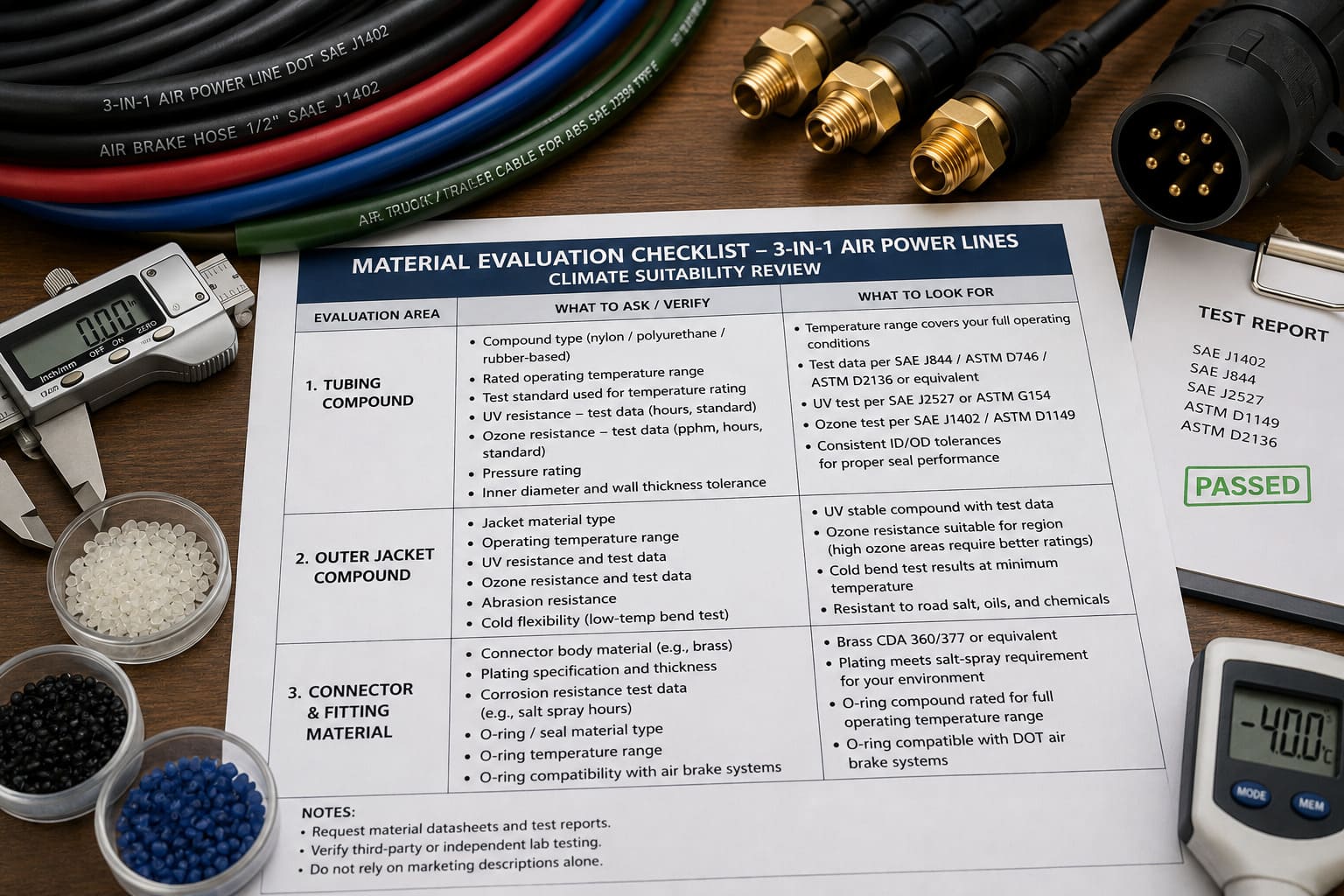
Evaluate 3-in-1 air power line material suitability by asking for compound type, applicable temperature range, UV and ozone resistance characteristics, and relevant standard compliance — then verify these against independent test data or third-party certification scope, not product descriptions alone.
Tubing Compound Options and Climate Relevance
The inner tubing of a 3-in-1 air power line must maintain flexibility and seal integrity across the operating temperature range. Common compound categories include nylon, polyurethane, and rubber-based formulations, each with different performance profiles:
- Nylon tubing: Good pressure resistance, moderate cold-temperature flexibility depending on grade. Commonly used for service lines on North American trucks. Performance at extreme cold temperatures varies by formulation.
- Polyurethane tubing: Generally better low-temperature flexibility than standard nylon, good abrasion resistance, but varying UV stability depending on grade and additives.
- Rubber-based compounds: Broader inherent flexibility range but more susceptibility to UV and ozone aging without stabilizer packages. Common in emergency and supply lines.
Rather than asking for a compound name, ask for:
- The rated operating temperature range with the applicable test standard
- Whether the compound includes UV and ozone stabilizers (and if so, what test data supports the claim)
- The same information for the outer jacket compound separately from the inner tubing
Connector and Fitting Material
The metal connectors — typically brass in quality aftermarket lines — have their own climate considerations:
- Brass: Good corrosion resistance, compatible with standard O-ring seals, widely used in North American applications
- Plating quality: In high-salt environments (northern routes with heavy road salt application), plating specification on connector bodies matters
- O-ring compound: The O-ring seal material inside each connector needs the same low-temperature performance consideration as the tubing compound — a tubing that stays flexible at -40°F provides limited benefit if the connector O-ring hardens and leaks at the same temperature
How Do You Build a Practical Climate Specification Checklist?
Everything discussed above leads to a practical output: a clear, usable specification document that reduces wrong-SKU purchases, manages supplier conversations more effectively, and protects your fleet from preventable climate-related failures.
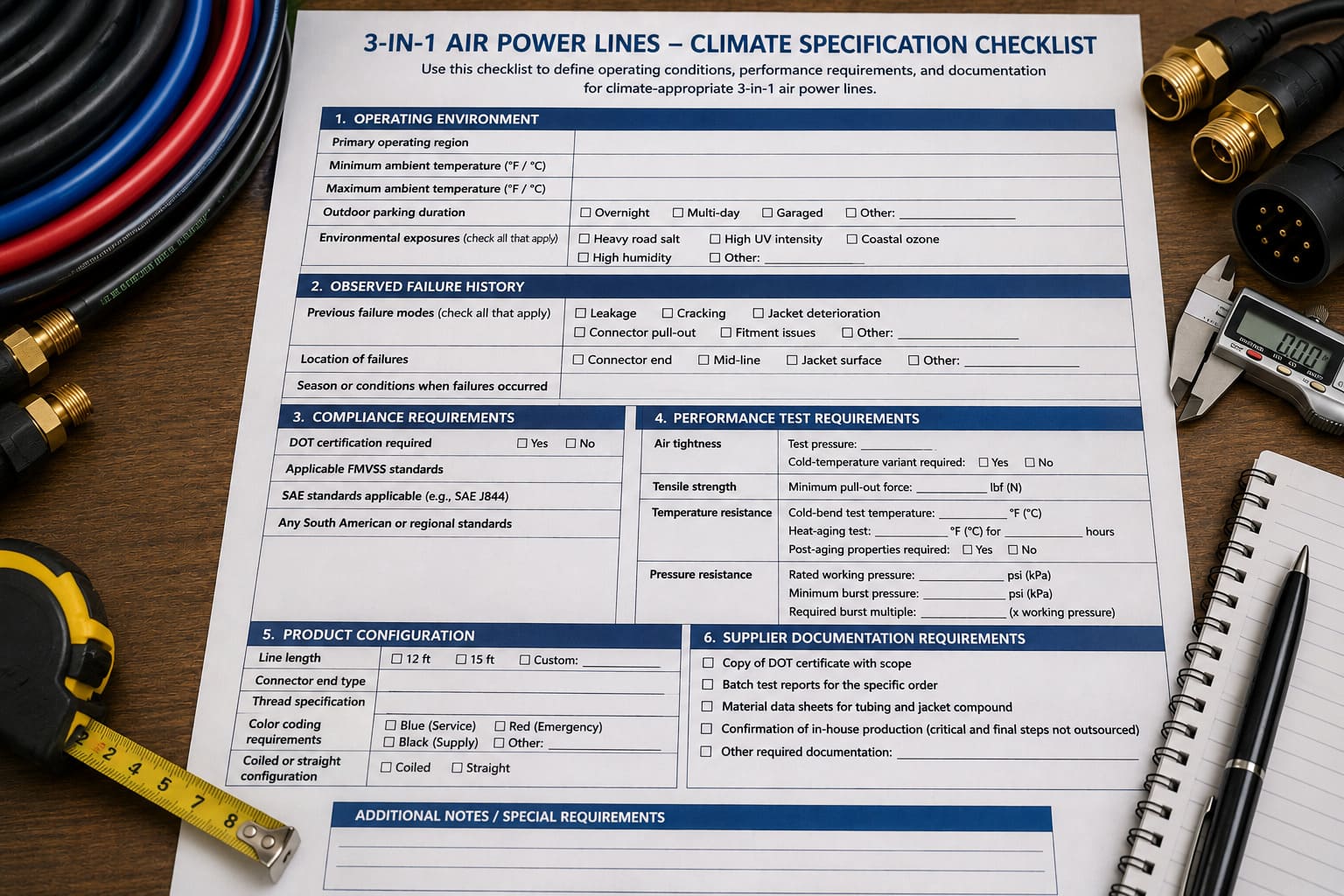
A practical climate specification for 3-in-1 air power lines should cover operating region, outdoor parking exposure, observed failure modes, required compliance certifications, requested test data, connector compatibility, and line length. This information transforms a generic product request into a supplier-evaluable specification.
Specification Checklist Template
Use this as a starting framework. Adapt the specific values to your application with input from qualified technical or maintenance staff.
Operating Environment
- Primary operating region (e.g., Northern U.S./Canada, Desert Southwest, South American lowland, Andean corridor, mixed cross-regional)
- Minimum expected ambient temperature during operation
- Maximum expected ambient temperature during operation
- Outdoor parking duration (overnight? multi-day? garaged?)
- Specific environmental exposures: heavy road salt, UV intensity, coastal ozone, high humidity
Observed Failure History
- Previous failure modes: leakage, cracking, jacket deterioration, connector pull-out, fitment issues
- Location of failures: connector end, mid-line, jacket surface
- Season or condition when failures occurred
Compliance Requirements
- DOT certification required: yes/no
- Applicable FMVSS standards: specify
- SAE standards applicable (e.g., SAE J844): specify
- Any South American or regional standards: specify
Performance Test Requirements
- Air tightness: specify test pressure and whether cold-temperature variant is required
- Tensile strength: specify minimum pull-out force requirement
- Temperature resistance: specify cold-bend test temperature and heat-aging test parameters
- Pressure resistance: specify working pressure and required burst pressure multiple
Product Configuration
- Line length (standard 12-foot, 15-foot, or custom)
- Connector end type and thread specification
- Color coding requirements (blue service, red emergency, black supply — or as applicable)
- Coiled or straight configuration
Supplier Documentation Requirements
- Copy of DOT certificate with scope
- Batch test reports for the specific order
- Material data sheets for tubing and jacket compound
- Confirmation of in-house production (critical and final steps not outsourced)
Frequently Asked Questions
Is a lower temperature rating always the right choice
"Polymers Processing Group - NIST", https://www.nist.gov/mml/materials-science-and-engineering-division/polymers-processing-group. A materials-science source explains that low temperatures reduce polymer chain mobility, increasing stiffness and, for some compounds, causing brittle behavior near the glass-transition region. Evidence role: mechanism; source type: research. Supports: A neutral materials-science source should explain that decreasing temperature reduces polymer chain mobility and can make rubber and thermoplastic compounds stiffer or brittle near or below relevant transition temperatures.. Scope note: This would support the general material mechanism; it would not prove the performance of any specific 3-in-1 air power line formulation. ↩
"0.170" ID x 1/4" OD Yellow Nylon Bulk Air Brake Tubing", https://www.fastenal.com/product/details/0421833. Low-temperature hose and tubing standards commonly evaluate flexibility or bend performance after cold conditioning, supporting the point that room-temperature flexibility does not by itself demonstrate performance near −40°F. Evidence role: general_support; source type: institution. Supports: A standards or testing source should show that tubing and hose products are commonly evaluated for low-temperature flexibility or cold-bend performance at subzero temperatures, including ranges around -40°F.. Scope note: This would contextualize the temperature-dependent risk; actual brittleness at −40°F depends on the specific compound and construction. ↩
"Thermo-Oxidative Aging Effects on Hyperelastic Behavior of ...", https://pmc.ncbi.nlm.nih.gov/articles/PMC12113194/. Rubber-aging literature describes elevated temperature as a factor that accelerates oxidative degradation in elastomers, leading to changes in mechanical properties and surface condition. Evidence role: mechanism; source type: paper. Supports: A peer-reviewed polymer or rubber aging source should support that heat accelerates oxidation reactions in elastomers and can change surface and mechanical properties.. Scope note: This supports the mechanism of heat aging generally, not the service life of a particular jacket compound. ↩
"Photodegradation and photostabilization of polymers ...", https://pmc.ncbi.nlm.nih.gov/articles/PMC4320144/. Polymer photodegradation research shows that ultraviolet exposure can initiate chain scission and photo-oxidation, while UV stabilizers are commonly used to reduce outdoor degradation. Evidence role: mechanism; source type: research. Supports: A neutral polymer-degradation source should explain that ultraviolet radiation can break chemical bonds or initiate photo-oxidation in polymers and that UV stabilizers are used to slow this process.. Scope note: This supports the general UV-degradation mechanism; the degree of protection depends on the exact polymer and stabilizer system. ↩
"Ground-level Ozone Basics", https://www.epa.gov/ground-level-ozone-pollution/ground-level-ozone-basics. Government air-quality monitoring data show that ground-level ozone varies regionally and that some southern and coastal areas experience elevated ozone concentrations during ozone seasons. Evidence role: general_support; source type: government. Supports: A government air-quality source should document regional patterns or monitoring data for ground-level ozone, including areas in southern or coastal regions where ozone concentrations can be elevated.. Scope note: This would support regional exposure context, not a route-by-route ozone level for any particular fleet. ↩
"Estimation of Synthetic Rubber Lifespan Based on Ozone ... - PMC", https://pmc.ncbi.nlm.nih.gov/articles/PMC11944956/. Rubber-degradation studies describe ozone cracking as a surface phenomenon in susceptible elastomers, with cracking promoted by tensile strain or repeated flexing. Evidence role: mechanism; source type: paper. Supports: A technical source should explain that ozone attacks unsaturated rubber structures and produces characteristic surface cracks, especially when the rubber is under tensile strain.. Scope note: This supports the degradation mechanism, but susceptibility varies substantially by rubber formulation and protective additives. ↩
"Interpretation ID: 10-001831 106", https://www.nhtsa.gov/interpretations/10-001831-106. FMVSS No. 106, codified at 49 CFR § 571.106, establishes federal requirements for brake hoses, brake hose assemblies, and brake hose end fittings. Evidence role: definition; source type: government. Supports: An official NHTSA or CFR source should identify FMVSS No. 106 as the federal standard covering brake hoses and related assemblies.. Scope note: The source defines the federal standard; whether a specific 3-in-1 assembly falls within scope depends on its construction and use. ↩
"Federal Motor Vehicle Safety Standards; Brake Hoses", https://www.federalregister.gov/documents/2004/12/20/04-27088/federal-motor-vehicle-safety-standards-brake-hoses. SAE J844 is a technical standard for nonmetallic air-brake system tubing, making it a relevant compliance reference when specifying applicable pneumatic line components. Evidence role: definition; source type: institution. Supports: A standards-body source should identify SAE J844 as a standard for nonmetallic tubing used in air brake systems or similar pneumatic vehicle applications.. Scope note: The standard’s relevance depends on the exact line component and application; it may not cover every part of a combined 3-in-1 assembly. ↩
"49 CFR 571.106 -- Standard No. 106; Brake hoses.", https://www.ecfr.gov/current/title-49/subtitle-B/chapter-V/part-571/subpart-B/section-571.106. Brake-hose and pneumatic-line test requirements commonly include leakage or pressure-hold evaluations, which assess whether an assembly maintains pressure under specified test conditions. Evidence role: definition; source type: government. Supports: A regulatory or standards source should describe leakage or pressure-hold testing for brake hose or pneumatic assemblies.. Scope note: This supports the purpose of air-tightness testing generally; specific pressures and acceptance limits must come from the applicable standard or purchaser specification. ↩
"49 CFR 571.106 -- Standard No. 106; Brake hoses. - eCFR", https://www.ecfr.gov/current/title-49/subtitle-B/chapter-V/part-571/subpart-B/section-571.106. Federal and industry brake-line standards include pressure-performance tests, including leakage, proof, or burst-pressure requirements, to verify that hose or tubing assemblies withstand specified pneumatic loads. Evidence role: general_support; source type: government. Supports: An official standard or regulation should show that brake hose or tubing specifications include pressure-related requirements such as proof, working, or burst pressure tests.. Scope note: The source would support pressure testing as a verification method; the correct thresholds depend on the applicable standard and product configuration. ↩