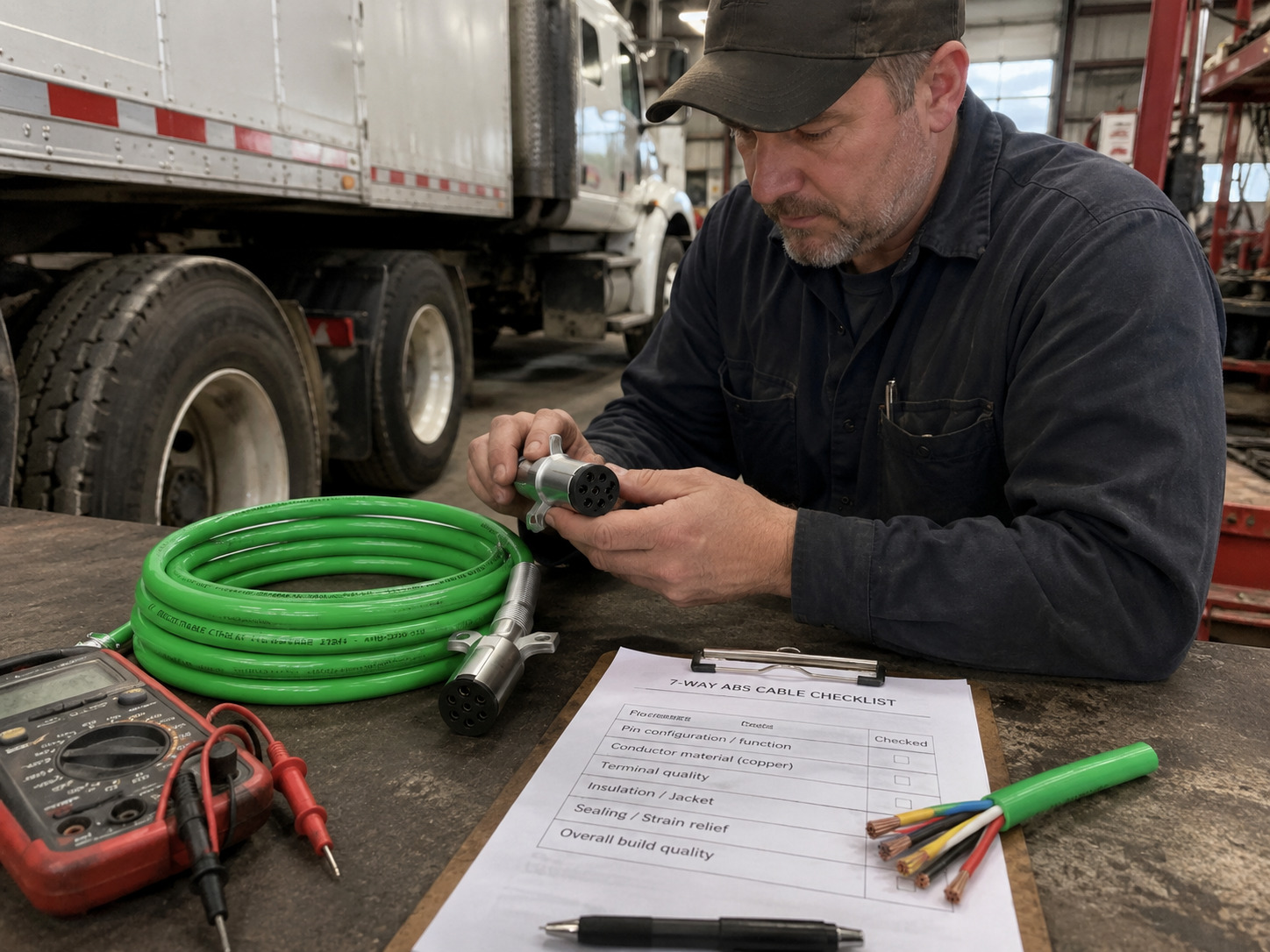
A flashing ABS warning light while hauling a loaded trailer is never just a dashboard nuisance. In a heavy-duty fleet, it often means a safety system is offline, a roadside inspection is coming1, and a repair bill is guaranteed. When I talk to fleet managers and repair shops about this, many still treat the 7-way ABS electrical cable as just another trailer light cord. That mindset leads straight to misdiagnosis and repeated cable swaps. In reality, this cable is the main electrical bridge between tractor and trailer2, and its reliability directly impacts whether your ABS system gets stable power and signal continuity mile after mile.
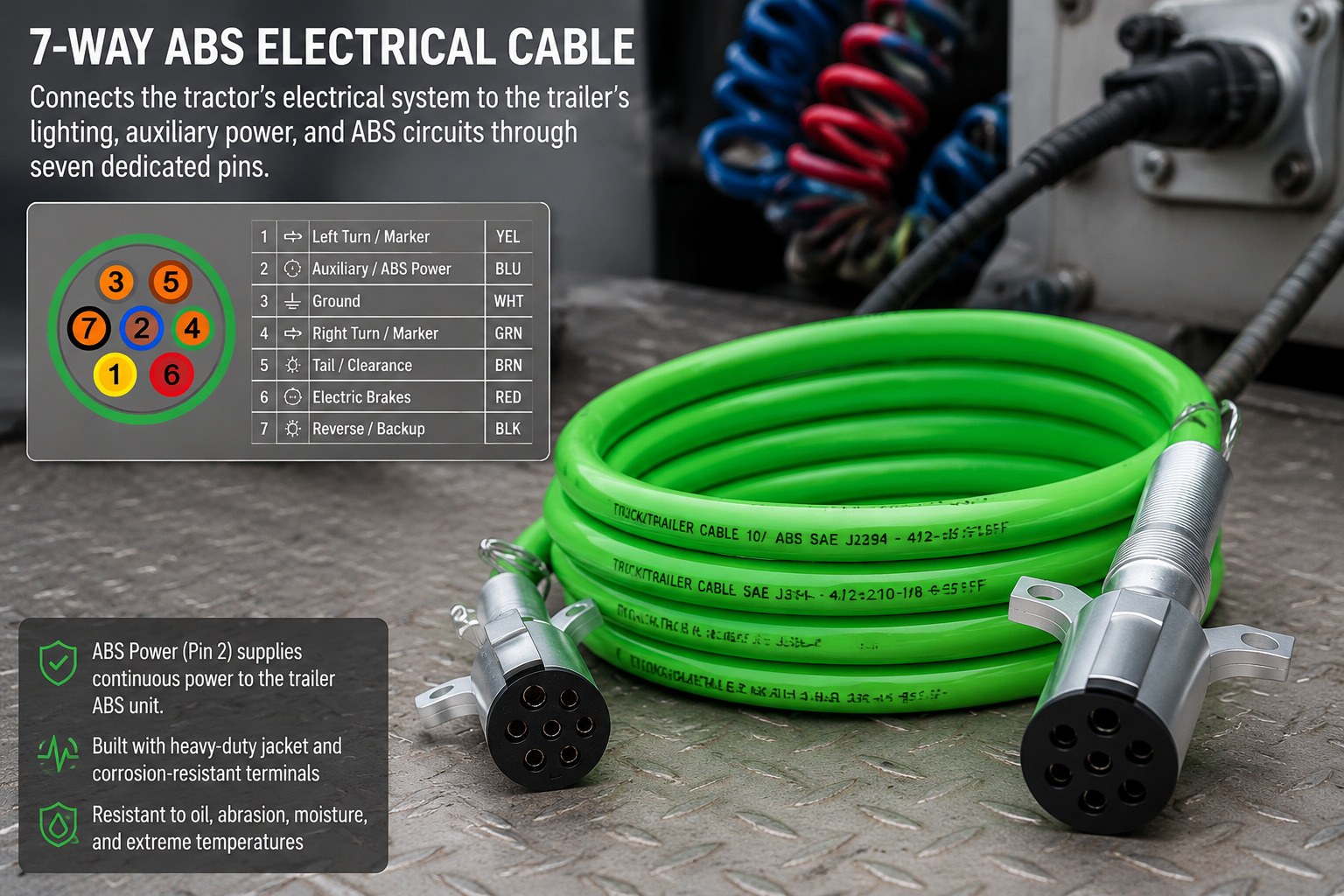
A 7-way ABS electrical cable connects the tractor’s electrical system to the trailer’s lighting, auxiliary power, and ABS circuits through seven dedicated pins, with one pin permanently supplying power to the trailer ABS unit.3 Unlike a basic 7-way light cable, its ABS power circuit must maintain uninterrupted voltage and clean grounding under vibration, weather exposure, and heavy electrical load. The cable works when its pin assignment matches the application, conductor material resists voltage drop, and its terminals, jacket, and sealing survive real operating stress.
I’ve inspected too many cables that looked right on the outside but failed early because of what was hidden inside the jacket. The difference between a cable that keeps an ABS system happy and one that triggers phantom fault codes is not luck. It’s material, construction, and matching the cable to the actual application. Let me walk you through what actually matters once you look past the plug shape.
What Circuits Are Inside a 7-Way ABS Electrical Cable?
Too many parts buyers focus only on “does the plug fit?” That’s a fast path to ordering the wrong cable. If the internal circuit assignments don’t match the tractor’s wiring and the trailer’s ABS requirements, even a plugged-in cable can leave the ABS unpowered or cause back-feeding issues.
A dedicated 7-way ABS electrical cable typically follows a standardized pin layout, with one circuit permanently supplying 12V power to the trailer’s ABS electronic control unit. This is the key functional difference from a non-ABS 7-way cable, where that pin might be allocated to backup lights or left unused.
Dive Deeper: Pin-by-Pin Role in ABS-Rated Cables
Most heavy-duty applications in North America use the SAE J560 pin configuration4 for the 7-way round connector. When an ABS system is present, the center pin (commonly pin 7) becomes the constant power feed for the trailer ABS ECU5. A typical assignment looks like this:
| Pin | Wire Color (Common) | Circuit Function | ABS Relevance |
|---|---|---|---|
| 1 | White | Ground | Must handle combined return current; poor ground creates ABS faults |
| 2 | Black | Clearance / marker lights | No direct ABS logic, but voltage dips affect whole trailer |
| 3 | Yellow | Left turn / stop | Not directly ABS, but shared ground path matters |
| 4 | Red | Stop lamps | Same caution — shared power distribution |
| 5 | Green | Right turn / stop | Not ABS-specific |
| 6 | Brown | Tail / license lights | Not ABS-specific |
| 7 | Blue (or other) | ABS constant power / auxiliary | Must deliver stable 12V+ to trailer ABS ECU |
From a product quality perspective, the most overlooked risk isn’t the pin assignment mismatch—it’s voltage drop on the ABS power circuit. I’ve seen cables where pin 7 was correctly wired, but the conductor was undersized or made from inferior material, dropping voltage below the ABS ECU’s threshold under load. The result: intermittent ABS faults that are nearly impossible to trace without a load test.
Every truck parts distributor or repair shop should verify the trailer manufacturer’s wiring diagram before selecting a 7-way ABS electrical cable. A few European-spec trailers may use different pin arrangements, and some older fleet retrofits may have non-standard wiring. The cable’s job is not just to complete a circuit—it must maintain clean, uninterrupted power to the ABS module while the trailer is rolling and bouncing down the highway.
Why Isn’t Every 7-Way ABS Electrical Cable Interchangeable?
The aftermarket is full of cables that look identical from the outside. I’ve had distributors tell me, “We bought the cheapest 7-way ABS cable available, same plug shape, same pin count—why are we getting ABS warnings within a month?” The answer almost always sits inside the cable: conductor material, wire gauge, terminal quality, and environmental sealing separate a reliable ABS cable from a source of chronic downtime.
A physically compatible plug does not mean the cable will support ABS power requirements. Even if pin 7 is present and wired, differences in copper content, cross-sectional area, and connector contact resistance can turn a new cable into an early failure.
Dive Deeper: The Hidden Variables That Break ABS Power
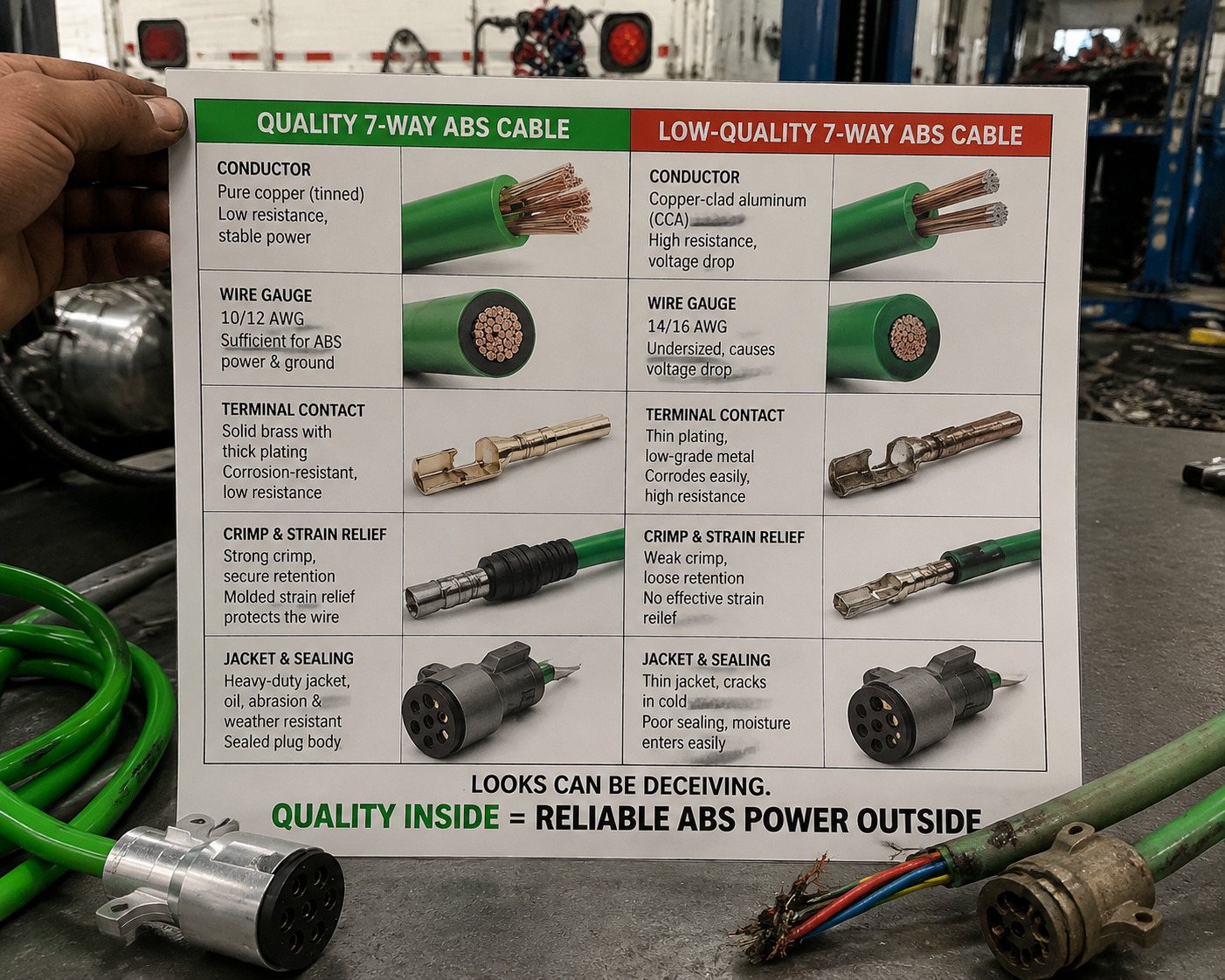
One of the biggest sourcing traps I see is cable assemblies built with copper-clad aluminum (CCA) or copper-aluminum alloy conductors. Some manufacturers use these materials to cut costs because pure copper is significantly more expensive. The problem? CCA has roughly 60% higher resistance than the same gauge of pure copper.6 When you run constant ABS power through that cable—especially over longer trailer lengths—voltage drop increases, and the ABS ECU may see a low-voltage condition. The symptom is often intermittent ABS warning lights, especially at idle or when multiple trailer lights are on.
I’ve disassembled failed cables returned by customers. In more than one case, the conductor looked copper-colored at first glance, but a quick scrape revealed aluminum underneath. In the truck industry, this is a shortcut you cannot afford. A 7-way ABS electrical cable needs tinned copper or bare copper conductors at a minimum gauge that matches the circuit length and current draw. For many heavy-duty trailer applications, 12 AWG or even 10 AWG on the power and ground circuits is a practical requirement, not a suggestion.7
Beyond the conductor, the terminal contacts inside the plug are another silent threat. Cheap terminals with thin plating corrode fast, increase resistance, and create heat.8 In a high-vibration environment, a poorly crimped terminal can loosen microscopically, generating intermittent ABS power loss that no scan tool will catch unless the fault is active. I always tell customers: check the terminal material and retention force. A quality ABS cable uses solid brass or high-grade steel terminals with robust crimp barrels and strain relief that protects the wire-to-terminal interface.
Then there’s the jacket and sealing. A cable that becomes stiff and cracked after one winter or lets moisture wick into the terminal area will fail early, even if the copper inside is perfect. Good ABS cables use jacketing rated for extreme temperatures, oil, and abrasion, with sealed plug bodies and molded strain relief at both ends. These details rarely show up on a simple specification sheet, but they explain why a $20 cable dies six months before a properly built $45 cable ever fails.
What Material and Construction Factors Cause a 7-Way ABS Electrical Cable to Fail Prematurely?
I’ve stood beside production lines and inspected thousands of cables, and I can tell you: the fastest way to kill an ABS cable’s reliability is to compromise on the invisible layers. A cable might look sturdy on a parts counter, but within weeks it develops high resistance, corrosion, or internal breaks. Those failures don’t announce themselves—they show up as ABS fault codes that get blamed on sensors, modulators, or wiring harnesses nobody suspects.
Most premature failures trace back to four construction weaknesses: low-grade conductor material, weak terminal crimps, poor jacket compound, and missing or ineffective strain relief. These are not theoretical. I’ve seen each one cause no-trouble-found service calls and expensive fleet downtime.
Dive Deeper: What Our QC Inspection Reveals About Cable Life
In our own incoming material inspection and production sampling, we’re trained to look for failure points before they leave the factory. For a 7-way ABS electrical cable, the first checkpoint is always the conductor. We verify batch certificates for copper purity and cross-check then measure actual conductor resistance. If a supplier tries to slip in copper-clad aluminum, it’s caught at the raw material stage. A reliable cable needs oxygen-free or electrolytic tough pitch copper with tinning to resist corrosion. That one decision alone can double the cable’s service life in humid or salted-road environments.
The next critical checkpoint is terminal crimp quality. A proper crimp deforms the terminal barrel around all wire strands, creating a cold weld with very low electrical resistance.9 We cut samples, measure pull force, and inspect cross-sections to ensure no strands are loose. A failed crimp might work on a bench but will fail intermittently on the road. For ABS circuits, even a momentary open can be enough for the ECU to log a fault and illuminate the warning light.10
Jacket material is another area where cheap cables cut corners. A thin PVC jacket may pass a visual check but will harden and crack after repeated temperature cycles.11 High-quality 7-way ABS cables use thermoplastic elastomer (TPE) or heavy-duty PVC compounds rated for dynamic flexing, UV exposure, and chemical resistance. The jacket must also form a watertight seal with the connector backshell. In our production, we test molded strain reliefs with a pull-and-flex cycle to confirm the seal remains intact. If moisture reaches the internal connections, corrosion accelerates and resistance climbs steadily until the circuit fails.
Even the overall cable shape and length flexibility matter. A cable that is too stiff transfers vibration directly to terminals; one that kinks easily gets bent at sharp angles during coupling and uncoupling. The best ABS cables balance flexibility with enough outer toughness to survive being dragged, stepped on, and pinched in storage boxes. I always recommend fleets physically handle a sample before committing to a bulk purchase, because a cable that fights you during installation will fail you later.
Finally, every quality-driven manufacturer performs continuity and high-potential tests on the finished assembly. In our facility, 100% final inspection on key products includes a multi-point electrical test that verifies each pin’s circuit and checks for shorts or excessive resistance. These tests are simple but non-negotiable; they catch assembly errors that would otherwise become a roadside headache.
How Can Fleet Buyers Select a Reliable 7-Way ABS Electrical Cable?
With so many look-alike options on the market, procurement teams and repair shops need a repeatable way to filter out cables that will become early failures. Buying only by price is a trap, but buying blindly by brand name is not much better. The most effective selection process treats a 7-way ABS electrical cable like any mission-critical vehicle component: specification matching first, material verification second, and then price negotiation.
The cable must satisfy three layers of requirements: it must match the tractor and trailer electrical layout, it must be built with conductors and terminals that preserve signal and power integrity under load, and it must be durable enough for the fleet’s operating environment. Skip any one of these layers, and you’ll be chasing intermittent ABS warnings with a multimeter in one hand and an invoice in the other.
Dive Deeper: A Practical Selection Checklist from the Supplier’s Point of View
Through years of supporting distributors and fleets, I’ve distilled what separates a trouble-free bulk purchase from a recurring warranty claim. Here’s what I ask every customer to verify before placing an order:
-
Pin configuration and circuit assignment
Confirm the connector standard (commonly SAE J560 for North America) and verify that pin 7 is wired for constant ABS power. If the trailer has additional auxiliary circuits, ensure the cable supports them without sacrificing ABS power integrity. Never assume the pinout matches just because the plugs fit. -
Conductor material and gauge
Request written confirmation that conductors are pure copper—not copper-clad aluminum, not a copper-aluminum alloy. For ABS power and ground circuits, minimum 12 AWG is typical; longer trailers or high-auxiliary loads may demand 10 AWG. Ask for a specification sheet that includes conductor resistance values. If the supplier can’t provide it, that’s a red flag. -
Terminal contact and crimp quality
Look for brass or nickel-plated high-strength terminals with a full-barrel crimp. The connection should maintain low resistance under vibration. If possible, request a sample and perform a simple wiggle test: plugged in, flex the cable near the connector—an intermittent ABS light on a test setup reveals poor terminal engagement instantly. -
Jacket and environmental sealing
Inspect the jacket material. TPE or heavy-duty PVC rated for -40°C to +85°C is common. The jacket should be smoothly bonded into a molded plug body with a strain relief that flexes without breaking the seal. Ask about the IP rating of the connector (IP67 or higher is a good sign), and check that the back shell prevents moisture creeping into the rear of the connector assembly. -
Independent testing and traceability
A trustworthy supplier will offer batch-level test reports: continuity checks, high-voltage insulation resistance, and conductor resistance. In our factory, we archive these by production date and serial number, so a fleet can trace a cable back to raw material batches. That level of traceability is worth more than a low unit price when you’re responsible for dozens of trailers. -
Application-specific cable length and form
Measure from the tractor gladhand area to the trailer nose box with some slack for turning. A cable that’s stretched tight will pull on connectors and fail early. Also consider coiled or straight cable styles. A coiled ABS cable reduces snagging but can trap ice in extreme cold; a straight cable may need more slack management.
I always encourage fleet buyers to request a pre-production sample—even just one piece—and install it on a real trailer for a few thousand miles. The data from that trial is more honest than any spec sheet. In many cases, that one sample reveals whether the cable’s jacket becomes brittle, the terminal starts to corrode, or the ABS warning light stays dark as it should.
Frequently Asked Questions
What is the difference between a 7-way ABS electrical cable and a standard trailer light cable?
The main difference is the dedicated ABS power circuit. A true 7-way ABS cable has pin 7 configured as constant 12V power for the trailer ABS ECU and uses pure copper conductors sized to minimize voltage drop. A standard light cable may use the same plug shape but might not wire pin 7 for continuous ABS load or may use lower-grade materials unsuitable for sustained power delivery.
Can a damaged 7-way ABS cable cause intermittent ABS warning lights?
Yes, and this is one of the most common causes of phantom ABS faults. A cable with internal conductor breaks, corroded terminals, or high resistance due to poor material can create voltage drops that the ABS ECU reads as a system error. The warning light may come and go depending on road vibration and humidity, making diagnostics difficult unless the cable is load-tested.
How do I know if my 7-way cable uses copper-clad aluminum conductors?
Scrape a small section of the conductor insulation (if accessible) and examine the wire cross-section. Copper-clad aluminum will show a silver-white core under a thin copper-colored layer. You can also measure resistance over a known length: CCA will read significantly higher than pure copper of the same gauge. If the supplier cannot confirm pure copper in writing, treat the cable as suspect.
What wire gauge is recommended for the ABS power circuit in a 7-way cable?
For most Class 8 tractor-trailer applications, 12 AWG is the practical minimum for the ABS constant power and ground wires. For trailers over 53 feet, or where additional loads are present on the same circuit, 10 AWG is a safer choice to maintain voltage above the ABS ECU’s minimum threshold. Always match gauge to the total circuit length and expected current draw.
Does the length of a 7-way ABS electrical cable affect ABS performance?
Yes, because longer cables have greater total conductor resistance. If the cable length increases, voltage drop at the ABS ECU also increases.12 Using a cable that is too long with inadequate wire gauge can cause low-voltage conditions. Always choose the correct gauge for the needed length, and avoid excessively long coiled extensions that add unnecessary resistance.
Conclusion
A 7-way ABS electrical cable does more than connect lights—it is the reliable power path that keeps a trailer’s ABS system ready at every start-up. As I’ve seen from both the production floor and the aftermarket repair shop, choosing the right cable means looking past the plug shape and into the copper, the terminals, and the jacket that will face years of wind, salt, and vibration.
When you’re sourcing these cables for your distribution business, repair shop, or fleet, start with pin assignment verification, demand pure copper conductors, and insist on sealed, strain-relieved terminations that survive real-world coupling cycles. Don’t let a low price hide copper-clad aluminum or weak crimps that will cost you time, safety compliance, and customer trust. If you need 7-way ABS electrical cables built to these standards—with full traceability, in-house testing, and flexible order quantities—reach out to our team. We’ll help you get the right cable on the shelf, not just the cheapest.
"49 CFR § 393.55 - Antilock brake systems. - Law.Cornell.Edu", https://www.law.cornell.edu/cfr/text/49/393.55. Federal motor carrier brake regulations and inspection guidance describe trailer ABS malfunction indicators as required safety-related equipment, supporting the view that an illuminated ABS lamp can signal a compliance issue; this does not prove that every flashing lamp will result in a citation or immediate repair order. Evidence role: general_support; source type: government. Supports: A government or enforcement source should support that commercial trailers are required to have ABS malfunction indicators and that these indicators may be checked during inspections.. Scope note: Contextual support only; inspection outcomes depend on jurisdiction, vehicle date, and inspection procedure. ↩
"Trailer connectors in North America", https://en.wikipedia.org/wiki/Trailer_connectors_in_North_America. SAE J560 defines the seven-conductor connector used for electrical circuits between truck tractors and trailers, supporting the description of the 7-way cable as the principal tractor-to-trailer electrical interface. Evidence role: definition; source type: institution. Supports: A standards source should define the SAE J560 seven-conductor connector as the electrical interface used between truck tractors and trailers.. ↩
"Interpretation ID: GF005930", https://www.nhtsa.gov/interpretations/gf005930. Standards and regulatory materials for heavy-vehicle seven-way connectors describe separate circuits for lighting, auxiliary functions, grounding, and ABS power, supporting the article’s summary of the cable’s role in supplying trailer ABS power. Evidence role: definition; source type: institution. Supports: A standard or regulatory source should support the seven-circuit layout and the use of one circuit for continuous trailer ABS power.. Scope note: The exact pin assignment may vary by region or application, so the source should be read as support for the North American heavy-vehicle configuration. ↩
"Trailer connectors in North America", https://en.wikipedia.org/wiki/Trailer_connectors_in_North_America. SAE J560 specifies the seven-pin electrical connector and circuit assignments used for truck-tractor and trailer connections, supporting the statement that this is the standard configuration in many North American heavy-duty applications. Evidence role: definition; source type: institution. Supports: A standards body or technical institution should identify SAE J560 as the common seven-pin connector standard for truck-trailer electrical connections.. Scope note: This supports the North American standard context and does not exclude other regional connector systems. ↩
"Trailer ABS light on even when truck off", https://static.nhtsa.gov/odi/tsbs/2021/MC-10187880-0001.pdf. Trailer ABS regulatory and connector guidance identifies the seven-way connector’s auxiliary/ABS circuit as the continuous electrical supply used by the trailer ABS controller, supporting the statement that the center pin is commonly used for ABS ECU power in this configuration. Evidence role: general_support; source type: government. Supports: A government or standards-related source should support that trailer ABS receives continuous power through the designated auxiliary/ABS circuit on the seven-way connector.. Scope note: The source supports the common North American arrangement; individual trailers may require verification against their wiring diagrams. ↩
"Electrical resistivity and conductivity", https://en.wikipedia.org/wiki/Electrical_resistivity_and_conductivity. Published resistivity tables list aluminum at about 2.65 × 10^-8 Ω·m and copper at about 1.68 × 10^-8 Ω·m, supporting the approximation that aluminum-based conductors have about 58–60% higher resistance than copper conductors of equal geometry. Evidence role: statistic; source type: encyclopedia. Supports: A materials reference should provide the electrical resistivity values for copper and aluminum, allowing comparison of resistance for equal cross-sectional area.. Scope note: This supports the material-property comparison; the exact resistance of a copper-clad aluminum cable depends on cladding thickness, strand geometry, and manufacturing quality. ↩
"Trailer connectors in North America", https://en.wikipedia.org/wiki/Trailer_connectors_in_North_America. Connector and vehicle-wiring standards for heavy-trailer electrical systems specify conductor sizing and current-carrying considerations for power and ground circuits, providing technical context for using 12 AWG or 10 AWG conductors to limit voltage drop in ABS supply circuits. Evidence role: expert_consensus; source type: institution. Supports: A standards or engineering source should support the use of heavier-gauge conductors for high-current power and ground circuits in seven-way trailer wiring.. Scope note: The cited standard would not prove that every fleet requires 10 AWG; final sizing depends on cable length, current draw, and allowable voltage drop. ↩
"CORROSION PROTECTION FOR SPACE FLIGHT ...", https://standards.nasa.gov/sites/default/files/standards/NASA/A/2022-01-11-NASA-STD-6012A-Approved.pdf. Connector reliability research shows that corrosion products and degraded contact surfaces increase electrical contact resistance, which can produce localized heating under load, supporting the mechanism described for low-quality terminals. Evidence role: mechanism; source type: research. Supports: A technical source should explain that corrosion films on electrical contacts increase contact resistance and can contribute to localized heating.. Scope note: The source supports the electrical mechanism generally and may not test the specific terminals used in 7-way ABS cables. ↩
"WORKMANSHIP STANDARD FOR CRIMPING, INTERCONNECTING ...", https://standards.nasa.gov/sites/default/files/standards/NASA/A/4/nasa-std-87394a_w_change_4_0.pdf. Electrical workmanship standards describe proper crimping as controlled deformation of the terminal barrel around the conductor to form a gas-tight, mechanically secure, low-resistance termination, supporting the article’s explanation of crimp quality. Evidence role: mechanism; source type: institution. Supports: A workmanship standard or technical manual should support that proper crimping plastically deforms the barrel and conductor to create a low-resistance connection.. ↩
"Interpretation ID: 1210corrforweb", https://www.nhtsa.gov/interpretations/1210corrforweb. Federal trailer ABS requirements describe malfunction indication for antilock brake systems, supporting the general point that electrical faults in ABS circuits can trigger a warning lamp. Evidence role: general_support; source type: government. Supports: A regulatory or technical source should support that trailer ABS systems monitor malfunctions and activate a malfunction indicator when electrical faults are detected.. Scope note: This is contextual support; the precise duration of an open circuit needed to store a fault depends on the ECU design and diagnostic calibration. ↩
"Study of the natural ageing of PVC insulation for electrical ...", https://www.academia.edu/31931428/Study_of_the_natural_ageing_of_PVC_insulation_for_electrical_cables. Studies of PVC cable insulation aging report changes such as plasticizer loss, increased hardness, embrittlement, and cracking after thermal or environmental exposure, supporting the mechanism by which low-grade jackets can fail after service cycling. Evidence role: mechanism; source type: paper. Supports: A polymer or cable-aging study should show that PVC insulation or jacketing can become brittle, harden, or crack under heat, cold, UV, or thermal aging.. Scope note: The source supports PVC aging behavior generally and may not evaluate the exact cable jacket formulation discussed in the article. ↩
"Ohm's law", https://en.wikipedia.org/wiki/Ohm%27s_law. Introductory circuit theory states that a conductor’s resistance increases with length and that voltage drop is given by Ohm’s law, supporting the claim that longer trailer cables can reduce voltage available at the ABS ECU under load. Evidence role: mechanism; source type: education. Supports: An educational electrical-engineering source should explain that conductor resistance is proportional to length and that voltage drop equals current times resistance.. ↩