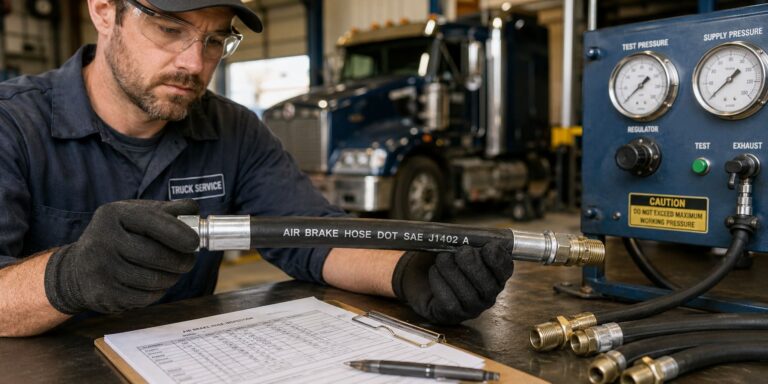
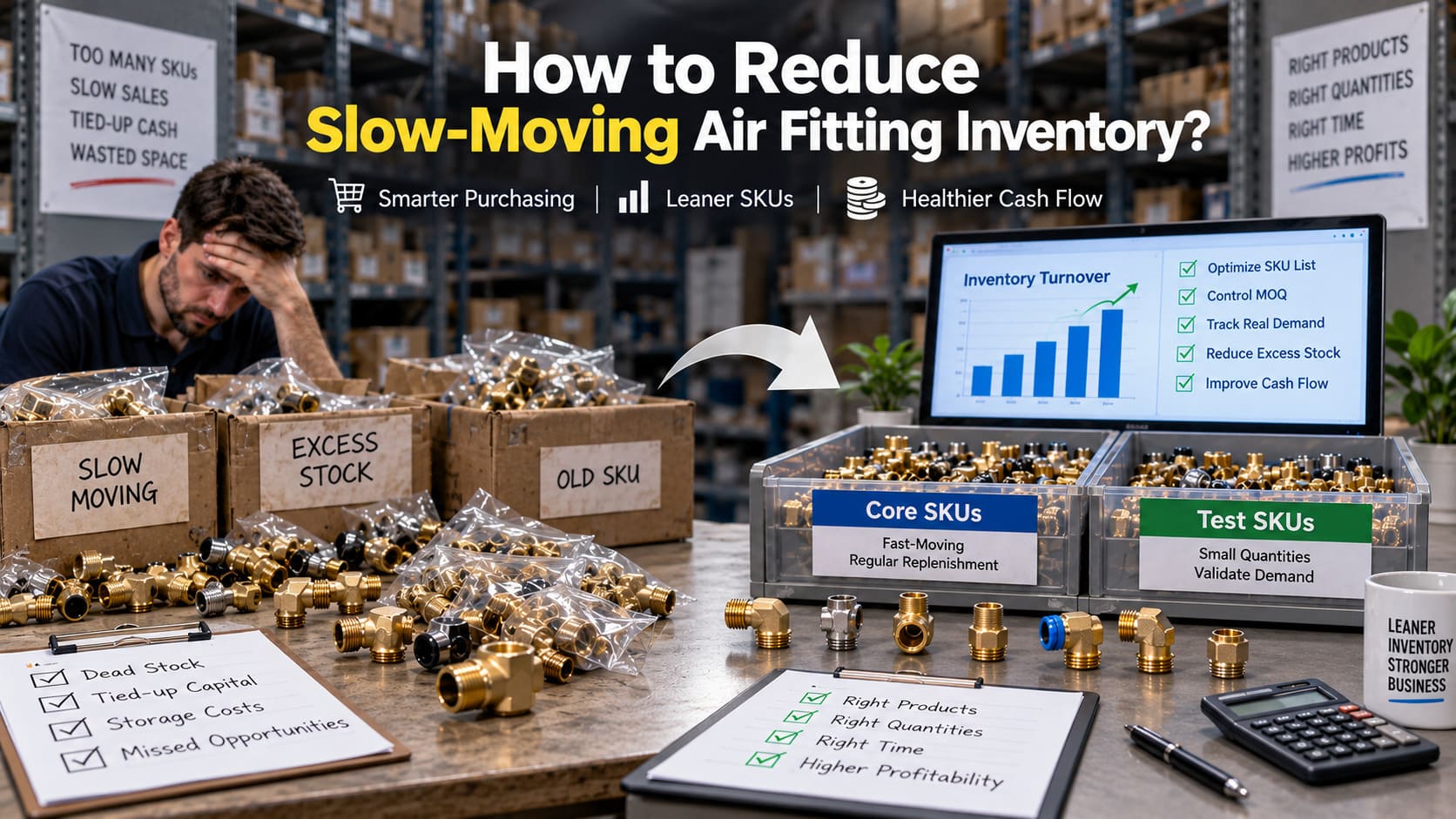
Slow-moving air fitting inventory is a quiet cash drain that compounds over time. You order a broad range of fittings to cover every possible application, only to find that a third of those SKUs barely move while your best-selling items run short. The real fix is not a clearance sale — it starts before you place the next order.
Reducing slow-moving air fitting inventory is primarily a purchasing-structure problem. The most effective approach combines SKU discipline, realistic MOQ planning, and a replenishment rhythm tied to actual demand signals. Clearance and discounts treat the symptom. Tightening which fittings you buy, in what quantities, and when you reorder them eliminates the root cause before stock accumulates.
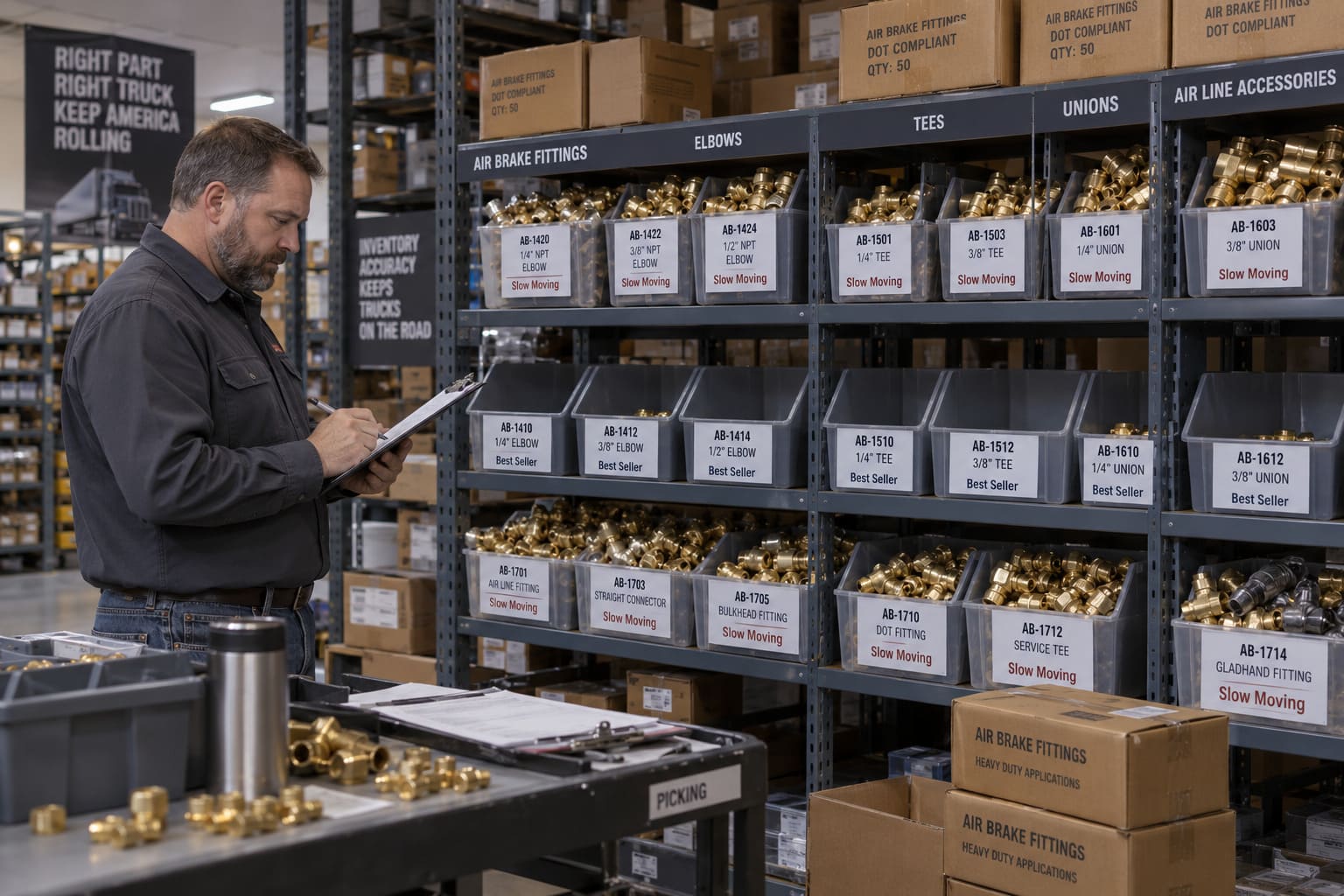
The sections below break down each lever in practical terms — from how to audit your current SKU list to how to negotiate mixed-batch orders that let you test demand without committing to full-container quantities. If you stock brass fittings or air line accessories for the North American or South American heavy-duty truck aftermarket, these questions apply directly to your purchasing decisions.
Does SKU Over-Expansion Cause Most Slow-Moving Inventory?
Every distributor or repair shop wants to be the one-stop source for customers. Adding more air fitting specifications seems logical — until the warehouse fills up with sizes no one orders twice. The wider your SKU list, the harder it is to predict which items will actually sell.
SKU over-expansion is one of the most consistent causes of slow-moving air fitting inventory.1 Buyers who stock long-tail fitting sizes — uncommon thread types, rarely requested material grades, or regional application variants — often find those items sitting untouched for months. Inventory that doesn't turn ties up capital that could replenish faster-moving core products.2
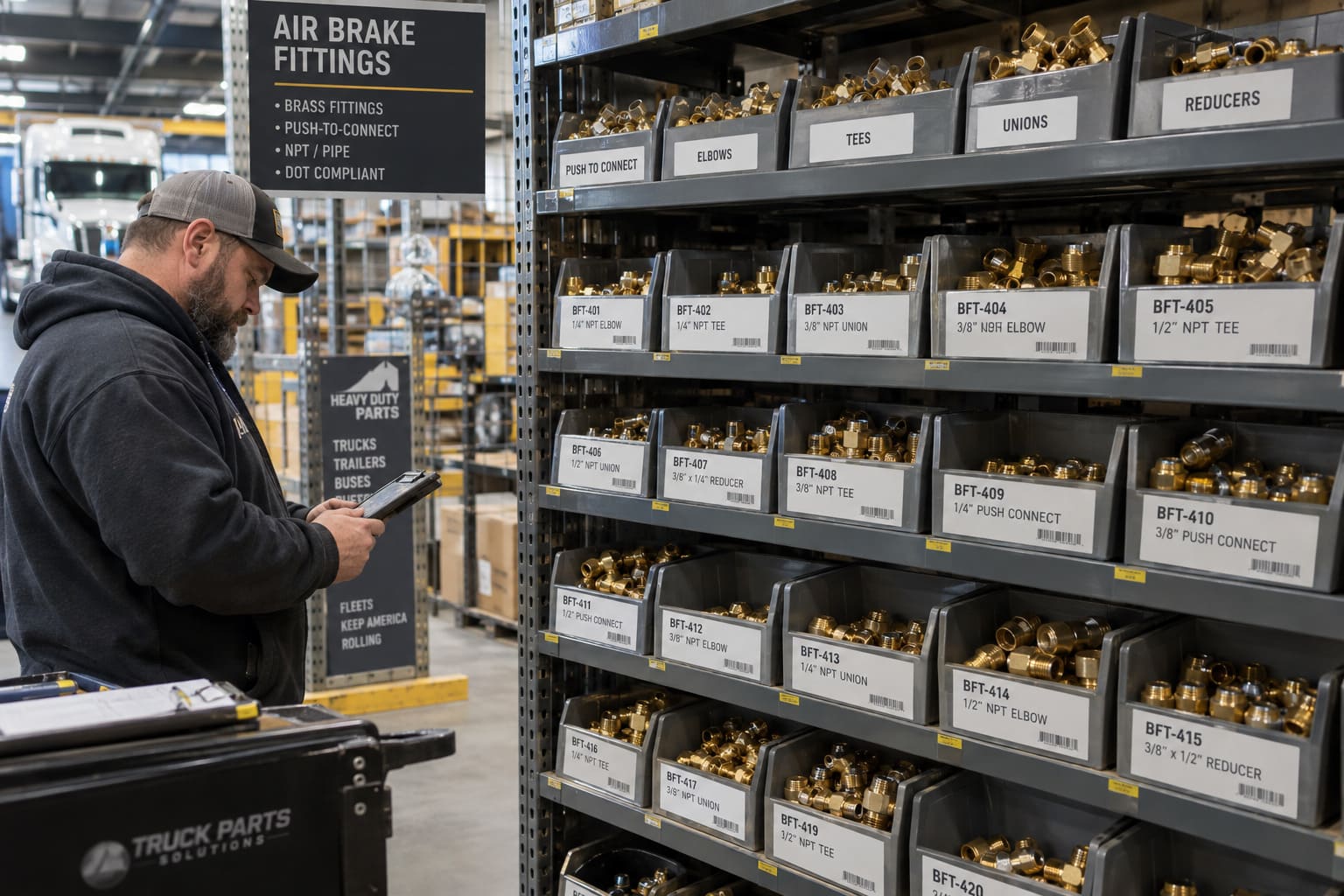
In discussions with overseas distributors and repair shop buyers, I hear a version of the same story regularly: a buyer added a new fitting specification because one customer asked for it, ordered the minimum available quantity, and then never saw a repeat order. That single line item now occupies shelf space and purchasing budget for months.
The Long-Tail Problem in Air Fittings
Air fittings for the heavy-duty truck aftermarket come in a wide range of thread types, body sizes, material grades, and end configurations. Common ones include:
- NPT threaded brass fittings (the workhorse of North American applications)
- DOT-compliant push-to-connect fittings for air brake and air line applications
- Metric-thread variants used in South American truck markets
- Specialty configurations — swivel elbows, bulkhead fittings, reducer couplings
The core problem is that many of these look nearly identical on a product photo. A buyer who expands SKUs based on visual similarity rather than confirmed application demand will almost always end up with slow movers.
A Practical SKU Audit Framework
Before placing your next order, run a simple audit on your current fitting inventory:
| Category | Question to Ask | Action |
|---|---|---|
| Velocity | Did this SKU sell at least once per month in the last 6 months? | Keep or flag for review |
| Reorder history | Has the same customer reordered this SKU more than once? | Keep if yes |
| Substitutability | Can a faster-moving SKU cover this application? | Consider eliminating |
| MOQ alignment | Did you order more than 6 months' worth of demand? | Tighten MOQ on reorder |
| Specification certainty | Do you have confirmed specs from the end user or OEM reference? | Verify before ordering again |
A leaner SKU list focused on proven, fast-moving common fittings is easier to replenish, easier to sell, and far less likely to generate dead stock.3
Is Low Unit Price Actually a Low Total Cost?
The appeal of a low per-piece price on air fittings is easy to understand. When a supplier offers a meaningful discount at a higher MOQ, the math looks attractive at first glance. But the unit price is only one part of what your inventory actually costs you.
Low unit price does not equal low total inventory cost.4 When a low per-piece price comes attached to an MOQ that exceeds your realistic sell-through, the savings on the fitting itself are offset by capital tied up in stock, warehouse space occupied, and the opportunity cost of not replenishing faster-moving items on time.

This is one of the most underestimated dynamics in air fitting procurement. I find that buyers focused on landed unit cost sometimes overlook the full cost structure sitting behind that number.
Breaking Down the Real Cost of an Air Fitting Order
Consider a simplified example — not specific numbers, but the structure of the decision:
- Capital cost: Money spent on a slow-moving SKU cannot be used to reorder a fitting that's running short on your shelf. The longer a fitting sits, the more it has effectively borrowed from your operating cash.
- Warehouse cost: Every cubic meter occupied by unsold inventory is space unavailable for faster-moving stock.5 In repair shop environments especially, storage space is limited and valuable.
- Replenishment delay risk: When your budget is committed to slow movers, you may delay reordering your core SKUs. That delay can mean stockouts on the items customers actually call you for.
- Obsolescence and specification drift: Truck models update.6 If a thread standard or fitting configuration falls out of common use in your market, an oversized batch of that SKU becomes dead stock with limited resale value.
MOQ Negotiation as a Cost Control Tool
One practical lever here is negotiating mixed-batch orders. Instead of hitting a minimum order quantity on a single SKU, some suppliers will allow you to reach the MOQ threshold across a mix of related fitting sizes. This approach:
- Reduces per-SKU overstock risk without sacrificing total order volume
- Lets you test new specifications in small quantities before committing to full batches
- Keeps working capital available for replenishment of proven core items
At ROADSPOWER, we support mixed small-batch orders precisely because we hear from distributors and shop buyers that rigid single-SKU MOQs are one of the main structural reasons slow-moving inventory accumulates. Flexible MOQ is not just a commercial convenience — it is a direct tool for inventory cost control.
Are Air Fittings Interchangeable If They Look the Same?
This is a question I wish more buyers asked before ordering. Visual similarity in air fittings is genuinely misleading. Two fittings can look nearly identical in a product photo and still be incompatible in application, thread engagement, or pressure rating.7
Air fittings that appear visually similar are not always interchangeable. Differences in thread type (NPT vs. BSPT vs. metric), body material (brass grade, zinc alloy), sealing method, and pressure rating can make a visually similar fitting the wrong choice for a specific truck system — leading to poor sell-through, customer returns, or application failures.
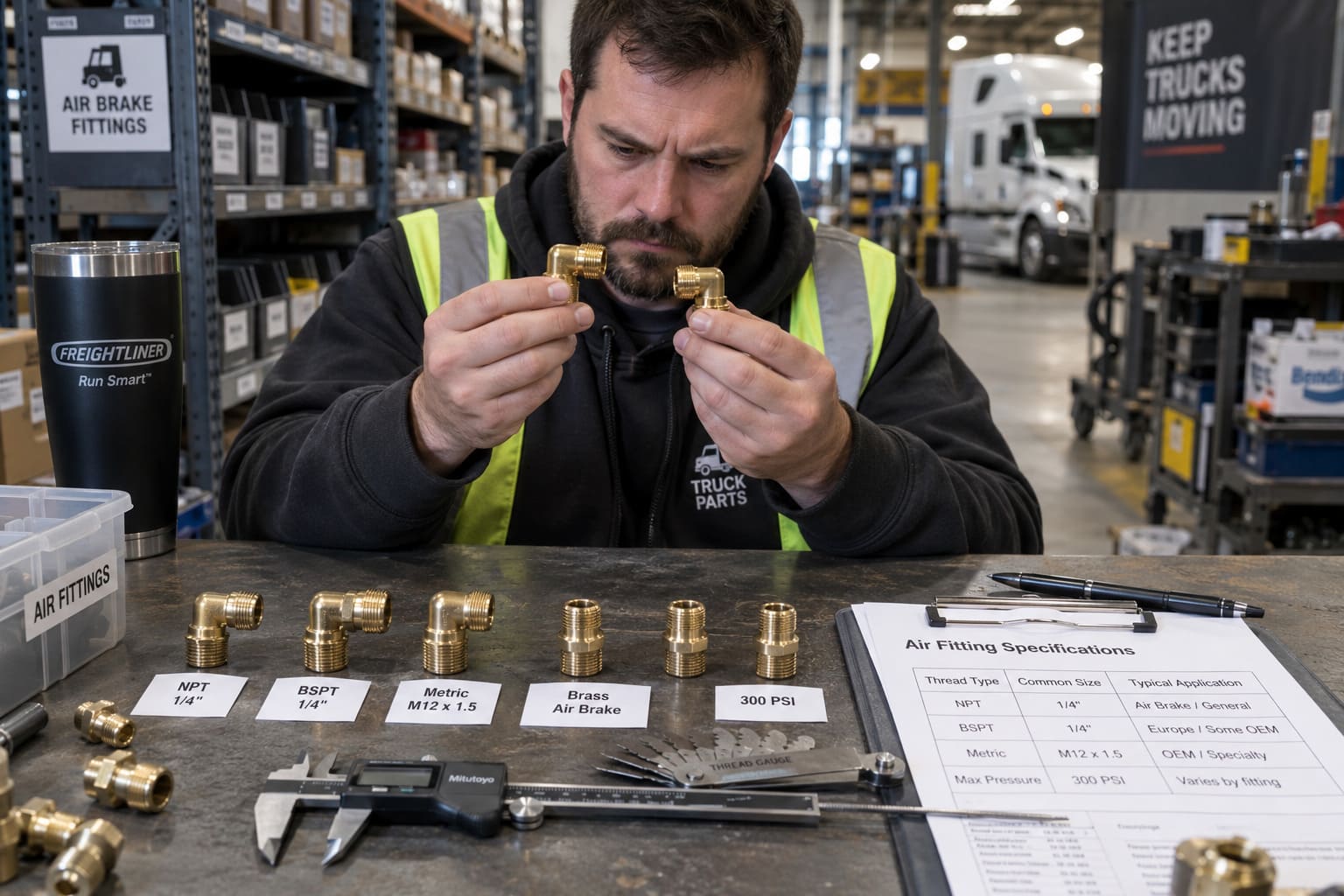
In the North American heavy-duty truck market, this shows up most often in thread type confusion. NPT (National Pipe Taper) is the standard in most U.S. truck applications.8 But buyers sourcing for South American markets — where European-influenced threading is more common9 — can easily order the wrong thread form and end up with a fitting that technically connects but does not seal correctly under pressure.
Key Specification Factors to Confirm Before Ordering
When evaluating or reordering any air fitting SKU, verify these parameters:
- Thread type and standard: NPT, BSPT, metric (M-thread) — confirm which your market actually uses
- Thread size: Nominal pipe size does not always equal actual dimensions; verify against OEM or reference part numbers
- Material and grade: Brass fittings for air brake applications should meet relevant SAE and DOT requirements; verify with the supplier's documentation
- Pressure and temperature rating: Air brake system fittings must handle operational pressures reliably10; confirm the supplier's testing documentation
- End configuration: Male/female, straight/elbow/tee/cross — a wrong configuration creates a non-sellable unit even if everything else matches
Why Wrong Purchases Feed Slow-Moving Inventory
When a buyer orders a fitting based on a photo, a partial description, or an assumption of interchangeability, the result is almost always a product that underperforms on the shelf. The customer returns it, or simply doesn't come back. That SKU accumulates in inventory without a clear path to sell-through.
The cleaner prevention is specification confirmation before the purchase order is issued — not after stock arrives. Request product drawings, reference the OEM part number the fitting is meant to replace, and ask the supplier to confirm thread standard and pressure test results in writing.
Certifications like DOT compliance and ISO 9001 quality management are meaningful trust factors when evaluating a supplier.11 But they do not substitute for confirming the exact specification you actually need. Treat certification documents as a baseline that tells you the supplier has a quality system — then do the specification work on top of that.
How Should You Separate Core SKUs from Test SKUs?
Most air fitting buyers treat their entire SKU list the same way: order when stock gets low, reorder the same quantity. This flat approach works reasonably well for fast movers and poorly for everything else. A tiered purchasing strategy changes that.
The most effective way to reduce slow-moving air fitting inventory is to separate your SKU list into two purchasing tiers: a core tier of proven fast-moving fittings managed with reliable replenishment, and a test tier of new or regional SKUs sourced in small mixed batches until demand signals justify larger orders.
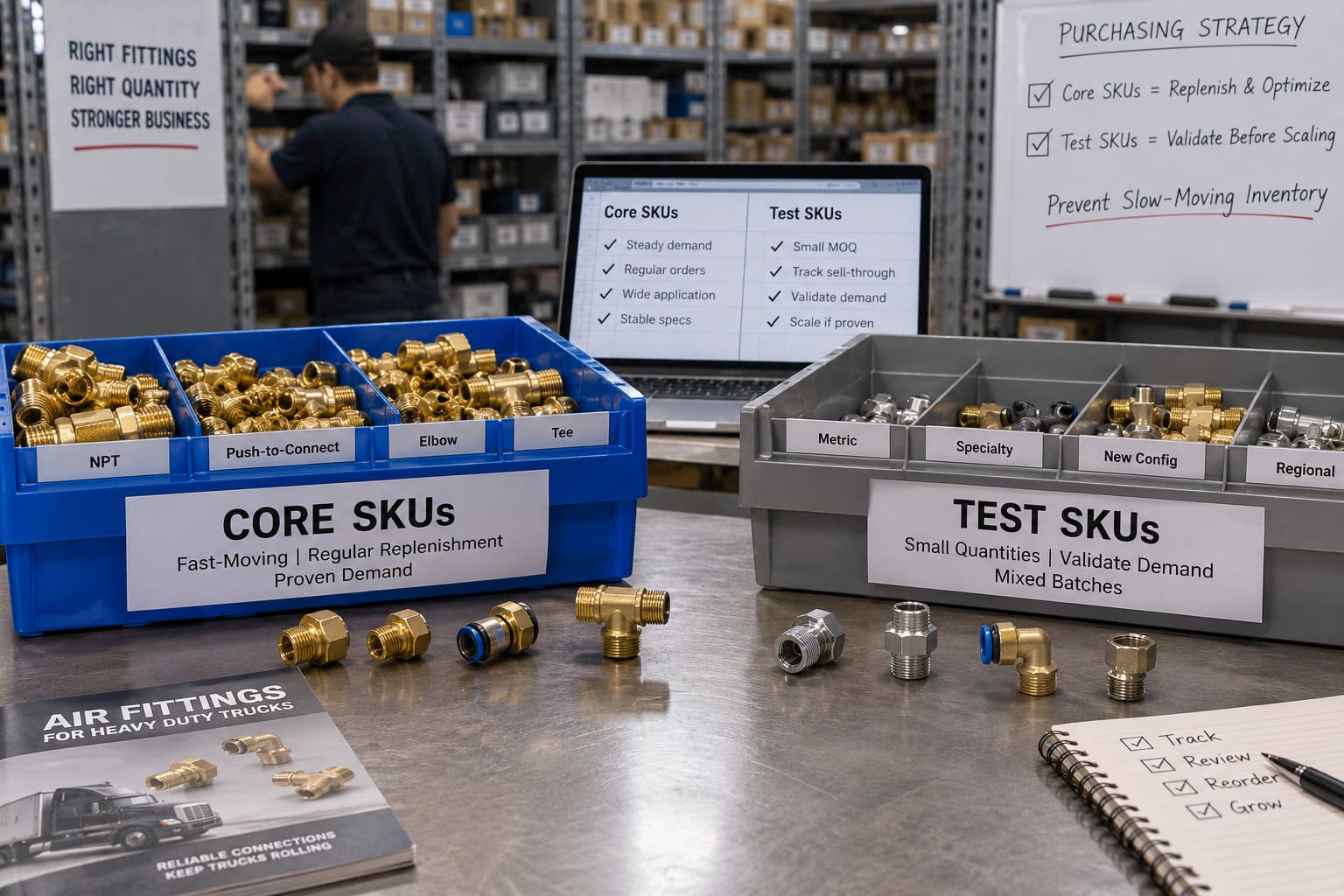
This is the structural change that moves inventory management from reactive (clearance after the fact) to proactive (preventing accumulation in the first place).
Defining Your Core SKU Tier
Your core fitting SKUs are the ones that:
- Reorder consistently — at least monthly, or with a predictable seasonal rhythm
- Have confirmed end-user demand — your customers ask for them by part number or OEM reference
- Cover the widest application range — common thread sizes and configurations that serve multiple truck platforms (Freightliner, Kenworth, Peterbilt, International, etc.)
- Have stable specification — the thread type, material, and configuration haven't changed and aren't likely to
For these SKUs, optimize your replenishment cycle. Negotiate stable pricing for regular volume. Pre-position safety stock if your supplier supports it. The goal is zero stockouts on items customers rely on.
Managing the Test Tier
New fitting specifications, unfamiliar market requirements, or customer-specific requests belong in a test tier. The rules for test-tier purchasing:
- Start with the smallest defensible quantity — use mixed-batch flexibility to minimize per-SKU commitment
- Set a clear reorder threshold — if a test SKU doesn't show repeat demand within a defined window, don't reorder it
- Track by actual sell-through, not just by whether it left the shelf (returns don't count as demand)
- Promote within your existing customer base before committing to larger volume — a simple communication to repair shops can validate or rule out demand quickly
This approach does not mean you carry fewer products. It means you carry the right products in proportional quantities, with new additions earning their shelf space through demonstrated demand rather than assumption.
Frequently Asked Questions
What is the most common reason air fitting inventory becomes slow-moving?
The most common cause is SKU over-expansion combined with MOQ-driven over-ordering. Buyers add long-tail fitting specifications based on single requests, then order more units than the actual demand justifies. The result is capital tied up in items that rarely sell. SKU discipline and smaller mixed-batch orders address this before it accumulates.
Can I reduce MOQ by ordering a mix of air fitting sizes from one supplier?
Many suppliers — including those focused on the heavy-duty truck aftermarket — will allow you to reach an MOQ threshold across a range of fitting sizes rather than on a single SKU. This mixed-batch approach reduces per-SKU overstock risk and lets you test new specifications in small quantities. Confirm MOQ flexibility directly with your supplier before placing the order.
How do I tell if two air fittings are truly interchangeable?
Visual similarity is not a reliable indicator of interchangeability. Confirm thread type (NPT, BSPT, or metric), thread size, material grade, pressure rating, and end configuration. Cross-reference against OEM part numbers or application documentation. Ask the supplier for product drawings and test documentation. Do not assume compatibility without verifying specifications in writing.
Should I prioritize DOT-certified air fittings to avoid slow-moving inventory?
DOT certification is an important trust factor for the North American market — it signals the product meets U.S. Department of Transportation requirements for air brake system components.12 However, certification alone does not prevent slow-moving inventory. The root causes are purchasing structure, SKU selection, and MOQ alignment. Verify certification as a baseline quality check, then address the purchasing decisions that drive inventory accumulation.
How often should I review my air fitting SKU list for slow movers?
A quarterly review is a reasonable starting cadence for most distributors and repair shops. For each SKU, check velocity over the past three to six months, whether there have been repeat customer orders, and whether the MOQ you ordered was proportional to actual demand. Flag any item that hasn't generated a repeat sale within six months for potential elimination or quantity reduction on the next reorder.
Conclusion
Reducing slow-moving air fitting inventory comes down to making better purchasing decisions before stock arrives — not managing the problem after it accumulates. The core levers are SKU discipline (resisting over-expansion into long-tail specifications), realistic total-cost thinking about MOQ and capital commitment, rigorous specification confirmation before ordering, and a tiered purchasing strategy that separates proven fast-movers from test-stage additions. None of these require a clearance event. They require a structured approach to which air fittings you buy, in what quantities, and how you validate demand before committing to larger volumes.
If you are sourcing brass fittings or air line components for the North American or South American heavy-duty truck aftermarket and want to discuss flexible MOQ options, mixed-batch ordering, or specification confirmation support, contact the ROADSPOWER team directly. We work with distributors and shop buyers at every procurement scale and can help you build a stocking plan that protects your working capital.
"How a Brand Reduced Slow-Moving Inventory", https://xorosoft.com/slow-moving-inventory-case-study/. Inventory-management studies on SKU proliferation indicate that expanding assortments can fragment demand and increase forecasting and replenishment complexity, which provides general support for treating over-expanded SKU lists as a contributor to slow-moving stock. Evidence role: general_support; source type: paper. Supports: Research on SKU proliferation and assortment complexity should support the general relationship between broader SKU ranges, harder demand forecasting, and increased risk of excess or slow-moving inventory.. Scope note: The source may address retail or manufacturing inventories broadly rather than air fittings specifically. ↩
"(PDF) Estimating the opportunity cost of capital for inventory investments", https://www.academia.edu/24012477/Estimating_the_opportunity_cost_of_capital_for_inventory_investments. Standard operations and working-capital management references describe inventory as capital committed to goods held for sale; low inventory turnover therefore increases the funds tied up in stock and can constrain replenishment of higher-velocity items. Evidence role: general_support; source type: education. Supports: A university or textbook-style source should explain that inventory is a use of working capital and that low turnover increases capital tied up in stock.. Scope note: This supports the financial mechanism generally and does not quantify the effect for a specific distributor. ↩
"[PDF] An Algorithm and Demand Estimation Procedure for Retail Assortment ...", https://faculty.wharton.upenn.edu/wp-content/uploads/2012/07/Demand-estimation---assortment-optimization.pdf. Inventory-control literature, including ABC classification and assortment-rationalization studies, supports prioritizing high-velocity or high-value SKUs because differentiated control policies can reduce excess stock and improve replenishment reliability. Evidence role: general_support; source type: paper. Supports: A source should support that focusing managerial attention and replenishment policies on high-velocity or high-importance SKUs is a recognized inventory-control approach.. Scope note: The evidence supports the principle of SKU rationalization rather than proving this exact outcome for air fitting distributors. ↩
"Economic order quantity", https://en.wikipedia.org/wiki/Economic_order_quantity. Economic order quantity and inventory-cost models treat total cost as a combination of purchase, ordering, and holding costs, showing that a lower unit price can be offset by higher carrying costs when order quantities exceed demand. Evidence role: mechanism; source type: education. Supports: A source should explain that total inventory cost includes purchase, ordering, holding, and shortage-related costs, so the lowest unit price is not always the lowest total-cost option.. Scope note: The source provides the cost mechanism; applying it requires firm-specific demand, holding-cost, and ordering-cost data. ↩
"Inventory Carrying Costs: How To Calculate and Reduce Them", https://www.fishbowlinventory.com/blog/what-is-carrying-cost. Logistics cost frameworks identify storage space and warehouse capacity as components of inventory holding cost, supporting the claim that space occupied by unsold items has an opportunity cost for stocking higher-velocity goods. Evidence role: mechanism; source type: research. Supports: A logistics or warehousing source should support that storage space is a component of inventory holding cost and that space allocation affects inventory availability.. Scope note: The source would support the general cost mechanism rather than measuring the cubic-meter cost in a specific warehouse. ↩
"Auto Parts Obsolescence Management Strategies That Work", https://www.scubemarketing.com/blog/strategies-handling-discontinued-obsolete-automotive-parts. Research on spare-parts and automotive aftermarket inventory notes that product design changes and model turnover can create obsolescence risk for stocked replacement parts, providing contextual support for specification drift as an inventory concern. Evidence role: general_support; source type: paper. Supports: A source should support that product design changes and model updates create obsolescence risk in spare-parts or aftermarket inventories.. Scope note: The evidence is likely to address spare parts generally and may not specifically study air fittings. ↩
"NPT vs. BSP Threads: Key Differences and Applications", https://www.titanfittings.com/articles/npt-vs-bsp-threads-key-differences-and-applications?srsltid=AfmBOooU-yg8DvaJMAyKARxHC7lwdhki-02I2t8PqiFPgHmJENEQ40EZ. Engineering standards for pipe threads and pneumatic connectors distinguish thread form, taper, sealing method, and pressure rating, supporting the point that visually similar fittings may not be mechanically or operationally interchangeable. Evidence role: mechanism; source type: institution. Supports: A standards or engineering source should explain that pipe-thread systems differ in geometry and sealing behavior and that fittings have specified pressure ratings.. Scope note: The source supports the technical basis for incompatibility but may not discuss product-photo purchasing decisions. ↩
"National pipe thread - Wikipedia", https://en.wikipedia.org/wiki/National_pipe_thread. Technical standards references identify National Pipe Taper threads as a U.S. pipe-thread standard for threaded fittings, providing contextual support for the article's discussion of NPT as a common thread form in U.S. truck applications. Evidence role: definition; source type: institution. Supports: A source should establish what NPT is and that it is a U.S. pipe-thread standard used for fittings; ideally it should connect NPT with vehicle or air-brake fittings.. Scope note: Unless the source specifically surveys truck fittings, it supports the standard's U.S. relevance rather than proving prevalence across all truck applications. ↩
"British Standard Pipe", https://en.wikipedia.org/wiki/British_Standard_Pipe. Market and standards references indicating a substantial European commercial-vehicle presence or metric/BSP standards use in Latin America would provide contextual support for the claim that thread requirements may differ from North American NPT-centered assumptions. Evidence role: historical_context; source type: research. Supports: A source should provide contextual evidence that European vehicle manufacturers, metric standards, or BSP-type fittings have significant presence in South American commercial vehicle markets.. Scope note: This would be contextual regional support and may not directly quantify thread usage in air fittings. ↩
"49 CFR 571.121 -- Standard No. 121; Air brake systems.", https://www.ecfr.gov/current/title-49/subtitle-B/chapter-V/part-571/subpart-B/section-571.121. U.S. Federal Motor Vehicle Safety Standards for air brake systems and brake hoses specify performance requirements for air-brake equipment, supporting the need to verify that fittings are rated for the pressures encountered in service. Evidence role: general_support; source type: government. Supports: A regulatory source should establish that vehicle air brake systems and related components are subject to pressure-performance requirements.. Scope note: The regulation may address system or hose performance broadly and may not list every fitting type discussed in the article. ↩
"Interpretation ID: 04-009159drn - NHTSA", https://www.nhtsa.gov/interpretations/04-009159drn. ISO describes ISO 9001 as a quality-management-system standard, while U.S. vehicle-safety regulations set compliance requirements for brake-related components; together, these frameworks support using certification and regulatory compliance as supplier-evaluation inputs. Evidence role: definition; source type: institution. Supports: Sources should define ISO 9001 as a quality-management-system standard and DOT-related compliance as relevant to regulated vehicle brake components.. Scope note: These certifications indicate management-system or regulatory conformance and do not independently verify that a particular SKU matches a buyer's required specification. ↩
"Interpretation ID: 04-009159drn - NHTSA", https://www.nhtsa.gov/interpretations/04-009159drn. NHTSA's Federal Motor Vehicle Safety Standard No. 106 establishes requirements for brake hoses, including air-brake hose assemblies and related end fittings, supporting the statement that DOT compliance is relevant to air-brake component qualification in the U.S. market. Evidence role: definition; source type: government. Supports: An official source should support that U.S. DOT/NHTSA standards apply to regulated brake hose and air brake components and define the nature of compliance.. Scope note: The source supports regulated brake-hose and fitting requirements; buyers still need to verify whether each individual product and application falls within the cited standard. ↩