Most buyers focus on price, material, and delivery time when sourcing DOT air fittings. They assume the threads will work because the catalog says "1/2 inch" or "3/8 inch." But thread accuracy is the hidden variable that determines whether a fitting actually seals, survives installation torque, and stays leak-free across seasons. I have seen too many procurement managers discover this only after a container arrives and the shop floor starts reporting problems.
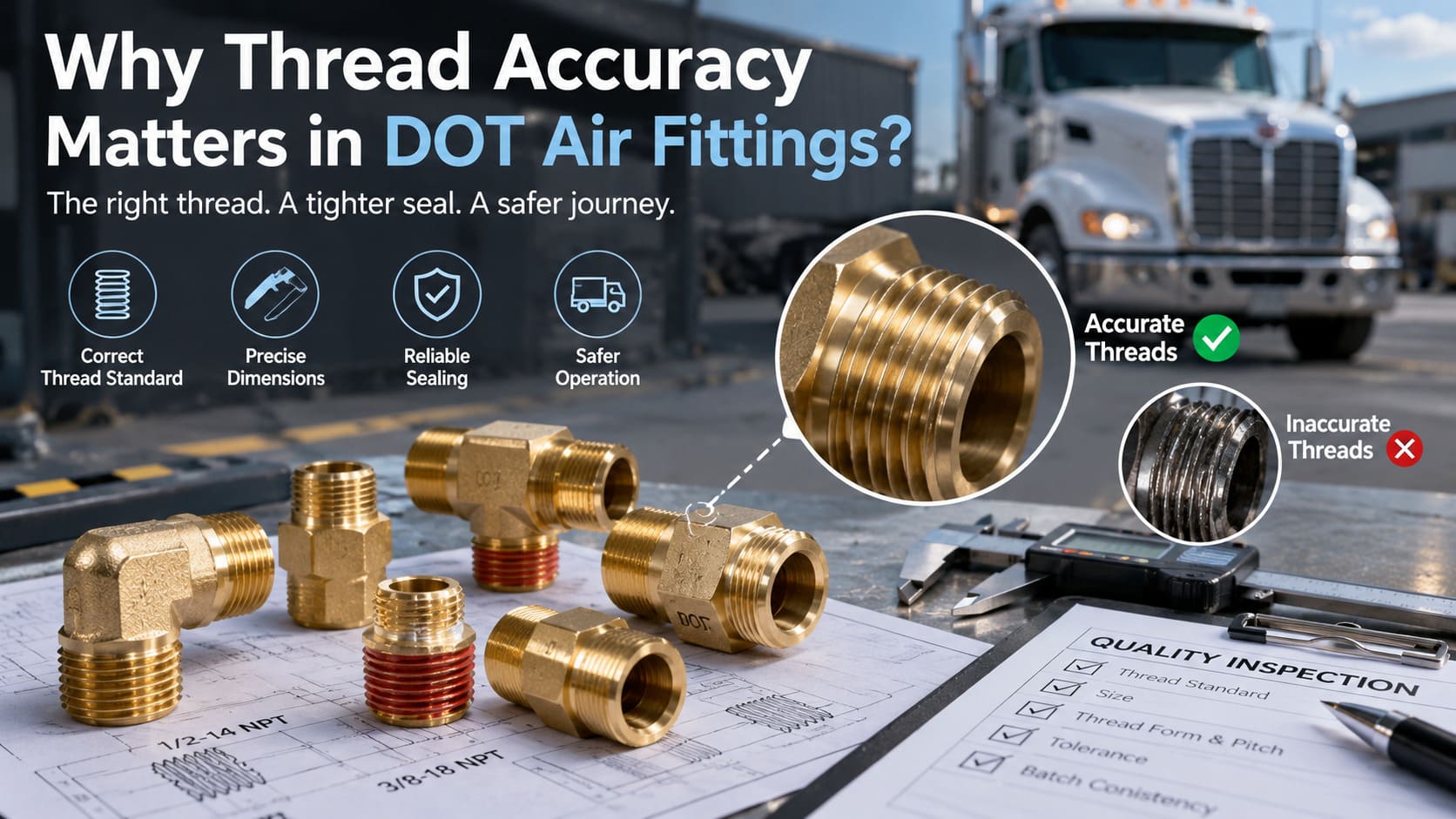
Thread accuracy in DOT air fittings is the measurable precision of thread form, pitch, diameter, and tolerance relative to the specified standard such as NPT, SAE, or JIC.1 It directly controls whether the fitting mates correctly with the mating port, seals properly under system pressure, and maintains that seal through vibration and temperature cycling. Without verified accuracy, even a fitting labeled "DOT-compliant" can cause sealing failures, installation damage, and costly returns.
You do not need to become a thread engineer to buy better fittings. But you do need to understand why thread accuracy matters to your bottom line, not just to the spec sheet. Let me walk through what I have learned from handling customer inquiries, specification corrections, and the occasional leak-related return discussion.
What Does a "Correct" Thread Really Mean?
A parts catalog might list a fitting as "1/4 inch." A buyer sees that and thinks the question is settled. But the real question has four layers. If any layer is wrong, the fitting will not perform correctly in service.
A correct thread means the fitting matches the mating port on all four levels: the thread standard, the nominal size, the thread form geometry, and the tolerance class.2 Missing even one of these creates a mismatch that may appear to fit initially but will cause problems under real operating conditions.
I have handled inquiries where a customer sent photos of two fittings that looked almost identical. They had the same nominal size printed on the box. But one was NPT, the other was BSPT. The thread angles differ. The pitch differs at certain sizes. You can sometimes screw a BSPT male into an NPT female for a few turns.3 That does not mean it fits. That false compatibility is exactly what creates warranty headaches down the road.
The four-layer check every buyer should apply
When I help customers confirm whether a fitting matches their application, I look at four things. You can do the same, either with your supplier or with a simple gauge check on your end.
Layer 1: Thread standard NPT is the most common in North American heavy-duty truck air systems. But I have also seen SAE straight threads with O-ring seals, JIC 37-degree flare connections, and compression-style fittings in certain applications. If the standard is wrong, nothing else matters. Always ask your supplier to confirm the thread standard by name, not by the "size" alone.
Layer 2: Nominal size This is the basic diameter designation: 1/8, 1/4, 3/8, 1/2 inch, and so on. Most catalogs get this right. But confusion arises when metric and inch designations sit next to each other in the same parts list. A 10 mm fitting is not the same as a 3/8 inch fitting, even if the measured outer diameter looks close.
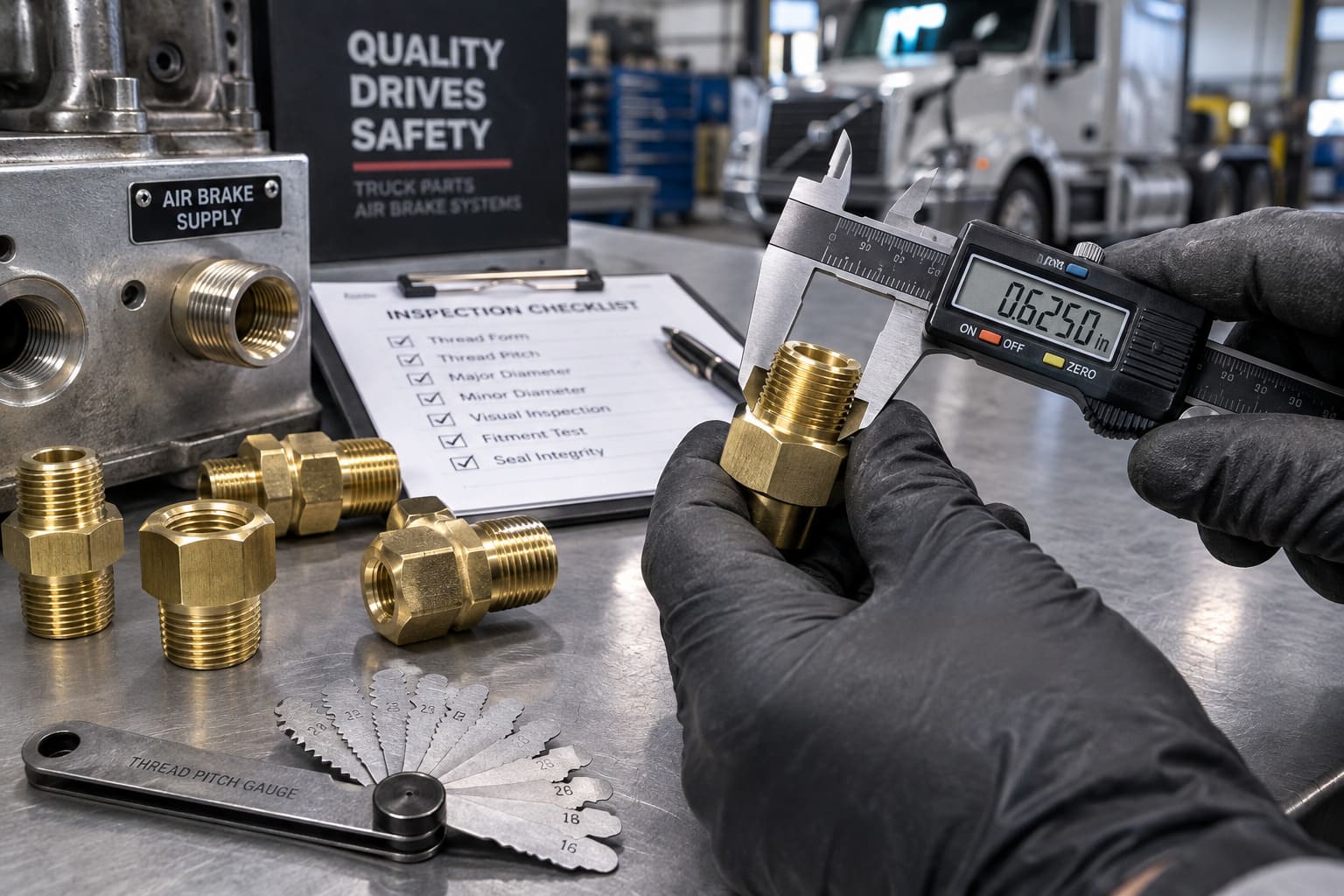
Layer 3: Thread form and pitch Even within the same standard, the thread form matters. NPT threads are tapered. The taper is 1 degree 47 minutes per side.4 The pitch varies by size. If a supplier's tooling wears and the pitch drifts from spec, the fitting may bind partway in or bottom out before the taper seals. I have seen this flagged during incoming inspection when a batch does not pass a simple NPT thread plug gauge test.
Layer 4: Tolerance class Every thread standard has a defined tolerance band for major diameter, minor diameter, and pitch diameter.5 A fitting produced at the loose end of the tolerance band may thread in easily but lack sufficient thread engagement to hold pressure. A fitting at the tight end may require excessive torque to install. Neither situation is acceptable in a heavy-duty truck that operates from sub-zero mornings to desert heat.
Why "it fits" is not the same as "it is correct"
I want to address a common assumption I hear from buyers: "If it screws in, it fits." That logic is expensive. A tapered NPT thread relies on progressive interference between the male and female threads to create a mechanical seal.6 When the thread form or pitch is off, you get uneven thread engagement. Some threads carry all the load. Others barely touch.
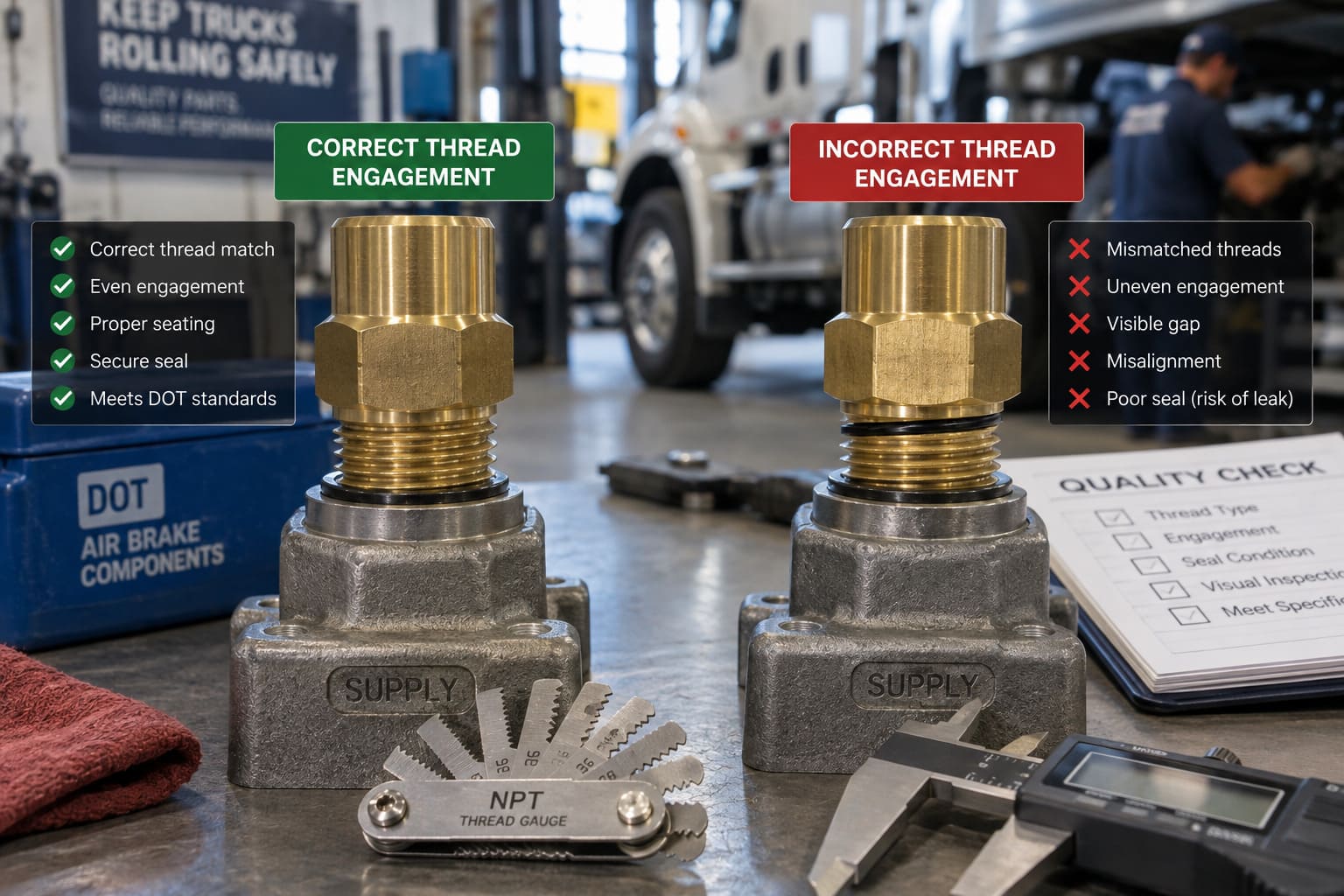
The result is a fitting that feels tight on the wrench but does not seal consistently. I have spoken with repair shop owners who chased leaks for hours, only to find that the replacement fitting had a thread tolerance problem. The old fitting sealed fine. The new fitting, same nominal size, did not. The difference was in the machining accuracy, not the design.
How Thread Accuracy Affects Sealing and Safety
You might wonder why I connect thread accuracy to safety. I do not suggest that a slightly loose thread will immediately cause a brake system failure. But I do know that air leaks in truck air systems create cascading problems. The compressor cycles more often. Air dryers work harder. Pressure fluctuations affect brake response consistency. A leak that starts small can grow as vibration works on a poorly seated fitting.
Thread accuracy directly controls how evenly the tapered threads contact the mating surface. Accurate threads distribute the sealing load across all engaged threads. Inaccurate threads concentrate the load on a few threads, creating potential leak paths and accelerating thread wear under vibration and thermal cycling.7
Where leaks actually start
In NPT fittings, the seal forms along the thread flanks, not at the tip or root. When the thread pitch is off, even by a few thousandths of an inch, the crests and roots do not align properly. This creates spiral leak paths. Thread sealant can help fill small gaps, but sealant is not designed to compensate for fundamental thread geometry errors.8
I remember reviewing a batch where the supplier had let their thread-cutting tool run past its replacement interval. The pitch diameter had drifted about 0.003 inches, still within visual tolerance but outside the gauge tolerance. Several end users reported slow leaks that appeared weeks after installation. The fittings threaded in fine during assembly. The leaks developed only after pressure cycling and road vibration.
Temperature and vibration amplify inaccuracy
Heavy-duty trucks operate across wide temperature ranges.9 A fitting installed at 70 degrees Fahrenheit must hold air at minus 20 and at 120 degrees. Thermal expansion and contraction stress the thread interface. When threads are accurate and within tolerance, the expansion is predictable and the seal holds. When threads are inaccurate, uneven engagement leaves weak spots where temperature cycling can break whatever partial seal existed.
Vibration does the same thing. A properly seated NPT thread has full flank contact. Vibration transmits through the fitting as a unit. A poorly seated thread has gaps. Those gaps allow micro-movement. Over thousands of miles, micro-movement wears the thread flanks. The leak grows. The driver or shop technician tightens the fitting more. That can strip or crack the female port. Now you have a bigger problem than a leak.
This table shows how thread accuracy issues translate into real-world consequences:
| Accuracy Issue | Installation Symptom | Field Consequence | Procurement Impact |
|---|---|---|---|
| Oversized pitch diameter | Fitting threads too deep with little resistance | Low thread engagement, potential blowout under pressure | Returns, claims, reorder costs |
| Undersized pitch diameter | Excessive installation torque required | Stripped threads, cracked female ports | Warranty claims, repair costs |
| Incorrect pitch | Binds partway in, uneven tightening | Partial thread contact, slow leaks | Customer complaints, reputation damage |
| Wrong thread standard | Cross-threads or appears to fit loosely | Complete seal failure, system pressure loss | Full batch rejection |
| Taper angle error | Seals at wrong depth, may bottom out | Inconsistent installation depth, seal instability | Rework, inconsistent field experience |
Why Size Confusion Creates Real Procurement Risk
One of the most common inquiry patterns I see goes like this: A buyer asks for a "3/8 DOT fitting" because that is what the old supplier labeled it. We quote it. The sample arrives. It does not fit. Why? Because the old supplier was providing a metric-thread fitting with a 3/8-inch hose barb, and the buyer assumed "3/8" described the thread. It did not. It described the hose end.
Thread size confusion happens when buyers use the hose diameter or wrench size to identify the thread. The thread size is independent of both. Verifying the actual thread specification with your supplier prevents ordering the wrong fitting even when the catalog description seems familiar.
Three common confusion points
Hose diameter versus thread size A fitting described as "3/8 air fitting" might have a 3/8-inch hose barb but a 1/4 NPT male thread. The 3/8 refers to the hose inner diameter it accepts, not the thread it screws into. I have guided several customers through this correction after they received fittings whose threads did not match their existing plumbing.
Wrench size versus thread size A 9/16-inch wrench fits across the hex flats of many 1/4 NPT fittings. A 7/8-inch wrench fits many 1/2 NPT fittings. But the wrench size is not the thread size. A buyer who orders fittings by the wrench size they remember using will have about a fifty percent chance of getting the right part.
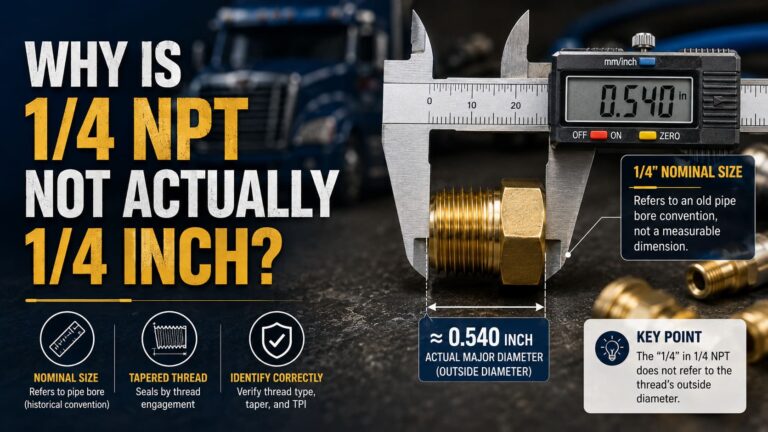
Nominal size versus actual measured diameter A 1/4 NPT thread does not measure 0.250 inches.10 The nominal size refers to the approximate pipe inner diameter the system was designed around historically. The actual major diameter of a 1/4 NPT male thread is roughly 0.540 inches.11 If you grab a caliper and measure the thread outer diameter expecting to see 0.250 inches, you will think the fitting is wrong when it might be correct.
If your supplier cannot clearly explain which part of the fitting description refers to the thread, the hose connection, and the wrench flats, you risk ordering parts based on incomplete information. The time to fix that assumption is before the purchase order goes out, not after the shipment arrives.
What Buyers Should Check to Verify Thread Consistency
You do not need to buy a coordinate measuring machine. But you do need to know what questions to ask your supplier and what to look for during initial sample evaluation. Thread consistency across batches is what separates a professional supplier from one that ships whatever comes off the line.
Buyers should verify thread consistency through three practical steps: request the supplier's thread inspection method, perform a simple gauge check on incoming samples, and confirm batch-level quality control documentation. These steps catch accuracy issues before they reach your customers.
The supplier questions that matter
When I speak with procurement managers about our thread quality process, I expect them to ask specific questions. The answers tell them whether we control our threads or just hope for the best.
Ask your supplier:
- What thread gauges do you use for NPT, SAE, or JIC threads? Are they plug gauges, ring gauges, or both?
- What is your sampling frequency during production runs? One check per shift is not the same as checks every hour.
- What happens to a batch that fails a thread gauge check? Is it reworked, scrapped, or shipped anyway?
- Can you provide thread inspection records for a specific batch before shipment?
A supplier who cannot answer these questions cleanly may not be controlling thread accuracy systematically. They may be relying on a worn gauge in the drawer that someone checks occasionally.
The incoming sample check you can do
If you have samples in hand, a simple Go/No-Go thread gauge costs far less than one return shipment. A Go/No-Go NPT plug gauge has two ends. The Go end should thread fully into the female fitting without excessive force. The No-Go end should not enter more than a turn or two. If the No-Go end goes deep, the thread is oversized. If the Go end binds, the thread is undersized or has pitch error.
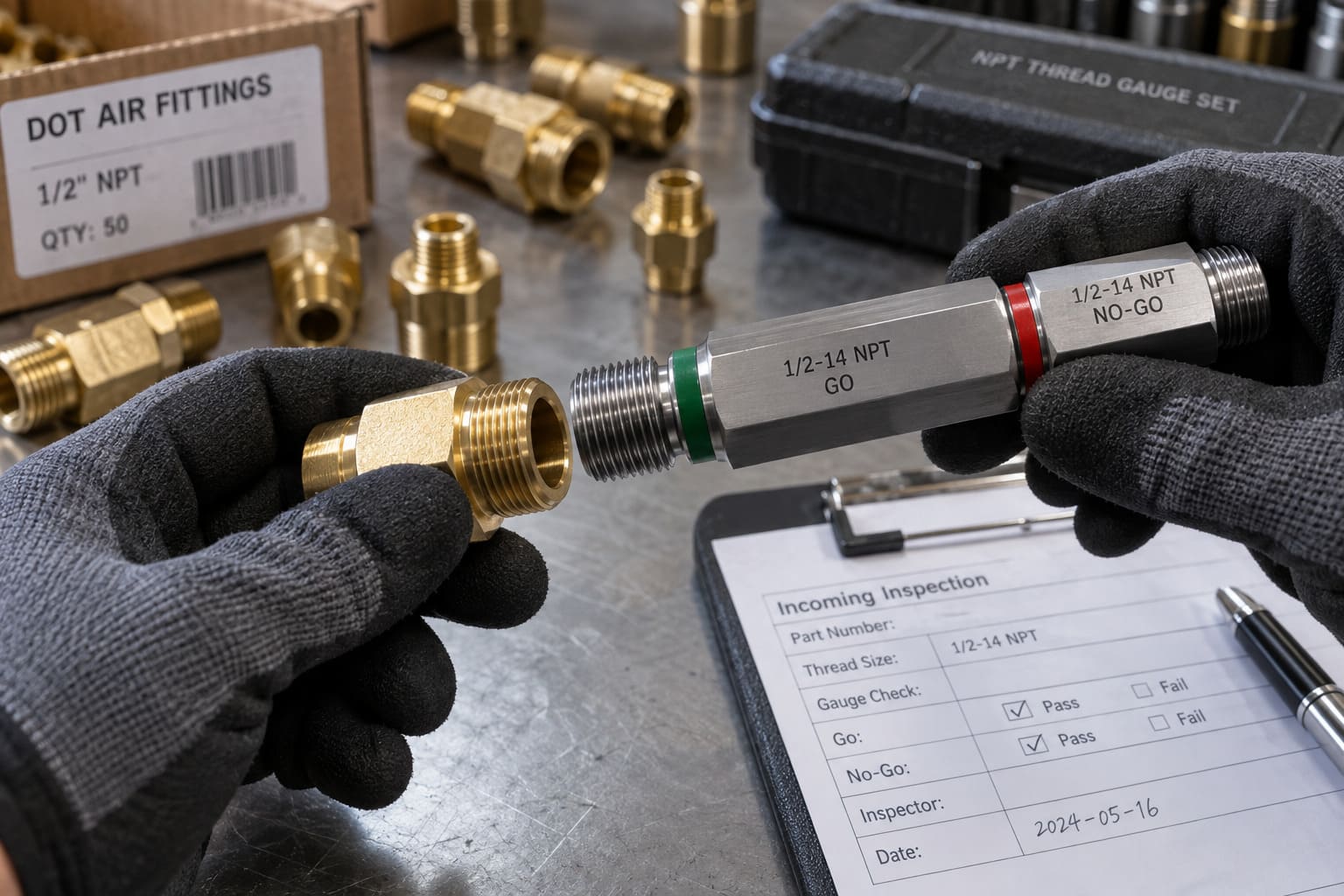
This test takes seconds per fitting. For a batch sample of 20 or 30 pieces, you can check threads in under ten minutes and have a clear pass/fail picture before you commit to a container order.
Batch consistency over time
A single sample passing a gauge check is good. But the real question is whether batch three performs like batch one did six months ago. Thread-cutting tooling wears. CNC offsets drift if not monitored. A supplier with documented in-process inspection and tool-change records can show you that they control these variables.
At our facility, we run multi-node in-process sampling with full records. Thread inspection is not a final check only. It happens alongside production so that if a tool starts to drift, we catch it early and correct it before a full batch runs out of tolerance. That approach matters for buyers who restock the same SKU repeatedly and expect the same fit every time.
How Thread Accuracy Affects Your Total Cost
The unit price on the invoice is not your total cost. I have spoken with enough buyers to know that the real cost includes sample evaluation time, installation labor, handling customer complaints, processing returns, and the quieter cost of a shop that starts questioning your entire product line after one bad batch.
Poor thread accuracy increases total procurement cost through sample rejection, installation rework, field returns, warranty pressure, and lost repeat business. The higher cost always lands somewhere, and usually in a way that is harder to measure than a simple unit price difference.
The cost chain
A supplier ships 1,000 DOT fittings. The threads are marginally within tolerance, but toward the tight end. The unit price was attractive. Then the calls start. Some fittings needed excessive torque. A few female ports cracked in aluminum valve bodies. The shop spends extra time on every installation. Some jobs get re-done. Returns come back. Your team spends hours on emails, photos, and credit notes. The next order goes to a different supplier.
Was that first unit price actually lower? Not when you tally the total.
Warranty pressure
Your customer installs these fittings on trucks. If a fitting leaks and a truck loses air pressure unexpectedly, the repair gets booked somewhere. The repair shop questions the parts. Your customer questions your supply. You are now managing a relationship problem, even if only a small percentage of fittings had issues. Thread accuracy problems rarely hit 100 percent of a batch. They cluster around a tooling wear period. That means intermittent field problems that erode trust slowly rather than a single obvious failure you can catch immediately.
Frequently Asked Questions
How can I tell if a DOT air fitting has the correct NPT thread?
Use a Go/No-Go NPT thread plug gauge for female threads or a ring gauge for male threads.12 The Go end should thread smoothly to full depth. The No-Go end should not engage more than one or two turns. This is the standard quick-check method used in receiving inspection and does not require thread measurement equipment.
Does DOT certification guarantee thread accuracy?
No. DOT certification confirms that the product meets specific Department of Transportation requirements for the intended application, which typically includes material, performance, and marking requirements. Thread accuracy is a manufacturing quality control matter. A DOT-certified fitting can still have thread accuracy problems if the supplier's machining process is not controlled properly. Always verify thread specifications and inspection methods separately from certification status.
What thread standards are most common in North American heavy-duty truck air systems?
NPT tapered pipe threads are the most widely used for pneumatic connections. SAE straight threads with O-ring seals appear in certain ports and adapters. JIC 37-degree flare fittings are common in some air line connections. Always confirm the specific thread standard for the port you are connecting to rather than assuming a standard based on the vehicle brand.
Why do some fittings leak even though they feel tight during installation?
A fitting can feel tight because a few thread flanks are binding while others are not fully engaged. This creates uneven load distribution. Under system pressure, temperature cycling, or road vibration, the partially engaged threads can shift slightly and open leak paths. This is a thread accuracy issue, not a torque issue. Tightening further may damage the threads or the mating port without solving the underlying geometry problem.
What should I ask a supplier about their thread quality control?
Ask what thread gauges they use, how frequently they inspect during production, what their gauge calibration schedule is, and whether they provide batch-level inspection records. Also ask what corrective action they take when a sample fails a thread gauge check — rework, scrap, or deviation approval. A supplier with clear answers to these questions has a controlled process rather than a reactive one.
Conclusion
Thread accuracy in DOT air fittings is not a technical footnote. It is the factor that decides whether your parts fit correctly the first time, seal reliably over thousands of miles, and keep your customers coming back. I have learned through direct experience that the questions a buyer asks about threads before ordering are far less expensive than the problems that surface after parts arrive.
When you evaluate a DOT air fitting supplier, look past the catalog descriptions and the certification marks. Confirm the thread standard, verify the inspection method, and test a sample batch with simple gauges. A supplier who controls thread accuracy consistently across production runs saves you money in ways that the unit price alone will never show.
If you are sourcing DOT air fittings for the North American or South American aftermarket and want to discuss thread specifications, sampling, or batch quality documentation, reach out to ROADSPOWER directly. We help distributors, fleet managers, and repair networks get the right threads the first time.
"National Pipe Thread: Charts And Formulas (NPT) - Machining Doctor", https://www.machiningdoctor.com/charts/thread-npt-charts/. Thread standards such as ASME B1.20.1 for pipe threads and SAE specifications for hydraulic and pneumatic fittings define thread geometry, pitch, diameters, and tolerance limits, providing the technical basis for assessing thread accuracy. Evidence role: definition; source type: institution. Supports: Thread standards define thread geometry, pitch, diameters, and tolerances that determine whether threaded fittings conform to a specified connection type.. Scope note: This supports the general definition of thread accuracy, not the quality of any specific DOT air fitting batch. ↩
"Thread Matching Explained: Compatibility, Standards & Fit ...", https://baer.tools/en/blog/thread-pairing-when-do-threads-match. Engineering references on screw-thread interchangeability describe thread fit as dependent on the thread standard, nominal designation, thread form, pitch, and dimensional tolerances, which together determine whether mating threads are compatible. Evidence role: general_support; source type: education. Supports: Thread compatibility depends on matching the standard, nominal designation, geometry, and tolerance-related dimensions of the male and female threads.. Scope note: This is general engineering support and does not specifically validate the article's four-layer checklist as an industry-standard procurement procedure. ↩
"Difference Between BSP Thread and NPT,G,R Thread", https://www.vpc-pneumatic.com/difference-between-bsp-thread-and-npt-g-r-thread.html. Reference tables comparing NPT and BSPT identify them as separate tapered pipe-thread systems with different thread forms and dimensional specifications, explaining why partial engagement may occur without producing a standards-compliant connection. Evidence role: definition; source type: encyclopedia. Supports: NPT and BSPT are different tapered pipe thread standards with different thread forms and dimensions, so partial engagement does not establish correct compatibility.. Scope note: The source would support the dimensional mismatch, but it would not prove that every BSPT/NPT pairing can be screwed together for a specific number of turns. ↩
"Pipe thread taper angle", https://bbs.homeshopmachinist.net/forum/general/59789-pipe-thread-taper-angle. The National Pipe Taper thread specification defines a 1:16 taper, which corresponds to an angle of approximately 1 degree 47 minutes from the thread axis on each side. Evidence role: definition; source type: institution. Supports: NPT pipe threads use a 1-in-16 taper, equivalent to approximately 1 degree 47 minutes per side.. ↩
"ISO metric screw thread", https://en.wikipedia.org/wiki/ISO_metric_screw_thread. Screw-thread standards specify limits and tolerances for major, minor, and pitch diameters, enabling inspection of whether produced threads fall within the permitted dimensional range. Evidence role: definition; source type: institution. Supports: Thread standards specify dimensional limits and tolerances for key thread dimensions, including major, minor, and pitch diameters.. Scope note: This supports the standards-based principle; the exact dimensions and tolerance terms vary by thread family. ↩
"Getting to Leakproof with NPT & NPTF Threads: What Matters", https://www.industrialspec.com/about-us/blog/detail/npt-nptf-tapered-threads-and-leakproof-seals?srsltid=AU7gw4WfrScXaOEyiYdkS5CPXeLVe2Cji4pXJYqe6VTG14kmxPJZYLHU. Engineering descriptions of tapered pipe threads explain that the male and female threads develop increasing interference as engagement depth increases, producing the mechanical contact needed for a pressure-tight threaded joint. Evidence role: mechanism; source type: education. Supports: Tapered pipe threads create increasing interference as they are tightened, which contributes to sealing and mechanical retention.. Scope note: This explains the sealing mechanism in general; it does not quantify leak performance for any particular fitting or installation. ↩
"Thread Engagement Depth for Bolted Joints", https://industrialmonitordirect.com/blogs/knowledgebase/thread-engagement-depth-for-bolted-joints-load-distribution-guide?srsltid=AU7gw4Wt6R0ikQ2cnPEmHsnvndZs4Uaus1hv_xgGQ6zAr4-EckIGWmfQ. Studies of threaded joint mechanics show that thread geometry, pitch accuracy, and engagement conditions affect load distribution among engaged threads; uneven contact can increase localized stress and provide a plausible mechanism for leakage or wear under cyclic loading. Evidence role: mechanism; source type: paper. Supports: Uneven thread geometry or engagement can alter load distribution and increase localized stress, which can contribute to leakage or wear in threaded joints.. Scope note: The evidence would be mechanistic and contextual unless it specifically tests DOT air fittings under vibration and thermal cycling. ↩
"Getting to Leakproof with NPT & NPTF Threads: What Matters", https://www.industrialspec.com/about-us/blog/detail/npt-nptf-tapered-threads-and-leakproof-seals?srsltid=AU7gw4V2C6UKq2uiwiNhBCbXUAeN6NM53EIZPmh5m4sfC-m6sPBWw2dp. Technical guidance on pipe-thread joints describes sealants as materials used to fill small clearances between mating threads, while maintaining that the joint still depends on proper thread form, engagement, and assembly. Evidence role: mechanism; source type: institution. Supports: Pipe-thread sealants are used to fill small voids and reduce leakage in threaded joints, but proper thread form and engagement remain necessary for a reliable connection.. Scope note: This supports the principle but may not directly address every type of commercial thread sealant or DOT air fitting. ↩
"Air Brake Systems", https://www.fmcsa.dot.gov/sites/fmcsa.dot.gov/files/docs/brake_safety_systems_02-14.pdf. Vehicle brake-hose and air-brake component standards include performance requirements under specified environmental conditions, supporting the general point that heavy-duty truck air-system parts must tolerate substantial temperature variation. Evidence role: general_support; source type: government. Supports: Regulations or standards for vehicle brake hoses and air-brake components include environmental or temperature-related performance requirements, indicating that these systems must operate under varied thermal conditions.. Scope note: This is contextual support for operating conditions and may not establish the exact temperature examples used in the article. ↩
"Male threads: Measure the outside diameter of the large ...", https://www.bestmaterials.com/pdf_files/pipe-sizes-threads.pdf?srsltid=AU7gw4WI6QxjuBhBs7b89Fe7souUAWvtzYXs24s02heQnssbBYPGzftU. NPT dimension tables show that nominal pipe size is a designation rather than the measured outside diameter of the thread, so a 1/4 NPT thread is not expected to measure 0.250 inches across its outside diameter. Evidence role: definition; source type: encyclopedia. Supports: NPT nominal pipe sizes do not correspond directly to the measured outside diameter of the threaded portion.. ↩
"National pipe thread", https://en.wikipedia.org/wiki/National_pipe_thread. Standard NPT dimensional tables list 1/4-18 NPT with an outside major diameter of about 0.540 inches, confirming that its actual thread diameter is much larger than the nominal 1/4-inch designation. Evidence role: definition; source type: institution. Supports: Standard NPT tables list the outside or major diameter for 1/4-18 NPT at approximately 0.540 inches.. ↩
"Pipe Thread Gages - NPT -NPTF - ANPT", https://www.judgetool.com/products/pipe-thread-gages-npt-nptf-anpt/?srsltid=AU7gw4XPpdGvUOk7gGKvFbX80c7nODfV9rFQW-1Abrgtv-3GbOvJHOwj. Thread-inspection guidance identifies plug gauges as instruments for checking internal threads and ring gauges as instruments for checking external threads, supporting their use in Go/No-Go inspection of NPT fittings. Evidence role: general_support; source type: institution. Supports: Internal threads are commonly checked with plug gauges and external threads with ring gauges, including in pipe-thread inspection contexts.. Scope note: This supports the inspection method generally; acceptance criteria can vary depending on the applicable thread standard and gauge class. ↩